California Lawn Ban 2027: What Your Street Will Look Like
AB 1572 stops potable irrigation of nonfunctional turf starting in 2027 and reaches HOA common areas in 2029. What it covers, what conversion costs, what rebates actually pay, and how it changes the look of a Bay Area street.

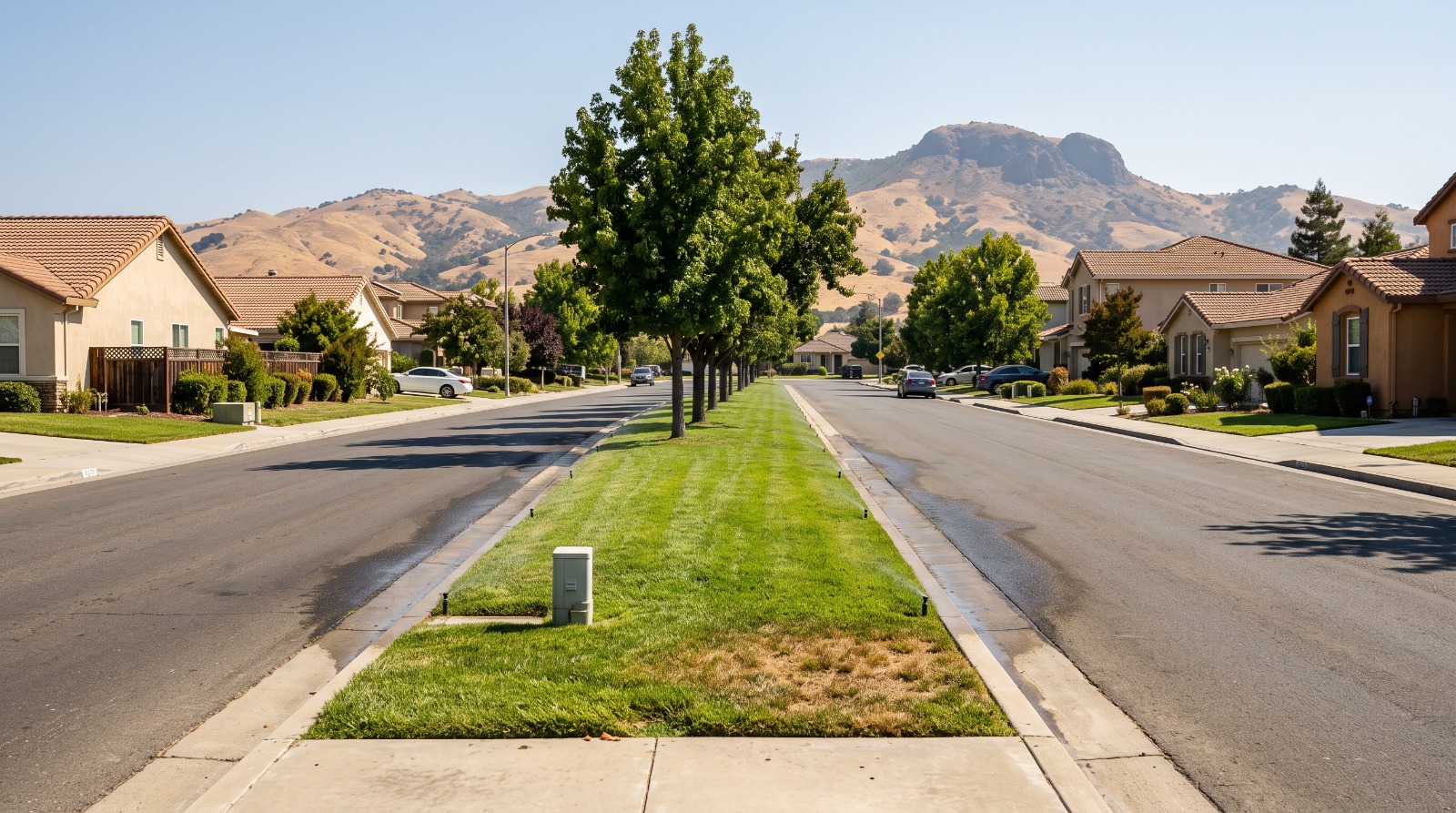
A wide irrigated grass median on a Morgan Hill residential street, the kind of nonfunctional turf California's AB 1572 lawn phase-out will reach. Photo: Houseberry
Start with the thing most people get wrong. California is not coming for your front yard. AB 1572, signed on October 13, 2023, bans the use of drinking water to irrigate nonfunctional turf on public, commercial and homeowners association property. Single-family residential yards are not covered at all. Apartment buildings outside a common interest development are not covered either.
What is covered is nearly everything else you look at on the way to your door. The median strip. The grass apron around the parking lot. The lawn at the entry monument with the community name on it. Those go first, and in the Bay Area the bill for changing them lands on HOA members on January 1, 2029.
What the law actually says, in one page
The statute is Water Code section 10608.14. It does not require anyone to rip out grass. It prohibits irrigating certain turf with potable water, which in practice means the same thing unless a property has access to recycled water, and most do not.
The definition is the load-bearing part. Functional turf is turf in a recreational use area or a community space, meaning ball fields, playgrounds, picnic lawns, dog runs, spaces built for civic gatherings. Nonfunctional turf is everything else, and the statute specifically names turf in street rights-of-way and parking lots.
There is a trap in there worth knowing about. Turf that is permanently fenced or otherwise permanently inaccessible cannot be functional turf, because nobody can use it. A gated lawn that looks like a lawn and is mowed like a lawn is still nonfunctional under this law.
The deadlines run in tiers.
| Property type | Potable irrigation of nonfunctional turf must stop |
|---|---|
| State properties under the Department of General Services | January 1, 2027 |
| Cities, counties, public agencies and public water systems | January 1, 2027 |
| Commercial, industrial and institutional property | January 1, 2028 |
| HOA and common interest development common areas | January 1, 2029 |
| Public property in disadvantaged communities | January 1, 2031, or when state funding is made available, whichever is later |
Then comes the paperwork. Any covered property with more than 5,000 square feet of irrigated area has to certify compliance to the State Water Resources Control Board and re-certify every three years through 2040. Commercial and institutional properties file first, by June 30, 2030. HOAs file by June 30, 2031.
Enforcement runs through water systems, cities and counties rather than through Sacramento, and noncompliance carries civil liability under Water Code section 1846. Published estimates of the daily penalty vary widely across law firm alerts and agency FAQs, from a few hundred dollars a day to several thousand, and the Board has not settled the question in a way anyone can point to. Treat any specific number you read as unconfirmed. There is also a hardship provision allowing the Board to push a deadline back by up to three years.
The money is the whole argument, and it is not close
Conversion is expensive. The Metropolitan Water District has put the cost at roughly 10 dollars per square foot. The clearest public example in the Bay Area is Alameda, which spent 204,000 dollars removing 6,500 square feet of turf at City Hall and expected somewhere between 7,000 and 15,000 dollars in rebates against it, with annual water savings across its converted sites of about 8,500 dollars.
Read that ratio again. It is the strongest thing anyone opposing this law can say, and it deserves to be stated plainly rather than argued around.
Rebates soften the blow, and here is where the Bay Area gets strange. The same statewide mandate meets wildly different local subsidies depending on which water agency happens to serve your street.
| Water agency | Rebate per square foot | Cap for HOA or commercial |
|---|---|---|
| Valley Water (Santa Clara County) | 2 dollars base, higher first-tier rates in some cities | 100,000 dollars, up to 110,000 in enhanced cost-share areas |
| BAWSCA Lawn Be Gone (Peninsula) | Up to 4 dollars | Not published |
| Marin Water Cash for Grass | 2.18 to 4.68 dollars | Capped at 5,000 square feet |
| Zone 7 and Tri-Valley cities | 2 dollars | 20,000 dollars |
| Alameda County Water District | 2 dollars | 20,000 dollars |
| Contra Costa Water District | 1 dollar | 20,000 dollars |
| EBMUD | 1 dollar, 2 dollars for sheet mulch with California natives | 15,000 dollars |
A 200-unit association in Cupertino can collect up to 100,000 dollars for the same project that gets a 200-unit association in Oakland 15,000. Nobody designed that gap on purpose. It is simply what happens when a state mandate arrives on top of eleven independently funded retail water agencies.
Two more things about the Santa Clara County money, because it is the most generous pot in the region and it is the least stable. Valley Water's landscape rebate funding, in its own words, lasts until June 30, 2027, or until depleted, and applications are handled in the order received. The district issued 149 rebates worth nearly 490,000 dollars in the third quarter of fiscal 2026, converting roughly 218,000 square feet of lawn, against an annual rebate budget in the range of 700,000 to a million dollars. Two maxed-out HOA projects would eat a fifth of a year.
The HOA deadline is January 1, 2029. The published funding runs out in mid-2027. Valley Water board director Shiloh Ballard, who represents District 2 and wrote the op-ed that prompted this piece, points to a Morgan Hill association called Woodland Estates that has already collected more than 60,000 dollars. The associations that move first will be fine. The ones that wait for a deadline will be paying retail.
How the bill reaches an individual homeowner
Through the assessment, and California law puts real friction in the way.
Under Civil Code section 5605, an HOA board can impose a special assessment of up to 5 percent of the current year's budgeted gross expenses without a vote of the membership, and can raise regular assessments up to 20 percent over the prior year on the same terms. Anything larger goes to a secret ballot of the owners.
Work the arithmetic on a 200-unit association with a 1.2 million dollar budget. The board can levy 60,000 dollars on its own authority. A 100,000 dollar conversion goes to a vote. There is an emergency exception for genuinely unforeseeable costs, but a statutory deadline that has been on the books since 2023 is a hard thing to call unforeseen.
There is a nice irony in the surrounding law. Civil Code section 4735 already bars an HOA from stopping an owner who wants to replace their own lawn with low water-using plants or artificial turf, and bars fines for cutting back watering during a declared drought. Your yard is protected as a choice. The common area is now a requirement.
The part nobody is writing about: what it looks like
Every explainer on this subject covers deadlines and rebates. None of them address the thing residents will actually notice, which is that entrances, medians and frontages are the parts of a neighborhood people form an opinion about in four seconds from a car window.
We score every neighborhood on Houseberry for curb appeal and public spaces precisely because those two things move how a place feels and how it shows. Dublin, a city built largely around master-planned associations with heavily landscaped entries, scores 4.2 out of 5 on curb appeal and 4.5 on public spaces. Citywide San Jose sits at 3.2 on both, while a well-kept hillside neighborhood like Graystone runs 4.1 on curb appeal and 3.9 on public spaces. Those gaps are worth real money at resale, and roughly 4,000 to 6,000 square feet of association frontage is a meaningful share of what produces them.
Which cuts both ways, and this is where the honest uncertainty lives. A well-designed conversion with mature oaks, manzanita, deer grass and real mulch depth reads as more expensive than a lawn, not less. A cheap one reads as a gravel lot with three plants in it. The California Landscape Contractors Association's Sandra Giarde has warned publicly about exactly that outcome, and the heat argument behind it is not rhetorical. Desert Research Institute researchers measured desert-style xeriscape plots running about 5.4 degrees Fahrenheit hotter than turf.
Trees are the hedge. The statute expressly permits potable water for trees and other perennial plantings to the extent needed to keep them healthy, which means an association can lose its lawn and keep its canopy. Whether boards actually spend the money to do that is the question, and it will be answered street by street.
Is this what the state should be spending its attention on?
I am not going to tell you the answer, because the case runs in both directions and both halves are serious.
For it: the Pacific Institute estimated in 2022 that converting commercial, industrial and institutional landscapes statewide could save 340,000 to 400,000 acre-feet of water a year. Assemblymember Laura Friedman, who authored the bill, called ornamental turf the lowest hanging fruit in urban water use, and said most of the entities she talked to responded that they were already doing this. Morgan Hill did not even wait for the state. Its own commercial nonfunctional turf watering ban is already in effect, and you can see the results along its arterials today, near neighborhoods on the Morgan Hill rankings where the median price ran about 1.58 million dollars in July 2026.
Against it: this is a statewide mandate with no state funding attached, arriving on associations whose ability to raise money is capped by a different state law, in a region where the subsidy varies by a factor of seven depending on which agency reads your meter. State Senator Brian Dahle made the local-control version of the objection during the bill's passage, saying he preferred these decisions be made locally rather than through a blanket bill covering all of California. You can disagree with him and still notice that Alameda's 204,000 dollar project earned back 8,500 dollars a year.
So, a real question rather than a rhetorical one. Given everything competing for Sacramento's attention, is a lawn phase-out with no funding line the right use of it, or is it exactly the sort of low-drama structural fix that gets ignored until a drought makes it urgent? I have heard both from people I respect.
What to do between now and 2029
If you sit on an HOA board, three dates matter. Get an irrigation audit and a square-footage count this fall. Apply for rebate money well before June 30, 2027, when the largest Bay Area program's current funding window closes. Budget the assessment before it becomes a ballot measure among your neighbors.
If you are buying into an association in the next two years, ask for the reserve study and ask specifically whether AB 1572 compliance is in it. A board that has not costed this yet has a bill coming that it has not told anyone about, and that belongs in the same mental column as a roof at year 22.
Sources
- California Water Code section 10608.14 (Justia)
- AB 1572 (Friedman), Chapter 849, Statutes of 2023, chaptered text
- San Jose Spotlight, September 4, 2026: Ballard, the lawn phase-out is coming and it is an opportunity, not a burden
- Valley Water landscape rebates
- Valley Water conservation rebates and programs, FY26 quarterly update
- EBMUD lawn conversion rebate
- Marin Water Cash for Grass
- Zone 7 landscape conversion rebate
- Contra Costa Water District rebate FAQs
- BAWSCA Lawn Be Gone
- CalMatters, September 13, 2023: California lawmakers move to ban irrigation of some decorative lawns
- Pacific Institute: the California business sustainability opportunity
- Nevada Current, September 19, 2022: removing grass may increase urban heat, study finds
- Davis-Stirling: special assessments and Civil Code section 5605
- Civil Code section 4735, low water-using plants and artificial turf
- City of Morgan Hill: commercial watering ban for nonfunctional turf
The Houseberry Research Team is Houseberry's reporting team: Bay Area real estate analysts, data specialists and longtime local market watchers. Every day we check the public record: building permits, city council and planning agendas, county recorder filings, state housing bills, police incident data and school results. Then we tie each story to what it means for specific neighborhoods, using Houseberry's own neighborhood data on prices, appreciation, safety, schools and amenities. Questions or corrections: Contact us.
Map of Morgan Hill Neighborhoods
Loading map...
View Full Map
Top Neighborhoods in Morgan Hill, CA



All information provided on this website including but not limited to - school ratings, safety, amenities, user opinions, and property data - is for general informational purposes only. We do not guarantee its reliability, accuracy, or completeness. Users should independently verify information and consult appropriate professionals as needed. By using this website, you agree Houseberry is not responsible for actions, decisions, or consequences arising from reliance on the information provided
houseberry.com - CA DRE# 01847391
 Bay East ©2025. CCAR ©2025. bridgeMLS ©2025. Information Deemed Reliable But Not Guaranteed. This information is being provided by the Bay East MLS, or CCAR MLS, or bridgeMLS. The listings presented here may or may not be listed by the Broker/Agent operating this website. This information is intended for the personal use of consumers and may not be used for any purpose other than to identify prospective properties consumers may be interested in purchasing. Data last updated at October 21, 2026 12:00 AM