Builders Remedy Explained: 116 Homes Coming to Gilroy
Gilroy has had a state-certified housing element since 2023 and is still processing a builder's remedy EIR. Here is how the mechanism actually works in 2026, and which other Bay Area projects are moving through it.

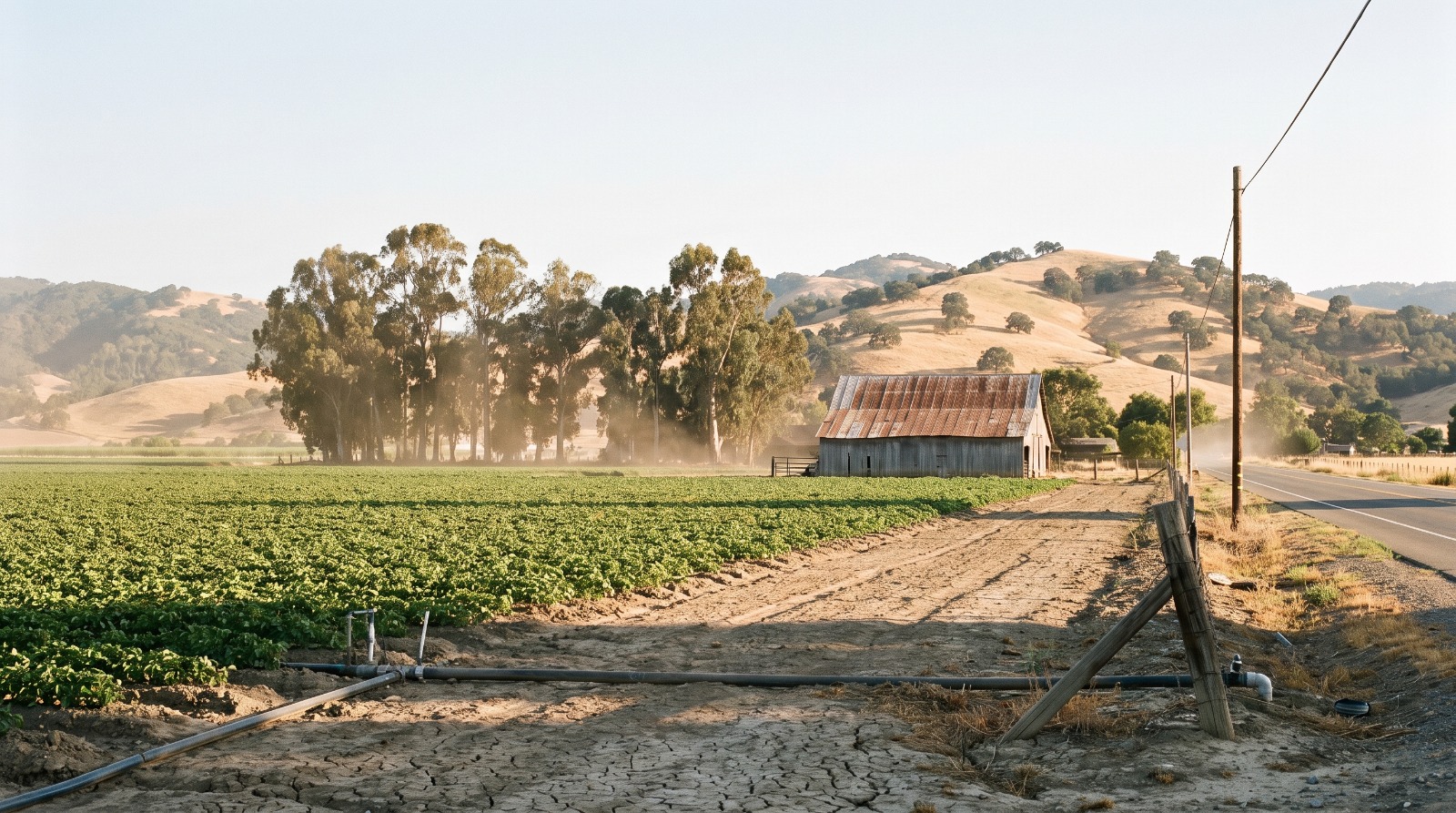
Farmland and a weathered barn along Hecker Pass Road in Gilroy, the site where a 116-home builder's remedy project is under environmental review. Photo: Houseberry
Gilroy has had a state-certified housing element since August 21, 2023. It is still processing a builder's remedy project three years later, and on August 21, 2026 the city released the Draft Environmental Impact Report for it. Public comments close October 5.
That combination confuses almost everyone who hears it, and understanding why it happens is the fastest way to understand the builder's remedy itself. The short version: eligibility locks in on the day a developer files, not on the day a city gets its paperwork straight. Mana Investment filed on May 11, 2023, during a window when Gilroy's housing element was not in compliance, and it has held those rights ever since.
The project, in specifics
The city calls it the 2480 and 2740 Hecker Pass Residential Project, files AS 23-19 and TM 23-03.
- 116 detached single-family homes on 24.3 acres of farmland on Hecker Pass Road at Third Street, on Gilroy's western edge
- 9 units deed-restricted for extremely low income households, which is 7 percent of the total
- Homes of 1,589 to 2,311 square feet, capped at 25 feet tall, in ranch, traditional and farmhouse styles, with 464 parking spaces
- Roughly 4.8 homes per acre, which is ordinary suburban subdivision density, not a tower
- Developer Mana Camden Fund, LLC, an affiliate of Carlsbad-based Mana Investment, with Holland and Knight as counsel
- Construction estimated at about 23 months across 12 phases
- Draft EIR published August 21, 2026, 45-day comment period closing October 5, 2026, community meeting September 28 at City Hall
The city's own project page is unusually blunt about the posture. The project, it says, does not align with the land use designations, zoning, or several goals and policies of the Hecker Pass Specific Plan, and the applicant has invoked the builder's remedy to proceed despite those inconsistencies.
What the builder's remedy actually is
It lives in Government Code section 65589.5, the Housing Accountability Act, at subdivision (d)(5).
The Act says a city cannot disapprove a qualifying affordable housing project unless it makes one of five specific written findings. One of those findings is that the project is inconsistent with zoning and the general plan. Subdivision (d)(5) takes that finding away from any city whose housing element the state has not found in substantial compliance.
Strip out the statutory language and it comes to this: if a city has not done its state-required housing planning, it loses the ability to say no on the grounds that a project does not match its own zoning map. Not every ground. It keeps health and safety findings, and it keeps objective standards. It loses the zoning argument, which is the argument cities actually use.
Two things changed on January 1, 2025, and most explainers still have it wrong
Search this topic and you will land on pages describing a 20 percent lower-income affordability requirement and no density limit at all. That was the law. It has not been the law for twenty months.
AB 1893, effective January 1, 2025, made a trade. A project now qualifies with any one of the following: at least 7 percent of units affordable to extremely low income households, at least 10 percent to very low income, at least 13 percent to lower income, or 100 percent to moderate income. Affordable units must match the market-rate units on bedroom and bathroom count, and stay restricted 45 years for rentals and 55 for ownership.
In exchange, California imposed the first density ceiling the builder's remedy has ever had. Maximum density is now the greatest of 50 percent above the jurisdiction's applicable minimum density, three times what the general plan or zoning allows, the density the housing element assigns that site, or an additional 35 units per acre if the site sits within half a mile of a major transit stop.
That trade is visible in Gilroy. The January 2025 notice of preparation described 24 low-income units. The current project carries 9 extremely low income units. Same project, lower affordability count, because 7 percent is the new floor. If you want a single sentence on what AB 1893 did, that is it: it made these projects easier to file and less affordable, and it stopped the eighteen-story surprises that made the earlier version politically radioactive.
Why a compliant city is still dealing with this
Here is the sequence, and it is worth following closely because it now applies statewide.
Gilroy adopted its housing element on May 1, 2023. Mana filed an SB 330 preliminary application ten days later, on May 11, invoking the builder's remedy. HCD certified Gilroy's element as substantially compliant on August 21, 2023. When the formal application arrived that October, the city deemed it incomplete and argued that because its adopted element had contained everything state law required back in May, the builder's remedy never applied.
HCD rejected that reading in a letter dated July 2, 2024. Gilroy, it found, was out of substantial compliance from July 5 through August 20, 2023, and became compliant only on August 21, the date of HCD's own letter. A jurisdiction is in compliance as of the date of HCD's finding. Cities do not get to certify themselves.
The Legislature then codified exactly that. AB 1886, effective January 1, 2025, established that compliance is measured as of the date a developer submits a complete preliminary application, and that only HCD or a court can determine compliance. AB 2023 added a rebuttable presumption in favor of HCD's determination, putting the burden on the city to disprove it.
So the vesting is the point. Statewide, 92 percent of jurisdictions were in housing element compliance as of March 25, 2026, with 480 having adopted final elements and 15 still out of compliance. Half Moon Bay is the only Bay Area city on that list. And yet builder's remedy projects keep surfacing, because the applications that matter were filed in 2023, when 96 of 101 Bay Area cities had their housing elements rejected and effectively lost their zoning authority.
Which other Bay Area projects are in the pipeline
Gilroy is not an outlier. It is one entry on a list that has been maturing quietly for three years.
| City | Site | Units | Developer | Status |
|---|---|---|---|---|
| Gilroy | 2480 and 2740 Hecker Pass Rd | 116 | Mana Investment | Draft EIR, comments close Oct 5, 2026 |
| Gilroy | 315 Las Animas Ave | 501 | TenSouth | Disputed with the city since 2023 |
| Morgan Hill | Four sites incl. Monterey Rd at Butterfield | 1,002 combined | DeNova, TenSouth, Glenrock, High Street | Preliminary applications filed 2023 |
| Los Gatos | Arya project, two applications | 292 | Arya Properties | Court ruled for the developer, February 2026 |
| Palo Alto | 156 California Ave | 400 | REDCO Development | Draft EIR completed, entitlement pending |
| Menlo Park | 80 Willow Rd, the former Sunset site | About 805 | N17 Development | Under review |
| Pacifica | Rockaway quarry, 86 acres | 1,225 | Eenhoorn | Back before Planning Commission |
| Santa Rosa area | 3843 Brickway Blvd | 1,464 | Gallaher Community Housing | Preliminary application |
Two patterns in that table. South County is heavily represented, with Gilroy and Morgan Hill alone accounting for more than 1,600 proposed homes. And the projects are getting older without getting resolved, which is the real story of this law.
Does anything actually get built?
This is the fair question, and for a long time the answer was no.
YIMBY Law counted 46 builder's remedy projects statewide in June 2023, when 227 jurisdictions covering roughly 12 million Californians were noncompliant. By April 2024 the count had roughly doubled to 93 projects across about 40 cities and roughly 17,000 units. Not one of them had broken ground. Cities refused to process nearly half. California YIMBY itself acknowledged that the pre-2025 builder's remedy had produced zero completed housing because of legal uncertainty.
The last eighteen months are where that changed, and the change is about maturation rather than volume. Attorney General Bonta issued a statewide legal alert on June 5, 2025 warning local agencies that refusing to process valid applications violates state law, and reminding them that Housing Accountability Act penalties start at 10,000 dollars per unit with a fivefold multiplier for bad faith. In October 2025, a project at 600 Foothill Boulevard in La Cañada Flintridge became the first Southern California builder's remedy project fully approved without a settlement, roughly three years after it was filed. In February 2026, a court ruled for the developer in Los Gatos.
Gilroy's Draft EIR belongs in that same sequence. These projects have moved from filing to entitlement, environmental review and litigation. Whether they move to construction is genuinely unsettled, and anyone telling you otherwise is guessing.
What 116 homes means in a city priced like Gilroy
This is where it stops being a legal story.
Gilroy had a median sale price of about 1.16 million dollars in August 2026. The Santa Clara County median single-family sale price in the same month was about 1.89 million. Gilroy sells for roughly 39 percent less than the county, and it is the county's release valve for anyone who wants a detached house and a yard.
It also ranks 18th of 18 places we score in Santa Clara County on overall neighborhood quality, and the reason is not mysterious. No Gilroy neighborhood scores above 3.1 out of 5 on schools. The top-ranked neighborhoods in Gilroy are Lions Creek and Sunrise Park at 3.5, with Sunrise Park carrying a strong 4.4 on safety, while Downtown Gilroy sits at 2.1 overall. Neighboring Morgan Hill ran about 1.58 million in July 2026, roughly 400,000 dollars more for a twelve-mile difference.
Adding 116 detached homes to a city of that size is not going to move the county median. What it does do is add 116 households of demand to Gilroy schools, Gilroy roads and the Highway 101 commute, in a place whose scores are already the lowest in the county. That is a real cost, and it is a cost that supply skeptics are right to name.
The objections, weighed honestly
The Draft EIR identifies significant and unavoidable impacts across six categories, including agricultural resources, cultural resources, aesthetics, greenhouse gas emissions, noise and transportation. The project requires demolishing the South Hoey Barn and removing 22 trees. Gilroy voters approved an urban growth boundary initiative in 2016 by roughly a two-thirds margin, and the west side along Hecker Pass is the agricultural face of the city. None of that is manufactured outrage.
And 9 affordable units out of 116 is a thin return for overriding a plan the community wrote through a public process. I say that as someone who thinks the Bay Area needs to build a great deal more than it does. AB 1893 bought developer participation by lowering the affordability ask, and Gilroy is what the purchase looks like.
Where I part ways with the opposition is on the counterfactual. Gilroy is 39 percent below its county's median because South County absorbs the demand the rest of Santa Clara County declines to house. Twenty-four acres of row crops at the edge of an existing city, at five homes per acre, is close to the least disruptive way that demand can land. The alternative is not open farmland forever. It is the same households commuting from farther out.
Also worth saying plainly: Gilroy chose the slow version of this. HCD told the city in July 2024 that its self-certification argument failed, and the Legislature wrote that rule into statute six months later. Three years of contesting eligibility is a significant part of why a project filed in 2023 is holding a hearing in 2026.
What to watch
Comments on the Draft EIR are due October 5, 2026, and the community meeting is September 28 at Gilroy City Hall. Both are open to anyone, and a comment letter on a Draft EIR is one of the few pieces of civic participation that actually enters the record and requires a written response.
After that, watch two things. Whether Mana's August 2026 notice alleging obstruction escalates into litigation, and whether the 501-unit Las Animas project restarts. Gilroy has been fighting these on legal grounds for three years. The law has moved decisively against that strategy, and the city's own environmental document is now the main venue left.
Sources
- City of Gilroy: 2480 and 2740 Hecker Pass Residential Project
- CEQAnet listing, SCH 2025010214
- The Registry, September 4, 2026: Mana pushes 116-home builder's remedy project through Draft EIR
- HCD letter to the City of Gilroy, July 2, 2024
- Gilroy Dispatch: city and builder's remedy Hecker Pass housing proposal
- Holland and Knight, September 2024: California Legislature passes major reforms for the builder's remedy
- Allen Matkins: builder's remedy 2.0 now effective
- Hanson Bridgett, January 10, 2025: clearing the fog on the California builder's remedy
- California Attorney General Legal Alert OAG 2025-03, June 5, 2025
- CalMatters, April 2024: builder's remedy bills and the statewide project count
- CalMatters, June 2023: Godzilla next door
- Office of Governor Newsom, March 25, 2026: final warning to 15 communities violating state housing laws
- Commercial Observer, November 2025: 600 Foothill and the first approved Southern California builder's remedy project
- The Real Deal, February 8, 2026: the statewide implications of a Los Gatos tower proposal
- Morgan Hill builder's remedy staff memo, October 12, 2023
- Santa Clara County market report, August 2026
The Houseberry Research Team is Houseberry's reporting team: Bay Area real estate analysts, data specialists and longtime local market watchers. Every day we check the public record: building permits, city council and planning agendas, county recorder filings, state housing bills, police incident data and school results. Then we tie each story to what it means for specific neighborhoods, using Houseberry's own neighborhood data on prices, appreciation, safety, schools and amenities. Questions or corrections: Contact us.
Map of Gilroy Neighborhoods
Loading map...
View Full Map
Top Neighborhoods in Gilroy, CA



All information provided on this website including but not limited to - school ratings, safety, amenities, user opinions, and property data - is for general informational purposes only. We do not guarantee its reliability, accuracy, or completeness. Users should independently verify information and consult appropriate professionals as needed. By using this website, you agree Houseberry is not responsible for actions, decisions, or consequences arising from reliance on the information provided
houseberry.com - CA DRE# 01847391
 Bay East ©2025. CCAR ©2025. bridgeMLS ©2025. Information Deemed Reliable But Not Guaranteed. This information is being provided by the Bay East MLS, or CCAR MLS, or bridgeMLS. The listings presented here may or may not be listed by the Broker/Agent operating this website. This information is intended for the personal use of consumers and may not be used for any purpose other than to identify prospective properties consumers may be interested in purchasing. Data last updated at October 21, 2026 12:00 AM