Caltrain Has a Code of Conduct Now. Will It Bring You Back?
Caltrain's first passenger code of conduct takes effect October 19, 2026. Here is what it bans, who can actually enforce it, and whether it addresses the reasons people stopped riding.

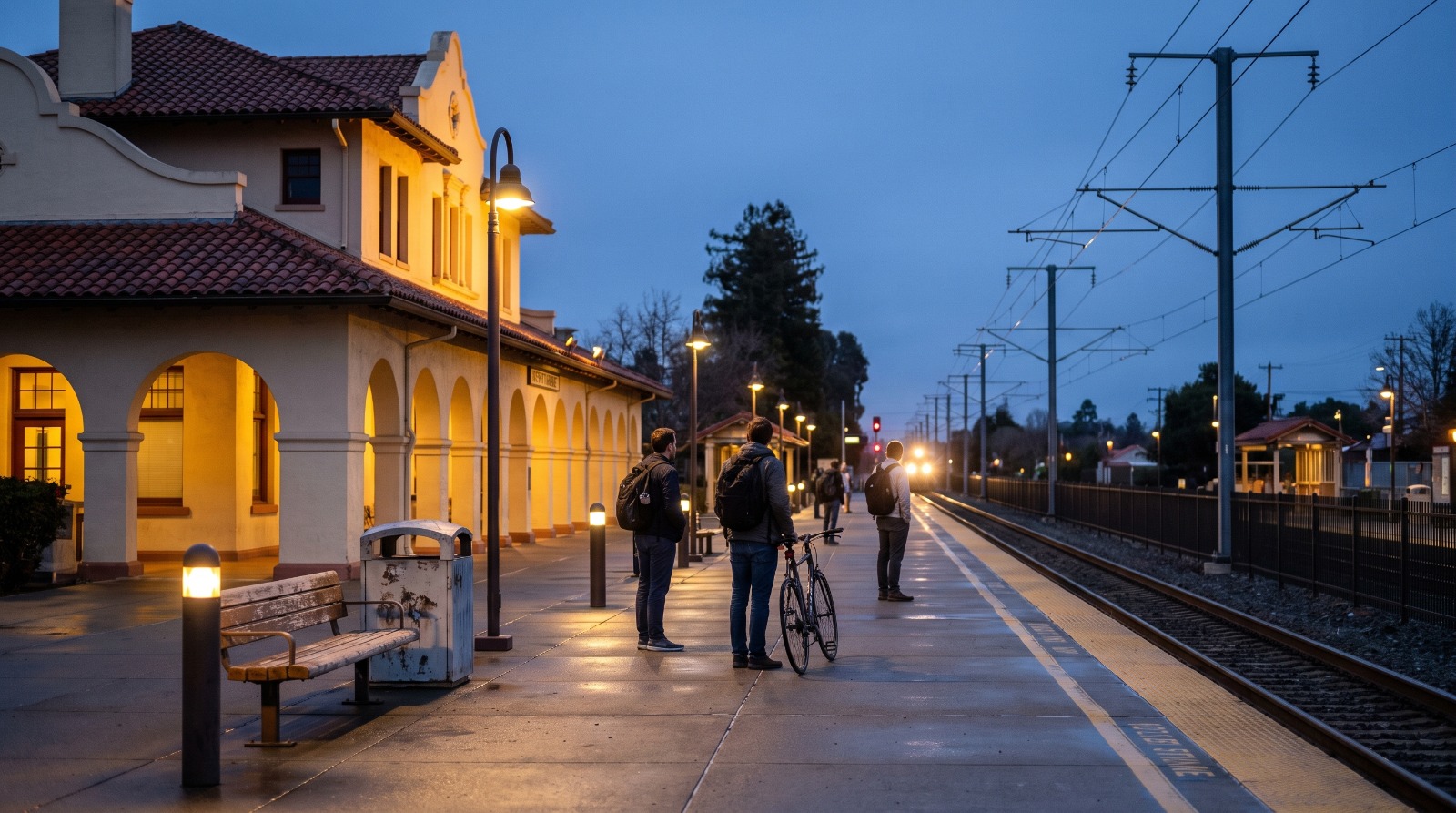
Commuters waiting on the platform at Burlingame Caltrain station at dusk, where a new Caltrain code of conduct takes effect in October 2026. Photo: Houseberry
If you quit riding Caltrain after something happened on the train, here is the honest answer about the new rules: on their own, they probably will not change your ride. The Peninsula Corridor Joint Powers Board approved the railroad's first formal passenger code of conduct on September 3, 2026, and enforcement begins October 19. It bans smoking, harassment, fighting, spitting, public urination and fare evasion. It does not come with a published fine schedule, a suspension policy, or one additional person on board to enforce any of it.
That last part is the whole story, and it is worth understanding before you decide whether to give the train another try.
What the code bans, and the one thing it leaves alone
The list is close to what you would guess. Smoking, public urination, harassment, discrimination, fare evasion, tampering with emergency doors and windows, and a catch-all category for willful disturbance that covers fighting, unwanted physical contact, spitting, excessive noise, vandalism and littering.
The interesting omission is alcohol. Drinking or selling it at a station without permission is now prohibited. Drinking on the train is still allowed. Caltrain has always been the Bay Area train where a beer on the way home from a Giants game is fine, and the new code keeps it that way.
Caltrain spokesperson Randol White told reporters there was no single incident behind this. The agency describes a formal code as a transit best practice, which is a polite way of saying every peer agency already had one. BART adopted its customer code of conduct on August 8, 2013. VTA has operated under a conduct ordinance since February 2015. SamTrans, run by the same management team as Caltrain, already had one. Caltrain was the outlier.
Conductors can ask you to leave. They cannot write you a ticket
This is the part that decides whether the code means anything to a rider.
Under the policy, conductors may issue a warning and request that someone leave the train. They cannot issue citations except for fare evasion. Actual citations come from the San Mateo County Sheriff's Transit Police Bureau. Caltrain chief operating officer Theodore Burgwyn was direct about why: the goal is to set expectations and let police enforce them without adding duties to onboard staff or pushing conductors into confrontations they are not trained for.
That is a defensible design. It is also a slow one. In February 2026, Transit Police logged 552 calls for service across the system, and the average response time for a Priority 1 call, meaning a crime in progress, was 14 minutes and 33 seconds. A Millbrae to Palo Alto trip takes about that long. If the thing that drove you off the train was somebody behaving badly in your car, a rule that summons an officer who arrives after you have already reached your stop is not the fix you were hoping for.
To be fair to Caltrain, it is doing more than writing rules. The agency logged 747 hours of high-visibility Transit Police patrols in July 2026 and has said it wants more officer presence on trains rather than only at stations. Watch that number. It matters more than the code does.
BART wrote these same rules in 2013. Its numbers moved in 2025
BART is the natural comparison, and it cuts both ways.
BART's code has existed since 2013, and the agency added a sexual harassment provision on April 22, 2021 after a survey found that 10 percent of riders had experienced harassment on the system in the previous six months. Then, in 2025, BART reported overall crime down 41 percent from 2024, robberies down 60 percent, and the share of riders who said they witnessed fare evasion falling from 24 percent to 15 percent in a single year.
Those are real improvements. They also arrived twelve years after the code, in the same period BART finished installing 715 new fare gates across all 50 stations and roughly doubled its officer deployment. The rules were the cheap part. The hardware and the staffing did the work.
Caltrain is adopting the scaffolding without the capital spending, and it is doing so while facing a projected 75 million dollar funding gap in fiscal 2028. Expect the code to shift behavior at the margins rather than to change the ride itself.
The thing that actually changed on Caltrain is the crowd
Here is the number that should influence your decision more than any of this.
Caltrain carried 1,321,627 riders in July 2026, up 22.6 percent from July 2025, and it was the fifth consecutive month to set the highest ridership mark since 2019. Across fiscal 2026 the railroad provided more than 12.5 million rides, a 36.9 percent jump over the prior year, with average weekday ridership back above 40,000.
Break that apart and it gets more interesting. Weekday ridership in July 2026 was still only 67.3 percent of July 2019. Weekend ridership was 203.1 percent of 2019. The commute train is still recovering. The weekend train is carrying twice what it did before the pandemic.
If your bad experience happened on a sparse 2022 or 2023 train, the train you would board this October is a different environment, mostly because there are far more people on it. Crowds are their own kind of enforcement. Whether that reads as reassuring or as one more reason to drive is a genuinely personal call.
What it costs, and where the train is worth paying for a house
An adult one-zone ride is 4 dollars in 2026, up from 3.75 on July 1, 2025, and Caltrain eliminated its 55 cent Clipper discount on January 1, 2026, so tapping no longer saves you anything over a paper ticket.
The way we look at it when we compare neighborhoods, a station is only an amenity if you would actually use it, and that calculation runs straight into Peninsula prices. Burlingame's median sale price was about 3.31 million dollars in August 2026 and Menlo Park's was about 3.13 million in June. Redwood City sat near 2.25 million in August, and San Mateo near 2.21 million in June, which makes the middle of the line the value stretch rather than either end.
Inside those cities the station-adjacent neighborhoods tend to score well on the things that make a car optional. Downtown Burlingame carries the highest amenities score in that city at 4.4 out of 5 while holding a 4.0 on safety, which is the combination you want if the plan is to walk to the platform. It is not universal. Lyon Hoag, also close to the corridor, pairs a strong 4.1 amenities score with a 2.9 on safety, and that gap is exactly the kind of block-level difference a listing photo will never show you. The same split shows up across San Mateo and in the amenity rankings for Redwood City.
So, would it bring you back?
Two weeks of education start October 5. Enforcement starts October 19. Between now and then, Caltrain has said it will post a public code page and put decals and flyers on the trains, and there is still no published information about penalties, suspension periods or how you would appeal one. Those are not small gaps in a policy that is supposed to change behavior.
My honest read: the code is a necessary piece of housekeeping that will matter mostly on the days a conductor needs something to point at. The reasons to try Caltrain again in 2026 are the electric trains, the 95 percent on-time performance, and the fact that the cars are simply fuller than they were.
If you got off the train over something specific, you are the person this policy is aimed at, and you are also the best judge of whether it addresses what actually happened. Ride it once in late October and see.
Sources
- Redwood City Pulse, September 4, 2026: No smoking, fighting or spitting, Caltrain strengthens rider code of conduct
- San Jose Spotlight, September 4, 2026: Silicon Valley public transit service strengthens rider code of conduct
- Caltrain, Executive Director report to the September 3, 2026 board meeting, ridership and policing data
- Caltrain, February 2026 Transit Police calls for service and response times
- Caltrain: ridership remains strong through FY26
- BART, January 2026: crime down 41 percent in 2025
- BART, June 2025: rider-witnessed fare evasion down 59 percent
- BART, April 22, 2021: sexual harassment added to the customer code of conduct
- Caltrain: Clipper discount eliminated January 1, 2026
The Houseberry Research Team is Houseberry's reporting team: Bay Area real estate analysts, data specialists and longtime local market watchers. Every day we check the public record: building permits, city council and planning agendas, county recorder filings, state housing bills, police incident data and school results. Then we tie each story to what it means for specific neighborhoods, using Houseberry's own neighborhood data on prices, appreciation, safety, schools and amenities. Questions or corrections: Contact us.
Map of Burlingame Neighborhoods
Loading map...
View Full Map
Top Neighborhoods in Burlingame, CA




All information provided on this website including but not limited to - school ratings, safety, amenities, user opinions, and property data - is for general informational purposes only. We do not guarantee its reliability, accuracy, or completeness. Users should independently verify information and consult appropriate professionals as needed. By using this website, you agree Houseberry is not responsible for actions, decisions, or consequences arising from reliance on the information provided
houseberry.com - CA DRE# 01847391
 Bay East ©2025. CCAR ©2025. bridgeMLS ©2025. Information Deemed Reliable But Not Guaranteed. This information is being provided by the Bay East MLS, or CCAR MLS, or bridgeMLS. The listings presented here may or may not be listed by the Broker/Agent operating this website. This information is intended for the personal use of consumers and may not be used for any purpose other than to identify prospective properties consumers may be interested in purchasing. Data last updated at October 21, 2026 12:00 AM