Five Wounds Urban Village Plan: 8,022 Homes, Explained
San Jose published the Draft EIR for the Five Wounds Urban Village Plan, which would raise capacity in East San Jose from 2,022 homes to 8,022 around a future BART station. Comments close in early October. Here is the plan, the two deadlines, and what the surrounding neighborhoods cost today.

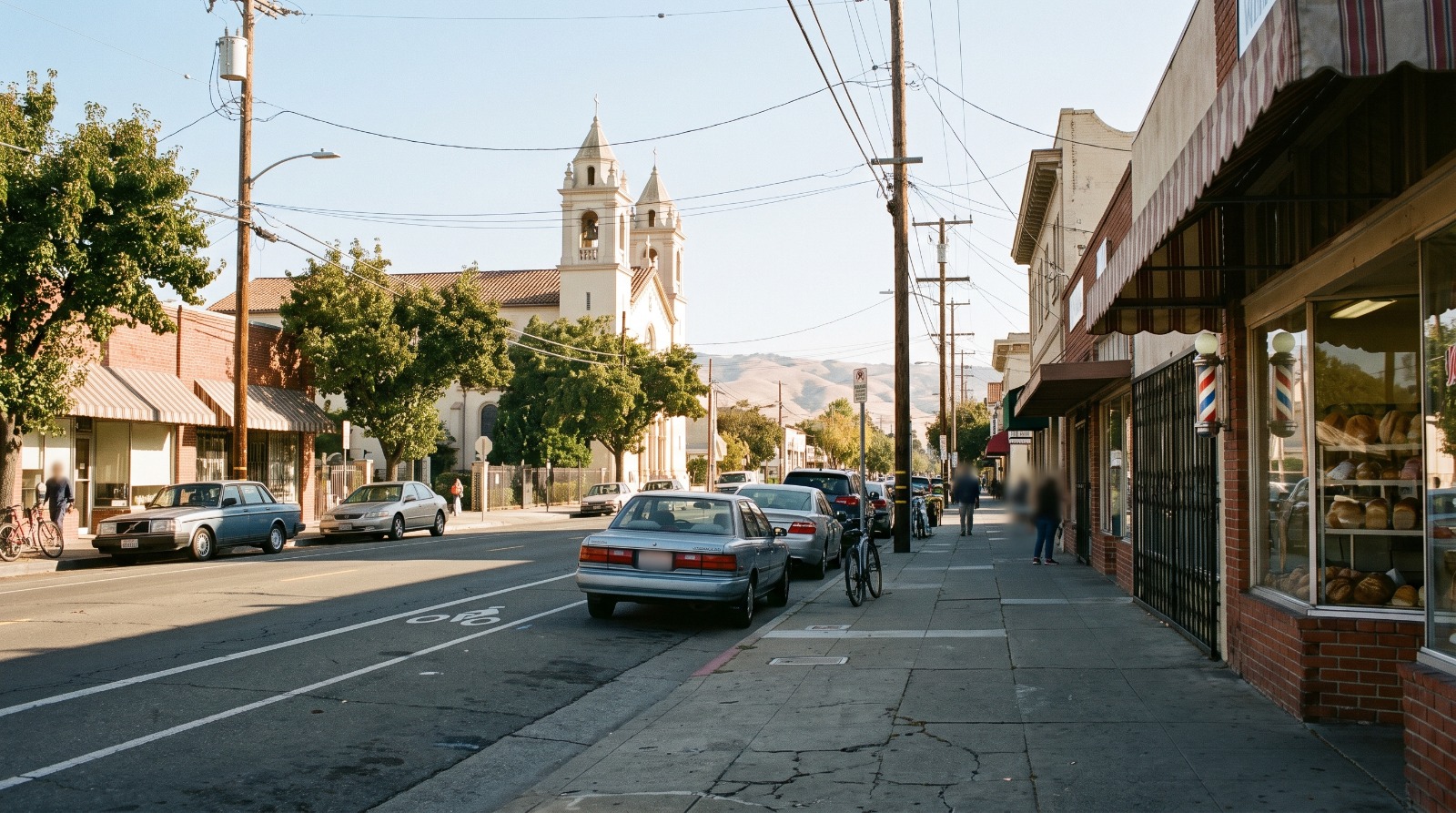
East Santa Clara Street in Little Portugal, San Jose, with the Five Wounds church towers rising behind the storefronts inside the Five Wounds Urban Village plan area. Photo: Houseberry
San Jose has published the Draft Environmental Impact Report for the Five Wounds Urban Village Plan, and public comments close at 5 p.m. on Friday, October 3, 2026. The plan would raise the housing capacity of a 427-acre slice of East San Jose from 2,022 homes to 8,022, most of it around a BART station that does not exist yet.
This is the kind of document that reshapes a neighborhood for twenty years and gets read by almost nobody. It is also, unusually, a plan whose comment window is still open, which means the reading is worth something. Below is what it proposes, how to actually send a comment, and what the neighborhoods inside the plan area score and cost right now.
Two deadlines, not one, and they are a day apart
There are two separate comment windows running at the same time on two different documents. Most coverage picks one and misses the other.
| What you are commenting on | Deadline | Where to send it |
|---|---|---|
| The Draft EIR, the environmental analysis under CEQA | Friday, October 3, 2026, 5 p.m. | Tina Garg, Supervising Planner, tina.garg@sanjoseca.gov, or Department of Planning, Building and Code Enforcement, 200 E. Santa Clara Street, 3rd Floor, San Jose, CA 95113 |
| The Draft Plan itself, the land use document | Friday, October 2, 2026 | 5W@sanjoseca.gov |
One warning worth passing along. The city’s own published notice lists the planner’s address with San Jose misspelled in the domain. The working address is the one above, tina.garg@sanjoseca.gov, and the file number to put in the subject line is ER21-298. The review period opened August 19.
If you would rather read it on paper, the Draft EIR is available at San Jose City Hall on the third floor, at the Dr. Martin Luther King Jr. Main Library on East San Fernando Street, and at the East San Jose Carnegie Library on East Santa Clara Street.
What the plan actually proposes
It consolidates four separate neighborhood plans into one and roughly quadruples the housing they allow.
The four are Five Wounds, Roosevelt Park, Little Portugal and 24th and William, and they have been governed as separate documents since the early 2010s. The merged plan covers 427.4 acres bounded by King Road on the east, Lower Silver Creek on the north, Coyote Creek on the west, and East San Fernando Street, William Court and San Antonio Street on the south. The horizon year is 2040.
Capacity goes from 2,022 homes to 8,022, an increase of roughly 6,000. Commercial capacity is set at 750,000 square feet. Building heights would be allowed up to 270 feet near the station, up from a 120-foot ceiling adopted in 2013. The plan also lays out a public plaza and a mobility hub at the station and carries the Five Wounds Trail through the area.
The number nobody is talking about is the jobs figure, which goes down. Planned job capacity drops from 4,855 to 2,500. This is a deliberate trade of employment capacity for housing capacity in a city that has spent a decade being told it has too many jobs and not enough homes, and it is the clearest signal in the document about what the city thinks this land is for.
The station is the reason all of it is happening
The 28th Street and Little Portugal station is an underground BART stop planned for the block behind the Five Wounds Portuguese National Church on East Santa Clara Street.
VTA projects 6,700 weekday passengers there by 2040. The station entry is planned at 28th Street and Five Wounds Lane, with a plaza, a shared-use path along 28th Street, and secured bike parking. The exterior is designed in red and white to sit alongside the church rather than against it, which is a small detail that took real community pressure to get. The station was renamed from Alum Rock and 28th Street to 28th Street and Little Portugal in November 2019 after the neighborhood asked.
The catch is the calendar. VTA’s BART Silicon Valley Phase II extension carries an estimated cost of about $12.2 billion, with $5.1 billion committed federally, and passenger service is anticipated in 2036. A ten-year runway is exactly why the plan matters now. The zoning has to be in place long before the trains are, or the land gets used for something else in the meantime.
The trail is on a nearer schedule. VTA’s board approved $4.14 million for environmental work and design on the Five Wounds Trail, a 1.5-mile rail-to-trail conversion running from East William Street up to the church and on toward Lower Silver Creek. The section between Interstate 280 and East William Street is already built, and the city is accessing $890,000 to finish the master plan and CEQA phases by March 2027.
What the plan-area neighborhoods cost today
These are the most affordable neighborhoods in San Jose, and that is the part of this story a buyer should care about most.
Current medians below come from each neighborhood page, all August 2026, next to a citywide median of $1.63 million.
| Neighborhood | Median price, August 2026 | Below the San Jose median |
|---|---|---|
| Northside | $1.16M | 29 percent |
| McKinley-Bonita | $1.09M | 33 percent |
| Little Portugal | $1.02M | 37 percent |
| Mayfair | $907,420 | 44 percent |
| Roosevelt Park | $725,000 | 56 percent |
| Spartan Keyes | $697,970 | 57 percent |
| San Jose citywide | $1.63M | reference |
A house under $1 million inside San Jose city limits is not a common thing in 2026, and there are four of them on that list. What these blocks already have is the thing new districts spend a decade trying to manufacture. Mayfair scores 4.4 out of 5 on nearby merchants and Spartan Keyes scores 4.6 on walkability to them, which is what a hundred years of small storefronts on a streetcar grid buys you.
What they do not have yet is the transit. That is the whole point of the plan, and it is why we treat corridors like this differently from a greenfield. The full San Jose ranking covers 112 neighborhoods, and the East Santa Clara Street corridor around Little Portugal and Roosevelt Park is where the price and the pipeline are furthest apart.
What neighbors are raising
The height increase is the live objection, and it comes from a group that has been at this a long time.
BART Transit Village Advocates, active in the area since 2006, argues that going from a 120-foot limit to 270 feet puts the church, which they measure at 106 feet, in the shadow of thirty-story buildings. That is a legitimate design question and exactly the kind of thing a comment letter is for. Their numbers on units and commercial space appear to describe a sub-area rather than the whole plan, so read them against the EIR rather than instead of it.
The counterweight is worth stating plainly. This is a subway station going into one of the last affordable, walkable, culturally intact parts of San Jose. Building enough homes near it is how the people already there get to stay near it. A plan that allows 8,022 homes and produces 2,000 is a much worse outcome for Little Portugal than one that allows 8,022 and produces most of them.
What happens after October 3
City staff must respond in writing to every comment received, and those responses have to be published at least ten days before a hearing. Public hearings before the Planning Commission and the City Council are scheduled for late 2026, with no dates set as of today.
Between now and then, the useful reading is the gap between what San Jose approves and what San Jose builds, which we looked at in detail on the Diridon housing pipeline. A capacity number in a plan is a permission, not a forecast. But permissions are the part the public actually gets a vote on, and this one is open for another three and a half weeks.
Sources
San Francisco YIMBY, Draft EIR published for the Five Wounds Urban Village Plan, September 3, 2026
City of San Jose, Draft EIR public review notice, file ER21-298
City of San Jose, Five Wounds Urban Village Plan Update
CEQAnet, Five Wounds Urban Village Plan, SCH 2024030360
VTA, 28th Street and Little Portugal Station
VTA, a closer look at cost changes on the BART Silicon Valley Phase II project
Friends of the Five Wounds Trail
BART Transit Village Advocates
City of San Jose, Urban Villages program
Houseberry, San Jose neighborhood and city data, September 2026
The Houseberry Research Team is Houseberry's reporting team: Bay Area real estate analysts, data specialists and longtime local market watchers. Every day we check the public record: building permits, city council and planning agendas, county recorder filings, state housing bills, police incident data and school results. Then we tie each story to what it means for specific neighborhoods, using Houseberry's own neighborhood data on prices, appreciation, safety, schools and amenities. Questions or corrections: Contact us.
All information provided on this website including but not limited to - school ratings, safety, amenities, user opinions, and property data - is for general informational purposes only. We do not guarantee its reliability, accuracy, or completeness. Users should independently verify information and consult appropriate professionals as needed. By using this website, you agree Houseberry is not responsible for actions, decisions, or consequences arising from reliance on the information provided
houseberry.com - CA DRE# 01847391
 Bay East ©2025. CCAR ©2025. bridgeMLS ©2025. Information Deemed Reliable But Not Guaranteed. This information is being provided by the Bay East MLS, or CCAR MLS, or bridgeMLS. The listings presented here may or may not be listed by the Broker/Agent operating this website. This information is intended for the personal use of consumers and may not be used for any purpose other than to identify prospective properties consumers may be interested in purchasing. Data last updated at October 23, 2026 12:00 AM