Who pays for Rancho Cordova's arena? Mostly its future taxes
Most of Rancho Cordova's $185 million arena commitment is shared future taxes. The $25 million to $40 million in fees is the part residents carry. Here is the split before the council votes.

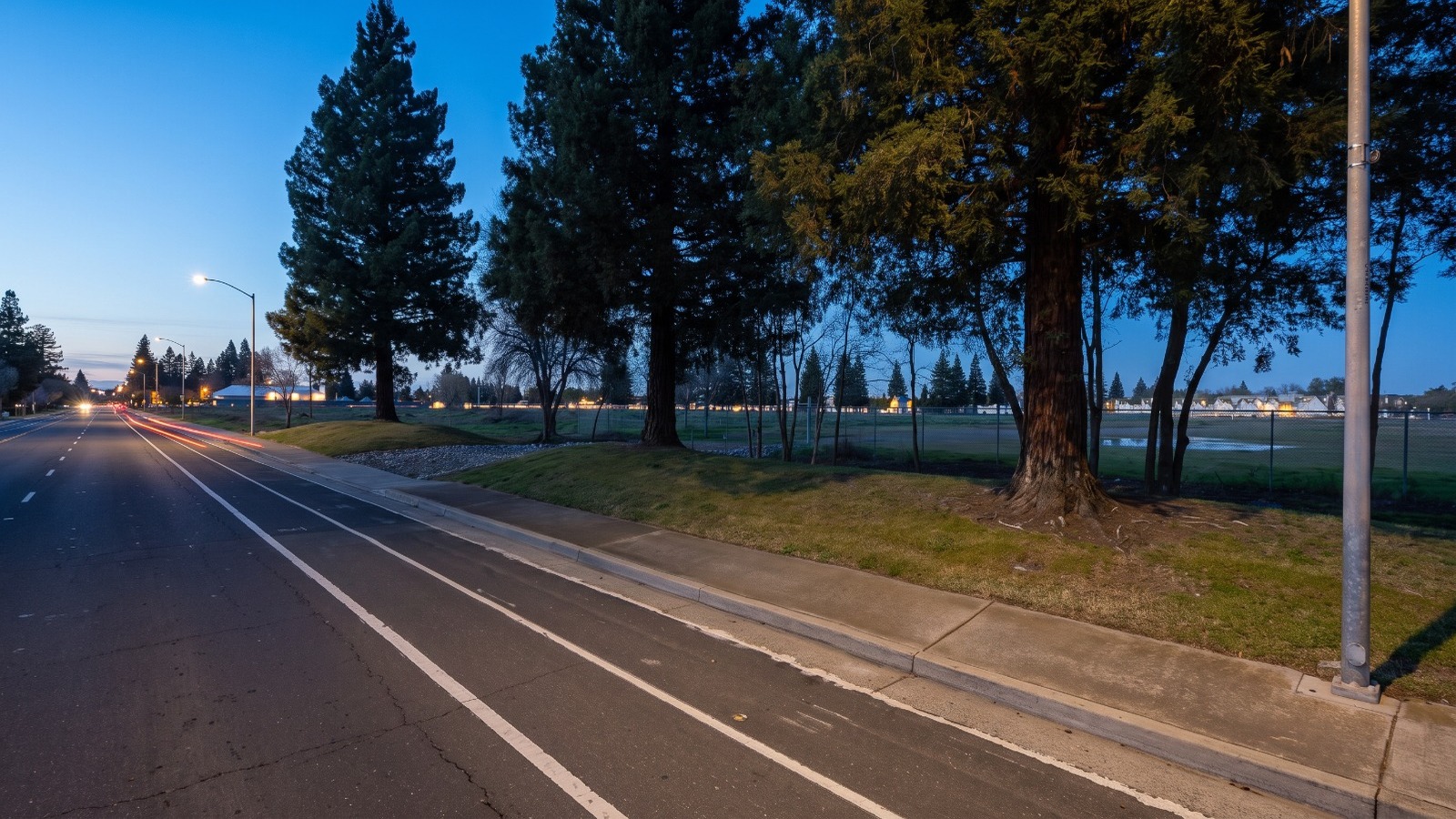
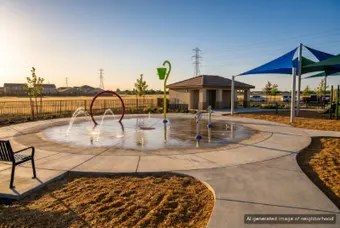
AI-rendered view of the empty arena site on Kilgore Road near Trade Center Drive in Rancho Cordova at blue hour, as it looks today Photo: Houseberry
On Kilgore Road, just south of Highway 50, a chain-link fence runs along a field of dry grass and a row of old redwoods. That field, 26 acres between Trade Center Drive and Sunrise Boulevard, is where Rancho Cordova wants a 7,500-seat arena. The developer says it will pay to build it. The city estimates its own share of the deal at $185 million over 35 years.
That number is the whole argument.
It is about $5.3 million a year, or roughly $61 a year for each of the city's 87,000 residents, by our math. Measured another way, $185 million is the price of about 374 typical Rancho Cordova homes at the September 2026 figure of about $494,900 in Houseberry's Rancho Cordova price history.
This is a story about what kind of money that is. Most of it, $145 million to $160 million, is future tax revenue the arena district would have to generate before the city shares a dollar. A smaller slice is fees the city gives up or pays out of its own budget, and that slice is where residents carry real risk.
The $185 million, split by what triggers it
The city's own staff materials, as reported by the Rancho Cordova Independent on Oct. 6, break the estimate into two parts that behave very differently.
| Piece | Estimated amount | When the city pays | Who carries the risk |
|---|---|---|---|
| Shared sales, hotel and cardroom taxes | $145M to $160M over 35 years | Only after the district opens and produces that tax | Mostly the developer |
| Waived permit fees and city-paid impact fees | $25M to $40M | At construction milestones and final inspections | The city budget |
| Public safety costs | Not yet estimated | Up to 15 years | Still being negotiated |
| City land on Kilgore Road | $3.5M sale to the developer | At closing | Money flows to the city |
Read the table from the top and the deal looks safe. The revenue share is 78 to 86 percent of the total, and it only exists if the arena and hotels are open and selling things. If the district never opens, the city never writes those checks. Assistant City Manager David Kwong called it "a performance-based incentive" at the Planning Commission hearing, according to the Folsom Times.
Read it from the bottom and it looks different. The fee piece is real money that leaves real accounts. For some impact fees, which normally pay for roads and affordable housing, the city would cover the developer's bill by moving money out of its General Fund. The council already approved about $940,000 in predevelopment fee waivers in January 2026. And the public safety line, covering added police and fire costs for up to 15 years, has no number on it yet. Kwong said of the special taxes tied to those services, "We're still negotiating those issues out."
Our read: the tax share can pencil, the fee side needs a cap
We think the revenue-sharing half of this deal is a defensible bet. Sales and hotel taxes from an arena district that does not exist today are new money. Sharing part of a new dollar costs residents less than spending an old one, and the city keeps some share of every dollar either way. A hotel-tax stream from 800 new rooms is the kind of revenue a suburb of 87,000 rarely gets a shot at.
The fee side is where the deal does not yet pencil for residents. Rancho Cordova's General Fund budget was about $79 million in fiscal 2024-25, according to the city's budget summary. The high end of the fee estimate, $40 million, is half a year of that budget, paid early, before the arena has sold a ticket. Add an open-ended public safety commitment and the honest answer to "what is the total public commitment?" is that nobody can say yet.
That was the question residents asked at the Sept. 30 hearing, and it is still the right one. Sara Malone, who chairs Stone Creek Residents for Smart Growth, wrote that her group first understood "privately funded" to mean taxpayers would not be on the hook, and asked for "a complete accounting" before approval.
On the numbers released so far, she has a point.
Where the arena would land
The site sits at the seam between Rancho Cordova's office parks and its older neighborhoods. The city owns about 13 acres of it at 2875 Kilgore Road and would sell that land to the developer for about $3.5 million, a change from the 2025 agreement that contemplated giving it away.
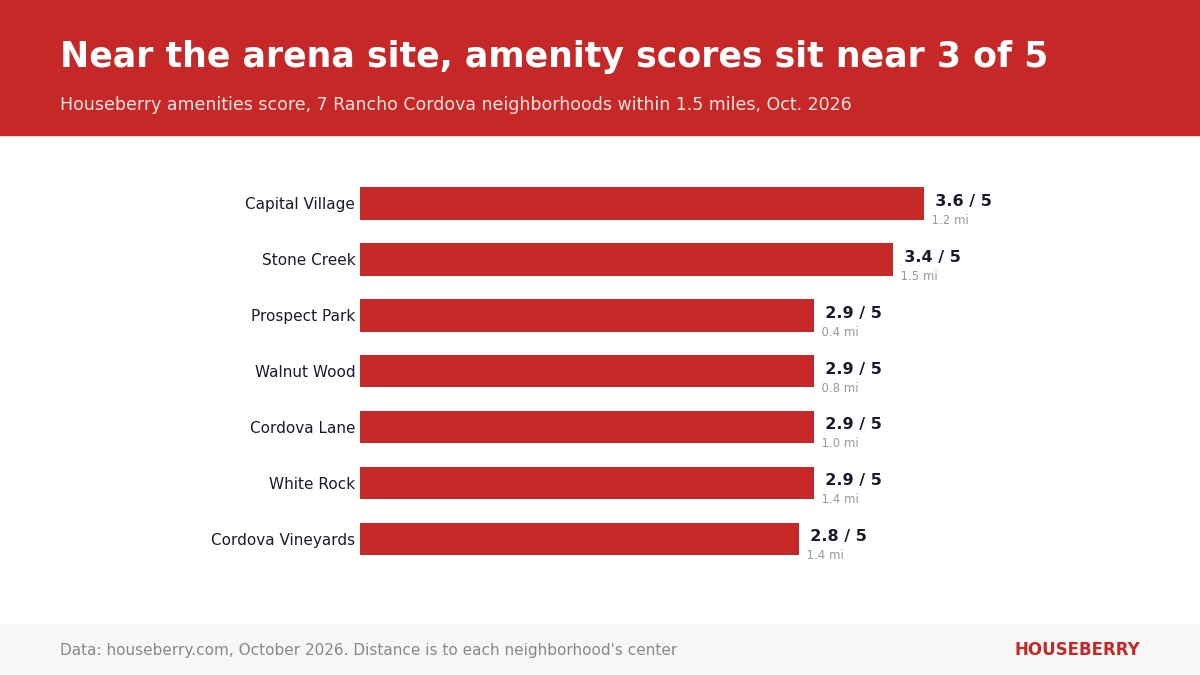
Seven of the neighborhoods Houseberry scores have their centers within 1.5 miles of the field. They average 2.6 out of 5 overall, a little under the citywide 2.8 on the Rancho Cordova neighborhood ranking. The closest is Prospect Park, about 0.4 miles away along the Zinfandel Drive office corridor, which scores 4.2 on safety and 2.9 on amenities. Capital Village, 1.2 miles south, has the best amenities score in the city at 3.6.
That last number explains why the arena has fans. No Rancho Cordova neighborhood scores 4 or better on Houseberry's amenities measure, and the city's own 2024 General Plan outreach ranked "a new, energetic downtown" as residents' top priority.
In 2012 the council voted 4-0 to explore helping with a Sacramento Kings arena downtown. Fourteen years later it is being asked to back one of its own.
Prices in the city have been flat. Houseberry's 12-month price history puts the typical Rancho Cordova home at about $486,900 in October 2025, a peak near $499,500 in March 2026 and about $494,900 in September, a gain of under 2 percent. An arena does not move that line on its own. Restaurants and a walkable center can, which is why the later phases matter more to homeowners than the arena does.
Traffic, parking and the 300-day question
City Manager Micah Runner told the Bee the project "will generate more traffic." The arena itself would have about 21 parking spaces. The first phase leans on about 2,270 temporary spaces on nearby land along Kilgore Road, and big events would still need about 2,600 off-site spaces through agreements with neighboring owners that, per the Folsom Times, were not signed as of Oct. 11. Improvements at the Sunrise Boulevard and Zinfandel Drive interchanges have to satisfy Caltrans before the arena can open, and their scope and cost are not set.
Then there is the calendar. The developer projects more than 180 events a year, including two Major Arena Soccer League expansion teams, one men's and one women's, that the league awarded to the region in September 2025. James Garcia, a Stone Creek resident, told the council on Oct. 19 that soccer plus about 40 concerts would fill roughly 60 days and asked, per Elk Grove News, what happens on the other 300. The revenue share is built to absorb that risk. If the building sits dark, the city shares less.
The fee money is gone either way.
Who is building it
KozPure Development was founded in 2024 by Joshua Wood and Charanjeet Kaur Tiwana-Purewal, and the arena would be its first significant project, the Bee reported. Wood worked on Sacramento's campaign to keep the Kings, and Alpha One Sports and Entertainment Group, a party to the development agreement, is tied to the soccer side. The draft agreement runs 10 years, with a possible five-year extension, annual compliance reviews, and a clause letting the developer defer or phase work if it becomes infeasible in its "reasonable business judgment."
What to ask before Nov. 2
A short list of what the staff report and term sheet should answer before the council signs:
- What share of each new tax dollar stays with the city, and does that share change over 35 years?
- Is there a dollar cap on city-paid impact fees and on public safety costs?
- Who pays the special police and fire taxes: the developer, or future residents of the 640 to 1,000 homes?
- If the hotels and housing never get built, does any fee waiver come back to the city?
The agenda and packet for both meetings will post on the city's CivicClerk portal, which showed no Oct. 26 agenda as of Oct. 23. Before either meeting, compare the arena site's neighbors on the Rancho Cordova neighborhood ranking, since those blocks will live with the traffic either way. We covered the 166 homes planned near International Drive in our Capital Village post.
Sources
- City of Rancho Cordova meeting calendar, CivicClerk portal, Oct. 26 and Nov. 2, 2026 meetings and Sept. 30 Planning Commission packet
- Rancho Cordova Independent, Oct. 6, 2026
- Folsom Times, Oct. 11, 2026
- Sacramento Bee via Yahoo News, Oct. 22, 2026
- Elk Grove News, Oct. 22, 2026
- CBS Sacramento, Sept. 23, 2025
The Houseberry Research Team is Houseberry's reporting team: Bay Area real estate analysts, data specialists and longtime local market watchers. Every day we check the public record: building permits, city council and planning agendas, county recorder filings, state housing bills, police incident data and school results. Then we tie each story to what it means for specific neighborhoods, using Houseberry's own neighborhood data on prices, appreciation, safety, schools and amenities. Questions or corrections: Contact us.
Map of Rancho Cordova Neighborhoods
Loading map...
View Full Map
Top Neighborhoods in Rancho Cordova, CA



All information provided on this website including but not limited to - school ratings, safety, amenities, user opinions, and property data - is for general informational purposes only. We do not guarantee its reliability, accuracy, or completeness. Users should independently verify information and consult appropriate professionals as needed. By using this website, you agree Houseberry is not responsible for actions, decisions, or consequences arising from reliance on the information provided
houseberry.com - CA DRE# 01847391
 Bay East ©2025. CCAR ©2025. bridgeMLS ©2025. Information Deemed Reliable But Not Guaranteed. This information is being provided by the Bay East MLS, or CCAR MLS, or bridgeMLS. The listings presented here may or may not be listed by the Broker/Agent operating this website. This information is intended for the personal use of consumers and may not be used for any purpose other than to identify prospective properties consumers may be interested in purchasing. Data last updated at October 23, 2026 12:00 AM