El Granada could get 70-foot apartments behind Coral Reef Avenue
San Mateo County wants to let six empty El Granada lots hold up to 70 homes an acre. Here is what would change, what stands in the way, and how to comment by November 24.

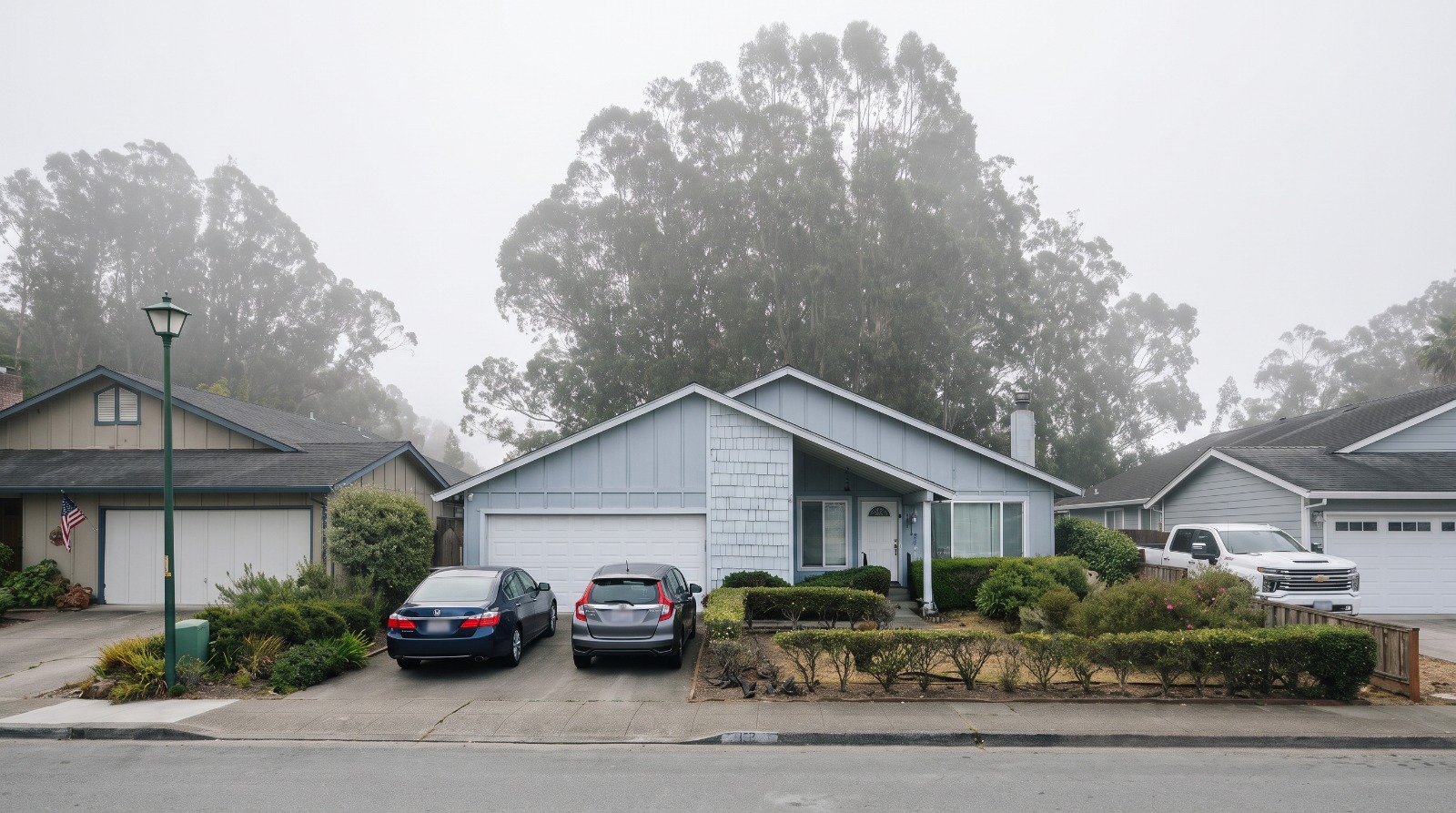
AI-rendered view of Coral Reef Avenue in El Granada under morning fog, one-story homes with the eucalyptus grove of the proposed rezoning site behind them Photo: Houseberry
Drive up Coral Reef Avenue from Highway 1 and look right, over the roofs of the one-story ranch houses. That wall of eucalyptus and Monterey cypress is 12.45 acres of empty land, and San Mateo County now wants to let someone build apartment buildings up to 70 feet tall inside it.
The county filed its Notice of Preparation for an environmental review on October 23, 2026. Six vacant lots between Coral Reef Avenue and Sevilla Avenue would go from a ceiling of 8 or 17 homes an acre to a ceiling of 70, with a floor of 30. Run that across 12.45 acres and you get somewhere between about 370 and 870 homes. That range is our multiplication. The county has not published a unit count, and nothing is proposed for the land yet.
For scale, Houseberry's El Granada neighborhood page puts the typical home there at about $1.55 million this month, in a place built almost entirely of one- and two-story houses. This is a story about quadrupling what the zoning allows, on land most people only notice as the trees behind Coral Reef.
The grove behind Coral Reef Avenue
The six lots sit east of Highway 1, inside the curving street grid that Daniel Burnham drew for a seaside resort that never quite arrived. They are surrounded on every side by houses, which the county's notice describes as "primarily one- and two-story single-family homes set back from the street."
Nobody lives on the land. It is grassland and a dense stand of eucalyptus and Monterey cypress, with informal trails cut through it from Sevilla Avenue. Comment letters in the county's December 2025 hearing file describe the six lots as Cabrillo Unified School District property, and the county's general plan already marks part of the area "Institutional."
Water would come from the Coastside County Water District and sewer service from the Granada Community Services District. That matters, because a lot of Midcoast land has neither.
Here is what the county's rules would allow once rezoned, straight from the notice:
- Up to 70 homes an acre, and at least 30, where today's cap is 8 or 17.
- Buildings of 60 to 70 feet, or whatever height a lot needs to reach that density.
- No more than one parking space per home.
- Front, side and rear setbacks of 10 feet or less.
- Shops or offices capped at 25 percent of a mixed-use building's floor area.
The rule that would change the most for neighbors is not on that list. Under the new standards, a project that meets the written design rules would be approved by Planning and Building staff, without a Planning Commission hearing. That is the whole point of the program, in the county's words: to "streamline the entitlement process for future housing development proposals."
Seventy feet is roughly a six-story building. The houses on Coral Reef top out at two.
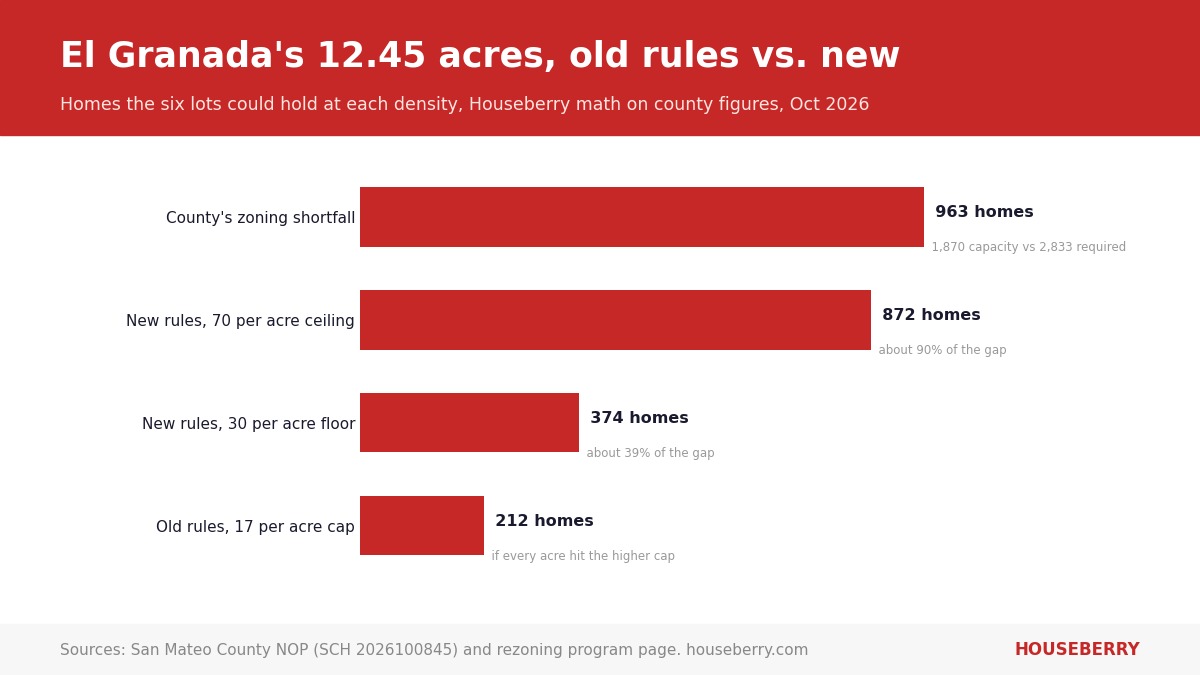
The state requires every county to zone for its share of new homes. San Mateo County's rezoning program page says unincorporated land currently has room for 1,870 homes against a state target of 2,833. That is a gap of 963.
The state housing department certified the county's 2023 to 2031 housing plan in May 2026, and that plan promised to rezone 137 lots in four areas: Broadmoor, the unincorporated Colma area, the Harbor Industrial area near Belmont, and El Granada. Supervisors adopted the first three on April 21, 2026. El Granada was split off because it sits in the Coastal Zone, and the California Coastal Commission has the final say over any change to the county's coastal plan.
So the math is blunt. At the full 70 homes an acre, El Granada alone could cover about 90 percent of the county's shortfall. Even at the 30-an-acre minimum, it covers about 39 percent. No other site in the program carries that much weight from so little land.
What the Midcoast looks like on our numbers
Houseberry scores five neighborhoods between Montara and Miramar. None of them clears 4 out of 5 overall. All five score 4.4 or 4.5 on safety, and school scores sit in a tight band from 2.9 to 3.2.
| Neighborhood | Overall | Safety | Schools | Typical price, Oct 2026 |
|---|---|---|---|---|
| El Granada | 3.7 | 4.4 | 3.1 | $1,552,000 |
| Moss Beach | 3.7 | 4.4 | 3.2 | $1,844,000 |
| Montara | 3.6 | 4.5 | 3.2 | $1,530,000 |
| Princeton | 3.5 | 4.4 | 3.1 | $879,000 |
| Miramar | 3.4 | 4.5 | 2.9 | $2,086,000 |
The prices come from each place's current Houseberry ranking and neighborhood pages: El Granada and Miramar, Moss Beach and Princeton, and Montara. El Granada's $1.55 million is the median of the five. Princeton, at $879,000, is the only one under a million, and it is mostly the harbor's working waterfront.
One El Granada number stands out. Houseberry's El Granada page scores it 4.2 out of 5 for public spaces and 1.9 for nearby merchants, the weakest score it has. People drive to Half Moon Bay for groceries. A few hundred new households would not fix that by themselves, but the new rules do leave room for ground-floor shops.
What the table cannot show is an apartment market. Every price above, from Princeton's $879,000 to Miramar's $2.09 million, is for a place built on houses. A 70-foot building near Coral Reef would be a new kind of home on this coast.
The wetlands question is the real fight
The county's own notice names the trouble spots. Preliminary surveys found wet soils and wetland plants across "much of the lower (central and southwestern) portion" of the lots. The eucalyptus and cypress groves offer suitable winter habitat for western monarch butterflies. The land is within dispersal range of the California red-legged frog, a federally and state listed species, and could support 10 rare plant species.
If a wetland delineation confirms what the surveys suggest, a good share of the 12.45 acres may never hold a building. That is why the 870 figure is a ceiling, not a forecast.
The other objection comes from people who live there. In public comments to the Planning Commission, residents raised wildfire risk and the fact that Highway 1 is the only way out. Others pointed to planes on approach to Half Moon Bay Airport. One commenter asked whether Coral Reef Avenue would get a traffic light. Nobody in the record answered.
Those are fair questions. Highway 1 does back up on beach weekends, and Route 92 over the hill to San Mateo is two lanes for much of its length. The notice lists transportation and wildfire among the impacts the county expects to find.
We would build here, after the wetlands are mapped
We think this is the right land for Midcoast housing. It is already surrounded by homes, already served by the Coastside County Water District and the Granada Community Services District, and part of it already carries the county's R-3-A affordable housing zoning. Building here keeps homes off open farmland and out of the hills.
We would rather see the county map the wetlands first, say how much of the 12.45 acres can carry a building, and set the density for the land that is left before the Coastal Commission vote. A 70-home-an-acre ceiling on a parcel that turns out to be half wetland is a promise to the state that the land cannot keep.
Before November 24
The 30-day comment period runs from October 26 to November 24, 2026, at 5 p.m. Written comments go to Will Gibson, Planner III, San Mateo County Planning and Building, 455 County Center, Redwood City, CA 94063, or wgibson@smcgov.org. The county asks that comments stick to environmental effects and alternatives to the plan.
The Planning Commission holds its scoping session on Wednesday, November 18, 2026, at 9 a.m. in the Board Chambers at 500 County Center in Redwood City, with Zoom details on the Planning Commission page. After the draft review comes back, supervisors vote, and then the Coastal Commission decides.
Does this approve any building? No. The October 23 notice says plainly that "no specific development is proposed or approved." It sets the rules a future project would follow.
Will 870 homes really go up? Unlikely at that number. Wetlands and the 60-to-70-foot height limit will shrink what fits, and the owner would still need a builder.
Who has the last word? The California Coastal Commission, which must certify any change to the county's coastal plan.
If you own on Coral Reef, Sevilla or Madrid, read the notice before the scoping session. To see how El Granada stacks up against the rest of the coast before you write your comment, start with the El Granada neighborhood ranking.
Sources
- San Mateo County Notice of Preparation, Housing Element Rezoning Program Phase 2, El Granada, SCH 2026100845, received October 23, 2026
- San Mateo County Housing Element Rezoning Program
- Public comments to the San Mateo County Planning Commission on the El Granada parcels, December 2025
- San Mateo County Planning Commission
- Houseberry El Granada neighborhood ranking
The Houseberry Research Team is Houseberry's reporting team: Bay Area real estate analysts, data specialists and longtime local market watchers. Every day we check the public record: building permits, city council and planning agendas, county recorder filings, state housing bills, police incident data and school results. Then we tie each story to what it means for specific neighborhoods, using Houseberry's own neighborhood data on prices, appreciation, safety, schools and amenities. Questions or corrections: Contact us.
Map of El Granada Neighborhoods
Loading map...
View Full Map
Top Neighborhoods in El Granada, CA




All information provided on this website including but not limited to - school ratings, safety, amenities, user opinions, and property data - is for general informational purposes only. We do not guarantee its reliability, accuracy, or completeness. Users should independently verify information and consult appropriate professionals as needed. By using this website, you agree Houseberry is not responsible for actions, decisions, or consequences arising from reliance on the information provided
houseberry.com - CA DRE# 01847391
 Bay East ©2025. CCAR ©2025. bridgeMLS ©2025. Information Deemed Reliable But Not Guaranteed. This information is being provided by the Bay East MLS, or CCAR MLS, or bridgeMLS. The listings presented here may or may not be listed by the Broker/Agent operating this website. This information is intended for the personal use of consumers and may not be used for any purpose other than to identify prospective properties consumers may be interested in purchasing. Data last updated at October 23, 2026 12:00 AM