Morgan Hill approves 105 homes by the freeway. Here's the trade
Morgan Hill approved 105 houses on a commercial field off Cochrane Road after a builder's remedy filing. Here is what the city got in return, what it had to override, and how nearby neighborhood prices compare.

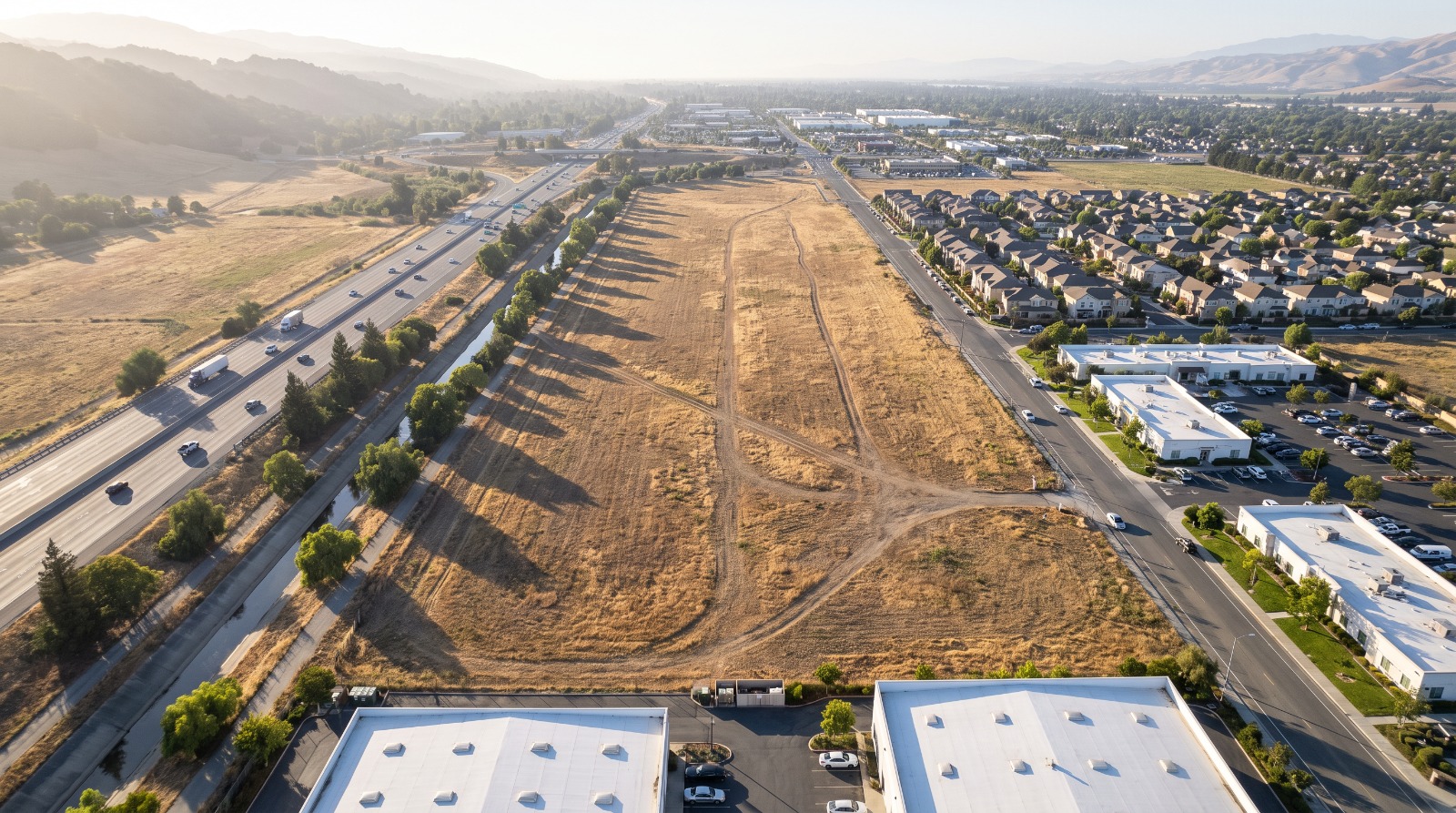
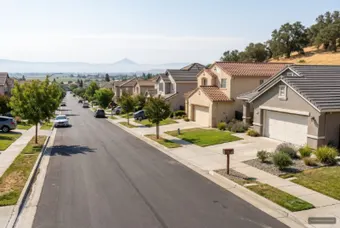
AI-rendered oblique aerial view of the empty field off Cochrane Road in Morgan Hill between Highway 101 and DePaul Drive, as it looks today Photo: Houseberry
Drive south on 101 past the Cochrane Road exit and look left. Between the freeway and DePaul Drive sits a long, empty field, dry grass and dirt tracks, with the county's Valley Health Center across the street and a row of warehouses at the far end. On Oct. 21, the Morgan Hill City Council approved 105 houses for it.
The city did not want houses there. Its general plan calls the land commercial, and the staff report says plainly that residential development "was not envisioned for this project site." It approved them anyway, over its own environmental review's finding of impacts it cannot fix, because a 2023 builder's remedy filing left it few other options. What Morgan Hill got in return is the more interesting part of this story, and it matters for anyone weighing a home in a city where Houseberry's overall score is 3.3 out of 5 and all four ranked neighborhoods priced lower this September than last October.
105 homes, not 171
If you looked this project up before the vote, you may have seen a bigger number. The city's project page still lists 171 units, 98 houses and 73 townhome-style condos, on about 20.56 acres, with a status of "Processing Entitlements." That page is out of date.
The council's own record settles it. Item 9 on the Oct. 21 agenda and the staff report behind it describe 105 single-family homes on a 15.8-acre site, and the Notice of Determination the city filed with the state on Oct. 22 matches: 114 lots, 105 homes, an approval dated Oct. 21. The council's vote tally was not posted in the city's records when we checked on Oct. 23. The Planning Commission had recommended approval 7 to 0 on Oct. 13.
How a commercial lot became a subdivision
High Street Residential, a Trammell Crow company, filed a preliminary application on Oct. 10, 2023. Morgan Hill's council had adopted its housing plan, but the state had not yet certified it. That gap is what the builder's remedy exploits: under the Housing Accountability Act, a city without a certified plan cannot deny a qualifying project for breaking its zoning. The Morgan Hill Times counted a 151-unit version of this site among four builder's remedy filings inside city limits that fall.
Rather than litigate, the city signed a settlement on Oct. 15, 2025. It carved the roughly 28.5 acres into three pieces.
| Piece | Acres | What happens there |
|---|---|---|
| DePaul Residences | 15.8 | 105 market-rate houses, a detention basin and two small parks |
| Corner at Cochrane and DePaul | 7.83 | Stays commercial, the Poppy Ranch shopping center |
| Parcel deeded to the city | 4.72 | Earmarked for affordable housing, possibly mixed use |
The developer also owes an in-lieu affordable housing fee of $23.18 per square foot of living space. San José Spotlight put the total at roughly $5.85 million. That works out to about $55,700 a house, paid instead of building affordable units on site. Spotlight also reported a Sprouts market is slated to anchor the commercial corner in late 2027.
What the city had to override
The Draft EIR circulated from May 29 to July 13. Three findings survived every mitigation the city could require.
Farmland is the first. The site holds 10.8 acres classified as Unique Farmland. The developer must preserve land elsewhere or pay a fee, but preserving a field elsewhere in Santa Clara County does not create a new one, so the loss stands.
Driving is the second, and the bigger one. The analysis projects 30.47 daily vehicle miles per resident against the city's threshold of 24.64, about 24 percent over. The required fixes (a school carpool program, bike share, a travel behavior program) cut that by at most 13.6 percent, to 26.32. Still over. The report blames "limited alternative modes of transportation" in the city. Greenhouse gas emissions fail for the same reason, which makes three. Air pollution exposure and noise came in under the thresholds once mitigated. So a council that approves this is approving a car subdivision on a freeway, and it is doing so on the record.
We think Morgan Hill got a better deal than the vote makes it look. The houses were coming either way. Had the city fought and lost in court, it would likely have gotten the same houses with no land, no $500,000 and no say over the corner. Instead Morgan Hill walks away with 4.72 acres of free land for the homes it most needs, the kind no developer was offering to build on a commercial lot by the freeway.
The cost is real, and it falls on the people who will live here. Commissioner Liam Downey voted yes and still said "it's not the right place to put housing," as Spotlight reported. On a site the city's own traffic study says has limited alternatives to driving, most errands will start in a car.
Where 105 new houses land in Morgan Hill's market
The field sits outside all four Morgan Hill neighborhoods Houseberry ranks. The closest is Downtown Morgan Hill, about 1.6 miles south by our measure, where Houseberry data puts the typical home at about $909,700 in September 2026. Jackson Meadows, about 2.7 miles southeast, ranks first in the city on schools at 3.2 out of 5, and its typical price was about $1.29 million.
Both got cheaper.
Jackson Meadows fell about $62,100, or 4.6 percent, between October 2025 and September 2026, according to Houseberry's price history. Downtown fell 4.1 percent.
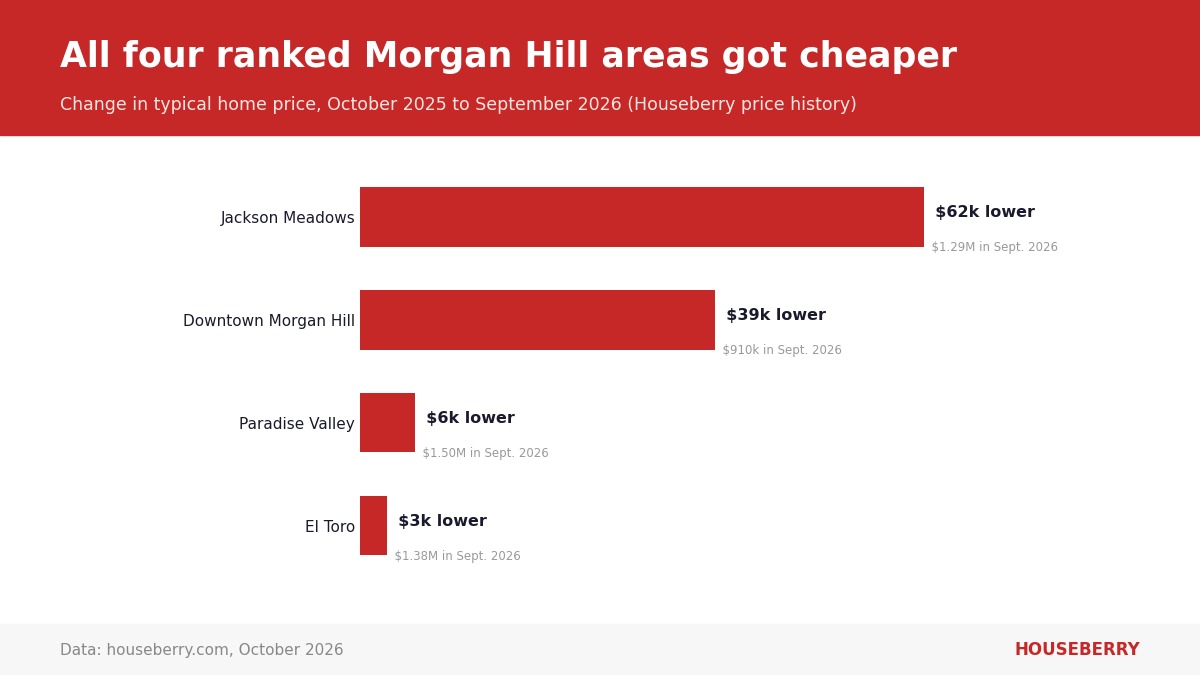
Paradise Valley, the city's top-ranked neighborhood at 3.8 overall, barely moved at about $1.50 million. El Toro held near $1.38 million. A soft market is the backdrop for 105 new houses of 2,100 to 2,600 square feet, and it gives buyers a little more room to compare new construction against resale on the Morgan Hill affordability ranking.
Citywide, Morgan Hill sits 15th of 18 places on the Santa Clara County ranking, held down by an amenities score of 1.5. That number is the same problem the EIR describes in different words: daily life here runs on a car.
Questions readers ask
Can neighbors still stop it? A CEQA lawsuit generally has to be filed within 30 days of the Notice of Determination, and denial of a qualifying builder's remedy project would violate state law and the settlement, according to the staff report.
Will any of the homes be affordable? None of the 105 are. The affordable housing is meant to come later on the 4.72-acre parcel the city now controls.
Is this Morgan Hill's only housing change this fall? No. We covered the Monterey Road rezoning in September.
The next real test is that 4.72-acre parcel. Morgan Hill now owns land for affordable homes beside a shopping center that is still on paper, and how fast it moves will say more about the city's housing plans than this vote did. To see how the neighborhoods around it compare, start with the Morgan Hill neighborhood ranking.
Sources
- Notice of Determination, DePaul Residences, SCH 2026020243, City of Morgan Hill, Oct. 22, 2026
- Draft EIR record, DePaul Residences, City of Morgan Hill, May 29, 2026
- Morgan Hill City Council agenda and staff report, Oct. 21, 2026, item 9
- Cochrane-DePaul project page, City of Morgan Hill
- 100 homes planned off freeway exit in Morgan Hill, San José Spotlight, Oct. 16, 2026
- Developers plan homes in Morgan Hill under builder's remedy, Morgan Hill Times, Nov. 2, 2023
The Houseberry Research Team is Houseberry's reporting team: Bay Area real estate analysts, data specialists and longtime local market watchers. Every day we check the public record: building permits, city council and planning agendas, county recorder filings, state housing bills, police incident data and school results. Then we tie each story to what it means for specific neighborhoods, using Houseberry's own neighborhood data on prices, appreciation, safety, schools and amenities. Questions or corrections: Contact us.
Map of Morgan Hill Neighborhoods
Loading map...
View Full Map
Top Neighborhoods in Morgan Hill, CA



All information provided on this website including but not limited to - school ratings, safety, amenities, user opinions, and property data - is for general informational purposes only. We do not guarantee its reliability, accuracy, or completeness. Users should independently verify information and consult appropriate professionals as needed. By using this website, you agree Houseberry is not responsible for actions, decisions, or consequences arising from reliance on the information provided
houseberry.com - CA DRE# 01847391
 Bay East ©2025. CCAR ©2025. bridgeMLS ©2025. Information Deemed Reliable But Not Guaranteed. This information is being provided by the Bay East MLS, or CCAR MLS, or bridgeMLS. The listings presented here may or may not be listed by the Broker/Agent operating this website. This information is intended for the personal use of consumers and may not be used for any purpose other than to identify prospective properties consumers may be interested in purchasing. Data last updated at October 23, 2026 12:00 AM