Morgan Hill Rezone Could Allow 240 Units on Monterey Road
Morgan Hill has put a five-acre Monterey Road parcel out for review to be rezoned Mixed Use Flex, with an environmental study that analyzes up to 240 homes and six stories. No project has been proposed, and comments close October 12.
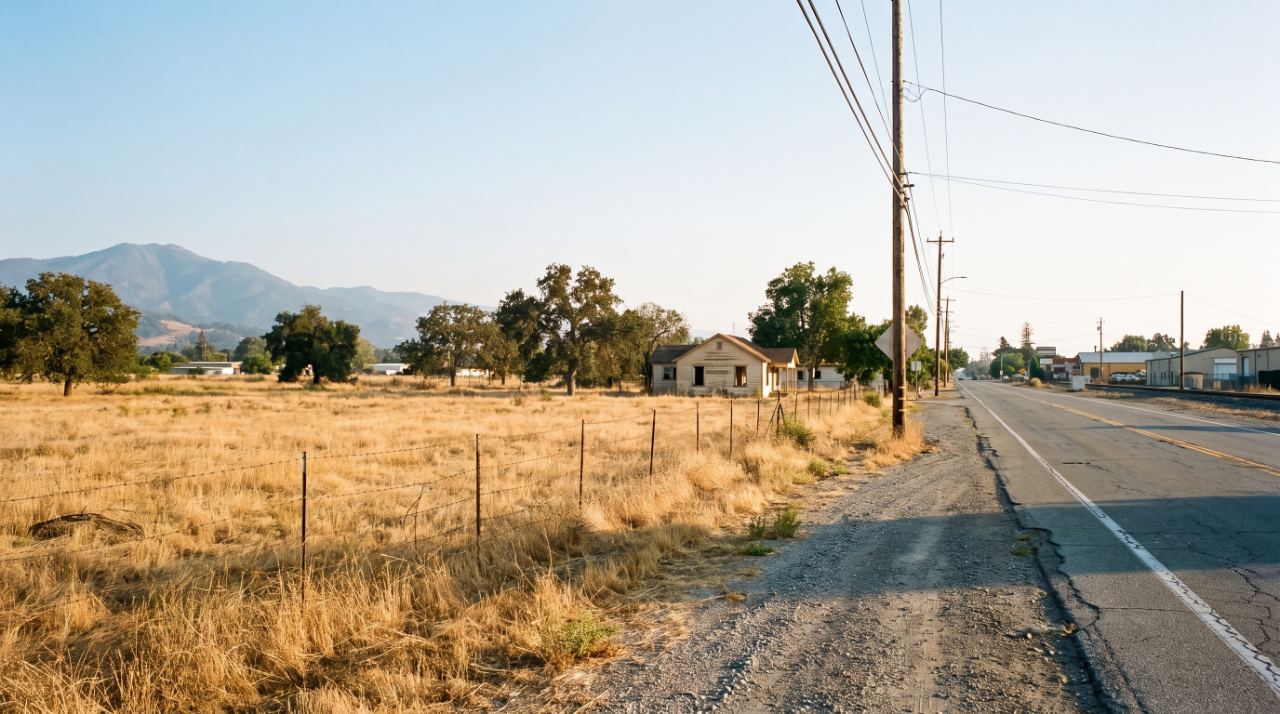
Vacant parcel at Monterey Road and Watsonville Road in Morgan Hill proposed for Mixed Use Flex rezoning Photo: Houseberry
The comment clock runs out October 12 at 5 p.m., and most people who drive that corner have no idea it is ticking. Morgan Hill has put a rezone of 15295 Monterey Road, the five-acre parcel at Watsonville Road, out for public review. The environmental study filed September 10 analyzes up to 240 homes in buildings as tall as six stories. And nobody has proposed building anything there. That last sentence is the most important one in the file.
Five acres, one empty house, and a corner the city has not decided about
This is not a shopping center somebody is bulldozing. Parcel 779-04-072 is 5.015 acres of mostly open ground, and the only structure on it is one unoccupied single-family house in the eastern corner.
The neighbors make the corner legible. Vacant land and outdoor storage to the north. Two houses and Little Bean's Cat Cafe to the northeast, beside a site with a proposed 50-unit townhome project. Oakwood School to the south. Across Monterey to the east, more vacant land and a sports park already in environmental review.
Half-built in four directions at once. That is what a general plan amendment is for.
The rezone does not buy six stories. State law might.
Mixed Use Flex in Morgan Hill has a base maximum height of 35 feet and three stories, the same ceiling General Commercial already carries there today. What the rezone adds is housing as a permitted use and a base density of 24 units per acre. Not one foot of height.
The 70 feet and six stories show up only if a future applicant stacks state density bonus law on top. The city's own density bonus guidance is blunt: a developer who meets the state requirements is entitled to the bonus and the waivers as a matter of right, with no limit on how many development standards get waived. The height is not the council's to hand out. The zoning is.
And the old growth cap will not slow it. Morgan Hill's 215-unit annual allotment has been unenforceable since SB 330 took effect in January 2020.
Side by side, the change is narrower than the headline.
| What it governs | Today: General Commercial | Proposed: Mixed Use Flex | Studied ceiling with density bonus |
|---|---|---|---|
| Housing as a use | Not allowed | Allowed, with commercial and office | Allowed |
| Maximum height | 35 feet | 35 feet | 70 feet |
| Maximum stories | 3 | 3 | 6 |
| Residential density | None | 24 units per acre | Bonus of up to 100 percent assumed |
| Homes on 5.015 acres | 0 | About 120 | Up to 240 |
| Status today | In effect | Out for review, no vote yet | No application filed |
The column that changes a neighborhood is the second one. The column everyone will argue about is the third.
Where 240 came from, and why I would not bank on it
That 240 is a CEQA ceiling, and a generous one. The study assumes a density bonus of up to 100 percent. Morgan Hill's own page caps the standard bonus at 50 percent for most lower-income projects and 80 percent for a fully affordable one, with no cap only within a half mile of a major transit stop, and says plainly that only the train station qualifies. The Caltrain depot on Butterfield Boulevard is about a mile and a half north of here.
So 240 is a defensible worst case to study, not a number anyone has the right to build. Studying the high end is sound practice. It also sets the terms of every comment card that follows.
For scale: the council approved the Granada Hotel downtown at five floors and 65 feet in November 2022. Seventy feet clears that by five.
What this corner is actually worth to a South County buyer
Downtown Morgan Hill is the only neighborhood in the city scoring 4 out of 5 on anything. Our amenities ranking puts it at 4.0 while Paradise Valley, El Toro and Jackson Meadows sit at 0.8, 0.6 and 0.6. Downtown still finishes last of the four overall, at 2.8, dragged down by a 2.6 on safety and a 2.9 on schools. No Morgan Hill neighborhood we rank reaches 4 overall.
Two prices tell the rest. Morgan Hill's citywide median sale price was about $1.58M in August 2026. Downtown's was about $916,000 that same month, roughly 42 percent below it and flat all year. The cheaper housing here sits where the walkable amenities are, and the amenities are not where the scores are.
Monterey and Watsonville is not downtown, and that is the honest weakness in the case for 240 homes here. The grocery run is still a drive. Housing here would create the demand for a corner store long before it creates the corner store, which is how corridors fill in, and Heron Power's 600 jobs are a reason to start. We built Houseberry because that sequence is what buyers should price, not the rendering.
Getting on the record before October 12
Comments go to Adam Paszkowski in Development Services at adam.paszkowski@morganhill.ca.gov or 17575 Peak Avenue, and they have to land by 5 p.m. on October 12, 2026. The notice of intent is on the city's public notices page. One thing worth knowing: comments on an initial study are about whether the environmental analysis is adequate, a narrower question than whether you want the buildings.
Save the land use argument for the hearings. The Planning Commission recommends, and the City Council decides the General Plan amendment, the rezone, and whether to adopt the negative declaration. No hearing date is posted yet. When one is, the number to watch is not 240. It is 24 units per acre, because that is the one Morgan Hill actually controls.
Sources
- CEQAnet, City of Morgan Hill, 15295 Monterey Road General Plan Amendment and Rezone Project, SCH 2026090442
- Draft Initial Study and Mitigated Negative Declaration, 15295 Monterey Road (September 2026)
- Notice of Intent to Adopt a Mitigated Negative Declaration, City of Morgan Hill
- City of Morgan Hill, Density Bonus Law FAQ
- City of Morgan Hill, What Happened to the City's RDCS Program
- City of Morgan Hill, Monterey Corridor Block-Level Master Plan
- Morgan Hill Times, Granada Hotel expanded to five floors (November 2022)
- Houseberry neighborhood scores and price history for Morgan Hill, September 2026
Map of Morgan Hill Neighborhoods
Loading map...
View Full Map
Top Neighborhoods in Morgan Hill, CA



All information provided on this website including but not limited to - school ratings, safety, amenities, user opinions, and property data - is for general informational purposes only. We do not guarantee its reliability, accuracy, or completeness. Users should independently verify information and consult appropriate professionals as needed. By using this website, you agree Houseberry is not responsible for actions, decisions, or consequences arising from reliance on the information provided
houseberry.com - CA DRE# 01847391
 Bay East ©2025. CCAR ©2025. bridgeMLS ©2025. Information Deemed Reliable But Not Guaranteed. This information is being provided by the Bay East MLS, or CCAR MLS, or bridgeMLS. The listings presented here may or may not be listed by the Broker/Agent operating this website. This information is intended for the personal use of consumers and may not be used for any purpose other than to identify prospective properties consumers may be interested in purchasing. Data last updated at September 13, 2026 12:00 AM