600 Jobs Come to Morgan Hill. The Commute Is the Story.
Heron Power will hire more than 600 people at 850 Jarvis Drive in Morgan Hill. For households in South County, the change worth watching is the direction of the morning drive, not the price of the house.

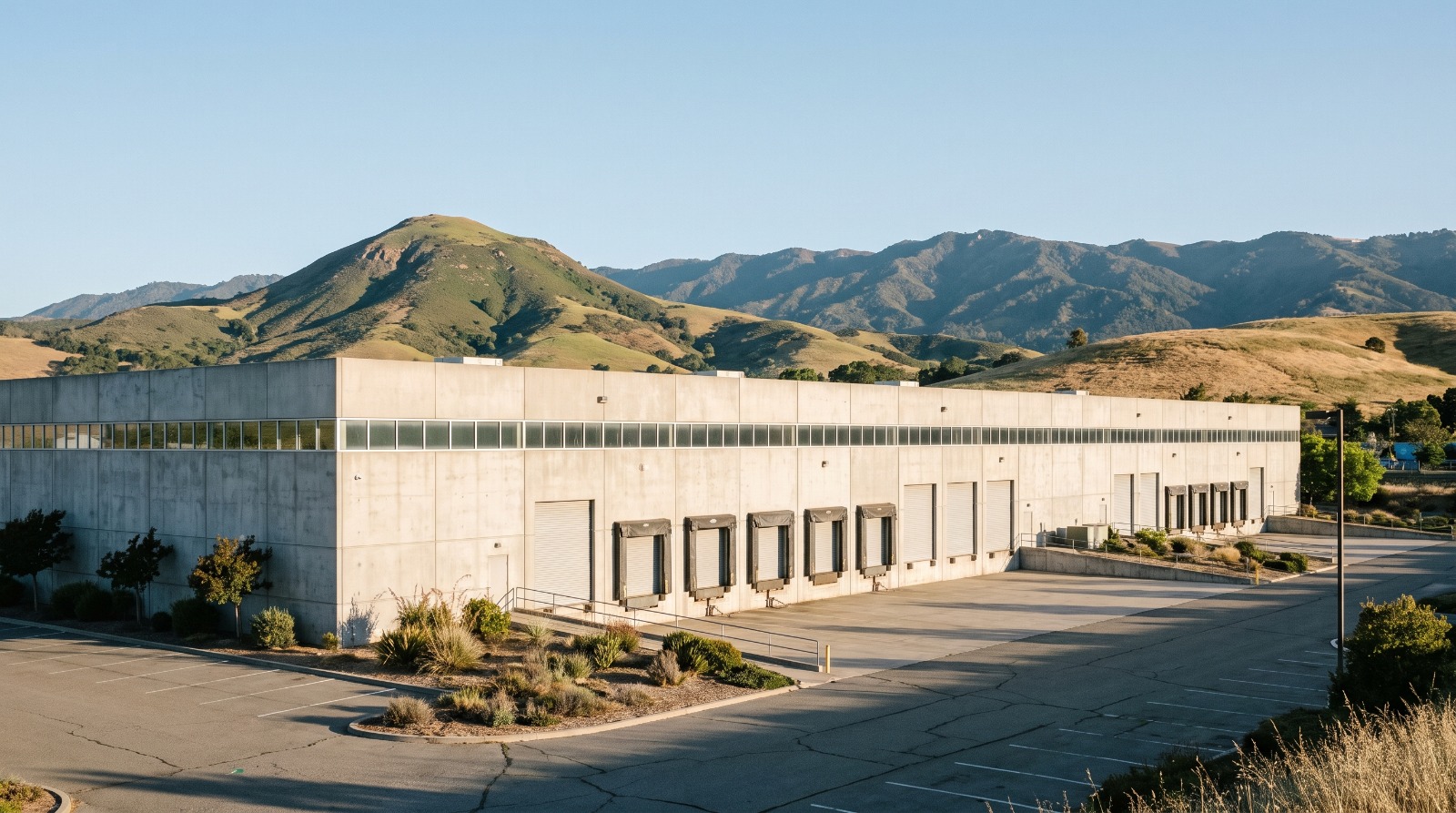
A large modern manufacturing building on a Morgan Hill business park street with El Toro peak rising behind it, near the site of Heron Power's new factory. Photo: Houseberry
Anyone who has driven north out of Morgan Hill on a weekday knows the shape of the morning. The Cochrane Road on-ramp starts stacking up before seven, 101 goes slow somewhere around Bailey, and by the time you clear Blossom Hill you have already spent an hour of your life to live somewhere with a yard. That trade is the entire economic logic of South County. It is also the thing that just got interesting.
Heron Power has leased 286,000 square feet at 850 Jarvis Drive in Morgan Hill for its first American factory, committing more than $100 million and saying it will hire over 600 people. For anyone who already lives down here, the meaningful change is the direction of that drive, not the price of the house. Six hundred jobs is a large number in a city of roughly 46,000, and it is the first serious test of whether South County can be somewhere people work rather than somewhere people sleep.
What the company is actually building
Heron Power makes the Heron Link, a five-megawatt modular power device that collapses a rack of traditional grid equipment into one unit, aimed at solar farms and data centers. The building at 850 Jarvis Drive was sitting vacant as a distribution warehouse. According to the Morgan Hill Times, the company took a $26.4 million tax credit from California's Jobs First Initiative in May, is targeting more than 10,000 units a year, and expects full production capacity in late 2027.
The jobs are in manufacturing, engineering, automation, supply chain and operations. The company's CEO is Drew Baglino, formerly of Tesla, and the site search ran about ten months across several states before landing here. Mayor Mark Turner called it hundreds of high-quality jobs, which is the kind of thing mayors say, but in this case the specificity of the hiring plan makes it more than a press release.
Late 2027 is the number to hold on to. Nothing about this changes anyone's commute next month.
The South County discount is not where people think it is
Here is the finding that surprised me when I pulled our own numbers. Morgan Hill's median sale price was $1.58M in July 2026. San Jose's citywide median that same month was $1.63M. Those are not meaningfully different.
The discount people believe they are buying by moving south past Coyote Valley mostly is not in Morgan Hill at all. It is in Gilroy, where the median was $1.16M in July 2026, about 29 percent below Morgan Hill and down roughly 2.5 percent over the year. That is a real gap, and it comes with another fifteen minutes each way and a citywide overall score of 2.7 out of 5 against Morgan Hill's 3.3.
So the honest framing of Morgan Hill is not cheap. It is roughly San Jose money for a smaller, quieter, safer place with a weaker school profile, and until now, a much longer drive. Morgan Hill's citywide safety score is 3.8 out of 5 against San Jose's 3.7, and its school score is 3.0 against San Jose's 3.1. The safety edge shows up much more sharply at the neighborhood level, which is where these citywide averages stop being useful.
Caltrain is not going to solve this
It is tempting to answer a jobs story with a transit story. Not here. Caltrain's South County service to Morgan Hill and Gilroy runs only a handful of weekday trains, all pointed at the traditional commute, north in the morning and south in the evening. If you work in Morgan Hill and live in San Jose, the schedule is close to useless. If you work in Morgan Hill and live in Morgan Hill, you do not need it.
Which is exactly why a local employer matters more down here than it would in Mountain View or Redwood City. In a place with thin transit, the only real way to shorten a commute is to move the job.
Six hundred jobs against Morgan Hill's housing math
This is where I would slow down before drawing any conclusion about prices. Morgan Hill's state housing target for the current cycle is 1,037 homes across eight years, and the city reports 815 of them already achieved.
| Morgan Hill, 2023 through 2031 | Number |
|---|---|
| State housing target (RHNA allocation) | 1,037 homes |
| Homes the city reports achieved so far | 815 |
| Remaining against the target | 222 |
| Jobs Heron Power says it will add | 600+ |
Read that table carefully, because it is easy to misread. The RHNA number is a planning target, not a construction cap, and Morgan Hill has long used its own allotment system to meter how fast homes get built. Hitting 815 of 1,037 is genuinely good performance by Bay Area standards.
The point is the ratio. A city that plans for about a thousand homes over eight years is adding a single employer that intends to hire six hundred people. Plenty of those hires will come from households already living in Morgan Hill, Gilroy, Hollister and San Jose, so it is not six hundred new households. But it does not have to be. It only has to be enough to tighten a small market, and small markets tighten fast.
If you want an early signal, watch the city's building allotments and any housing item that appears on the council agenda between now and the end of 2027. That is where the pressure will show up first, well before it shows up in a median.
What this changes for a family already looking down here
Nothing about a factory lease should make anyone rush. But if South County was already on your list, this is a reason to look at it with different eyes.
Start with the neighborhood level, because Morgan Hill's citywide numbers hide a lot. Of the four ranked Morgan Hill neighborhoods, Paradise Valley leads at 3.8 out of 5 overall with a 4.9 safety score, well above the 3.8 citywide figure, and a median of about $1.36M in July 2026, which is roughly $220,000 under the city median. El Toro follows at 3.5 overall with a 4.3 safety score. Downtown Morgan Hill scores lowest overall at 2.9 but is the only one of the four with strong amenities, which is the usual walkability trade in a small city.
The soft spot is schools, and I would not talk anyone out of taking it seriously. A 3.0 citywide school score is the weakest of Morgan Hill's numbers, and it is the number most likely to matter to a household with young kids over a ten-year hold. A shorter commute is worth a lot. It is not worth pretending a school profile is stronger than it is.
The way we tend to think about it at Houseberry is that a jobs announcement changes the question rather than the answer. It does not make Morgan Hill a better place to live than it was last week. It makes it more plausible that a household could live and work in the same valley, which is a different life than the one the 6:40 on-ramp offers. Check the specific neighborhood, check the specific schools, and check the drive you would actually be making, not the one the region assumes you make.
Sources
The Houseberry Research Team is Houseberry's reporting team: Bay Area real estate analysts, data specialists and longtime local market watchers. Every day we check the public record: building permits, city council and planning agendas, county recorder filings, state housing bills, police incident data and school results. Then we tie each story to what it means for specific neighborhoods, using Houseberry's own neighborhood data on prices, appreciation, safety, schools and amenities. Questions or corrections: Contact us.
All information provided on this website including but not limited to - school ratings, safety, amenities, user opinions, and property data - is for general informational purposes only. We do not guarantee its reliability, accuracy, or completeness. Users should independently verify information and consult appropriate professionals as needed. By using this website, you agree Houseberry is not responsible for actions, decisions, or consequences arising from reliance on the information provided
houseberry.com - CA DRE# 01847391
 Bay East ©2025. CCAR ©2025. bridgeMLS ©2025. Information Deemed Reliable But Not Guaranteed. This information is being provided by the Bay East MLS, or CCAR MLS, or bridgeMLS. The listings presented here may or may not be listed by the Broker/Agent operating this website. This information is intended for the personal use of consumers and may not be used for any purpose other than to identify prospective properties consumers may be interested in purchasing. Data last updated at October 3, 2026 12:00 AM