Where Anthropic's IPO money is buying San Francisco homes
Anthropic closed its first trading day worth about $1.76 trillion. Houseberry's San Francisco sales records show where AI money has already landed, which neighborhoods it skipped, and where demand is likely to go next.

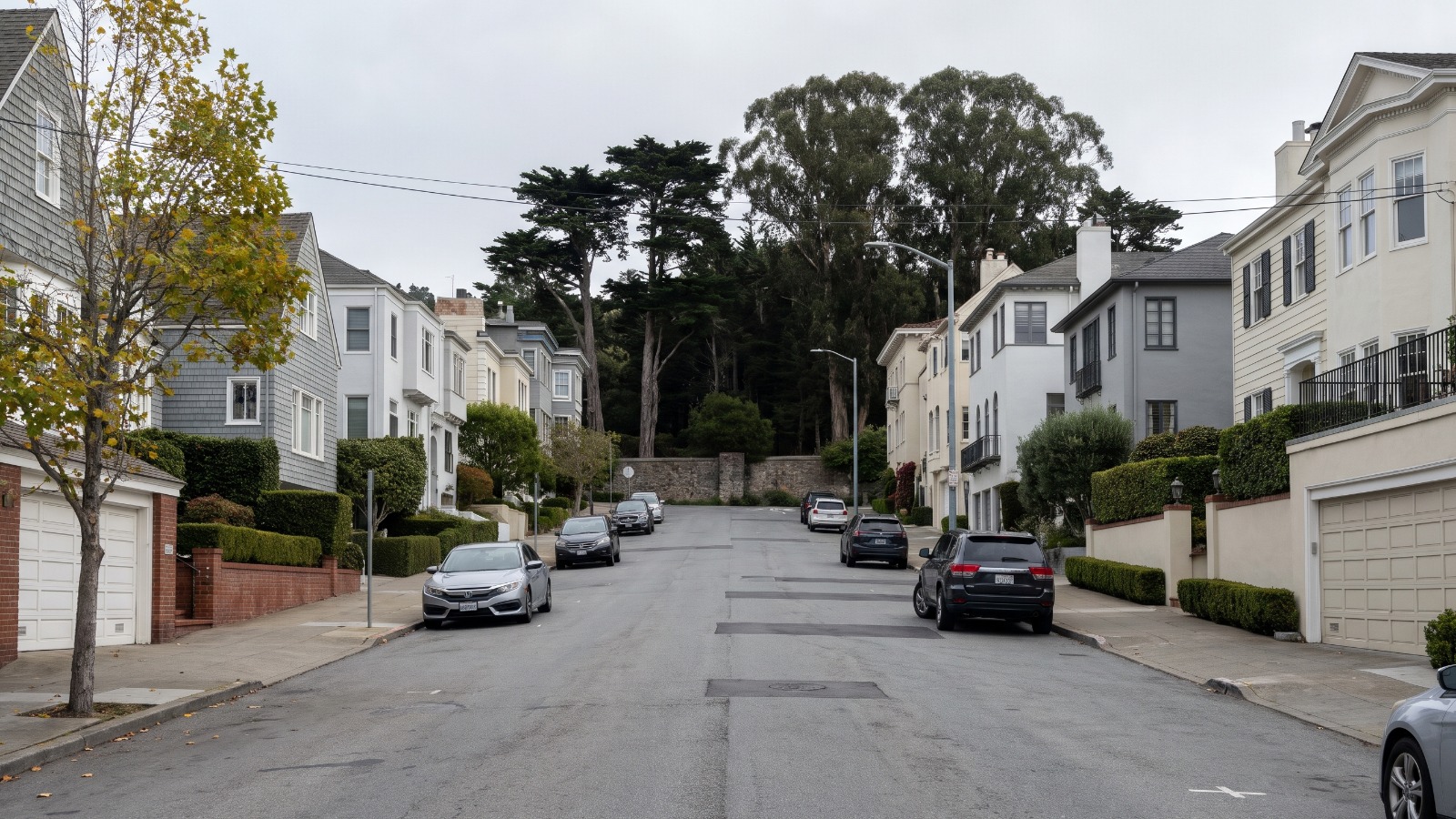
AI-generated view up Cherry Street in San Francisco's Presidio Heights toward the Presidio, where record home sales closed in October 2026 Photo: Houseberry
Three houses on Cherry Street in Presidio Heights changed hands in the eight days between Oct. 15 and Oct. 22. Together they sold for $52.3 million, and one of them, 20 Cherry St., went for $28.5 million, $10 million over its asking price. That is the largest overbid in the city's history.
Four weeks later the money everyone assumed was behind sales like that finally has a ticker. Anthropic, the San Francisco company that makes Claude, closed its first day on the Nasdaq on Thursday at $97.17 a share, 17 percent above its $83 IPO price, for a market value of about $1.76 trillion, CNN reported. In Houseberry's San Francisco data, the typical home was worth $2.20 million in October 2026, up 16 percent since November 2025.
This is a story about where that money goes once it can be spent. We pulled 1,216 recent closed sales from Houseberry's 92 San Francisco neighborhood pages to find out where it has already gone. The answer is narrower than "San Francisco." The money is buying single-family houses on the west and north sides of the city. It is mostly skipping the condo towers that sit a few blocks from Anthropic's own offices.
What Thursday actually created
Start with the size of it. The offering of 980 million shares at $83 raised $81.3 billion, topping the roughly $75 billion SpaceX raised in June, according to CNBC. The stock briefly touched a $2 trillion valuation after it opened, then settled.
The company had 5,300 employees in September. At the $83 IPO price, Hill.com, a marketplace that tracks private-company shares, estimated that about 600 of them held equity worth more than $100 million, as many as 2,800 held more than $10 million, and about 5,100, or 96 percent, held at least $1 million. Fortune put employees' combined stake at about $232 billion at the IPO price, The Real Deal reported. Run that forward to Thursday's close and it is roughly $272 billion, about $40 billion added in a single trading session. That last figure is our arithmetic, not a filing.
The seven cofounders each hold between 231 million and 244 million shares, according to the prospectus as tallied by Fortune. At $97.17, each stake closed Thursday worth roughly $22 billion to $24 billion. All seven have pledged to give away 80 percent of their equity.
Paper wealth isn't a down payment, though. What matters for housing is what employees can sell, and Anthropic staggered it. Non-founder directors, officers and certain employees could sell up to 10 percent of their locked-up shares starting Thursday. Another 35 percent opens two trading days after Anthropic reports full-year 2026 results, probably in late winter. The rest comes free at the earlier of its first-quarter 2027 results or day 180, which lands in mid-May. We walked through that calendar in detail last week.
The money moved before the stock did
San Francisco didn't wait for the opening bell. Some Anthropic employees pledged shares toward home purchases months ago, The New York Times reported on Thursday. This spring, a developer listed a restored 1907 house at 160 Noe St. in Duboce Triangle for just under $3 million and said Anthropic or OpenAI stock would be considered as payment.
The citywide numbers show it too. Compass data cited by the Times put October's median house price at $2.39 million, up 29 percent in a year, and called it the best month ever for the luxury end: nine homes over $10 million and 40 over $5 million. Redfin's broader measure, which includes condos, put the typical sale at $1.7 million in October, up nearly 19 percent, and Houseberry's own citywide typical price rose from $1.89 million in November 2025 to $2.20 million in October 2026.
Rents moved too. When Mayor Daniel Lurie declared a "rent emergency" on Sept. 10, rents were up 26 percent in a year by Apartment List's count, Mission Local reported. We covered what that means for anyone deciding whether to rent or buy right now.
The sales we can tie to AI money, and the ones we can't
This is where coverage of the AI housing boom usually gets loose, so we will be precise. Most trophy buyers in San Francisco hide behind trusts and LLCs. A handful of 2026 deals have buyers who were identified, by name or by an agent, as working in AI:
- 471 Hoffman Ave., Noe Valley. Listed Sept. 11 at just under $7 million, sold for $9.1 million, more than $2 million over asking, after the seller accepted an offer seven hours after it hit the market. The listing agent, Compass's Ali Healy, told The Real Deal the buyers work in the AI industry and had just lost out on another house.
- 2033 Baker St., Pacific Heights. Listed at $3.99 million in August, drew 16 offers and sold for $6.63 million, more than 65 percent over asking. The buyer was Ram Gudavalli, founder of the AI recruiting company Sense, The Real Deal reported.
- 1818 California St., Pacific Heights. The landmark Sloss-Lilienthal House sold for $7.7 million to a Google DeepMind researcher, per The Real Deal.
- 3000 Ralston Ave., Hillsborough. The $70 million estate sale in August doubled the town's record. Property records point to xAI cofounder Yuhuai Wu as the buyer behind the LLC, the San Francisco Standard reported.
Now the ones nobody has identified. In October, 2 Sixth Ave. in Presidio Terrace sold for $15 million on an $8 million asking price. 45 Scenic Way in Sea Cliff sold for $21 million against $15.8 million, 14 days after listing. The 20 Cherry St. record came a few weeks later. On Tuesday, 3501 Jackson St. in Presidio Heights sold for $24 million, $3 million more than it fetched in June.
We don't know who bought any of those. We do know that all four closed between Oct. 5 and Nov. 17, in the run-up to the largest IPO on record, with overbids this city had rarely seen. We wouldn't bet on coincidence.
Where the money is going inside San Francisco
Each Houseberry neighborhood page lists its 15 most recent closed sales with the list price and the sale price. Across all 92 pages that comes to 1,216 sales, more than half of them from this fall, and 96 of them closed at least $1 million over asking. Of the 681 that closed since Sept. 1, the 301 single-family houses sold at a median 32 percent over asking, and 94 percent of them sold over. The 380 other sales, mostly condos, tenancy-in-common units and two- to four-unit buildings, sold at a median 7.5 percent over.
Grouping the neighborhoods makes the split sharper.
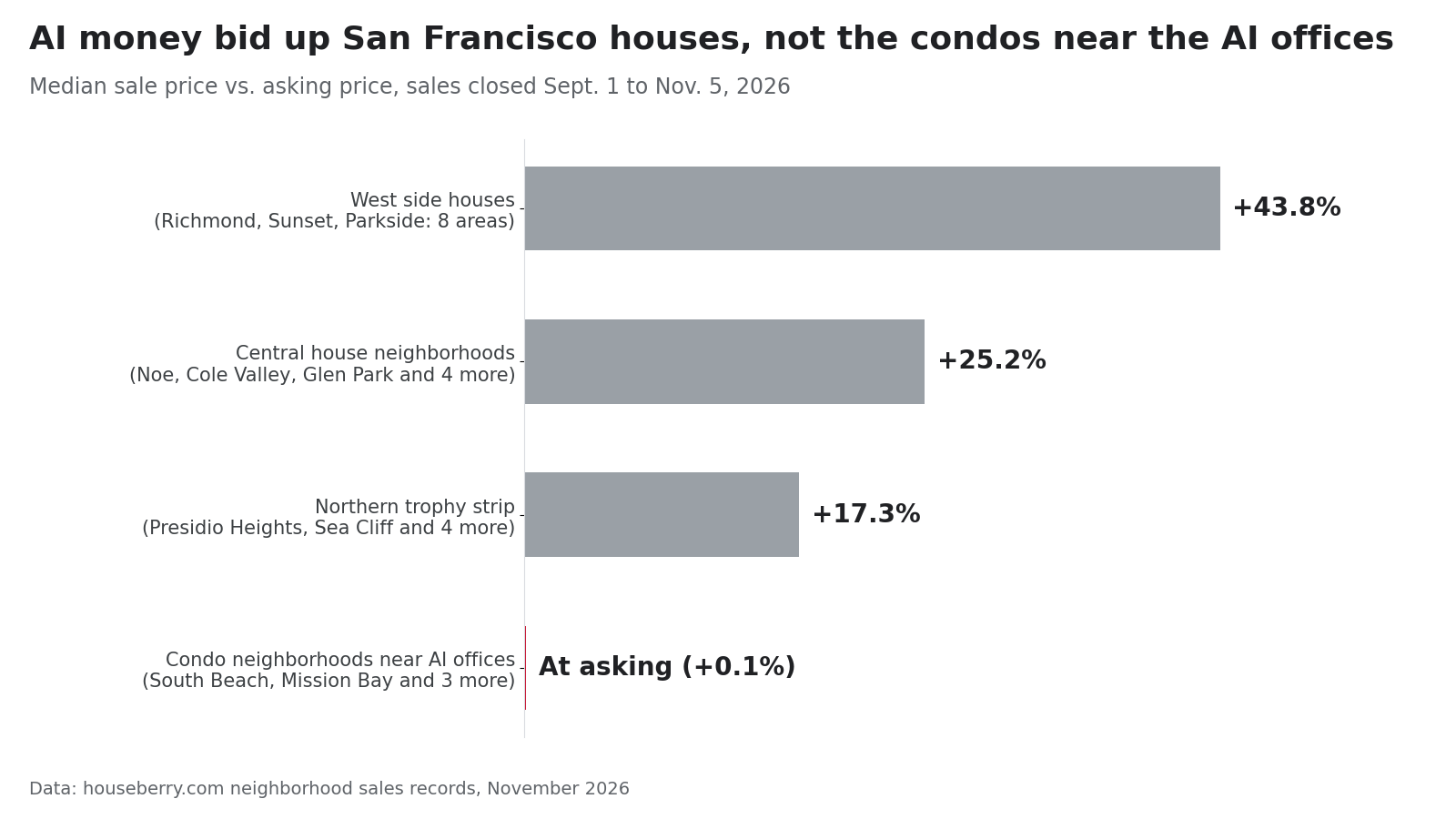
The west side house belt, eight neighborhoods from the Richmond through the Sunset and Parkside, sold at a median 43.8 percent over asking, and 97 percent of sales went over. The central house neighborhoods (Noe Valley, Cole Valley, Glen Park, West Portal, Forest Hill, Eureka Valley and Bernal Heights) came in at 25 percent. The northern trophy strip ran 17 percent, a smaller percentage on far bigger dollars, and it produced every one of the nine $10 million sales.
Then there are the five condo-heavy neighborhoods closest to the AI office cluster: South Beach, Mission Bay, Yerba Buena, Dogpatch and Hayes Valley. Their 65 sales since Sept. 1 closed at a median of 0.1 percent over asking. Only 57 percent sold over at all.
Here is how that looks neighborhood by neighborhood. Prices are Houseberry's October 2026 typical prices from each neighborhood page, and the overbid column is the median across that page's most recent recorded sales.
| Neighborhood | Typical price, Oct. 2026 | Change since Nov. 2025 | Median sale vs. asking | Houseberry overall score |
|---|---|---|---|---|
| Presidio Heights | $4.47M | +0.2% | +16.5% | 4.2 |
| Sea Cliff | $5.57M | +17.0% | +13.7% | 4.2 |
| Cole Valley/Parnassus Heights | $2.45M | +19.5% | +33.3% | 4.1 |
| Golden Gate Heights | $2.40M | +25.7% | +35.7% | 3.9 |
| West Portal | $2.62M | +4.8% | +28.5% | 3.8 |
| Inner Parkside | $2.20M | +13.4% | +45.1% | 3.9 |
| Outer Sunset | $1.69M | +15.0% | +46.2% | 4.2 |
| South Beach | $1.23M | +3.4% | 0.0% | 3.1 |
| Mission Bay | $1.50M | +2.0% | +0.1% | 3.3 |
Two things in that table deserve a second look. Golden Gate Heights, a hilltop pocket of view houses above the Inner Sunset, gained 25.7 percent, the biggest jump in the table. And Presidio Heights barely moved on the typical-price line while posting the biggest sales in the city. That is what a market looks like when the top sales are one-offs. A few $15 million trades don't move a neighborhood median much, but they reset what the next seller asks.
The overbids on the west side are partly a pricing tactic. Agents list low on purpose to draw a crowd. Even so, 146 Lenox Way in West Portal sold on Nov. 4 for $2.6 million against a $1.15 million asking price. 1775 37th Ave. in the Outer Sunset went for $3.1 million on a $1.985 million list in October. At a $1.4 million gap, the list price has stopped meaning much.
The condos next to the office are getting left out
You'd expect the money to land closest to where it's made. It hasn't. Anthropic has assembled about a million square feet of leases across seven buildings around Howard and First streets, a stretch brokers now call AI Alley, and plans to move its headquarters into the 25-story tower at 300 Howard starting next year, The Real Deal reported. Nearly 70 percent of the city's office occupancy gains in the past year went to that South Financial District cluster, according to CBRE.
The homes within walking distance of it are the ones that didn't move. In Houseberry's data the typical South Beach home rose 3.4 percent between November 2025 and October 2026. Mission Bay, home to OpenAI's headquarters, rose 2.0 percent. Dogpatch rose 2.7 percent. The city as a whole rose 16.
We think the condo towers next to the office are the last place this money goes. Brokers told the Times that buyers like these have been paying well over asking for spacious houses in Noe Valley, Cole Valley and Potrero Hill. People who can buy any house in the city mostly don't buy a two-bedroom with an HOA bill. Our read is that the ones who want to walk to work rent instead. That fits a year when rents jumped 26 percent and the condos by the office barely moved.
Where we expect the demand to keep going
The first 10 percent of employee stock that became sellable on Thursday is real money, but it arrives in the slowest weeks of the year, when San Francisco has the fewest listings. The bigger release, another 35 percent, comes after full-year results in late winter, right as spring listings appear. That is when we expect the pressure to show up in offers. Based on where this fall's sales already went, four parts of the city stand out.
West of Twin Peaks, along the Muni Metro. West Portal and Forest Hill are blocks of detached houses with a one-seat train ride under Twin Peaks to the Market Street stations a few blocks from Howard Street. In Houseberry's recent West Portal sales, the median closed 28.5 percent over asking. Forest Hill's median ran 33 percent.
The house belt from the Richmond down to Parkside. These are some of the cheapest single-family neighborhoods in the city with strong Houseberry scores, and they absorbed the most aggressive bidding this fall. Outer Sunset shares the highest overall score in the city at 4.2 out of 5, with a typical price of $1.69 million. Inner Parkside scores 4.6 on safety at $2.20 million. Every one of the last 15 recorded Inner Parkside sales closed over asking.
Noe Valley, Cole Valley and Glen Park. In June, the 94114 ZIP code, which covers Noe Valley and the Castro, had more $1 million-plus overbids than any other by Compass's count. Cole Valley/Parnassus Heights posted four $1 million-plus overbids in its last 15 recorded sales, and Glen Park posted three. We broke down how far over asking each district is running earlier this year.
The northern trophy strip. Presidio Heights, Sea Cliff, Pacific Heights, Cow Hollow and Presidio Terrace (which Houseberry maps inside Lake Street) serve a much smaller pool: the roughly 600 employees Hill.com puts above $100 million, plus the cofounders. That pool is small, and the houses are fewer. Expect more records and more anonymous trusts. We looked at where top AI executives have already bought across the Bay Area in September.
Some of the money will leave the city entirely. Compass chief economist Mike Simonsen told the Times he expects a run on second homes in Tahoe, Napa and Hawaii.
What could cool it
The stock first. Anthropic's debut came on a day when the broader market slid, and the shares gave back part of their opening jump before the close. If ANT trades well below Thursday's close when the 35 percent window opens, employees hold and spring gets quieter.
Taxes and diversification take a bigger bite than the headlines suggest. Much of this equity is taxed as ordinary income, and a California earner at this level can lose close to half of it to state and federal taxes. Most of what remains goes into index funds and giving, not houses. Redfin's widely quoted estimate that Anthropic employees could buy 9 percent of San Francisco's homes was built on $63 billion in after-tax equity and assumes they spend all of it.
And the next wave may blur this one. OpenAI president Greg Brockman said this month the company could be ready to go public in 2027. A second lockup calendar would land on a market still digesting the first.
None of that changes the map. The money this fall bought single-family houses on the west and north sides of the city, and it bid hardest where a house still cost under $2.5 million. Before spring, see how every neighborhood in the city scores on Houseberry's San Francisco rankings, and where prices are rising fastest on the appreciation ranking.
Sources
- CNN, Anthropic's first day of trading, Nov. 19, 2026
- CNN, almost all of Anthropic's employees are now millionaires, Nov. 19, 2026
- CNBC, Anthropic prices IPO at $83, raises $81.3 billion, Nov. 18, 2026
- The New York Times via the San Francisco Examiner, what Anthropic workers will do with their wealth, Nov. 19, 2026
- The Real Deal, Anthropic's Howard Street footprint, Nov. 19, 2026
- The Real Deal, 20 Cherry St. overbid record, Oct. 26, 2026
- Mission Local, San Francisco's rent emergency, Sept. 2026
- Houseberry neighborhood and city pages for San Francisco, price histories through October 2026 and recorded sales through Nov. 5, 2026
The Houseberry Research Team is Houseberry's reporting team: Bay Area real estate analysts, data specialists and longtime local market watchers. Every day we check the public record: building permits, city council and planning agendas, county recorder filings, state housing bills, police incident data and school results. Then we tie each story to what it means for specific neighborhoods, using Houseberry's own neighborhood data on prices, appreciation, safety, schools and amenities. Questions or corrections: Contact us.
Map of San Francisco Neighborhoods
Loading map...
View Full Map
Top Neighborhoods in San Francisco, CA





All information provided on this website including but not limited to - school ratings, safety, amenities, user opinions, and property data - is for general informational purposes only. We do not guarantee its reliability, accuracy, or completeness. Users should independently verify information and consult appropriate professionals as needed. By using this website, you agree Houseberry is not responsible for actions, decisions, or consequences arising from reliance on the information provided
houseberry.com - CA DRE# 01847391
 Bay East ©2025. CCAR ©2025. bridgeMLS ©2025. Information Deemed Reliable But Not Guaranteed. This information is being provided by the Bay East MLS, or CCAR MLS, or bridgeMLS. The listings presented here may or may not be listed by the Broker/Agent operating this website. This information is intended for the personal use of consumers and may not be used for any purpose other than to identify prospective properties consumers may be interested in purchasing. Data last updated at November 20, 2026 12:00 AM