Where Top AI Executives Live, and the Houses They Bought
A tour of six Bay Area places that keep turning up in the property records of the people building AI, from a Burnham rebuild on Russian Hill to a 16th-century Japanese estate in Woodside, with what each neighborhood is actually like.

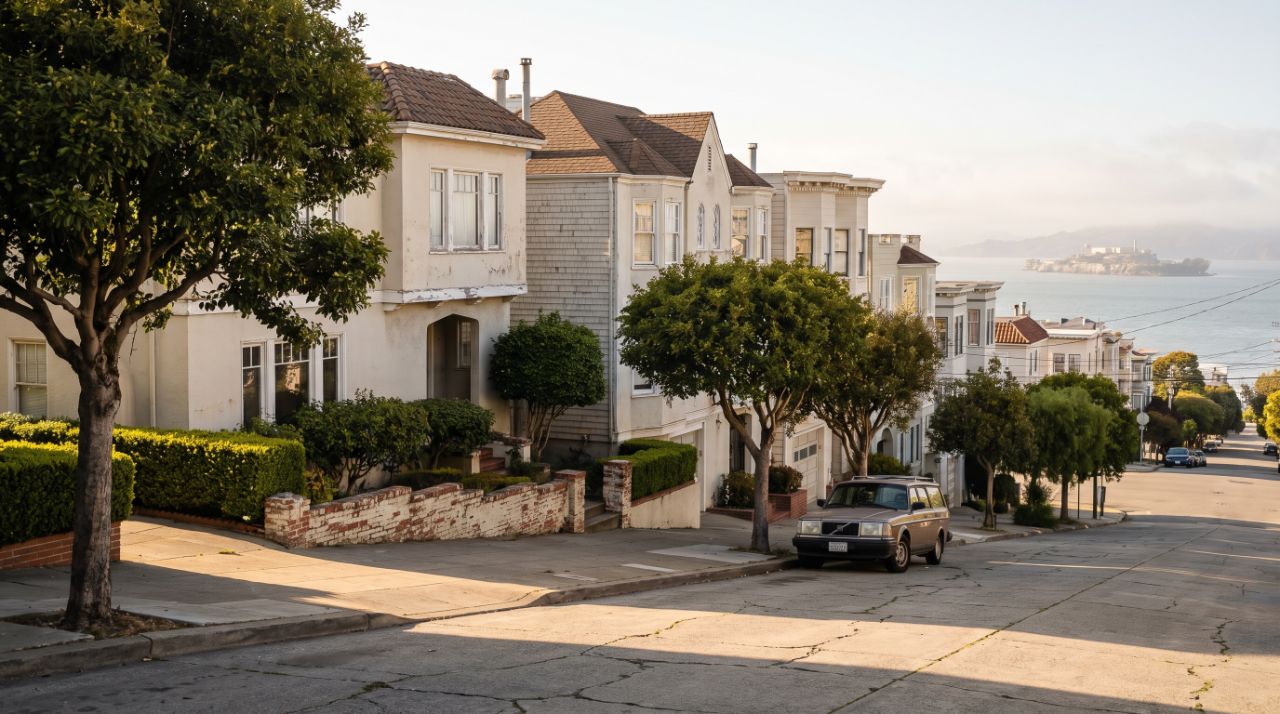
A steep Russian Hill street in San Francisco descending toward the bay, the neighborhood where several top AI executives live. Photo: Houseberry
There is a house on Russian Hill with a tunnel under it. The tunnel runs to an underground garage with a turntable set into the floor, so a car can be spun around and pointed back out without reversing down one of the steepest streets in San Francisco. The listing called it the Batcave, and Sam Altman bought it in March 2020 for $27 million.
Six Bay Area places turn up over and over in the property records of the people building AI. This is a tour of all six, starting in San Francisco, working south down the Peninsula, and finishing back across the bridge in Marin.
| Place | Who | Houseberry score | Median price |
|---|---|---|---|
| Russian Hill, San Francisco | Sam Altman, OpenAI | 3.6 / 5 | $1.84M (Aug 2026) |
| Hillsborough | Yuhuai Wu, xAI cofounder until Feb 2026 | 4.2 / 5 | $5.42M (Jun 2026) |
| Woodside | Larry Ellison, Oracle | 3.9 / 5 | $4.45M (Aug 2026) |
| Crescent Park, Palo Alto | Mark Zuckerberg, Meta | 4.5 / 5 | $6.15M (Aug 2026) |
| Los Altos Hills | Sundar Pichai, Google. Jensen Huang, Nvidia | 5.0 / 5 | $5.89M (Aug 2026) |
| Belvedere, Marin County | Jony Ive, OpenAI | Not scored separately | Not published |
Russian Hill: Burnham, The North Face, and a car turntable
Sam Altman runs OpenAI, the company that built ChatGPT. He has lived on Russian Hill since 2020.
His house stands on a site first built on in 1864. The 1906 earthquake took whatever was there, and the owners hired D.H. Burnham and Co. to draw the replacement, with Willis Polk running the reconstruction. Burnham had just delivered the sweeping 1905 plan to redesign San Francisco, most of which was shelved after the fire, and Polk went on to build a good deal of the city that went up instead.
From roughly 1978 to 1992 the house belonged to Doug and Susie Tompkins, who between them founded The North Face and Esprit, and it served as their conference center.
A developer bought it in 2012 and rebuilt it over preservationist objections, keeping pieces of two turn-of-the-century houses and splicing them onto a modern addition. The finished version had century-old olive trees in a walled garden, a cantilevered infinity pool aimed at the bay, and the tunnel. It listed at $45 million, the most expensive home for sale in the city at the time.
In July 2024 Altman sued the developer, alleging the house was a lemon and that the pool's waterproofing had failed and flooded it. The suit put repairs above $4 million, and no resolution has been reported. Six months later an entity managed by his cousin bought the three parcels next door, according to the SF Standard: a 1924 house of about 5,400 square feet and two empty lots. The recorded price was $14 million, though a source told the Standard the figure in the MLS was closer to $38 million.
Polk's work shows up again a mile west. Architectural surveys credit him with the Presidio Heights palazzo that sold in August as half of a $67.8 million pair, the largest San Francisco deal of the year.
Russian Hill itself is one of the densest patches of the city, roughly 13,000 people on four tenths of a square mile, and the grade explains nearly everything unusual about it. Natural slopes reach 27 percent. The crooked block of Lombard got its eight switchbacks in 1922 because the hill was otherwise undrivable. Stretches of Vallejo and Green stop being streets and turn into public stairways. Macondray Lane carries no cars at all and is the real Barbary Lane from Armistead Maupin's Tales of the City. The name goes back to a small Russian cemetery found at the summit during the Gold Rush.
Our score for Russian Hill is 3.6, with a 4.3 for safety, and the August 2026 median was $1.84 million. That is a neighborhood figure rather than a block figure. Most of the hill is flats and 1920s apartment buildings served by the Powell-Hyde cable car, and houses like Altman's sit at the far tail of the data.
Hillsborough: a villa, and a minimum house size
Yuhuai Wu, 31, who goes by Tony, is a mathematician who helped found Elon Musk's xAI and left the company in February 2026. On August 6 he closed on a $70 million estate in Hillsborough, the largest residential sale recorded in Northern California this year.
Twelve acres. A 12,000-square-foot main house modeled on an Italian lakeside villa, a 4,600-square-foot guest house, a sunken tennis court, a nine-hole golf course, a 150-seat amphitheater, a koi pond, a 2,100-gallon saltwater aquarium, and fountains the listing describes as inspired by the Bellagio.
Musk sold his own Hillsborough estate in December 2021 after eighteen months on the market. SocketSite recorded that sale at $30 million on roughly 47 acres, while SFGate and others reported $32 million at contract.
Hillsborough sits seventeen miles south of San Francisco, between Burlingame and San Mateo, and it carries the most unusual zoning rule in the region: a minimum house size of 2,500 square feet. Not a cap. A floor. Add half-acre minimum lots and no apartments, condos, townhouses or commercial zoning, and the result is a town of about 11,400 people holding the deepest bench of pre-war estate architecture on the Peninsula. Carolands, a 65,000-square-foot French chateau, is here. So is a Frank Lloyd Wright house.
The road network follows the terrain rather than a grid, which is why first-time visitors get lost, and most streets have no sidewalks by design. Caltrain is in Burlingame, US-101 and I-280 are minutes away, and SFO is about fifteen. With no downtown to gather in, civic life runs through the Hillsborough City School District, one of the most sought-after elementary districts in California.
We score Hillsborough 4.2, with a 4.6 for schools and a 3.5 for amenities, that last figure a direct consequence of the missing commercial zone. The most recent month in our price history, June 2026, put the median at $5.42 million.
Woodside: the Japanese estate a Zen priest built
Larry Ellison founded Oracle in 1977 and is its chairman and chief technology officer. Oracle now rents data-center capacity at enormous scale to AI companies, including a multi-year compute agreement with OpenAI reported at roughly $300 billion, and the stock's run on that news briefly made Ellison the richest person in the world in September 2025. He is a Hawaii resident these days. His Bay Area house is in Woodside.
Starting in the mid-1990s he had it built as a reproduction of a 16th-century Japanese country estate designed around a lake. The architect was Paul Discoe, an ordained Zen priest. The Almanac, Woodside's local paper, covered the build: structures engineered to withstand a 7.3 earthquake, 2,000 tons of imported Chinese granite facing the bridges and surfaces, and a 30-ton stone serving as a shower feature.
It was supposed to be finished in July 1999. Reproducing historical construction methods proved harder than expected, the schedule slipped about two years, and the cost climbed from an estimated $40 million to about $60 million. A 1913 house on the site, attributed to Julia Morgan, was dismantled to clear the way and its historic elements put into storage. Five boxes of Native American artifacts turned up during excavation. Ellison paid the town at least $257,000 in fees, including $101,000 for building permits alone.
By 2008 the paper described a finished 23-acre estate holding a main house, a two-bedroom guest house, three cottages, a barn converted into a gym, and a five-acre man-made lake with two waterfalls and two bridges. That December the San Mateo County Assessment Appeals Board cut its assessed value from $173 million to an estimated $69.7 million, accepting the argument that features on that scale have limited appeal to any plausible buyer.
Woodside is the most rural place on this tour, about 5,300 people spread across eleven and a half square miles on the eastern slope of the Santa Cruz Mountains, fifteen minutes from Sand Hill Road. It was a logging town first, and the redwoods that built early San Francisco came off these hills.
The roads are narrow and shoulderless, the fencing is split rail, and the town maintains horse trails as public infrastructure, which means being stopped by a horse is an ordinary part of driving here. Filoli, the Georgian Revival mansion with sixteen acres of formal gardens, is open to the public just up the road. Old La Honda Road is the most famous climb in Bay Area cycling. Roberts Market on Woodside Road does the job a downtown would do somewhere else.
Woodside scores 3.9 with a 4.1 for safety, and its August 2026 median was $4.45 million, the lowest of the four Peninsula places on this list.
Crescent Park: the creek, the flood, and the doughnuts
Mark Zuckerberg runs Meta, the company behind Facebook and Instagram, which has spent the past year assembling an AI research group at considerable expense. He bought his first house in Crescent Park in 2011.
Two years later he bought four more around it. He said at the time that he wanted the backyards, per CNBC. Reporting since has put the running total at eleven or more properties and past $110 million.
The city's Architectural Review Board recommended against a plan to demolish and rebuild four of the houses at once in 2016, so the work went ahead one permit at a time. Between June 2017 and September 2019 the city issued at least ten building permits on a single parcel, as The Real Deal has traced. During construction the family sent the neighbors noise-cancelling headphones, along with sparkling wine and boxes of Krispy Kreme.
Crescent Park occupies the northern edge of Palo Alto, bounded by San Francisquito Creek, Fulton Street, Edgewood Drive and Channing Avenue. Its streets curve because the creek does, which is also where the name came from. Dr. William Newell farmed the land from 1864, and when it opened as a subdivision in 1924 the rules were written for exclusivity: half-acre average lots, a $10,000 minimum build cost at a time when the average American house ran about $6,000, and a ban on livestock. What went up is old for California and unusually varied, including Queen Anne, English manor and Spanish Colonial Revival work by Birge Clark, the architect who gave Palo Alto its Spanish look.
The creek is also the first thing buyers here check. In February 1998 it overtopped and pushed a two-mile path of water, mud and debris through the neighborhood, and flood-control work at the Pope-Chaucer Bridge bottleneck was still breaking ground in 2026.
Crescent Park earns a 4.5 from us, including a 4.8 for schools, and the August 2026 median was $6.15 million.
Los Altos Hills: no downtown, eighty miles of trails
Sundar Pichai runs Alphabet, Google's parent company, whose DeepMind division builds Gemini. Jensen Huang runs Nvidia, which makes the chips nearly all of these models are trained on. Both live in Los Altos Hills.
Pichai bought a 3.17-acre parcel in 2014 for $6 million. The plans he filed the following year proposed replacing a 3,274-square-foot house with about 10,557 square feet of floor area, stepped into the hillside to keep the profile low, plus a 3,651-square-foot basement, an infinity pool, a reflecting pond and 500 square feet of rooftop solar. The design scored 131 GreenPoint Rated points against the 50 needed to certify, and the Planning Commission approved it unanimously in December 2015. Three neighbor concerns went on the record: tree screening, the brightness of the white exterior, and whether the glass would glow like a lantern after dark.
Worth a correction, since this house has an active second life online. The tennis court and the $40 million price tag that circulate on aggregator sites do not appear anywhere in the 2015 filing.
Huang has been in Los Altos Hills since the early 2000s according to real estate trade coverage, though not exclusively. In 2017 he paid a reported $38 million for a Pacific Heights mansion, a record for San Francisco at the time.
The town incorporated in 1956 to avoid being annexed and subdivided, and the zoning it wrote then still defines it. One-acre minimum lots, one primary house per lot, and a total ban on commercial zoning upheld by the California Court of Appeal in 1973, with carve-outs only for schools, religious institutions and recreation clubs. There is no post office and no public library inside the town limits, no grocery store and no coffee shop, and Santa Clara County provides police and fire under contract to about 8,500 residents.
In place of sidewalks the town maintains roughly 80 miles of off-road pathways linking the neighborhoods, used by walkers, runners and horses, with a town run held on them every year. Foothill College sits inside the boundary. Everything else is down the hill in Los Altos.
Los Altos Hills is the only place on this tour with a perfect 5.0 from us, matched by a 5.0 for safety, and its August 2026 median was $5.89 million.
Belvedere: four houses in one day
Jony Ive designed the iPhone at Apple. OpenAI bought his hardware startup for $6.5 billion in 2025 and he now leads its device design. A few weeks after that deal closed, in August 2025, he spent about $73 million on four houses in Belvedere, all on the same day.
Three sit in a row at the end of a small court. The fourth is down on the water. The largest went for $43.5 million and carries an annual property tax bill of roughly $590,000. One neighbor's reaction, given to the SF Standard: "It'll be hard to throw any parties on this street without valet parking."
Belvedere is barely a town on land. It is two islands, Belvedere and Corinthian, with a private lagoon between them, tied to the Tiburon peninsula by two causeways, and roughly 78 percent of its area is water. About 2,100 people live there.
The island slopes carry Victorians, Mediterranean villas and mid-century moderns stacked up the hill for the San Francisco skyline view, a few of them by Willis Polk again and a few on the National Register. Around the lagoon sits a flat tract from the 1950s and 60s where the houses were designed around private boat docks, so residents keep a boat at the back door. Two yacht clubs anchor the social calendar, and the commute of choice is the Tiburon ferry into the Ferry Building. There is almost no commerce in town, so shopping and dinner happen in downtown Tiburon, and the two places work as one place under two governments. In 2017 Belvedere formed a sister-city relationship with Portofino.
Belvedere is small enough that we do not score it as a place of its own. The nearest Houseberry data is Tiburon, next door across the causeway.
Sources
- Sam Altman is amassing a private compound on Russian Hill, SF Standard, February 19, 2025
- Sam Altman's mega-mansion is a history of San Francisco wealth, SF Standard, August 31, 2024
- Billionaire Sam Altman claims his $27 million San Francisco mansion is a lemon, Forbes, July 17, 2024
- The 31-year-old xAI cofounder behind Northern California's biggest sale of 2026, SF Standard, August 12, 2026
- Elon Musk's Silicon Valley estate sold for $30 million, SocketSite, December 2021
- Ellison's Woodside estate under construction, The Almanac, July 14, 1999
- Ellison wins 60 percent tax cut on Woodside estate, The Almanac, March 25, 2008
- Crescent Park: how farmland became Palo Alto's most exclusive planned neighborhood, The Almanac, December 29, 2025
- Zuckerberg snatches up Palo Alto homes in privacy bid, CNBC, October 11, 2013
- Mark Zuckerberg's Palo Alto compound, permit by permit, The Real Deal, August 12, 2025
- Los Altos Hills Planning Commission approves Google CEO's home design, Los Altos Town Crier, December 9, 2015
- Record-setting Pacific Heights home sold for $38 million, SocketSite, June 20, 2017
- Jony Ive quietly spent $73 million on four Belvedere homes, SF Standard, September 20, 2025
- Town profiles from Los Altos Hills, Woodside, Hillsborough and Belvedere municipal sources and Wikipedia. Scores and twelve-month median price histories from Houseberry neighborhood and city pages, accessed September 7, 2026.
The Houseberry Research Team is Houseberry's reporting team: Bay Area real estate analysts, data specialists and longtime local market watchers. Every day we check the public record: building permits, city council and planning agendas, county recorder filings, state housing bills, police incident data and school results. Then we tie each story to what it means for specific neighborhoods, using Houseberry's own neighborhood data on prices, appreciation, safety, schools and amenities. Questions or corrections: Contact us.
All information provided on this website including but not limited to - school ratings, safety, amenities, user opinions, and property data - is for general informational purposes only. We do not guarantee its reliability, accuracy, or completeness. Users should independently verify information and consult appropriate professionals as needed. By using this website, you agree Houseberry is not responsible for actions, decisions, or consequences arising from reliance on the information provided
houseberry.com - CA DRE# 01847391
 Bay East ©2025. CCAR ©2025. bridgeMLS ©2025. Information Deemed Reliable But Not Guaranteed. This information is being provided by the Bay East MLS, or CCAR MLS, or bridgeMLS. The listings presented here may or may not be listed by the Broker/Agent operating this website. This information is intended for the personal use of consumers and may not be used for any purpose other than to identify prospective properties consumers may be interested in purchasing. Data last updated at October 23, 2026 12:00 AM