Who Bought Marc Benioff's old SF Mansion? Record price in secret sales in Presidio Heights
Two Presidio Heights mansions just sold for $67.8 million to anonymous trusts. Our best guess at the buyer, and it is only a guess, is a famous one, and the house itself has spent a century collecting owners exactly like him.

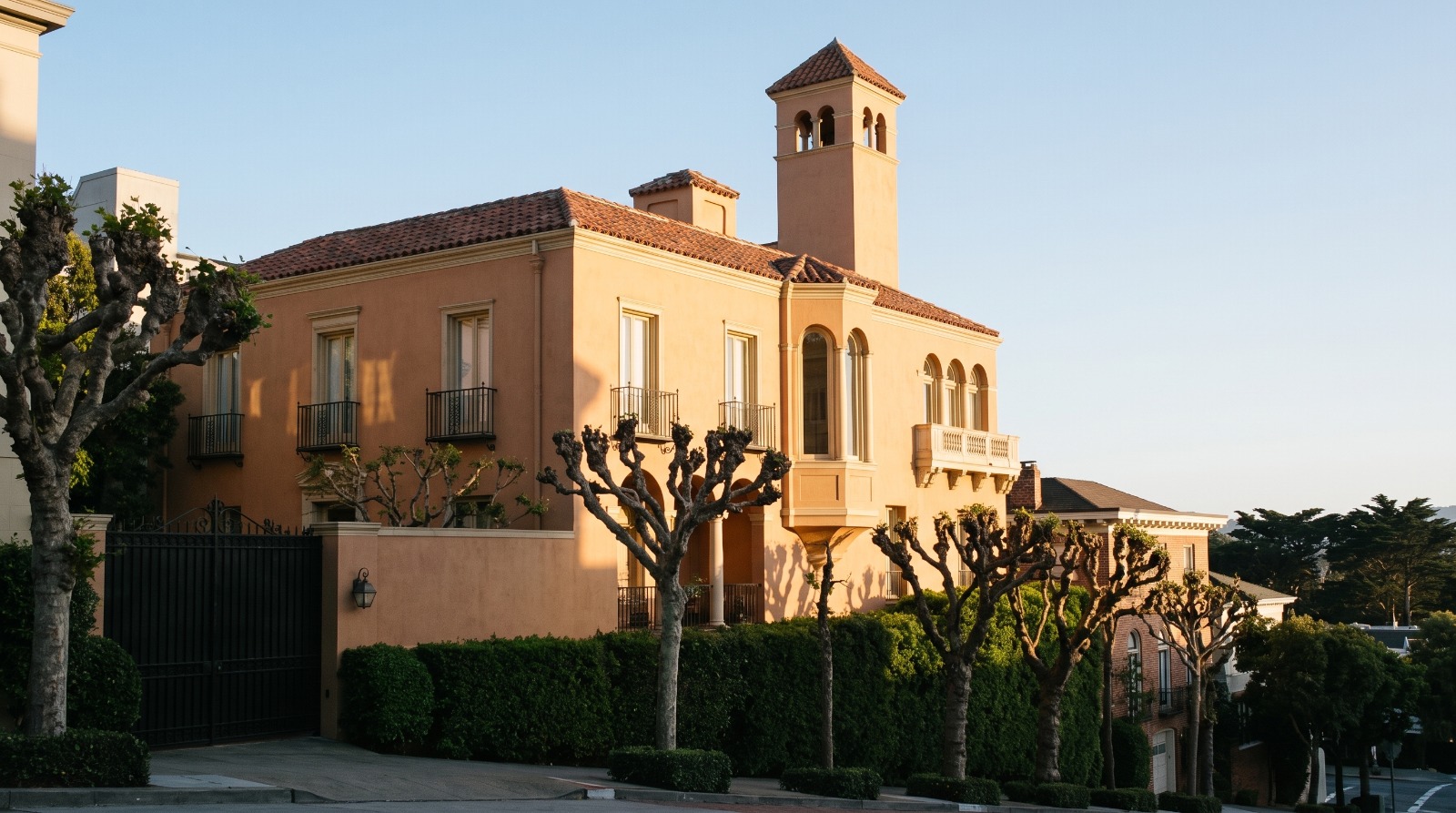
Illustration of the Willis Polk palazzo at 3277 Pacific Avenue in Presidio Heights, San Francisco, with its tower and pollarded plane trees. Photo: Houseberry
On August 20, two adjoining Presidio Heights mansions once owned by Salesforce founder Marc Benioff, 3277 Pacific Avenue and 3230 Jackson Street, sold for a combined $67.8 million, the second-largest home purchase in San Francisco history. Nobody knows who bought them. The buyer sits behind two anonymous trusts, the sale was never listed, and no broker took credit. The Real Deal broke the deal five days later and called the buyer a mystery.
We have a guess, and we want to be upfront that a guess is all it is. A trust cannot sign a deed, so a person did, and the man who signed for both buyers is, in the public records where his name appears, connected to the family of Airbnb co-founder and chief executive Brian Chesky, whose family trusts he has helped oversee for about a decade. It is also true that thirteen days before the deeds recorded, Chesky sold 200,000 Airbnb shares for roughly $35 million, though that was under a trading plan set months earlier, so it may mean nothing at all.
So this is speculation, not a finding. Everything above comes from recorded deeds and public securities filings, and none of it names a buyer. Nobody involved has commented, the trusts name no beneficiary, and a trustee can act for anyone, so the real buyer could be someone nobody has thought of. We will leave the ownership question there, as an open guess, because the better story is the house itself. For a hundred and thirteen years, 3277 Pacific Avenue has kept ending up with whoever runs San Francisco's defining company. If the hunch is right, it just did it again.
The Emporium, the Gap, Salesforce, and maybe Airbnb
Architectural surveys credit the house to Willis Polk, the architect behind the Hallidie Building and the rebuilt Mission Dolores, who designed it in 1913 as an Italian Renaissance palazzo for Mrs. Catherine Hooker of the Gilded Age Hooker family. In its early decades the photo archives place A.B.C. Dohrmann in the house. Dohrmann was president of the Emporium, the Market Street department store that was, for half a century, the biggest retail business in the West.
Skip ahead to 1994 and the house sold to Mickey Drexler, the chief executive then turning Gap, another San Francisco retailer, into a global brand. Drexler hired Thierry Despont, the architect trusted with restoring the Statue of Liberty, and rebuilt the place so completely that the Assessor's records to this day list the year built as 1994, not 1913.
In 2005 Drexler sold it for $25 million to his neighbor Marc Benioff, whose Salesforce was on its way to becoming the city's largest private employer. Benioff already owned the smaller house behind it at 3230 Jackson Street, and in 2011 he hosted Barack Obama at the big house for a fundraiser where Stevie Wonder played and tickets ran $35,800.
Emporium, Gap, Salesforce. Three eras of San Francisco commerce, one address. Which is what makes the trustee clue land the way it does: the next name in that sequence would more or less have to be a tech or platform founder. Whether it is the one our guess suggests, someone will eventually confirm or laugh at.
What $55.75 million actually bought
The deed records $55.75 million for the main house, about $3,515 per square foot. Assessor records put it at 15,858 square feet on a 14,000-square-foot parcel assembled from four lots, with six bedrooms, an indoor pool, and Golden Gate views over the Presidio wall. The $12 million second deed added the 6,000-square-foot house behind it, giving the buyer a compound with frontage on two streets.
Here is the full chain of title, with prices where a price was recorded.
| Year | Owner | Price |
|---|---|---|
| 1913 | Built by Willis Polk for Catherine Hooker; later home of Emporium president A.B.C. Dohrmann | not recorded |
| 1994 | Mickey Drexler, Gap CEO (Despont rebuild) | not disclosed |
| 2005 | Marc Benioff, Salesforce founder | $25.0M |
| 2017 | Anonymous trust | $30.0M |
| 2026 | Anonymous trust, all cash | $55.75M |
| 2026 (both houses) | Same buyer, including 3230 Jackson St | $67.75M combined |
The 2017 row is its own small mystery, and it is the part of this story nobody else has written. When Benioff quietly sold the big house for $30 million in May 2017, it was by far the largest home sale in San Francisco that year, double the $15 million sale the papers celebrated as the year's record. It went entirely unreported. The buyer hid behind a trust administered by Los Angeles entertainment-industry professionals, banked at the LA private bank long nicknamed the bank to the stars, and then did nothing for nine years. City permit records show no construction permit on either lot since a 2015 reroofing job. Whoever it was walked away this summer with a roughly $31.8 million gain on the pair, still anonymous.
The numbers around the sale are their own show
The deal had been quietly in escrow since at least July 10, when the city's pre-sale energy inspection reports were recorded for both houses. It closed all cash. And it showered money on everyone standing nearby.
- City Hall: San Francisco's transfer tax runs 6 percent on sales of $25 million and up, so the two deeds generated roughly $4 million in transfer tax the day they recorded. We covered how those tiers work in our guide to Bay Area transfer taxes.
- The tax roll: under Prop 13 the big house had been assessed at about $34.8 million. Reassessed at the new price, its annual property tax bill jumps from about $412,000 to about $659,000.
- The neighborhood comps: Presidio Heights already carries a median home price of $10.03 million as of August 2026, the highest in the city and about 365 percent above the San Francisco median. This sale closed at 5.6 times that.
For scale, the only larger residential purchase in city history is Laurene Powell Jobs's $71 million Pacific Heights buy in 2024, and this year has now produced the second and third largest sales ever recorded in San Francisco.
The questions everyone is asking
Who bought Marc Benioff's former San Francisco mansion?
On paper, an anonymous trust, and that is all the record says. The one public clue is that the trustee who signed both deeds is, in the public records where his name appears, connected to the family of Airbnb CEO Brian Chesky. No document names a buyer and nobody involved has commented, so the honest answer is: unknown. We have a guess, not an answer.
How much did 3277 Pacific Avenue sell for?
The recorded deed shows $55,750,000 on August 20, 2026, about $3,515 per square foot for the 15,858-square-foot house, paid all cash. The same buyer paid $12 million for 3230 Jackson Street, the house directly behind it, the same day.
What is the most expensive home ever sold in San Francisco?
Laurene Powell Jobs's $71 million Pacific Heights purchase in 2024 still holds the record. This $67.75 million double purchase ranks second. As a single house, 3277 Pacific's $55.75 million lands third, just behind the $56 million Vallejo Street sale this April, which means 2026 has now produced two of the three biggest home sales in city history.
Did Brian Chesky buy a house in Presidio Heights?
There is no public record or statement saying so, and this article does not claim he did. What exists is circumstantial: a trustee tied to his family's trusts signed both deeds, and Chesky sold about $35 million of Airbnb stock thirteen days before closing, under a trading plan set months earlier. Treat it as an open question and our speculation as exactly that.
Why do luxury buyers purchase homes through trusts?
Privacy. A California trust registers nowhere, names no beneficiary publicly, and appears on the deed as nothing but a name someone made up in escrow. The only human being it must expose is the trustee who signs, which is exactly the thread this story hangs on.
Why the top of Presidio Heights trades in secret
Presidio Heights ranks third of 92 San Francisco neighborhoods on our scoring, and it is finished. There is no land, no pipeline, and effectively no turnover: a fixed set of estates passed between people who can pay whatever the moment demands. The AI boom is minting those people faster than the neighborhood produces houses, which is why the biggest deals now happen off-market, between trusts, with no sign in the yard. The mansion shortage is real, and it is the same supply problem as everywhere else in the San Francisco market, just wearing better shoes.
The practical lesson for everyone not buying a palazzo is about records. A deed can hide an owner completely, and this one nearly did. What no trust can hide is everything around the house: the sale prices, the permits, the assessments, and the neighborhood itself. That is the layer we built Houseberry to read, and it is usually where the real story is anyway. This time it was a 113-year-old pattern hiding in plain sight.
Sources
- The Real Deal, "Mystery buyer drops $68M on two Presidio Heights homes once owned by Marc Benioff," August 25, 2026
- San Francisco Business Times, "Presidio Heights homes once owned by Marc Benioff sell for $68M," August 27, 2026
- San Francisco Assessor-Recorder public index, documents 2026093400 and 2026093402 and the recorded history of Block 0973
- San Francisco Assessor historical secured property tax rolls, Block 0973 Lot 039 (DataSF)
- San Francisco building permits (DataSF)
- Architectural survey photo and caption for 3277 Pacific Avenue (Willis Polk, 1913, Hooker residence; Dohrmann occupancy)
- Emporium Capwell history (A.B.C. Dohrmann, Emporium president)
- Airbnb Form 4 filings, sales of August 7, 2026
- SF.gov, real property transfer tax rates
- San Francisco Treasurer and Tax Collector, secured property tax rate
- SFGate, "Ho-hum mansion goes for $15 million, SF's most expensive home sale of the year" (2017)
- Houseberry, Presidio Heights neighborhood scores and median price
The Houseberry Research Team is Houseberry's reporting team: Bay Area real estate analysts, data specialists and longtime local market watchers. Every day we check the public record: building permits, city council and planning agendas, county recorder filings, state housing bills, police incident data and school results. Then we tie each story to what it means for specific neighborhoods, using Houseberry's own neighborhood data on prices, appreciation, safety, schools and amenities. Questions or corrections: Contact us.
Map of San Francisco Neighborhoods
Loading map...
View Full Map
Top Neighborhoods in San Francisco, CA





All information provided on this website including but not limited to - school ratings, safety, amenities, user opinions, and property data - is for general informational purposes only. We do not guarantee its reliability, accuracy, or completeness. Users should independently verify information and consult appropriate professionals as needed. By using this website, you agree Houseberry is not responsible for actions, decisions, or consequences arising from reliance on the information provided
houseberry.com - CA DRE# 01847391
 Bay East ©2025. CCAR ©2025. bridgeMLS ©2025. Information Deemed Reliable But Not Guaranteed. This information is being provided by the Bay East MLS, or CCAR MLS, or bridgeMLS. The listings presented here may or may not be listed by the Broker/Agent operating this website. This information is intended for the personal use of consumers and may not be used for any purpose other than to identify prospective properties consumers may be interested in purchasing. Data last updated at October 13, 2026 12:00 AM