Anthropic's IPO cash reaches Bay Area housing in spring, not now
Anthropic prices its IPO Nov. 18, but its lockup schedule pushes most employee selling into early and mid 2027. Our estimate of how much money could reach Bay Area homes, when, and where.

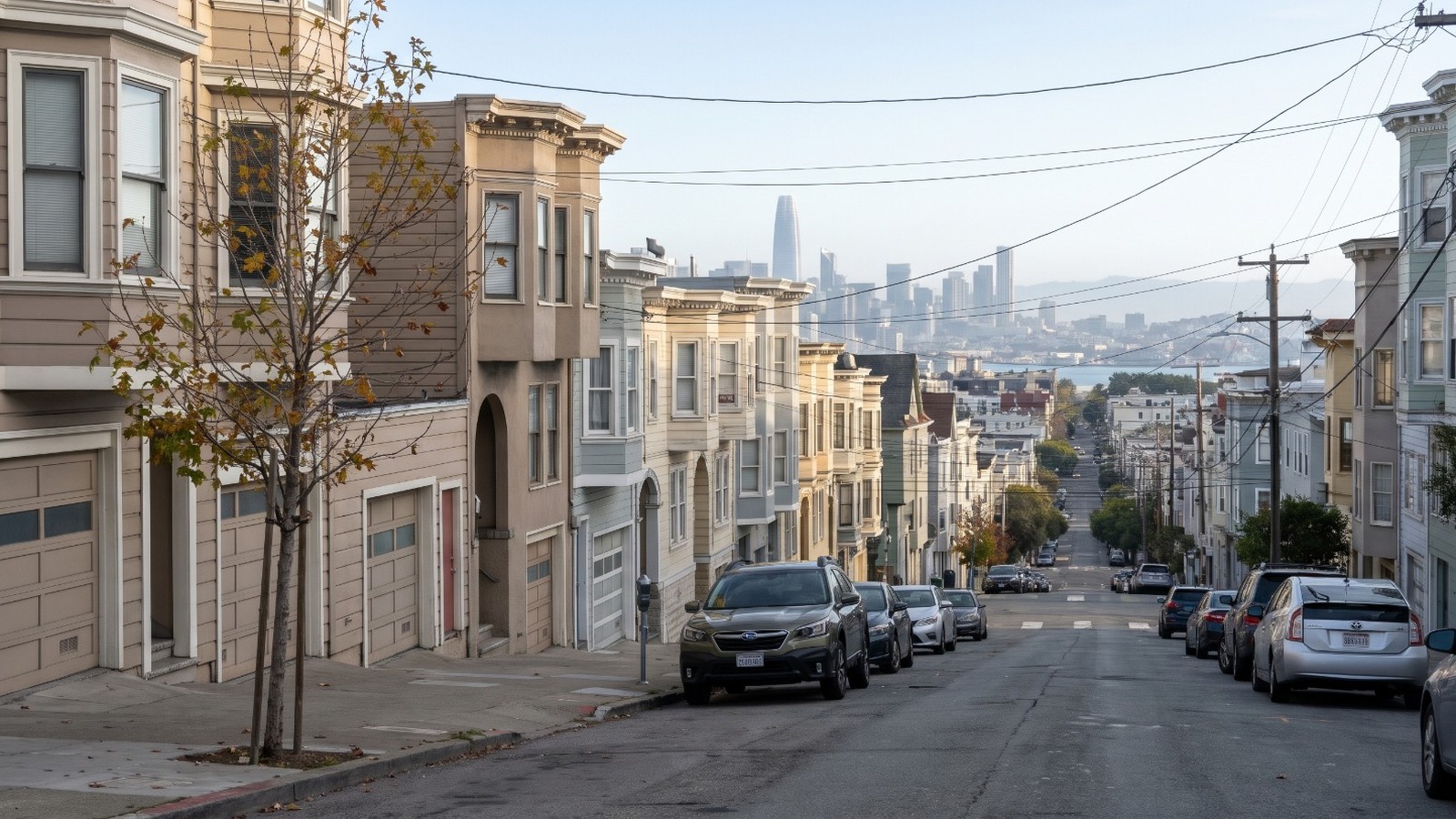
AI-generated afternoon view down a Noe Valley street in San Francisco with Victorian homes and the downtown skyline in the distance Photo: Houseberry
Anthropic plans to sell 825 million shares at $70 to $78 apiece, set the price on Nov. 18 and start trading on the Nasdaq under ANT the next day. At the top of that range the company would be worth up to $1.4 trillion on a fully diluted basis. Somewhere inside that number is the down payment on a lot of San Francisco houses.
Not yet, though. The money that reaches Bay Area housing does not arrive with the IPO. It arrives when employees are allowed to sell, and Anthropic's lockup schedule puts most of that in the spring of 2027, right on top of the selling season. In Houseberry's San Francisco data the typical home was already $2.08 million in September 2026, up 9 percent in a year.
In July we wrote that IPO money was coming for a short list of Bay Area neighborhoods. The Anthropic prospectus now gives us the calendar and a price, so we can put rough numbers on how much and when.
How much money we are talking about
Anthropic has not said how much of the company its employees own. Redfin modeled it in July at 10 to 15 percent and estimated about $63 billion after taxes at a valuation near $1 trillion, enough to buy about 9 percent of San Francisco's homes if they spent it all.
Rerun that at the new price. Ten to 15 percent of $1.4 trillion is $140 billion to $210 billion before taxes. Employee stock is taxed as ordinary income, and a California earner at that level gives up close to half, which leaves roughly $70 billion to $105 billion. Executives and directors alone hold more than $118 billion in shares, the San Francisco Standard reported, and several cofounders hold more than $17 billion each.
Almost none of that goes into houses. People diversify into index funds, pay off loans, start companies and give money away. Say one dollar in twenty goes into Bay Area real estate. That is $3.5 billion to $5.3 billion, or 1,700 to 2,500 homes at San Francisco's typical price. Our assumption could be off by half in either direction. Even at the low end, that is a lot of buyers with no mortgage contingency, arriving at once.
When it lands
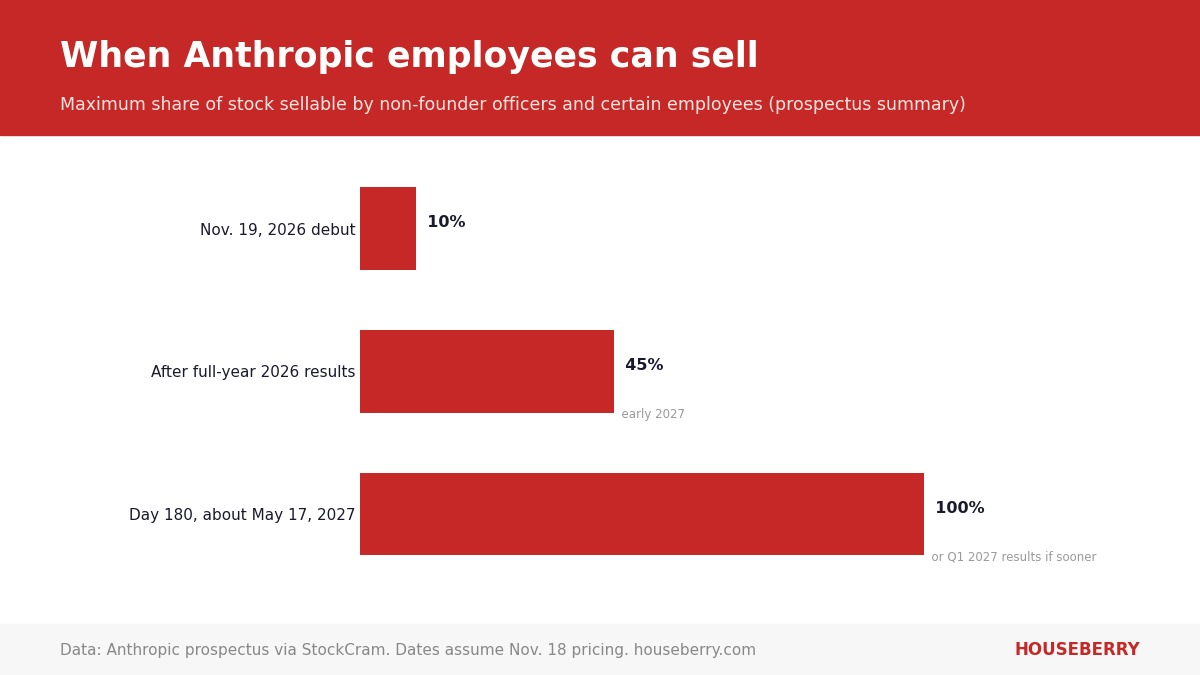
The prospectus splits holders into groups. For non-founder officers, directors and certain employees, the schedule summarized by StockCram works like this. Up to 10 percent can be sold from the first day. Up to another 35 percent after the full-year 2026 results. Everything else at day 180 or at the first-quarter 2027 results, whichever comes first. The seven cofounders wait a full year, with up to 29 percent released at the six-month mark.
Put that against the housing calendar. The first 10 percent arrives in late November, when San Francisco listings are at their seasonal low. That money is real but small, and most of it will sit.
The second wave arrives in late winter, just as spring listings start to appear. The third lands in May, when the season peaks. We think spring 2027 is when Anthropic money shows up in San Francisco offers, and a buyer competing in March through June should plan for it.
Where it is most likely to show up
New tech money concentrates. It goes to neighborhoods with short commutes to the company, good light, and housing stock that reads as a forever home. Anthropic is based in San Francisco.
Houseberry's neighborhood prices already show where demand runs hottest. These are September 2026 typical prices and 12-month changes from each neighborhood's page, including Pacific Heights and Noe Valley.
| Neighborhood | Typical price | 12-month change |
|---|---|---|
| Pacific Heights | $3.01M | +16% |
| Noe Valley | $2.53M | +12% |
| Cole Valley and Parnassus Heights | $2.45M | +18% |
| Inner Parkside | $2.20M | +19% |
| Glen Park | $2.11M | +16% |
| Mission Bay | $1.50M | +3% |
| San Francisco citywide | $2.08M | +9% |
The pattern is single-family neighborhoods with quick access to downtown pulling away, while condo-heavy Mission Bay barely moved. That fits how equity money buys. It wants a house with a yard on a hill more than a two-bedroom near the office.
The Peninsula is the other landing zone. Houseberry's Palo Alto page put the typical Palo Alto home at $3.63 million in September 2026, up 5 percent, and it ranks second of 18 Santa Clara County cities on Houseberry's overall score.
The case against a spring frenzy
The stock has to hold up first. The roadshow opened into a market rattled by AI spending worries and a post-midterm drop, and bankers had floated a $2 trillion valuation a few months ago before investors talked it down. If ANT trades below $70 in March, employees will hold, and the spring wave shrinks.
Lockups can also be waived early by the lead banks, Goldman Sachs and Morgan Stanley, which would spread the selling out instead of bunching it.
Then there is OpenAI, expected to go public in 2027. If it does, a second set of lockups lands on top of this one, and the spring of 2027 stops looking like a one-time event.
If you are planning to buy in San Francisco next year, the useful move is to decide now which neighborhoods you would actually live in and what they cost, before March. Houseberry's San Francisco rankings score all 92 of them on schools, safety and price.
Sources
The Houseberry Research Team is Houseberry's reporting team: Bay Area real estate analysts, data specialists and longtime local market watchers. Every day we check the public record: building permits, city council and planning agendas, county recorder filings, state housing bills, police incident data and school results. Then we tie each story to what it means for specific neighborhoods, using Houseberry's own neighborhood data on prices, appreciation, safety, schools and amenities. Questions or corrections: Contact us.
Map of San Francisco Neighborhoods
Loading map...
View Full Map
Top Neighborhoods in San Francisco, CA





All information provided on this website including but not limited to - school ratings, safety, amenities, user opinions, and property data - is for general informational purposes only. We do not guarantee its reliability, accuracy, or completeness. Users should independently verify information and consult appropriate professionals as needed. By using this website, you agree Houseberry is not responsible for actions, decisions, or consequences arising from reliance on the information provided
houseberry.com - CA DRE# 01847391
 Bay East ©2025. CCAR ©2025. bridgeMLS ©2025. Information Deemed Reliable But Not Guaranteed. This information is being provided by the Bay East MLS, or CCAR MLS, or bridgeMLS. The listings presented here may or may not be listed by the Broker/Agent operating this website. This information is intended for the personal use of consumers and may not be used for any purpose other than to identify prospective properties consumers may be interested in purchasing. Data last updated at November 12, 2026 12:00 AM