Palo Alto's Crossroads market site could become 200 apartments
High Street Residential wants an 8-story, 200-apartment building at 720 San Antonio Road. Here's what the council asked for, the 633 homes planned on the same road, and what nearby homes cost.

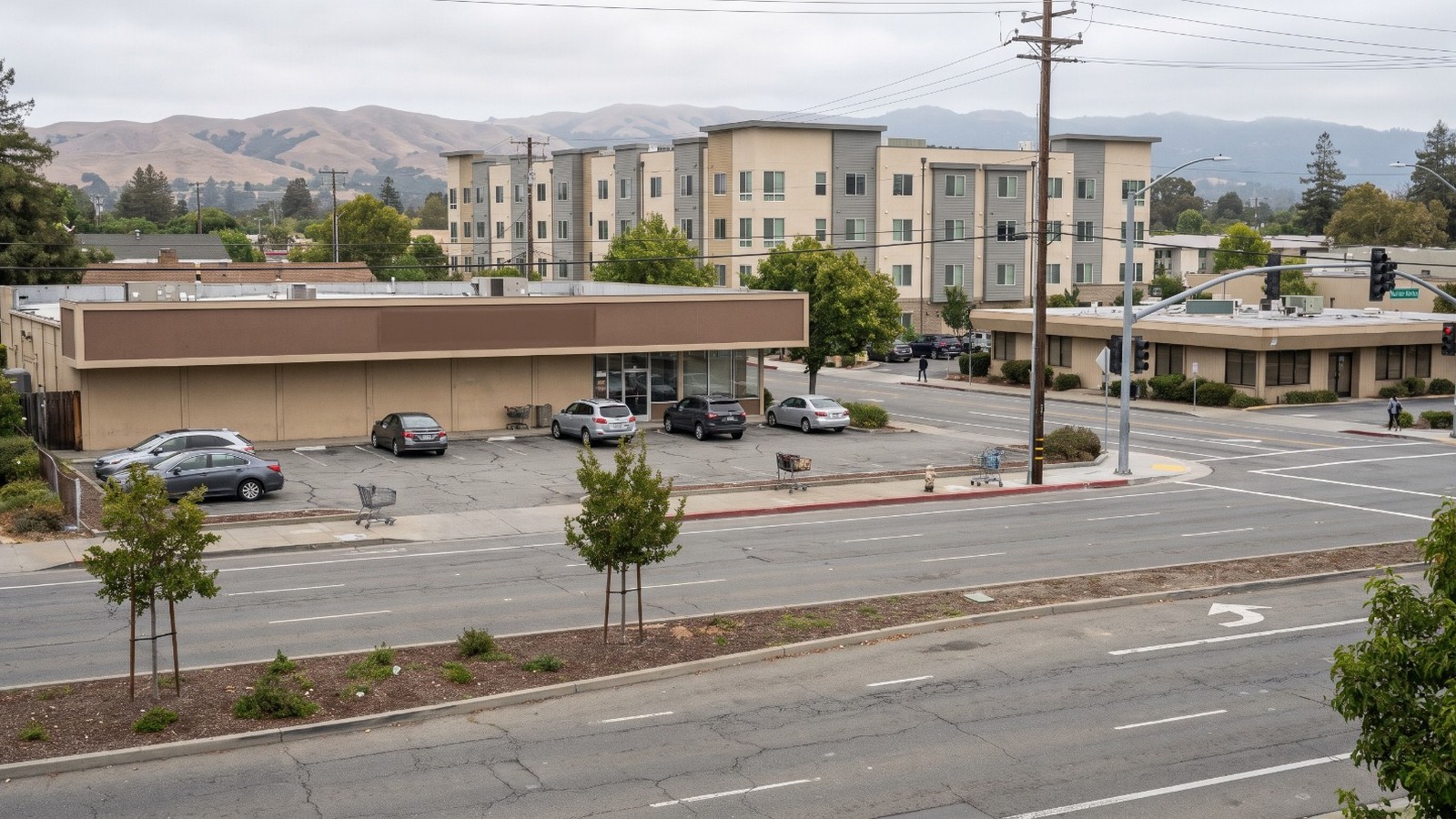
AI-generated daytime view of a one-story retail strip on San Antonio Road in Palo Alto with newer apartments behind it Photo: Houseberry
Drive San Antonio Road from Middlefield toward the Mountain View line and you pass a row of one-story commercial buildings with parking out front. One of them holds Crossroads Specialty Market. High Street Residential wants to knock down that building and two others at 720 San Antonio Road and put up 200 apartments, eight stories and 89 feet tall.
The Palo Alto City Council took its first look on Monday, Nov. 9, in a prescreening hearing held before any formal application. The reaction was mostly warm, San José Spotlight reported, with three asks: more affordable units, more parking and some retail on the ground floor.
This is a story about where Palo Alto is putting its new housing. It is not downtown or along University Avenue. It is this strip of low-slung commercial lots on the city's southeast edge, where four apartment projects and a townhome plan now sit within a few blocks. In a city where the typical home cost $3.63 million in September 2026, according to Houseberry's Palo Alto city page, that is the only kind of new home most people here will be able to afford.
What would go up at 720 San Antonio
The building would put parking and amenities on its two lowest floors and apartments on the six above. The mix leans small: 113 one-bedrooms, 44 two-bedrooms, 25 studios and 18 three-bedrooms. There would be a pool lounge, a gym, a club room and a co-working space.
Thirty of the 200 apartments, 15 percent, would be below market rate. Eighteen of those would go to very-low-income households and 12 to moderate-income households. Councilmember Ed Lauing asked for more.
The plan includes 217 parking spaces. Palo Alto's code would require 276, so the project offers 79 percent of what the code asks, about 1.1 spaces per apartment. It also has 148 bike spaces. The developer is asking to rezone the site from commercial to the city's planned home zoning, which lets residential go in and gives the council leverage to ask for changes.
The block is already changing
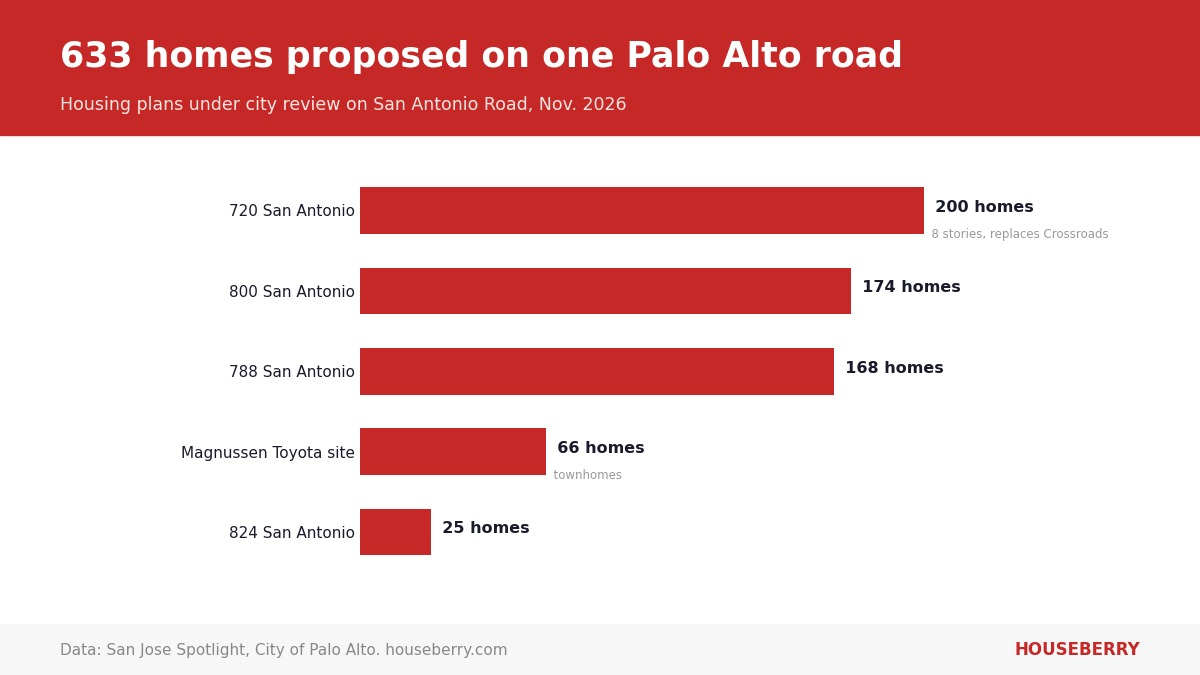
720 San Antonio is the largest of five housing plans on this stretch that the city now has under review.
| Address | What's proposed | Homes |
|---|---|---|
| 720 San Antonio Road | 8-story apartment building replacing Crossroads and two other buildings | 200 |
| 800 San Antonio Road | Apartments | 174 |
| 788 San Antonio Road | Apartments | 168 |
| Magnussen Toyota site | Townhomes | 66 |
| 824 San Antonio Road | Apartments | 25 |
Add them up and you get 633 homes. That is about a tenth of the 6,086 homes Palo Alto has to plan for by 2031 under its state housing target, a number Palo Alto Online reported when the city released its plan. Several of these sites were rezoned for housing in that plan precisely because they were car dealers, offices and shopping strips with nobody living on them.
The retail fight is the real one
Councilmembers Pat Burt and Keith Reckdahl both want shops on the ground floor. Reckdahl called retail "essential in this area" and warned against a retail desert. Burt worried that approving buildings now, before the city finishes its San Antonio Road Area Plan, would make it harder to require ground-floor retail on the lots that follow.
They have a point. If the 633 planned homes all get built, perhaps 1,200 people will live within a few blocks of Middlefield and San Antonio, and the first building removes the specialty grocery they would walk to.
We think the council should take the 200 apartments and stop short of making retail a condition. Ground-floor retail in a new building on a busy four-lane road is a hard lease. Plenty of Bay Area projects have built storefronts that sat empty for years. The better tool is the area plan itself: zone a few corners for retail, and let the rest of the frontage be homes. Asking every building to carry a shop is how you end up with fewer buildings.
Parking is the weaker objection. The site is a short ride from the San Antonio Caltrain station, and 1.1 spaces per apartment is close to what new Bay Area rentals actually fill.
Seven figures on every side of the road
Palo Alto prices sit far above most of the region. Houseberry scores 27 Palo Alto neighborhoods, and 20 of them rate 4 or better out of 5 overall on the Palo Alto rankings. The city ranks second of 18 in Santa Clara County.
Even the less expensive pockets near this end of town carry seven figures. Charleston Gardens, a south Palo Alto neighborhood of ranch homes and newer builds near the Charleston Center, had a typical price of about $1.7 million in Houseberry's September 2026 data. Greenmeadow, with a 5.0 safety score, was $3.24 million.
A one-bedroom in a new building is the realistic way into those school boundaries for a lot of households. Palo Alto's school score is 4.8 out of 5 on Houseberry, which is the main reason people pay these prices.
A prescreening, not an approval
A prescreening is the council's way of telling a developer what it wants before the developer spends money on a formal application, and High Street Residential has not filed one yet. The next real decision comes when that application reaches the Planning and Transportation Commission.
Councilmember Julie Lythcott-Haims put the timing problem plainly at Monday's meeting. The city is approaching the tarmac, she said, while "we're still building the airport." The plane is already circling. To see how the neighborhoods around San Antonio Road compare on schools, safety and price, start with the Palo Alto neighborhood map and rankings.
Sources
The Houseberry Research Team is Houseberry's reporting team: Bay Area real estate analysts, data specialists and longtime local market watchers. Every day we check the public record: building permits, city council and planning agendas, county recorder filings, state housing bills, police incident data and school results. Then we tie each story to what it means for specific neighborhoods, using Houseberry's own neighborhood data on prices, appreciation, safety, schools and amenities. Questions or corrections: Contact us.
Map of Palo Alto Neighborhoods
Loading map...
View Full Map
Top Neighborhoods in Palo Alto, CA





All information provided on this website including but not limited to - school ratings, safety, amenities, user opinions, and property data - is for general informational purposes only. We do not guarantee its reliability, accuracy, or completeness. Users should independently verify information and consult appropriate professionals as needed. By using this website, you agree Houseberry is not responsible for actions, decisions, or consequences arising from reliance on the information provided
houseberry.com - CA DRE# 01847391
 Bay East ©2025. CCAR ©2025. bridgeMLS ©2025. Information Deemed Reliable But Not Guaranteed. This information is being provided by the Bay East MLS, or CCAR MLS, or bridgeMLS. The listings presented here may or may not be listed by the Broker/Agent operating this website. This information is intended for the personal use of consumers and may not be used for any purpose other than to identify prospective properties consumers may be interested in purchasing. Data last updated at November 12, 2026 12:00 AM