Waymo Oakland: Which Neighborhoods Get Rides First
Waymo has been cleared to charge for driverless rides in Alameda County since August 14. It has not launched in Oakland yet. Here is the cost math against owning a car, and the Oakland neighborhoods where a reliable late ride changes the most.

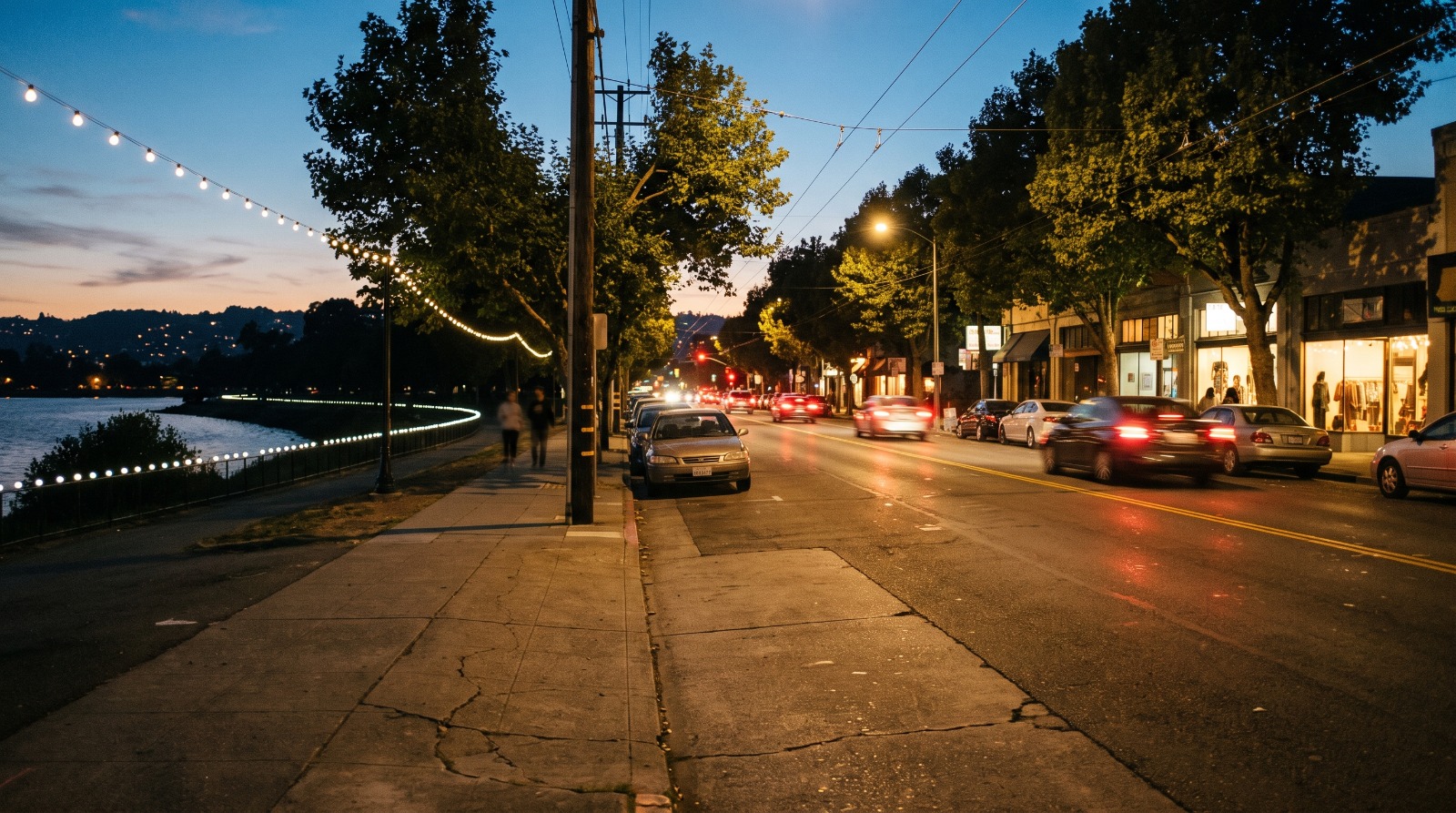
Grand Avenue in Oakland at dusk beside Lake Merritt, one of the high-amenity neighborhoods a robotaxi service would reach first. Photo: Houseberry
Waymo has been allowed to charge for driverless rides in Alameda County since August 14, 2026. As of today it has not launched a single one in Oakland.
That gap is the whole story right now. The permission is real, the cars are not here yet, and the golden two-seaters people keep photographing on Broadway are Teslas with a person behind the wheel. What is worth doing in the meantime is the arithmetic, because a robotaxi is not a gadget, it is a line item that competes with a car payment. And that competition looks very different in Adams Point than it does up in Montclair.
Three numbers to hold onto:
- Waymo’s fared driverless approval covering Alameda County took effect on August 14, 2026, and the company put cars on the street in San Diego just 17 days after that same approval.
- The average Bay Area Waymo fare was $19.69 across more than 94,000 simulated ride requests between late November 2025 and January 1, 2026, against $17.47 for Uber and $15.47 for Lyft.
- AAA put the all-in cost of a new car at $11,577 a year in September 2025, which at that average fare buys roughly 588 rides, or about 11 a week.
Approved in August, and still no launch date
Waymo can legally charge Oakland passengers today. It has chosen not to start yet, and it has not said when it will.
The approval came in two pieces. The California DMV cleared Waymo for driverless testing and deployment in Oakland, Berkeley, Fremont, Hayward and Alameda in late November 2025, which covered the driving but not the fares. The California Public Utilities Commission then approved fared driverless service across 18 counties, Alameda included, effective August 14, 2026. Waymo had filed for it on January 28, so the wait was nearly seven months.
Waymo’s own service page still describes the Bay Area as San Francisco down the Peninsula to San Jose. The East Bay is not on it. The best available benchmark for how fast that changes is San Diego, where cars were carrying paying riders 17 days after the same approval. The company is also operating at a scale that makes a new city less of an event than it used to be, running roughly 4,000 vehicles across 14 metros and more than 500,000 paid rides a week as of September 1, 2026.
Scott Moura, a civil engineering professor at UC Berkeley, put the pacing plainly to ABC7 in August: while they have clearance to drive throughout the Bay Area and Los Angeles, it is not going to happen all at once.
The golden cars on Broadway are Teslas, and they have drivers
Tesla is visible in Oakland right now, and Tesla is not running driverless rides in California.
The Cybercabs turning up downtown, near Lake Merritt and along Broadway are real, and Tesla has been servicing a Bay Area fleet out of garages at 1900 Broadway and 1950 Franklin Street. But the permit Tesla holds is a charter-party carrier permit. Pat Tsen, a CPUC deputy executive director, described it in March 2026 as essentially the same type of permit that a limousine company would get, and said Tesla is not operating an autonomous vehicle service in the state.
Practically, that means the Tesla Robotaxi app has been available to California passengers since September 2025 with a human driver in a Model Y, priced at roughly what Uber or Lyft cost. Useful, and worth knowing about. Just not the thing the paint job suggests.
The ride-versus-car math, at Oakland prices
Here is what the competing costs actually look like, each with the date it was measured.
| Cost | Amount | As of |
|---|---|---|
| Average Bay Area Waymo fare | $19.69 | Nov 2025 to Jan 2026 |
| Average Bay Area Uber fare | $17.47 | Nov 2025 to Jan 2026 |
| Average Bay Area Lyft fare | $15.47 | Nov 2025 to Jan 2026 |
| Waymo One Premier subscription | $29.99 a month | June 2026 |
| AAA all-in cost of a new car | $964.78 a month | September 2025 |
| Downtown Oakland meter, premium zone | $3.50 an hour | Spring 2026 |
| AC Transit local ride with Clipper | $2.75 | July 1, 2026 |
| BART, downtown San Francisco to Oakland | $2.60 | January 1, 2026 |
Read the table from the bottom up and the shape of it changes. Nobody replaces a BART commute with a $19.69 car ride. What a robotaxi replaces is the trip transit is worst at, which in Oakland is the 10pm return, the grocery run in the rain, the trip across town that AC Transit makes into two buses and 45 minutes.
Set against $964.78 a month of car ownership, that is a real substitution for a household that owns two cars and only really needs one. It is not a substitution for the first car. The people for whom this math works already live somewhere they can walk to most of what they need, and only occasionally need to leave.
The high-amenity ring is where this lands hardest
Oakland has 14 neighborhoods scoring 4 out of 5 or better on amenities, and the interesting ones are not the expensive ones.
Amenities is our measure of how much of daily life is close by, and it is the score that decides whether a car is a convenience or a requirement. Here are the strongest, with the current median price from each neighborhood page and the month it comes from.
| Neighborhood | Amenities score | Median price (month) |
|---|---|---|
| Rockridge | 4.6 | $2.31M (Aug 2026) |
| Grand Lake | 4.2 | $984,430 (Jun 2026) |
| Lakeshore | 4.2 | $1.48M (Aug 2026) |
| Adams Point | 4.1 | $1.44M (Jul 2026) |
| Piedmont Avenue | 4.1 | $1.42M (Aug 2026) |
| Temescal | 4.0 | $1.15M (Jun 2026) |
| Oakland citywide, for reference | 3.2 | $974,220 (Aug 2026) |
Rockridge is the city’s best-served neighborhood and it charges for it, at $2.31 million in August 2026. Grand Lake scores 4.2 on the same measure and cleared at $984,430 in June. That is most of the walkability for roughly $1.3 million less, and it is the kind of spread that only shows up when you look at neighborhoods instead of listings.
Add a reliable late-night ride to a block that already has a grocery store, a movie theater and a farmers market, and the last argument for a second car in the driveway gets thin. That is why the full Oakland amenities ranking is the page I would open before the Waymo app, whenever it does show up.
Quick answers before you plan around it
Can I take a Waymo in Oakland today?
No. The company has the approval and has not launched service in the East Bay. There is no published start date.
Does the approval cover Berkeley and the rest of the East Bay?
Yes. The DMV clearance named Oakland, Berkeley, Fremont, Hayward and Alameda, and the CPUC approval covers all of Alameda County along with 17 other counties.
Is a Waymo cheaper than an Uber here?
On average it was not. Over the winter window measured, Waymo ran about $2.22 a ride above Uber and $4.22 above Lyft, though the gap has been narrowing and Waymo waits averaged 5.74 minutes.
Which Oakland neighborhoods would get service first?
Nobody has published a map, so anyone answering this with certainty is guessing. The reasonable read is the dense, gridded, high-demand center of the city, which is also where Tesla parks its fleet. Treat it as an expectation, not a fact.
Where I would not get ahead of this
The honest caveats are worth more than the forecast.
There is no launch date, and a company that took seven months to get an approval is under no obligation to use it quickly. The average fare is above Uber’s, so the savings story depends on dropping a car, not on cheaper individual rides. And a robotaxi does nothing for the commute, which is still the trip that decides where most people buy.
We wrote in August about whether the premium on living near BART survives robotaxis reaching the far suburbs, and the Oakland version of that question is narrower and more useful. It is not whether a driverless car replaces a train. It is whether it replaces the second car in a two-car household on a block that was already walkable. We looked at the same math for Sunnyvale’s $3.50 microtransit rides earlier this month and it came out the same way: the service is only worth what the neighborhood around it already is.
Which is the boring, durable point. A ride you can summon is a feature of a place, and it stacks on top of what is already there. If you are comparing Oakland neighborhoods this fall, the citywide numbers and the amenities score will tell you more about your future transportation budget than any launch announcement will.
Sources
The Oaklandside, Waymo is poised for Oakland, September 8, 2026
Electrek, CPUC approves Waymo expansion to 18 California counties, August 14, 2026
NBC Bay Area, DMV clears Waymo for the north and east Bay
ABC7 News, Waymo announces California service expansion, August 2026
TechCrunch, The price gap between Waymo and Uber is narrowing, January 27, 2026
AAA, Your Driving Costs, September 16, 2025
City of Oakland, downtown demand-responsive parking meter rates
AC Transit fares, effective July 1, 2026
KQED, BART fare increase, January 2026
Houseberry, Oakland neighborhood rankings and city data, September 2026
The Houseberry Research Team is Houseberry's reporting team: Bay Area real estate analysts, data specialists and longtime local market watchers. Every day we check the public record: building permits, city council and planning agendas, county recorder filings, state housing bills, police incident data and school results. Then we tie each story to what it means for specific neighborhoods, using Houseberry's own neighborhood data on prices, appreciation, safety, schools and amenities. Questions or corrections: Contact us.
All information provided on this website including but not limited to - school ratings, safety, amenities, user opinions, and property data - is for general informational purposes only. We do not guarantee its reliability, accuracy, or completeness. Users should independently verify information and consult appropriate professionals as needed. By using this website, you agree Houseberry is not responsible for actions, decisions, or consequences arising from reliance on the information provided
houseberry.com - CA DRE# 01847391
 Bay East ©2025. CCAR ©2025. bridgeMLS ©2025. Information Deemed Reliable But Not Guaranteed. This information is being provided by the Bay East MLS, or CCAR MLS, or bridgeMLS. The listings presented here may or may not be listed by the Broker/Agent operating this website. This information is intended for the personal use of consumers and may not be used for any purpose other than to identify prospective properties consumers may be interested in purchasing. Data last updated at October 23, 2026 12:00 AM