Waymo Bay Area Expansion: Does the BART Premium Survive?
Regulators cleared Waymo for 18 California counties, from Brentwood to Sea Ranch. What robotaxis reaching the far suburbs means for commutes, transit towns, and the price of living close-in.

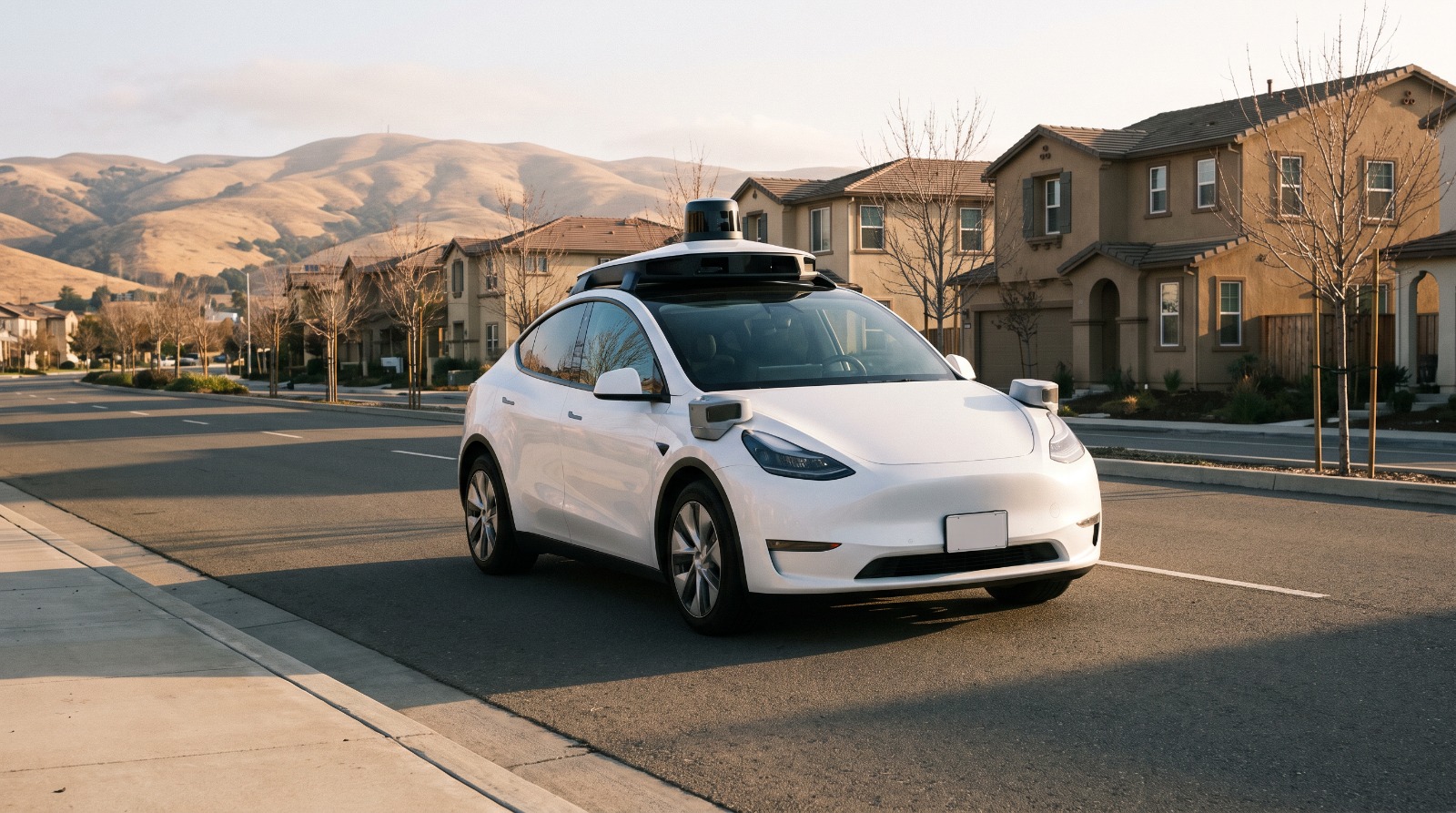
Driverless robotaxi with rooftop sensors on a suburban street in the far East Bay, part of Waymo's newly approved Bay Area territory Photo: Houseberry
Sea Ranch sits more than 100 road miles from San Francisco, up a stretch of Highway 1 with hairpins and fog and no cell signal in places. As of mid-August, it is inside the territory where Waymo is allowed to run driverless taxis. So are Brentwood, Livermore, Santa Rosa, Napa, and effectively every town a Bay Area buyer has ever shortlisted, after the California Public Utilities Commission approved the company’s expansion to 18 counties on August 14.
The interesting question for this site is not when a robotaxi reaches Healdsburg. It is whether the oldest rule in Bay Area pricing, that homes near BART and Caltrain command a premium, softens once a car with no driver can cover the last ten miles. My short answer: at the margin yes, at the core no, and the approval changes less than the headlines suggest.
What regulators approved, and what they did not
The CPUC vote authorizes driverless passenger service across Alameda, Contra Costa, Marin, Napa, Solano, Sonoma, Santa Cruz, and Yolo counties among others, adding the entire Bay Area to a permit that already covered San Francisco down through San Jose. It is a permission slip, not a launch. Waymo said plainly it will not start service in the new cities immediately, and that it maps and tests each area with human drivers first.
The company has been widening its footprint in steps for a while: freeway driving arrived in November 2025, San Jose airport trips followed, and a $16 billion investment round in February 2026 is paying for the buildout, per the Standard’s reporting. The pattern says the close-in East Bay comes first and the Sonoma coast comes last, likely by years.
The approved map, in plain terms:
- East Bay: Oakland, Walnut Creek, Livermore, Fremont, out to Brentwood and the Delta edge.
- North Bay: Marin, Napa, and Sonoma, including Santa Rosa, Petaluma, and Healdsburg, reaching Sea Ranch on the coast.
- South and beyond: Santa Cruz County, the coast past Pescadero, plus Sacramento and Yolo for the valley.
The question that matters: what happens to the transit premium
Living near a BART station costs real money. Walnut Creek, a BART town with a walkable downtown, carried a median sale price of about $1.53 million in June 2026. Antioch, forty minutes further out with a BART extension of its own, sat at about $603,780 in July 2026. Brentwood, past the end of the line entirely, was $770,310. Some of that gap is schools and downtown restaurants. A lot of it is the daily cost of distance.
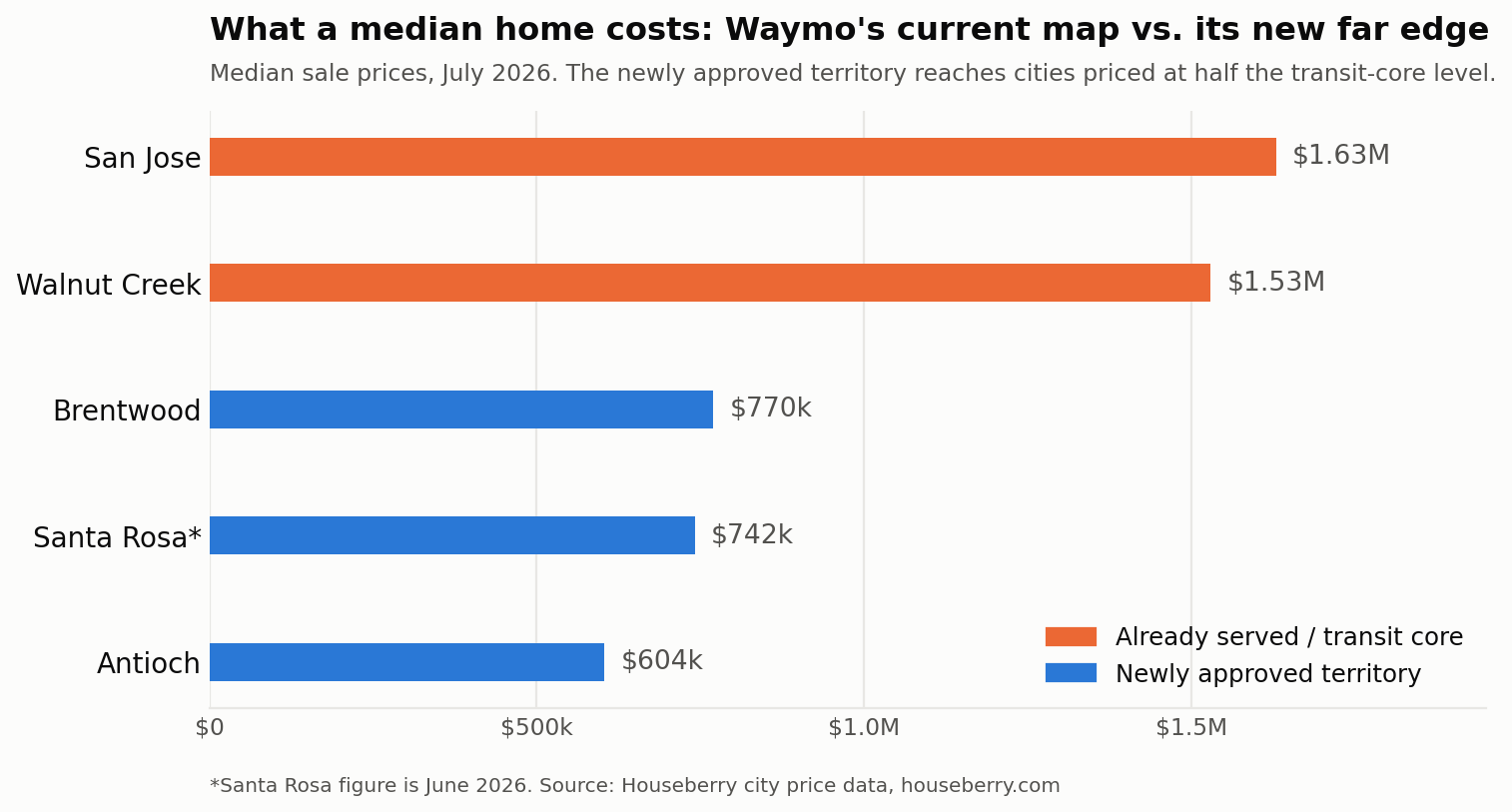
A door-to-door robotaxi chips at that gap from two directions. It makes the far suburb less isolated, since the 8:40 pm pickup from a Walnut Creek dinner no longer requires a spouse in a second car. And it weakens the one-car-household argument for paying close-in prices, because hybrid workers going in two or three days can treat the robotaxi fare as a line item instead of owning the second car outright.
What it does not do is move the arithmetic of a daily 50-mile commute. Ride-hail economics price by the mile, a robotaxi sits in the same traffic on Highway 4 that a driven car does, and five round trips a week from Brentwood to a San Francisco desk would cost more than a BART pass by an order of magnitude. Distance still costs. It just bills differently.
The honest catch
Nobody, including Waymo, has said when service starts in any of these places. The Standard’s experts flagged real technical limits on the fog belt and the narrow coastal two-lanes, and the CPUC approval process tells us nothing about pricing. I would not adjust a single home-buying decision today on the promise of a robotaxi in Petaluma. The buyers who should notice are the ones already torn between a transit town and the far edge, because the far edge’s biggest hidden cost, being stranded without a second car, now has an expiration date that is plausible instead of science fiction.
The premium has a simpler enemy
Here is the part the robotaxi conversation keeps missing. The BART premium is not mostly a technology problem, it is a scarcity problem. Walnut Creek costs $1.53 million because the number of homes within a walk of that station barely grows. The state’s SB 79 transit-density law, which we covered when it went live, attacks the premium directly by legalizing more homes where the premium is highest. More supply at the stations beats cheaper rides to the fringe, both for prices and for the region’s sanity.
So watch for Waymo’s white mapping cars on Ygnacio Valley Road sometime in the next year or two, and enjoy the novelty. But if you are choosing between close-in and far-out right now, make the choice on what is true today. Our data-driven guide to moving to the Bay Area is built for exactly that math, and none of it requires betting on a launch date Waymo itself will not give.
Sources
The San Francisco Standard: State OKs Waymo trips to East Bay, wine country
KTVU: Waymo receives approval to expand services across the Bay Area
Patch: Waymo inches closer to passenger trips in these CA counties
Waymo: Taking riders further, safely, with freeways
Houseberry city price data for Walnut Creek, Antioch, and Brentwood, June to July 2026
The Houseberry Research Team is Houseberry's reporting team: Bay Area real estate analysts, data specialists and longtime local market watchers. Every day we check the public record: building permits, city council and planning agendas, county recorder filings, state housing bills, police incident data and school results. Then we tie each story to what it means for specific neighborhoods, using Houseberry's own neighborhood data on prices, appreciation, safety, schools and amenities. Questions or corrections: Contact us.
All information provided on this website including but not limited to - school ratings, safety, amenities, user opinions, and property data - is for general informational purposes only. We do not guarantee its reliability, accuracy, or completeness. Users should independently verify information and consult appropriate professionals as needed. By using this website, you agree Houseberry is not responsible for actions, decisions, or consequences arising from reliance on the information provided
houseberry.com - CA DRE# 01847391
 Bay East ©2025. CCAR ©2025. bridgeMLS ©2025. Information Deemed Reliable But Not Guaranteed. This information is being provided by the Bay East MLS, or CCAR MLS, or bridgeMLS. The listings presented here may or may not be listed by the Broker/Agent operating this website. This information is intended for the personal use of consumers and may not be used for any purpose other than to identify prospective properties consumers may be interested in purchasing. Data last updated at October 3, 2026 12:00 AM