Moving to the Bay Area in 2026: A Data-Driven Guide
Median home prices across the Bay Area’s five scored regions run from $904,492 to $2,849,095. Which region you pick decides more than which city, and the scores say which one fits.
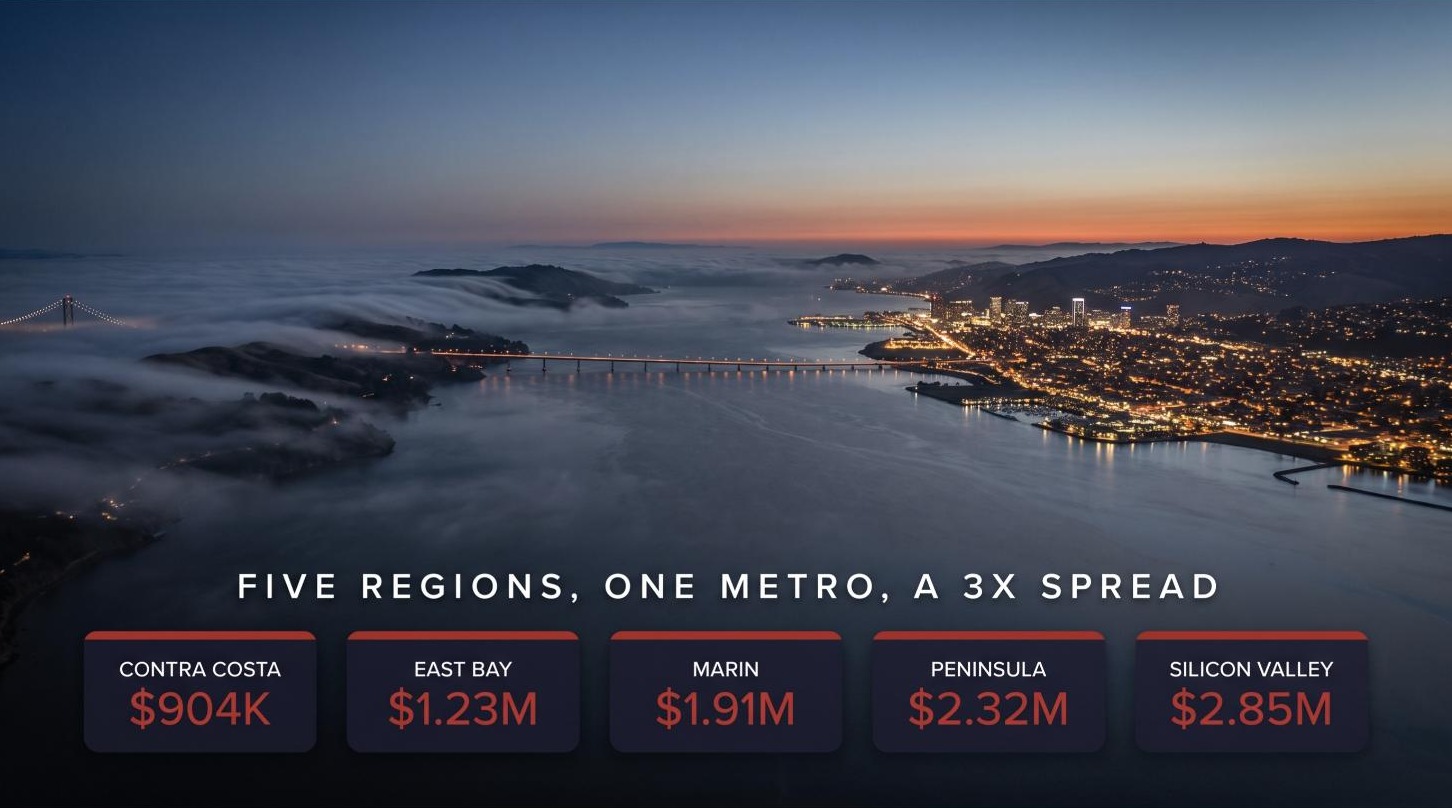
Aerial dusk view across San Francisco Bay with fog over the hills, overlaid with 2026 median home prices for five Bay Area regions from Contra Costa at $904K to Silicon Valley at $2.85M. Photo: Houseberry
Most relocation guides for this region are written by moving companies, and they all make the same mistake. They treat the Bay Area as one place with one price and one set of tradeoffs. It is five scored regions whose median home prices run from $904,492 to $2,849,095, and the region you choose settles more about your daily life than the city you choose inside it.
So this guide is built the other way around. Start from the factor you refuse to compromise on, let the data point you at a region, and only then argue about cities. Every number here comes from Houseberry’s August 2026 scores across 80 Bay Area cities and towns carrying both a price and a safety score.
The five regions, side by side
| Region | Places scored | Median price | Mean safety | Mean schools | Mean amenities |
|---|---|---|---|---|---|
| Contra Costa | 34 | $904,492 | 3.41 | 3.39 | 2.52 |
| East Bay | 12 | $1,233,505 | 3.50 | 3.20 | 3.44 |
| Marin | 10 | $1,906,275 | 3.85 | 4.20 | 3.54 |
| Peninsula | 16 | $2,318,265 | 3.41 | 3.91 | 3.42 |
| Silicon Valley | 8 | $2,849,095 | 3.46 | 4.39 | 3.50 |
Read down the safety column first, because it is the surprise. The mean safety scores are nearly flat across all five regions, from 3.41 to 3.85, despite a threefold spread in price. Paying three times as much does not buy you three times the safety score in this region. It buys schools, and it buys the specific commute. Everything else in this guide follows from that.
If schools are the non-negotiable
Go to Silicon Valley or the Peninsula, and expect to pay for it. Silicon Valley’s mean school score of 4.39 is the highest in the region by a wide margin, and the Peninsula follows at 3.91. The individual leaders are Belmont and Los Altos tied at a perfect 5.0, then Orinda at 4.9, then Palo Alto, Cupertino, Saratoga, Moraga and Lafayette all at 4.8.
That list contains the actual planning insight. Four of those eight are not in Silicon Valley or on the Peninsula at all. Orinda at $1,947,850, Moraga at $1,756,230 and Lafayette at $2,130,780 sit in Contra Costa, and Belmont at $2,339,990 is the cheapest 5.0 school score in the entire region. The Lamorinda towns deliver Silicon Valley school scores at roughly 60 percent of Silicon Valley prices, and the reason is the Caldecott Tunnel. You are buying the school score and paying for it in commute minutes instead of dollars.
If safety is the non-negotiable
Marin leads on the mean at 3.85, but the single strongest safety scores are scattered, and two of the region’s three perfect 5.0 marks are in Contra Costa: Saranap at $1,495,960 and Kensington at $1,643,280. Clayton follows at 4.8, then Castro Valley, Contra Costa Centre, Bayview-Montalvin and East Richmond Heights all at 4.7.
Only 16 of the 80 scored places clear 4.0 for safety, and only four of those cost under $1 million. If a high safety score is genuinely the thing you are moving for, that shortlist is most of your search, and we walked through it in the cheapest Bay Area places that are actually safe.
If daily life without a car is the non-negotiable
Look at the amenities column, and look hard at Contra Costa’s 2.52. That is the number people miss. Contra Costa is where the affordability lives, and it is also the region where the fewest neighborhoods have a real commercial center inside them. Clayton scores 4.8 for safety and 1.2 for amenities. Blackhawk scores 4.6 for safety and 0.7 for amenities. Alamo and Diablo both score 0.7. Those are not scoring errors. They are gated and semi-rural places where every errand is a drive.
The places that hold both are worth naming: Corte Madera at 4.4 amenities, Kensington at 4.2, Berkeley at 4.0, and Alameda, Burlingame, San Anselmo, El Cerrito and Dublin all at 3.9. Alameda is the interesting one, scoring an even 3.9 across safety, schools and amenities at a $1,394,630 median, which is as balanced as anything in the region gets.
If the budget is the non-negotiable
Start in Contra Costa and adjust from there. Its $904,492 median is 36 percent below the next region up, and 23 of the region’s 80 scored places sell under $1 million with all but a handful of them in that county. The strongest scores at the bottom of the market are East Richmond Heights at $719,580 with a 3.8 overall, and Bayview-Montalvin at $507,782 with a 3.7. Both trade amenities away to get there, at 1.8 and 2.2.
One region-level caution. Marin’s median reads $1,906,275, but its cheapest entry, San Anselmo, publishes at $585,000, and several Marin towns show appreciation figures swinging by 50 points or more between periods. Small towns trade few homes and their medians move on a handful of sales. Treat any single Marin price as a snapshot rather than a level.
The two cities that are not on this table
San Francisco and San Jose are scored neighborhood by neighborhood rather than as single rows, and the reason is that a citywide average would be actively misleading for both. San Francisco’s 92 neighborhoods average 3.9 for safety with 53 of them scoring 4.0 or higher, while its lowest scores concentrate in about two square miles downtown, a pattern we mapped in our San Francisco safety piece. San Jose’s 112 neighborhoods include 48 scoring 4.0 or higher against a downtown core that scores 1.3, covered in the San Jose breakdown.
If you are moving to either city, the region-level thinking in this guide stops being useful at the city line. Go straight to the neighborhood scores.
The version of this nobody tells you
The Bay Area’s pricing does not sort places by quality. It sorts them by school score and by proximity to a small number of job centers. Once you accept that, some of the arbitrage becomes obvious. Castro Valley scores 4.0 overall with a 4.7 for safety at $1,148,830, which beats a lot of what the Peninsula sells for double. Contra Costa Centre scores 4.4 overall, 4.7 for safety, 4.3 for schools, sits on a BART platform, and costs $1,378,100. Neither shows up in a single mover’s guide to this region, because neither has a famous name.
The corollary is also true and less fun. The famous names are mostly priced correctly for what they are. Palo Alto scores 4.2 overall at $4,430,580 and Los Altos scores 4.2 at $4,967,780, and Houseberry’s value model reads both as priced above their scored worth. You are buying the school score and the address, and the data will not pretend otherwise.
Before you commit to a region
Do the two checks that relocation guides skip. Look up the amenities score of the specific place, not the region, because that column has the widest spread of any factor here and it governs whether daily life needs a car. And look up the neighborhood rather than the city wherever the city is large, because Oakland rolls up to 2.5 overall while its hills neighborhoods carry perfect 5.0 safety scores, and San Jose rolls up to 3.2 while nearly half its neighborhoods clear 4.0. Nothing in this region survives being averaged.
How this guide was built
Houseberry scores 82 Bay Area cities and towns across five regions on schools, safety, amenities, price, value and appreciation, plus every neighborhood in San Francisco, Oakland and San Jose separately. Region medians and means here are computed across the 80 places carrying both a published median price and a safety score, as of August 5, 2026. The nine-county region as defined by ABAG also includes Napa, Sonoma and Solano, which Houseberry has not yet scored at this level, so they are absent by coverage rather than by judgment. Safety scores read reported incident data normalized by population.
Questions people ask
What is the cheapest part of the Bay Area to move to? Contra Costa County, with a $904,492 median across 34 scored places, against $1,233,505 in the East Bay, $1,906,275 in Marin, $2,318,265 on the Peninsula and $2,849,095 in Silicon Valley.
Which Bay Area region has the best schools? Silicon Valley, with a mean school score of 4.39 out of 5, followed by Marin at 4.20 and the Peninsula at 3.91. Belmont and Los Altos both score a perfect 5.0.
Where do you get the most for your money? Castro Valley at $1,148,830 scores 4.0 overall with a 4.7 for safety, and Contra Costa Centre at $1,378,100 scores 4.4 overall with BART access. Both beat places costing twice as much on Houseberry’s composite.
Is the Bay Area safe? Mean safety scores across the five regions sit between 3.41 and 3.85 out of 5, a narrow band. Sixteen of 80 scored places clear 4.0. The variation that matters is between neighborhoods, not between regions.
Should I move to a city or a suburb? Check the amenities score before deciding. Several of the highest-scoring suburbs here score below 1.5 for amenities, meaning no meaningful commercial center inside the boundary, while Berkeley, Alameda and Corte Madera clear 3.9.
Ready to narrow it down? Open the region rankings and sort by the one factor you will not compromise on. The region falls out of that answer faster than any guide can tell you.
All information provided on this website including but not limited to - school ratings, safety, amenities, user opinions, and property data - is for general informational purposes only. We do not guarantee its reliability, accuracy, or completeness. Users should independently verify information and consult appropriate professionals as needed. By using this website, you agree Houseberry is not responsible for actions, decisions, or consequences arising from reliance on the information provided
houseberry.com - CA DRE# 01847391
 Bay East ©2025. CCAR ©2025. bridgeMLS ©2025. Information Deemed Reliable But Not Guaranteed. This information is being provided by the Bay East MLS, or CCAR MLS, or bridgeMLS. The listings presented here may or may not be listed by the Broker/Agent operating this website. This information is intended for the personal use of consumers and may not be used for any purpose other than to identify prospective properties consumers may be interested in purchasing. Data last updated at September 18, 2026 12:00 AM