Wente Livermore Land Sale: 1,500 Acres, Not Housing
Wente is shopping at least 1,500 acres around Livermore, and the city is at the table. Two voter-approved growth boundaries and a 100-acre minimum lot size explain why almost none of it can become homes.
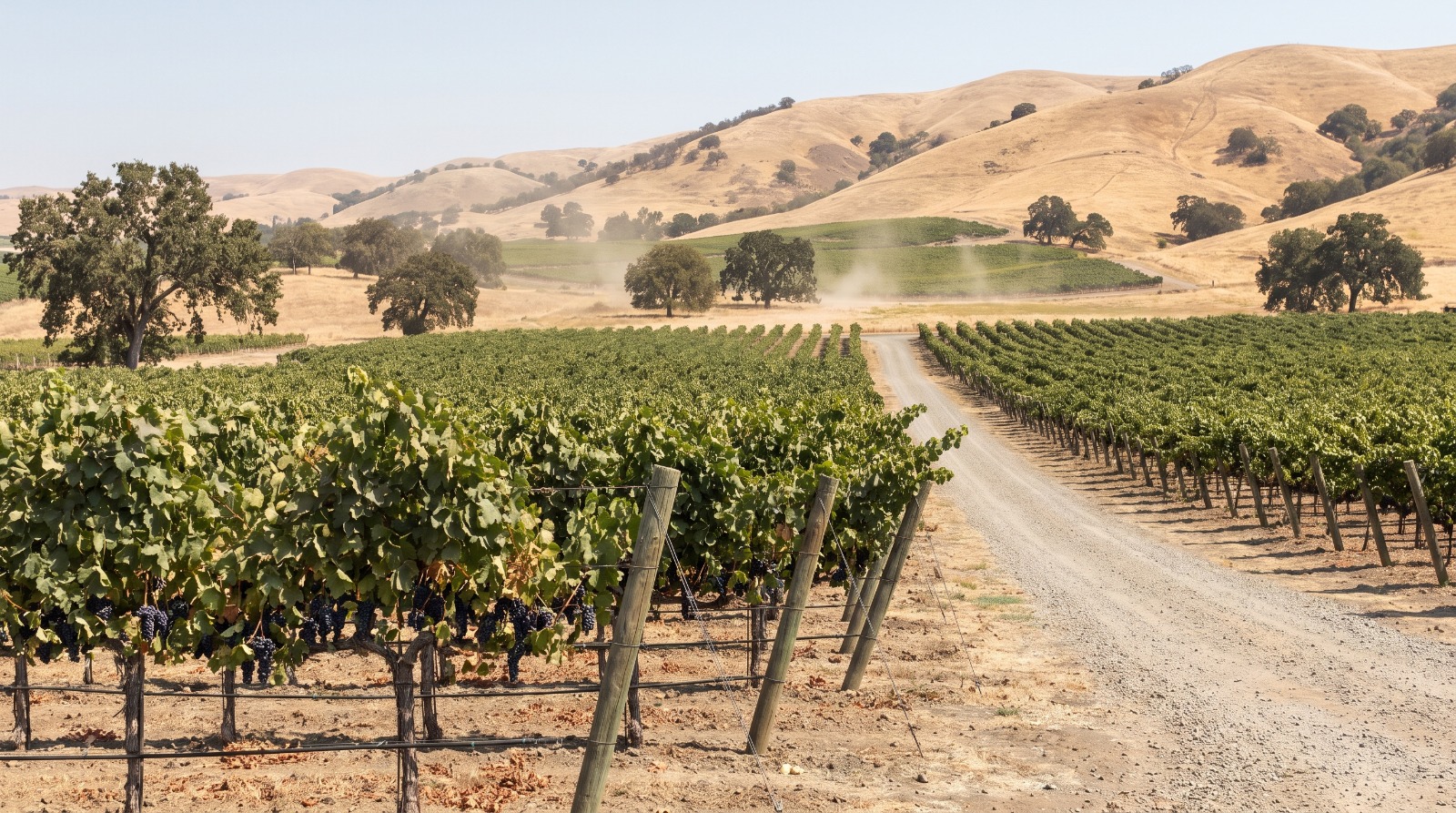
Rows of wine grapevines on the Livermore Valley floor along Tesla Road, where Wente is selling land. Photo: Houseberry
About $32,600 an acre. That is the only real price signal attached to the Wente land story so far, and it tells you almost everything you need to know. Wente Family Vineyards is negotiating the sale of at least 1,500 acres in and near Livermore, and the City of Livermore itself is one of the parties at the table. If you read that as 1,500 acres of future subdivisions, stop. Two voter-approved growth boundaries and a 100-acre minimum lot size sit between that land and a single new tract home.
The numbers that matter:
- At least 1,500 acres across 15 parcels were the subject of a Livermore City Council closed session on July 27, 2026.
- A separate Wente property of about 244 acres at 6741 Tesla Road is pending at $7,950,000, which is roughly $32,600 an acre.
- Livermore's citywide median sale price was $1.27 million in July 2026.
- That means the entire 244-acre parcel is priced at about six median Livermore houses.
What is actually on the block
Reporting from Pleasanton Weekly puts the figure at "at least 1,500 acres" of Wente-owned land, some of it neighboring The Course at Wente Vineyards. The July 27 closed-session agenda described instructions to the city's negotiators on price and terms of payment. Afterward, officials reported no action.
Karl Wente framed the move as staying open to opportunities, not as a sale under pressure. No asking price for the 1,500 acres is public. No broker has been named. The paper itself noted that some of the parcels were not accessible on the Alameda County assessor's online parcel viewer, which is an unusually honest caveat and worth carrying forward: nobody outside the negotiation currently knows the exact boundaries of what is being sold.
One more thing to keep in mind while reading anything about this. As of publication, the story has been carried by Embarcadero Media papers and nobody else. No Chronicle, no Business Times, no trade coverage. That does not make it wrong. It does mean the details may move.
Why the city is the one negotiating
This is the tell. When 1,500 acres of private land comes up and the buyer at the table is a municipality rather than a homebuilder, it is usually because a homebuilder cannot use it. Cities and public agencies can acquire restricted land for open space, parks, trails, water, or agricultural preservation. A developer buying it would be buying a very expensive view.
The two growth boundaries that decide everything
Livermore voters approved the South Livermore Urban Growth Boundary Initiative on March 7, 2000, committing the city to a permanent line on its southern edge past which urban development is barred. Non-urban uses like agriculture, parks and open space are still allowed. The city adopted a companion North Livermore boundary in December 2002 after its own vote. Neither can be moved by a council. Both require another citywide election.
Layered on top is Alameda County's Measure D, passed the same year, which drew an East County urban growth boundary and folded it into the East County Area Plan in 2002. The county's own 20-year review found no amendments and no expansion of that boundary in two decades. Two locks, two different electorates, one piece of land.
What the zoning actually allows
Livermore's own code implements the agricultural side of this through Chapter 2-85, the South Livermore Valley Agricultural district. The rules are specific and they are not friendly to houses.
| SLV-AG rule | What it permits |
|---|---|
| Minimum lot size | 100 acres for new lots |
| Homes | One single-family home per lot |
| Boutique wineries | 100 to 5,000 cases, permitted outright |
| Larger wineries | Conditional use permit required |
| Site coverage | 20 percent maximum |
| Height limit | 40 feet |
Do the arithmetic on 1,500 acres at one home per 100-acre lot and the theoretical maximum is fifteen houses. Fifteen. That is the ceiling before anyone gets to Measure D's separate cap on non-residential building intensity, and before the South Livermore Valley Specific Plan, which governs roughly 1,891 unincorporated acres just south of the city line and required new vineyard planting under permanent agricultural easement as the price of development inside it. That plan is the reason the valley looks the way it does.
The price is the proof
Land you can build houses on and land you cannot are not the same asset, and the market prices them accordingly. At about $32,600 an acre, the pending Tesla Road parcel is priced as farmland with a view, not as a development site. Compare that to what finished housing costs a few miles north.
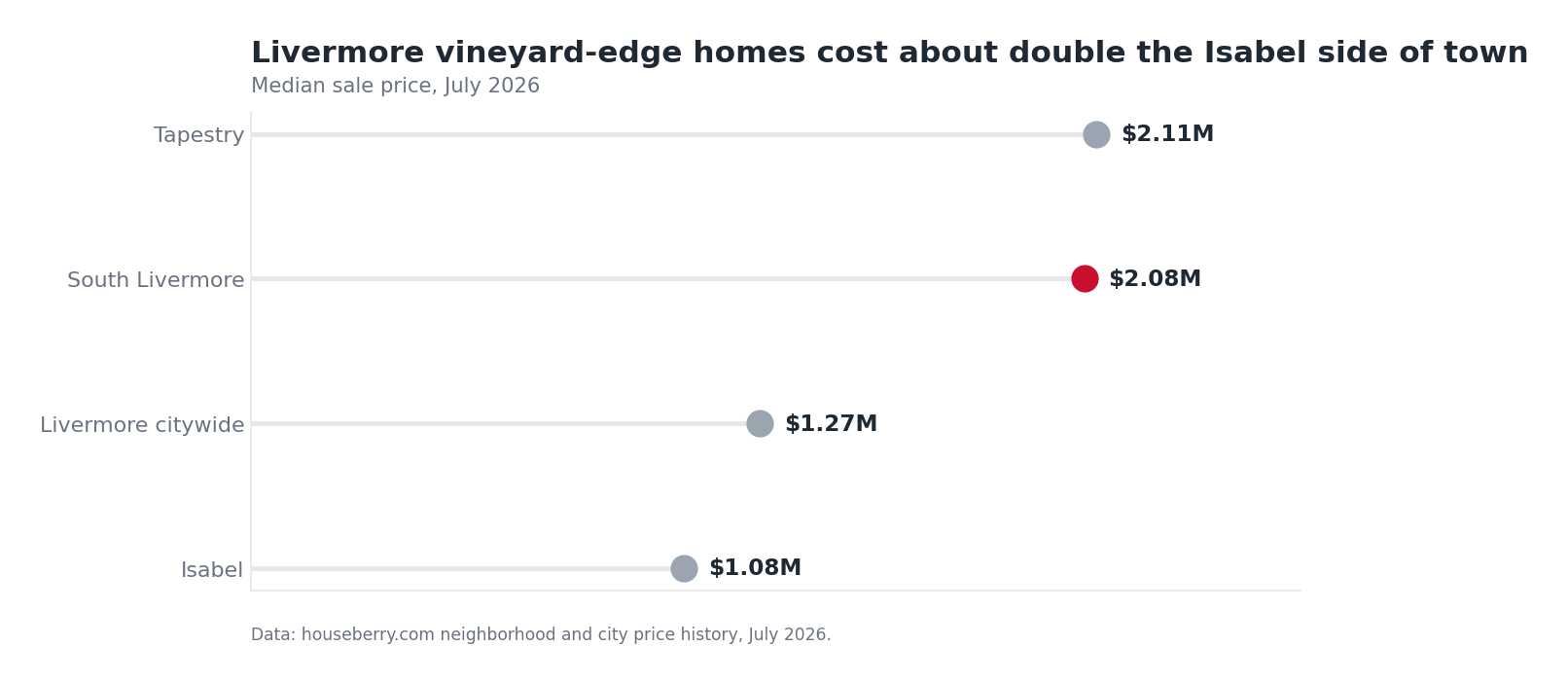
| Place | Median sale price, July 2026 | Houseberry overall score |
|---|---|---|
| Tapestry | $2.11M | 4.1 |
| South Livermore | $2.08M | 4.2 |
| Livermore citywide | $1.27M | 3.4 |
| Isabel | $1.08M | 4.0 |
South Livermore is our top-ranked Livermore neighborhood out of 42, at 4.2 out of 5 overall, and it costs about $1 million more than Isabel, which scores 4.0 and has the best school score in the top ten at 4.7. That spread is the vineyard premium in a single line. People are paying roughly $1 million for proximity to the same landscape Wente is now selling by the acre. Nothing about a change in who owns the vines moves that number.
What this does and does not mean
It does mean a large ownership change is possible in the valley's signature landscape, and that a public agency may end up holding land that has been privately farmed for generations. It also means any entitlement that runs with the land travels to the buyer, including the Beyer Ranch winery project the Alameda County Planning Commission approved back in February 2018 for the Tesla Road parcel.
It does not mean new housing supply, a shift in Livermore's price trajectory, or a growth boundary about to loosen. A 2021 general-plan discussion about revisiting the boundary went nowhere, and it would have needed a public vote regardless. If you are watching for the thing that would actually change Livermore's math, it is a ballot measure, not a land sale.
The trade-off nobody in Livermore likes saying out loud
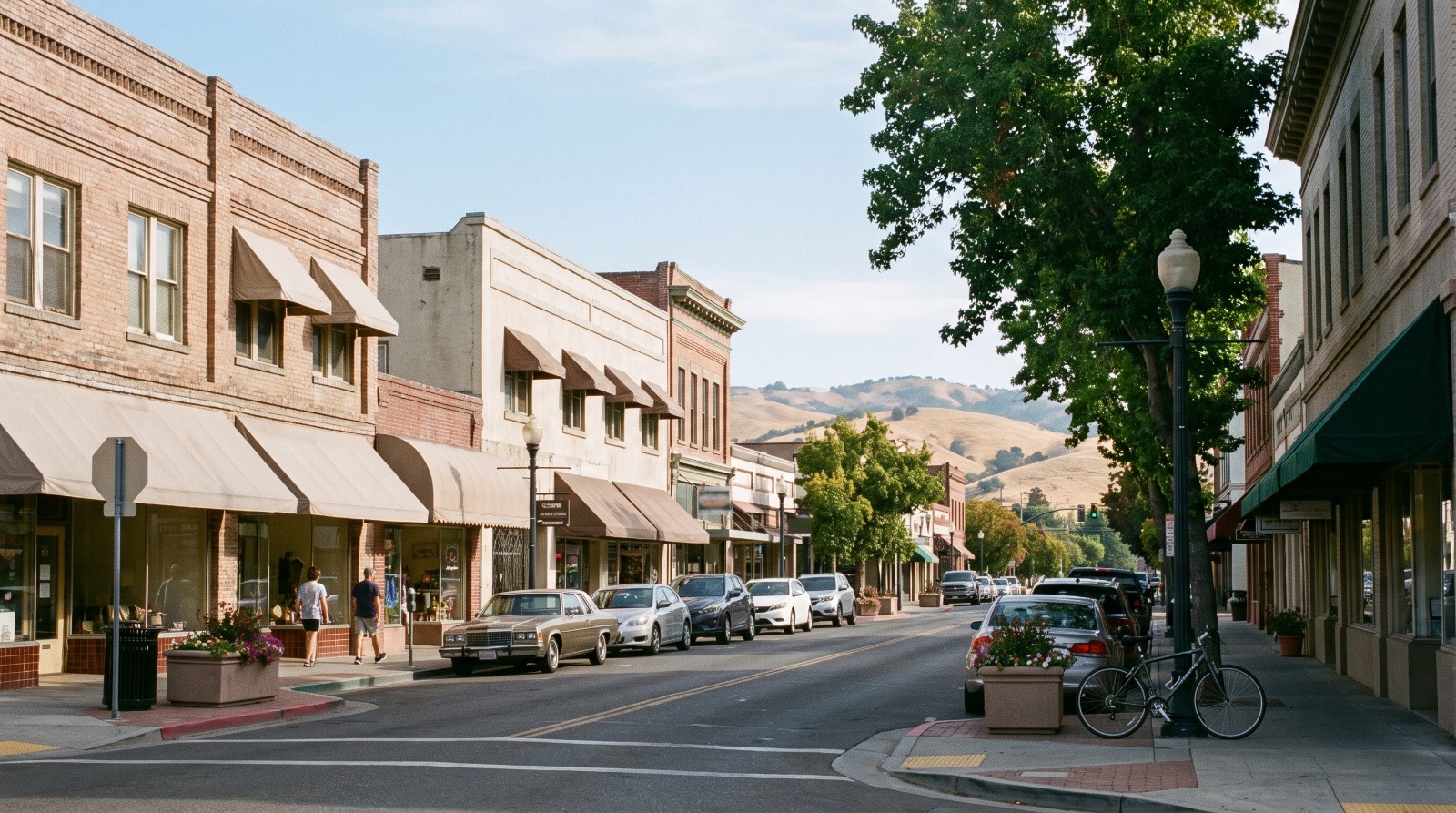
The boundaries did the job they were sold on. Drive south from downtown and you hit vineyards instead of the subdivisions that filled in Tracy. That is a real public good and I would vote for it again.
It also has a price, and Livermore residents pay it. A city that cannot grow outward has to grow upward and inward or not at all, and Livermore has not been fast about either. The citywide median has been stuck near $1.27 million, and the cheapest neighborhood in our top ten still asks $1.08 million. Only nine of the 42 Livermore neighborhoods we rank score above 3.8 overall, which is not a supply-rich city describing itself. You do not get to keep the open valley and complain about the prices. You get to keep the open valley and build more homes downtown and along the Isabel Avenue corridor, or you get the prices.
Quick answers
Can the Wente land become housing? Not under current law, beyond roughly one house per 100 acres. Changing that requires a citywide vote in Livermore and, for county land, a countywide vote under Measure D.
Is the land inside Livermore city limits? The reporting says "in and near" the city limits and does not break it down. Treat any more specific claim as unconfirmed.
Who is buying it? Unknown. The City of Livermore was negotiating in closed session on July 27, 2026 and reported no action afterward.
Does this change Livermore home prices? No. It changes ownership of land that could not be built on either way.
What is Livermore vineyard land worth per acre? About $32,600, based on the one pending listing with a public price. One data point is one data point, so hold it loosely.
The bottom line: a headline with 1,500 acres in it looks like a housing story and is not one. The useful comparison is still the boring one. Six median Livermore houses cost the same as 244 acres of Livermore Valley. That is what a growth boundary looks like when you price it. When we compare places at Houseberry, this is exactly the sort of constraint that explains a neighborhood's price better than anything in the listing.
Sources
- Pleasanton Weekly, Wente eyes sale of at least 1,500 acres in Livermore Valley, August 10, 2026
- Imagine Livermore 2045 General Plan, introduction and growth boundary history
- Alameda County, Measure D 20-year review presented to the Board of Supervisors, March 2022
- Livermore Municipal Code Chapter 2-85, South Livermore Valley Agricultural district
- City of Livermore, South Livermore Valley Specific Plan
- Independent News, Possible urban growth boundary change considered for Livermore
- Houseberry price history for Livermore, South Livermore, Tapestry and Isabel, July 2026
Map of Livermore Neighborhoods
Loading map...
View Full Map
Top Neighborhoods in Livermore, CA


All information provided on this website including but not limited to - school ratings, safety, amenities, user opinions, and property data - is for general informational purposes only. We do not guarantee its reliability, accuracy, or completeness. Users should independently verify information and consult appropriate professionals as needed. By using this website, you agree Houseberry is not responsible for actions, decisions, or consequences arising from reliance on the information provided
houseberry.com - CA DRE# 01847391
 Bay East ©2025. CCAR ©2025. bridgeMLS ©2025. Information Deemed Reliable But Not Guaranteed. This information is being provided by the Bay East MLS, or CCAR MLS, or bridgeMLS. The listings presented here may or may not be listed by the Broker/Agent operating this website. This information is intended for the personal use of consumers and may not be used for any purpose other than to identify prospective properties consumers may be interested in purchasing. Data last updated at September 26, 2026 12:00 AM