The Alameda Rezoning: 18 Townhomes on a 60-Year Vacant Lot
San Jose filed the environmental review for 18 townhomes at The Alameda and Emory Street, on a lot that has sat vacant since 1965. What the rezoning does, what it costs the trees, and what the blocks on either side already score.
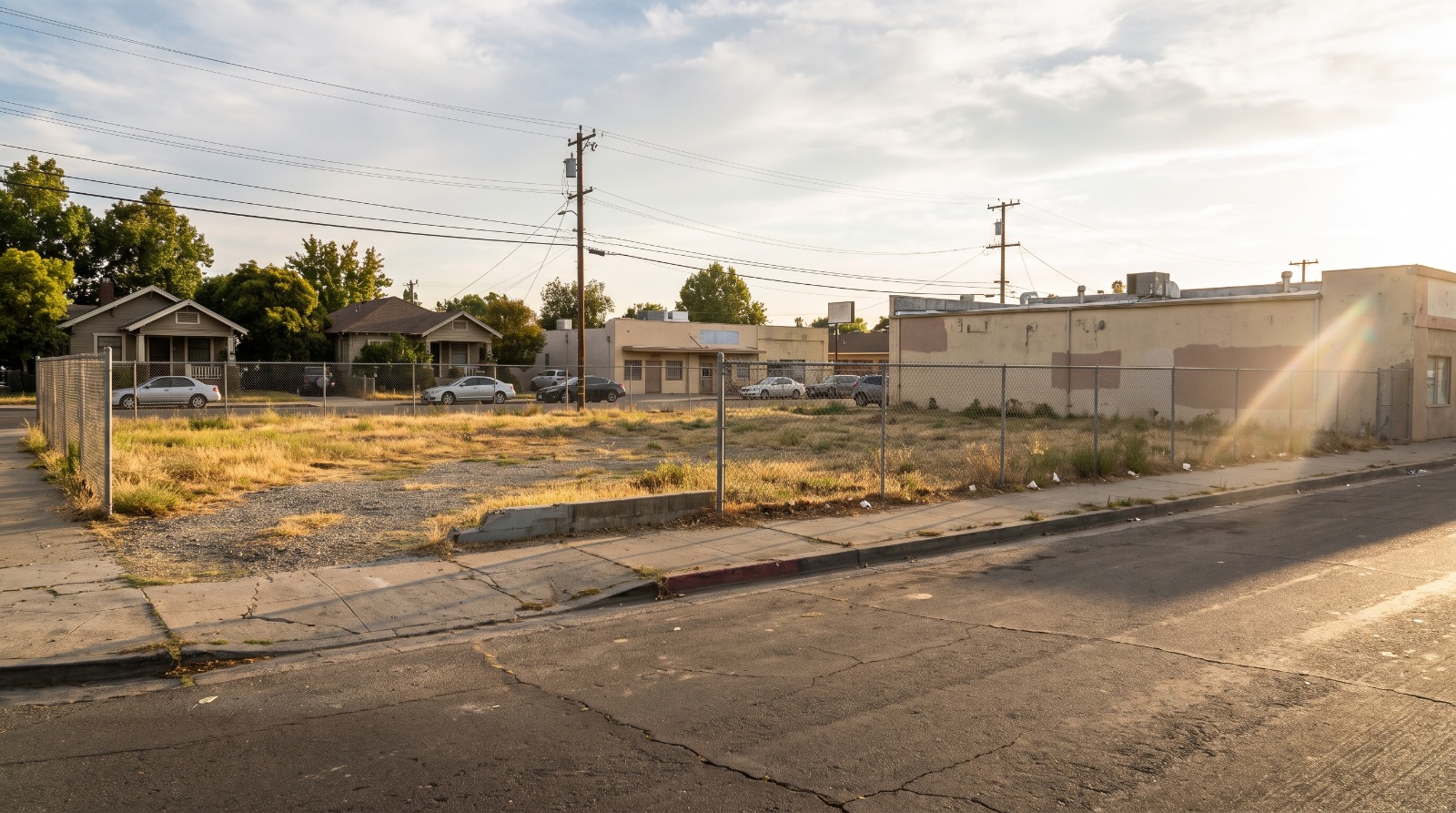
The vacant corner lot at The Alameda and Emory Street in San Jose where 18 townhomes are proposed Photo: Houseberry
The lot at the northeast corner of The Alameda and Emory Street in San Jose has been empty since 1965. On September 18, 2026 the city filed the environmental review that could finally end that run: a General Plan Amendment and rezoning to allow 18 townhomes in five buildings on 0.99 acres. Public comment closes October 8, 2026.
No newspaper has written a word about it. That is normal for a project this size, and it is also the reason small filings like this one are worth reading. Eighteen homes will not move San Jose's housing numbers. What the paperwork says about the land underneath them is a different story.
What is actually proposed at The Alameda and Emory
The proposal is small, specific, and unusually easy to picture. Five buildings, three stories each, two with three units and three with four, on an L-shaped parcel of just under an acre. Two 26-foot driveways off Emory Street, nothing off The Alameda. Roof ridges at 36 to 37.5 feet. The applicant is Dan Mountsier of Emory Holding LLC, and the city is carrying it under file numbers GP25-002, C26-003, H26-007 and ER25-231.
Here is the whole thing on one page:
| Emory Street Townhomes | What the filing says |
|---|---|
| Site | Northeast corner of The Alameda and Emory Street, San Jose 95126, APN 261-12-084 |
| Size | 0.99 gross acres, L-shaped, vacant since 1965 |
| Homes | 18 townhomes in 5 buildings, 3 stories, 36 to 37.5 feet to the roof ridge |
| Density | 18.2 homes per acre |
| Land use change | Neighborhood/Community Commercial to Mixed-Use Neighborhood |
| Zoning change | A(PD) Agricultural Planned Development to MUN Mixed-Use Neighborhood District |
| Trees removed | 20 total, 17 of them ordinance-size |
| Construction | About 18 months, 379 workdays, 7am to 7pm weekdays |
| Review status | Mitigated Negative Declaration, comments due October 8, 2026 |
Nothing in there is exotic. Three-story townhomes with driveways off the side street is about the most conventional thing you can build on a corner like this. The fight, to the extent there is one, is over the trees and the rezoning, not the building.
A commercial designation that produced no commerce for 61 years
This is the detail worth stopping on. The site is designated Neighborhood/Community Commercial on the General Plan and zoned A(PD), agricultural planned development. It has produced neither a shop nor a crop since Lyndon Johnson was president.
Sixty-one years is long enough to call the experiment. When land sits empty that long under a designation meant to deliver storefronts, the designation is not protecting anything. It is just paperwork that has outlived the market it was written for. San Jose has thousands of parcels like this, and the city is currently rewriting its own rules about them.
We wrote about the bigger version of that rewrite in San Jose's General Plan reset, where staff proposed allowing four to ten homes where one sits now. The Emory Street filing is the retail-scale version: one parcel, one amendment, 18 homes.
Four empty lots, about 304 homes, one corridor
The Alameda is quietly converting. Not through a big specific plan or a headline rezoning, but one long-vacant parcel at a time, each with its own file number and its own small hearing.
Count the ones currently in the pipeline within roughly a mile of this corner: 174 modular apartments at 2165 The Alameda on a half-acre vacant lot, about 100 units at 945 West Julian Street near Diridon, 12 condos at 1038 McKendrie Street on another vacant lot, and these 18.
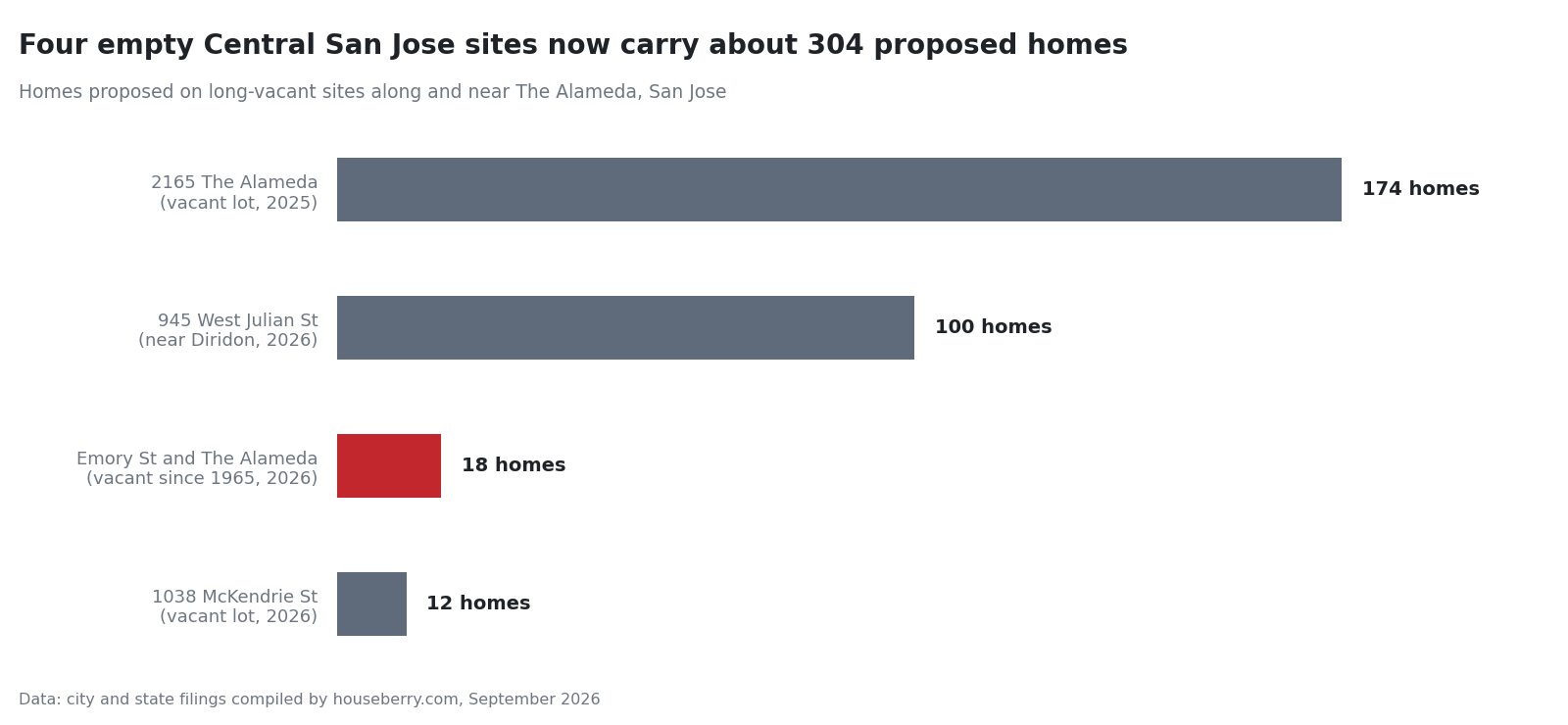
Three hundred and four homes is not a wave. But it is 304 homes on land that was producing nothing, in the most central, most walkable part of a city that spent decades building outward. The Emory Street project is the only one of the four that needs a General Plan Amendment, which is a fair measure of how out of date its designation is.
The trees are what the hearing will be about
Twenty trees come out. Seven are street trees, 13 are on the site, and 17 of the 20 are ordinance-size, which in San Jose means they are large enough to require a permit and a replacement plan to remove.
That is a real cost and it deserves to be named plainly. Mature trees on a Central San Jose corner take decades to replace, and the replacement plantings will be saplings for most of the next 20 years. Anyone who tells you this is a free trade is selling something.
The rest of the mitigation package is the standard Central San Jose list: Tier 4 construction equipment to cut diesel particulate by 60 percent, a vibration monitoring plan because there are historic structures within 200 feet, a Historical Resources Protection Plan, and archaeological monitoring with a Native American representative present during ground disturbance. All of it is in the Initial Study and Mitigated Negative Declaration.
What the blocks on either side of The Alameda actually cost
This corner sits on a seam. To the southwest is Rose Garden, the Central San Jose neighborhood built around the 5.5-acre San Jose Municipal Rose Garden and Rosicrucian Park. To the northeast, between The Alameda and Highway 880, is College Park, the older pocket anchored by Bellarmine College Prep and a Caltrain platform that sees only a few trains a day.
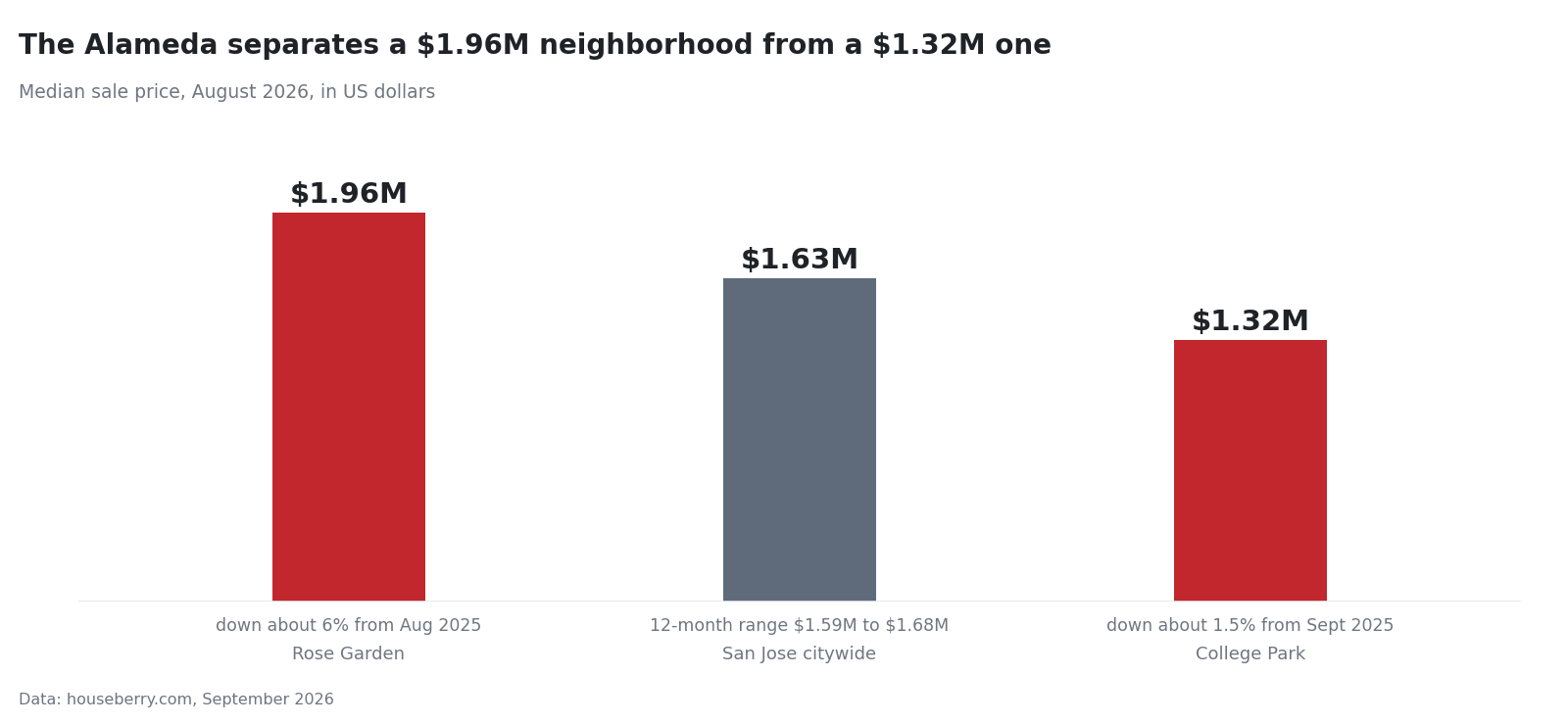
The gap is about $640,000 across one arterial. Rose Garden's median sale price was roughly $1.96M in August 2026, down from about $2.08M a year earlier. College Park's was about $1.32M in August 2026, essentially flat. San Jose citywide sat at about $1.63M, right between them.
The scores tell the same story from a different angle. Rose Garden ranks first of the 112 San Jose neighborhoods we score on amenities at 4.5 out of 5, and 61st overall at 3.5. College Park ranks 10th on amenities at 3.7 and 104th overall at 2.5, dragged down by a 2.1 school score and a 2.7 safety score.
So 18 townhomes are going in between a neighborhood that scores near the top of the city on what is walkable and one that does not clear the middle on much of anything. That is not a warning. It is the reason the corner is worth building on: the amenities are already there, a five-minute walk away, and nobody has to create them.
Questions people are asking about the Emory Street project
Is the rezoning approved?
No. As of September 2026 the project is in environmental review. The Mitigated Negative Declaration was posted for public comment on September 18, and a Planning Commission hearing and City Council action on the General Plan Amendment and rezoning would follow after the comment period closes.
How do I comment before October 8?
Comments go to San Jose's Department of Planning, Building and Code Enforcement, and the city's public notice for the draft MND carries the current contact and submission details. Reference file number ER25-231.
Will these be for sale or for rent?
The environmental filing describes 18 townhome units and does not state the tenure. Townhomes on a site this small are usually built for sale, but until a tract map or a marketing plan surfaces, treat ownership as unconfirmed.
What does a Mitigated Negative Declaration mean?
It means the city found no significant environmental effect that cannot be reduced with specific, enforceable conditions, so no full Environmental Impact Report is required. It is the middle tier of CEQA review, and it is the outcome a small infill project on a vacant lot usually gets.
October 8, then the hearing
The comment deadline is the only fixed date on this project right now. After it passes, the file moves toward a Planning Commission hearing and then a Council vote on the amendment and rezone, and those dates will post on the city's agenda calendar.
If you are shopping this part of San Jose, the practical move is to stop treating The Alameda as a boundary and start watching it as a pipeline. Four vacant parcels, about 304 homes, all of them inside the walkshed of the Rose Garden. When we compare neighborhoods at Houseberry, that is the kind of thing that moves a score over five years, well before it shows up in a listing description: what is being permitted two blocks away, not what is on the market this week.
A good starting point is the full San Jose neighborhood ranking, where Rose Garden and College Park sit 43 places apart with one street between them.
Sources
CEQAnet, Emory Street Townhomes Project, SCH #2026090816
City of San Jose, Initial Study and Mitigated Negative Declaration, Emory Street Townhomes
City of San Jose, public review notice for the draft MND (GP25-002, C26-003, H26-007, ER25-231)
San Francisco YIMBY, new modular housing proposed on The Alameda
San Francisco YIMBY, new housing proposed for 945 West Julian Street
San Francisco YIMBY, 1038 McKendrie Street, San Jose
Houseberry neighborhood data for Rose Garden, San Jose (accessed September 2026)
Houseberry neighborhood data for College Park, San Jose (accessed September 2026)
Map of San Jose Neighborhoods
Loading map...
View Full Map
Top Neighborhoods in San Jose, CA


All information provided on this website including but not limited to - school ratings, safety, amenities, user opinions, and property data - is for general informational purposes only. We do not guarantee its reliability, accuracy, or completeness. Users should independently verify information and consult appropriate professionals as needed. By using this website, you agree Houseberry is not responsible for actions, decisions, or consequences arising from reliance on the information provided
houseberry.com - CA DRE# 01847391
 Bay East ©2025. CCAR ©2025. bridgeMLS ©2025. Information Deemed Reliable But Not Guaranteed. This information is being provided by the Bay East MLS, or CCAR MLS, or bridgeMLS. The listings presented here may or may not be listed by the Broker/Agent operating this website. This information is intended for the personal use of consumers and may not be used for any purpose other than to identify prospective properties consumers may be interested in purchasing. Data last updated at September 21, 2026 12:00 AM