AB 130 Was Supposed to Speed Housing. It Just Stalled 102 Homes
Santa Cruz had to approve a 102-unit affordable building twice. A labor condition in California's new CEQA exemption could not be met, so the city reached for an older law that has no labor rules at all.
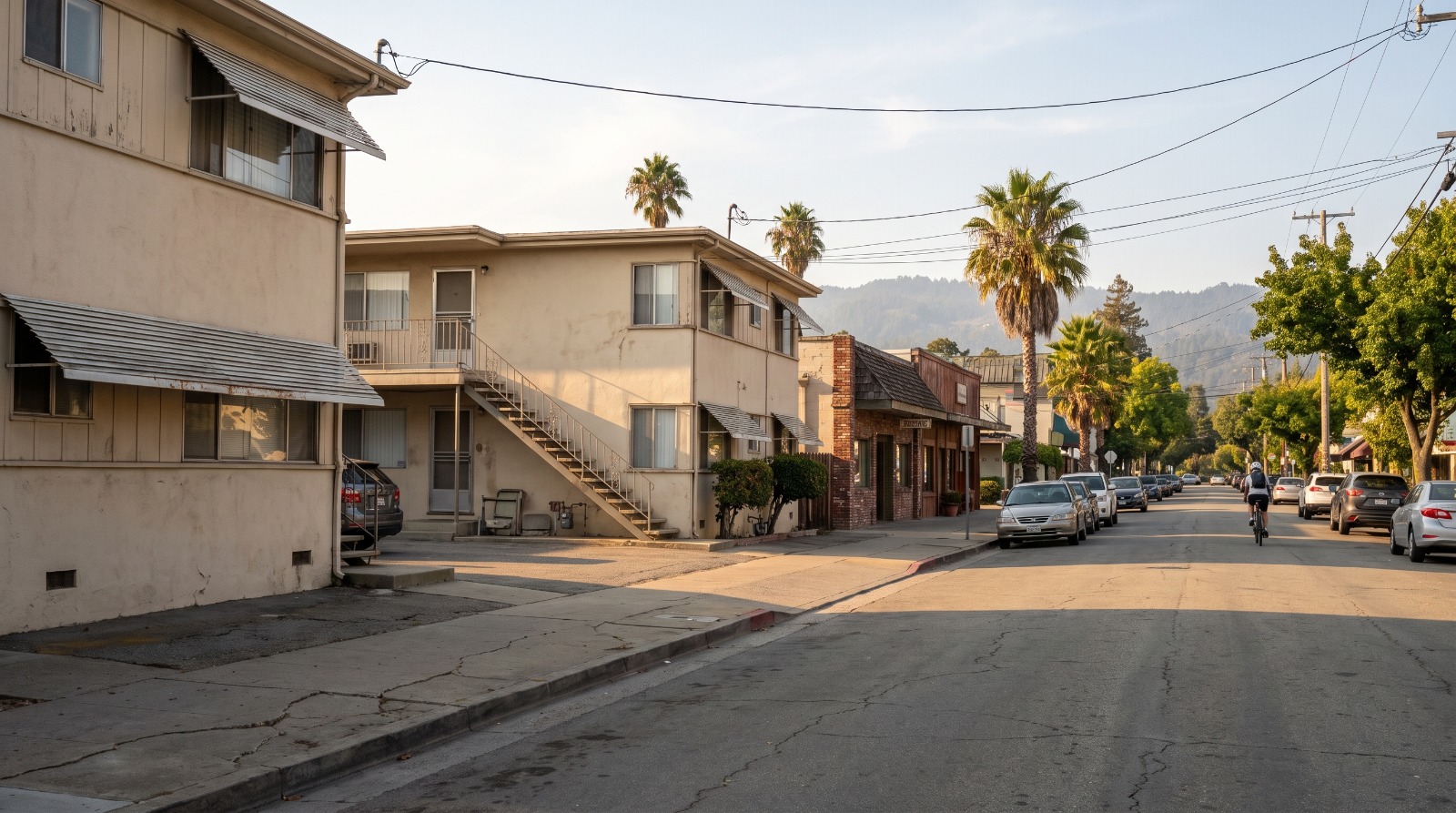
Two-story apartment buildings on the south end of Pacific Avenue in Santa Cruz, the site of the 102-unit Driftwood Flats affordable housing project. Photo: Houseberry
One sentence in a Santa Cruz planning filing posted this morning explains why 102 affordable apartments had to be approved twice. A condition meeting the labor standards in AB 130, California's newest housing law, “now cannot be met,” the city wrote. The fast-track approval the project won in April is void. Santa Cruz rescued the building the same day by re-approving it under a different, older piece of environmental law that carries no labor conditions at all. The apartments are fine. The statute is what broke.
If you have never heard of AB 130, that is normal, and you are going to keep hearing about it. It is the law that ended environmental review for most urban housing in California. This looks like the first documented case of its labor rules costing a real project its exemption, and what the city did next is the more interesting half of the story.
What AB 130 actually changed, for people who have never heard of it
AB 130 let most urban housing in California skip environmental review. Not shorten it. Skip it.
Since 1970, the California Environmental Quality Act has required a public agency to study what a project will do to traffic, air, noise, water and the rest before approving it. For a big apartment building that study runs hundreds of pages, takes a year or more, costs six figures, and opens a window in which anyone can sue over whether the study was thorough enough. The lawsuits are the part that matters. A project does not need to lose one to die. It just needs to be tied up long enough that the financing goes away.
Governor Newsom signed AB 130 on June 30, 2025 as part of the state budget, and it took effect immediately. It created a new statutory exemption at Public Resources Code section 21080.66. Clear its checklist and the environmental document does not get faster. It stops existing.
The checklist, roughly: the site is 20 acres or less, it is inside a city or a census-defined urban area, it was already developed or is surrounded by development, the project matches the local zoning or general plan, it hits at least half the density the state expects there, and it is not on farmland, wetland, high fire, fault zone or protected habitat. We have now watched it work twice in our own coverage area, starting with 264 apartments on Winchester Boulevard in San Jose in August.
AB 130's labor standards live in the part nobody reads
AB 130 is not a free pass for every building. Subdivision (d) attaches labor conditions, and they get heavier as the building gets taller.
The reason is political. Construction unions were never going to hand the Legislature a CEQA rollback for nothing. The State Building and Construction Trades Council wanted skilled-and-trained workforce rules on anything using the new exemption. The California Conference of Carpenters, working in what it called a virtually non-union industry, wanted production and a wage floor instead. CalMatters covered the fight as it landed in the budget on June 24, 2025. The compromise survives in the statute as three tiers.
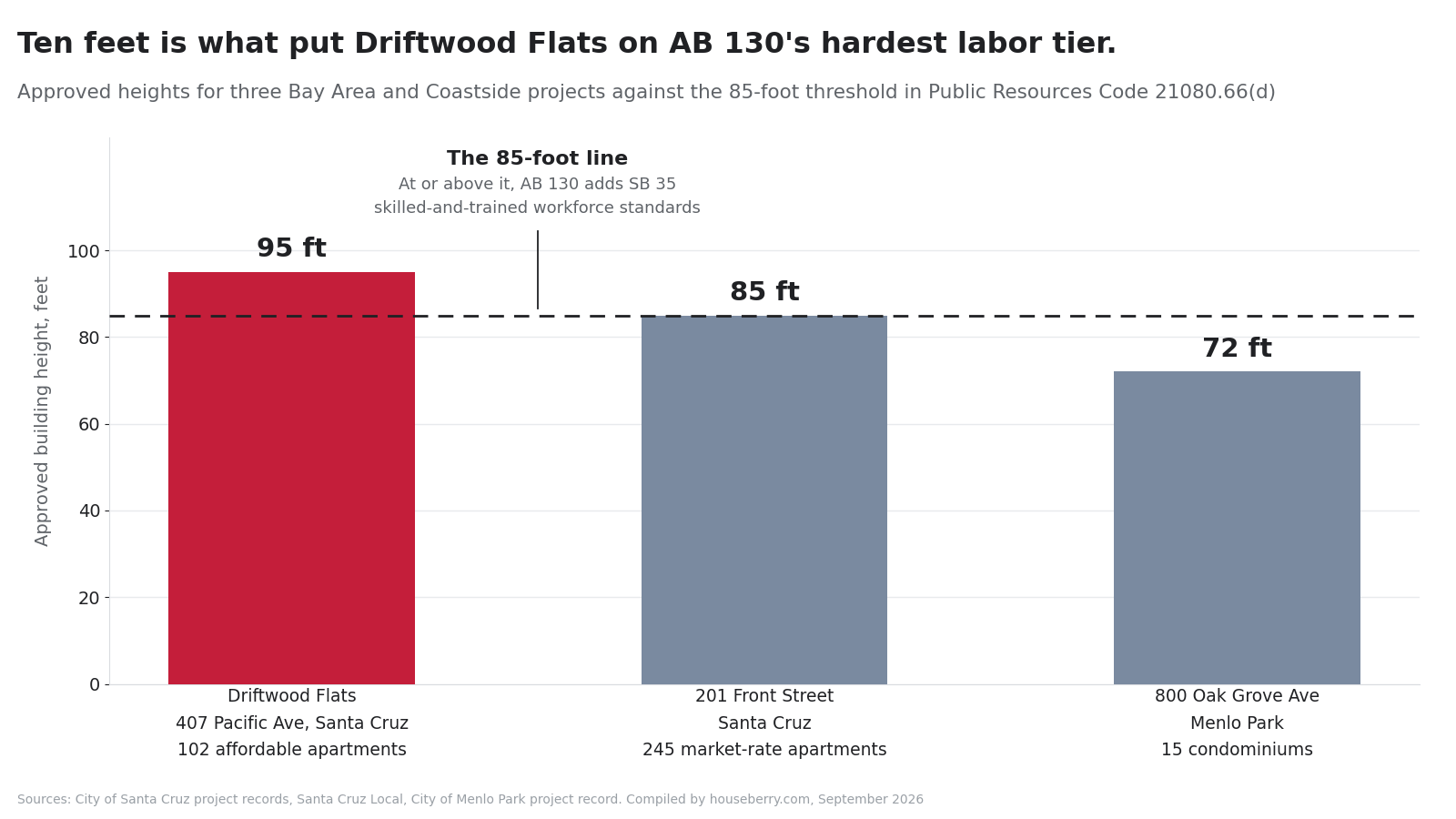
Most projects under 85 feet get no labor conditions at all. A project that is 100 percent affordable to lower income households pays prevailing wage whatever its height. And anything 85 feet or taller has to pay prevailing wage and use a skilled and trained workforce, the standard the law borrows from SB 35 at Government Code section 65913.4(a)(8).
That last phrase is where a layperson usually stops reading, so here is what it means. A skilled and trained workforce is not a wage rule. It is a hiring-pipeline rule. Every craftworker on the job has to be a registered apprentice or a journeyperson, and depending on the trade, 30 to 60 percent of the journeypersons must hold a graduation certificate from a state-approved apprenticeship program. The contractor files monthly reports proving it, and those reports are public.
Meeting that in Oakland or San Jose is a phone call. Meeting it in a county with one mid-sized city in it is a different exercise.
Driftwood Flats landed in both hard tiers at once
Driftwood Flats is a 102-unit, 100 percent affordable building planned for 407 to 415 Pacific Avenue, the low-rise south end of Pacific Avenue near Laurel Street in downtown Santa Cruz, a few blocks inland from the Boardwalk. The developer is CRP Affordable Housing and Community Development. Eight stories, about 95 feet, 34 two-bedroom and 68 three-bedroom apartments over 1,490 square feet of ground floor commercial space. It replaces the Neptune Apartments, whose tenants had to vacate by July 27, 2026 with relocation help and a guaranteed spot in the new building. The Planning Commission approved it unanimously on April 16, 2026.
Read the tiers against those facts and the problem is obvious. The project is 100 percent affordable, so it owes prevailing wage. It is also 95 feet, so it owes the skilled and trained workforce standard on top. Two tiers, one building.
The filing does not say which condition failed, and I am not going to pretend it does. But the odds point one direction. A 100 percent affordable building is financed with federal low income housing tax credits, and prevailing wage is already part of that world. Paying it is routine. Finding general contractors and subcontractors in Santa Cruz County who can certify apprenticeship graduation ratios trade by trade, every month, on a 95-foot building, is not routine. That is my read of the most likely wall, not the city's statement, and the staff report on the modification is the document that will settle it.
The workaround was a law from a different era
Santa Cruz did not fight the problem. It swapped statutes. The new Notice of Exemption leans on Public Resources Code section 21083.3 and CEQA Guidelines section 15183, and those carry no labor conditions whatsoever.
In plain language, section 15183 says that if a city already did a full environmental study for its general plan, a project that fits inside what that study already analyzed does not need its own. Santa Cruz has a certified General Plan 2030 EIR and a Downtown Plan Expansion supplemental EIR. Driftwood Flats sits inside the buildout those documents already examined, the city found no new impacts peculiar to the project, and the exemption held.
Same building. Same 102 homes. Same block. Different statute, and a very different set of obligations attached to it.
| AB 130 infill exemption (PRC 21080.66) | General plan consistency (PRC 21083.3, CEQA Guidelines 15183) | |
|---|---|---|
| What it does | Full statutory CEQA exemption for qualifying infill housing | Streamlined review for a project consistent with a certified general plan EIR |
| In force since | June 30, 2025 | A long-standing part of CEQA practice |
| Labor conditions | Prevailing wage for 100 percent affordable projects, plus skilled and trained workforce at 85 feet or taller | None |
| What the city must already have | Nothing beyond zoning and the site checklist | A certified program-level EIR the project fits inside |
| Used at 407 Pacific Avenue | April 2026 approval | September 2026 refiling |
That table is the whole finding. AB 130's labor deal only binds projects that use AB 130. A city that did its general plan homework has another door, and walking through it costs a developer nothing but paperwork.
So are the 102 apartments stalled or not?
The homes are not cancelled and never were. What stalled was the approval, not the project.
The practical cost is time and risk. Five months after a unanimous approval, the city had to redo the environmental finding and reopen the conditions, and the modification also asks for an additional density bonus concession. Tenants are already out. Driftwood Flats also carries a second building on its back. It is the off-site affordable housing required for Lincoln Property Company's 245-unit market-rate project at 201 Front Street, so roughly 347 homes in one small downtown ride on this paperwork holding together.
One detail worth noticing without reading intent into it. The market-rate building at 201 Front Street is capped at exactly 85 feet. The affordable one is 95.
What 102 deed-restricted homes do in a $1.47 million city
Santa Cruz passed the point of an affordability problem on the horizon a long time ago. The citywide median sale price was about $1.47 million in August 2026, down from roughly $1.56 million in June. A softer year at that level is still a market where an ordinary Santa Cruz salary does not buy a house, which is why 102 permanently deed-restricted apartments matter more than the number suggests.
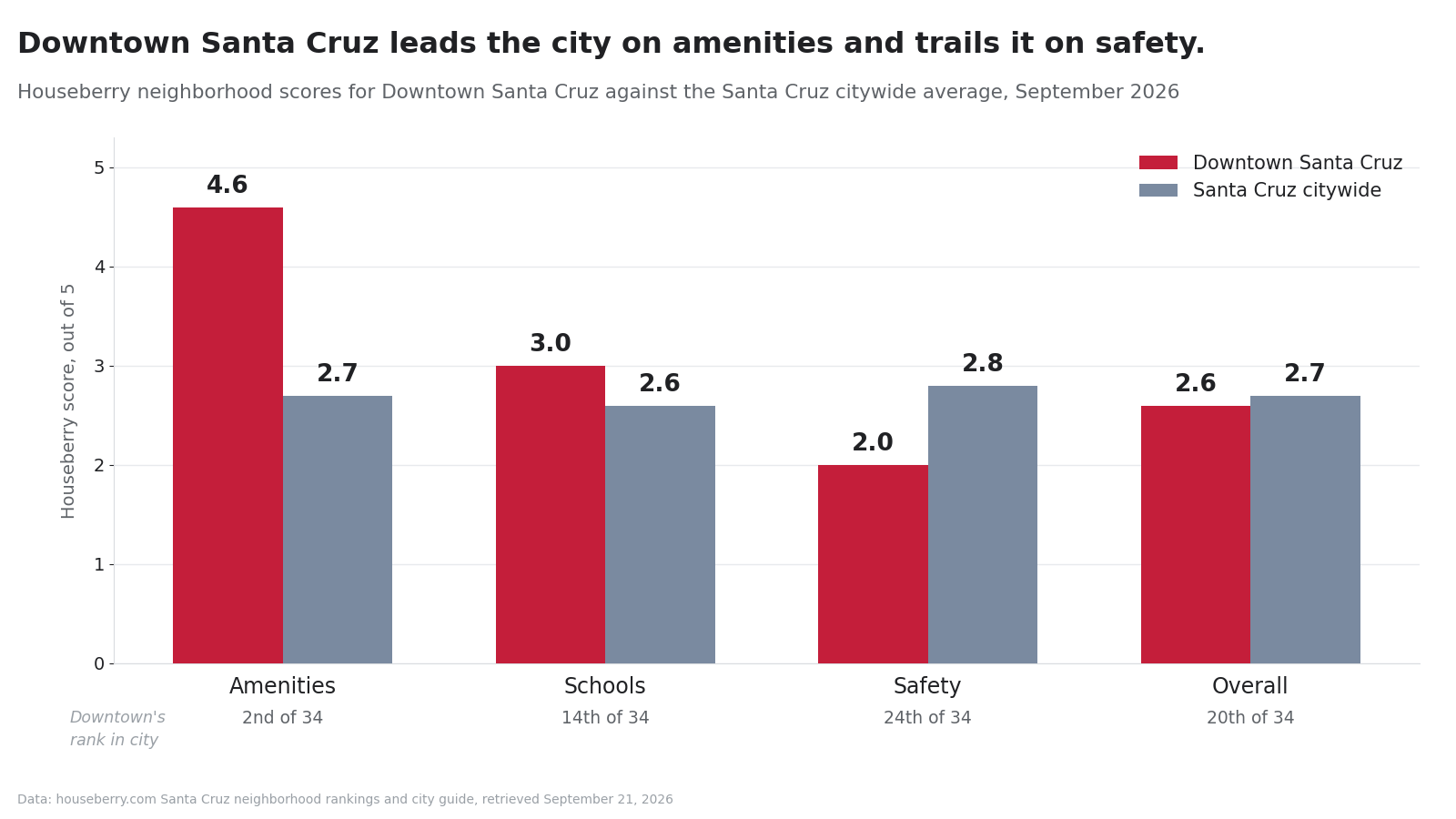
The location is the interesting part. Downtown Santa Cruz rates 4.6 out of 5 on amenities, second of the 34 neighborhoods we score in the city, and 2.0 out of 5 on safety, which puts it 24th. The blended score lands at 2.6, which ranks it 20th, just under a citywide 2.7.
Read those two numbers together and you have the actual trade these 102 households make. They get the most walkable address in the county, groceries and transit and work within a few blocks, no car required. They also get the part of town the police blotter knows best. When we compare neighborhoods at Houseberry, that split is the thing we want people to see before they sign anything, because a strong overall score and a strong daily-life fit are not the same question. For a household that would otherwise commute in from Watsonville or over Highway 17, a 2.0 on safety and a 4.6 on amenities may be an easy trade. For someone with a kindergartner, less so.
The honest cost of the workaround
Someone did lose something here, and it was not the developer or the future tenants. It was the construction workers.
The Legislature attached a labor floor to 95-foot buildings on purpose. It was the price the trades extracted for giving up CEQA leverage, and it is the reason a lot of Democrats voted for the bill at all. A 95-foot building is now going up in Santa Cruz without that floor, through a door the deal never contemplated.
I am firmly on the side of building this thing. One hundred and two permanently affordable homes in downtown Santa Cruz is worth more to this county than a procedural point, and a labor condition that would have killed affordable housing in one of the most expensive markets in America is a condition doing the opposite of its job. But being pro-housing does not require pretending the trade was free. The cleaner fix is for the Legislature to decide whether the 85-foot line should apply to 100 percent affordable buildings at all, rather than letting the answer depend on whether a city happens to own a certified general plan EIR.
Because that is what it depends on right now. A well-planned city can offer the exit. A city that never certified a program EIR cannot, and its projects eat the labor conditions. That is a strange way to decide who gets paid what.
Where this shows up next
The next document to watch is the Santa Cruz staff report on the modification, which has to name the condition the filing only gestures at. After that, the interesting question is how many other projects have quietly done the same thing.
Any 100 percent affordable building over 85 feet approved under section 21080.66 since mid-2025 is sitting on the same tripwire, and any of them in a city with a certified general plan EIR has the same escape hatch. Menlo Park's 800 Oak Grove Avenue project, which we covered this week, came in at 72 feet and never touched the line. The ones to check are the towers.
If you are shopping downtown Santa Cruz, none of this changes what you should look at. It just means that a headline about a project being delayed is usually a story about paperwork, not about the neighborhood. The block is the thing that will still be there in ten years, and that is the part worth researching first. Our Santa Cruz neighborhood rankings are a reasonable place to start.
Sources
CEQAnet, Notice of Exemption, SCH 2026090868, Driftwood Flats, City of Santa Cruz, posted September 21, 2026
City of Santa Cruz, 407 Pacific Avenue project page, project CP26-0076, major modification to CP25-0156
Santa Cruz Local, “Design revealed for 8-story Pacific Ave. apartments in Santa Cruz,” January 23, 2026
Santa Cruz Local, “Tenants set to be displaced by new affordable housing in Downtown Santa Cruz,” April 25, 2026
City of Santa Cruz, 201 Front Street mixed-use project use narrative, CP25-0116
Holland & Knight, “California Legislature Enacts Major CEQA Reforms for Housing-Rich Infill Projects,” July 2025
Buchalter, “Effective Immediately: California Adopts Consequential Reforms to CEQA and Other Laws to Speed Housing Production,” July 2025
Associated General Contractors of California, skilled and trained workforce requirements
CalMatters, “California lawmakers weigh construction wage change in budget,” June 2025
Houseberry, Santa Cruz neighborhood rankings and city guide, retrieved September 21, 2026
Map of Santa Cruz Neighborhoods
Loading map...
View Full Map
Top Neighborhoods in Santa Cruz, CA




All information provided on this website including but not limited to - school ratings, safety, amenities, user opinions, and property data - is for general informational purposes only. We do not guarantee its reliability, accuracy, or completeness. Users should independently verify information and consult appropriate professionals as needed. By using this website, you agree Houseberry is not responsible for actions, decisions, or consequences arising from reliance on the information provided
houseberry.com - CA DRE# 01847391
 Bay East ©2025. CCAR ©2025. bridgeMLS ©2025. Information Deemed Reliable But Not Guaranteed. This information is being provided by the Bay East MLS, or CCAR MLS, or bridgeMLS. The listings presented here may or may not be listed by the Broker/Agent operating this website. This information is intended for the personal use of consumers and may not be used for any purpose other than to identify prospective properties consumers may be interested in purchasing. Data last updated at September 21, 2026 12:00 AM