Winchester Blvd San Jose: 264 Homes Skip CEQA Review
San Jose posted a Notice of Exemption on August 24 for 264 apartments at 741 S. Winchester Boulevard, using the new AB 130 infill exemption. No environmental study, no negotiated mitigation. Here is what that changes on the corridor.

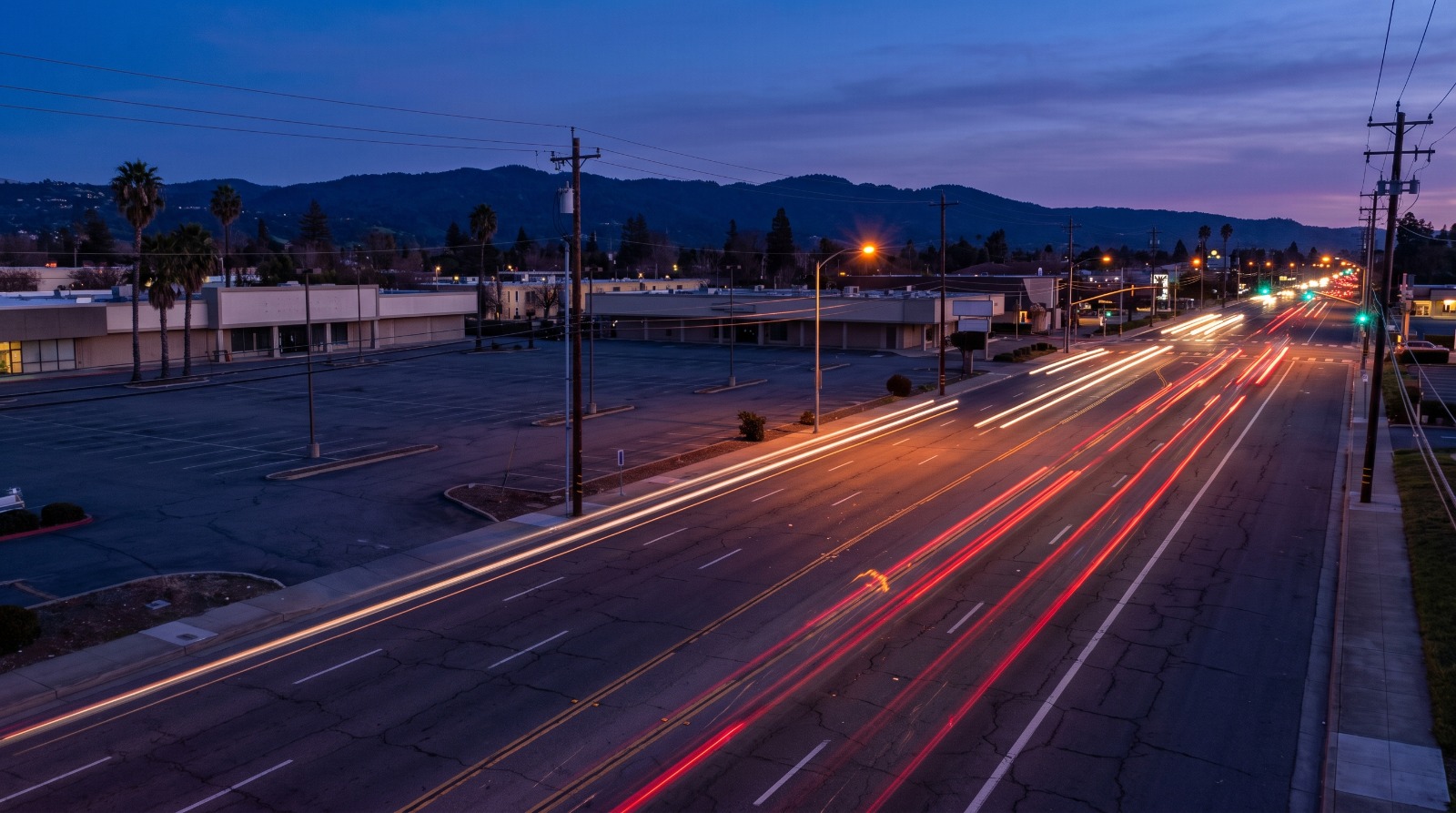
South Winchester Boulevard in San Jose at dusk near the site of a proposed 264-unit apartment building between Riddle Road and Neal Avenue. Photo: Houseberry
On August 24, 2026, San Jose posted a two-page Notice of Exemption for 264 apartments at 741 S. Winchester Boulevard, and that piece of paper is the news. Not the unit count. The filing, SCH 2026080820, cites a statutory exemption under Public Resources Code section 21080.66, the AB 130 infill exemption, which means a seven-story building on 2.97 acres cleared California environmental review without a study, a negotiated mitigation package, or the two years those normally take.
The short version: a project that has been stuck since a builder's remedy filing in September 2023 just had its longest remaining delay deleted by a change in state law, on a corridor that already has a 17-story tower in review a mile north. If you want to know what the CEQA reforms of the last two years actually do on the ground, this is what it looks like on the ground.
What a statutory exemption actually removes
A statutory exemption is different in kind from the categorical ones cities have used for years. The notice does not argue that this project has no significant effects. It states that the project meets criteria the Legislature wrote down: a qualifying housing development on a site of a certain size and density, in an urban area, consistent with the general plan and zoning, not on protected lands and not on a hazardous site.
Meet the criteria and the analysis does not happen. There is no draft environmental impact report, no comment period on traffic modeling, no mitigated negative declaration for a neighborhood group to challenge in Santa Clara County Superior Court. For two decades, that challenge was the main tool available to anyone who wanted to slow a project down, and it was used against good projects and bad ones with equal enthusiasm.
I am in favor of this change and I will say the honest cost of it in a minute. First, the site.
A dome theater, 2.97 acres and 23 trees
The parcel is APN 299-45-021, on the west side of Winchester between Riddle Road and Neal Avenue, a few minutes south of Santana Row and Westfield Valley Fair. Anyone who grew up in the West Valley knows it as the Century 24 dome, one of the last of the Syufy family's round theaters. The applicant is SyRES Properties, the Syufy real estate arm, which is why the theater company owns a development site in the first place.
The 2023 builder's remedy application described 264 homes as 35 studios, 113 one-bedrooms and 116 two-bedrooms, designed by Lowney Architecture, with roughly 20 percent affordable. The August 2026 exemption notice confirms the 264-unit, seven-story program, a Site Development Permit under the Housing Accountability Act, a State Density Bonus of about 9.8 percent, multiple waiver requests, and removal of 23 trees, 14 of them ordinance-size.
Fourteen protected trees is a real loss and it deserves to be said plainly rather than buried. It is also 2.97 acres of surface parking and a dead cinema producing zero homes in a county whose median sale price hit $1,955,000 in July 2026. Trees can be replanted at a ratio the city sets. Land next to a transit-served retail district cannot be manufactured.
Winchester Boulevard is quietly becoming a housing corridor
Look at the boulevard as one line instead of a series of parcels and the pattern is obvious.
| Project | Homes | Height | Status |
|---|---|---|---|
| 741 S. Winchester Blvd | 264 | 7 stories | CEQA exemption posted August 24, 2026 |
| 1073 S. Winchester Blvd | 61 | 6 stories, about 75 feet | Approved at Planning Director's Hearing, August 25, 2021 |
| 826 N. Winchester Blvd | Tower proposed | 17 stories | Entered public review, December 2024 |
That is a strip of mid-century commercial frontage converting to mid-rise housing one parcel at a time, without a specific plan, a rezoning campaign or a single ribbon cutting. Winchester works for this because it is wide, already zoned commercial, walkable to a genuine retail destination, and lined with buildings nobody will miss. The general plan reset San Jose staff have been pushing, which contemplates eight stories near Santana Row, would formalize what the market is already doing here.
It is the same direction the council chose when it voted to raise residential density citywide earlier this month. Winchester is where that policy meets asphalt first.
The neighborhood next door: third of 112 on amenities, 2.7 on schools
The 264 households moving in here will functionally live in Santana Row, the 42-acre mixed-use district a quarter mile north that is the closest San Jose comes to a European shopping street. Our scores on it are lopsided in a way that tells you exactly what you would be buying into.
Santana Row scores 3.0 out of 5 overall, which ranks 73rd of the 112 San Jose neighborhoods we score. But it ranks third of those same 112 on amenities at 4.2, carries a 4.9 on nearby merchants and a 4.2 on curb appeal, and then lands at 2.7 on schools and 3.0 on safety.
That spread is the trade every dense San Jose neighborhood makes. You get restaurants at the doorstep and a walk score most of the South Bay would envy, and you get a school assignment that is well below the 3.1 San Jose citywide school average. For a two-bedroom renter without kids, that is a fine bargain. For a family choosing between here and Cambrian, it is the whole decision, and it is the reason we tell people to look at the area before the address.
On price, one honest caveat. Santana Row is a condo and apartment district with too few detached sales to produce a stable neighborhood median, so our page falls back to the San Jose citywide figure of about $1.63 million in July 2026. Treat that as a city number, not a Santana Row number.
The question the notice does not answer
How many of the 264 will be affordable? The Notice of Exemption does not say, and that omission matters more than it looks.
A State Density Bonus of about 9.8 percent is small. Under California's density bonus law, a bonus that size is typically bought with a modest affordable set-aside, well short of the 20 percent the 2023 filing described. The builder's remedy path, which is what got this project standing in the first place back when San Jose lacked a compliant housing element, carries its own affordability requirement. Which of those governs the final approval is a question for the Site Development Permit, not the CEQA notice.
This is the honest cost of the faster path. When a project ran through an environmental review, the public got a document, a comment period and a hearing where questions like this got asked in front of a decision-making body. AB 130 removes the study, and it removes that venue with it. The affordability terms are still negotiated, and the trees are still replaced, but fewer people are in the room. Faster housing is worth that trade. Pretending there is no trade is how you lose the argument with the people who have to live next to it.
What to watch on Winchester
The Site Development Permit is the next real document, and it is where the affordable count, the parking ratio, the tree replacement plan and the ground-floor treatment get set. San Jose's supervising planner on the file is Cort Hitchens. Anyone who cares how this building meets the sidewalk should be reading that file, because the CEQA venue that used to carry those arguments is gone.
The second thing to watch is whether 741 S. Winchester is a one-off or a template. If the next three infill applications in San Jose come in under section 21080.66 the same way, the corridor fills in faster than any specific plan would have managed, and the West Valley gets its first real mid-rise spine. That is a bigger story than 264 apartments.
Sources
- CEQAnet, Notice of Exemption, SCH 2026080820, 741 S. Winchester Boulevard Residential Project, City of San Jose, posted August 24, 2026
- San Francisco YIMBY, "Builder's Remedy Filed for 741 South Winchester Boulevard, San Jose," September 2023
- City of San Jose, 1073 S. Winchester Boulevard Mixed-Use Project
- San Francisco YIMBY, "Public Review For 17-Story 826 North Winchester Boulevard, San Jose," December 2024
- California Association of Realtors, July 2026 county sales and price activity
- Houseberry, Santana Row neighborhood data
The Houseberry Research Team is Houseberry's reporting team: Bay Area real estate analysts, data specialists and longtime local market watchers. Every day we check the public record: building permits, city council and planning agendas, county recorder filings, state housing bills, police incident data and school results. Then we tie each story to what it means for specific neighborhoods, using Houseberry's own neighborhood data on prices, appreciation, safety, schools and amenities. Questions or corrections: Contact us.
All information provided on this website including but not limited to - school ratings, safety, amenities, user opinions, and property data - is for general informational purposes only. We do not guarantee its reliability, accuracy, or completeness. Users should independently verify information and consult appropriate professionals as needed. By using this website, you agree Houseberry is not responsible for actions, decisions, or consequences arising from reliance on the information provided
houseberry.com - CA DRE# 01847391
 Bay East ©2025. CCAR ©2025. bridgeMLS ©2025. Information Deemed Reliable But Not Guaranteed. This information is being provided by the Bay East MLS, or CCAR MLS, or bridgeMLS. The listings presented here may or may not be listed by the Broker/Agent operating this website. This information is intended for the personal use of consumers and may not be used for any purpose other than to identify prospective properties consumers may be interested in purchasing. Data last updated at October 9, 2026 12:00 AM