San Jose Single-Family Zoning: The Council Just Picked a Side
San Jose's council voted to push residential density from 8 to as high as 32 homes per acre citywide. Here is what actually changed, when it lands, and which neighborhoods feel it first.

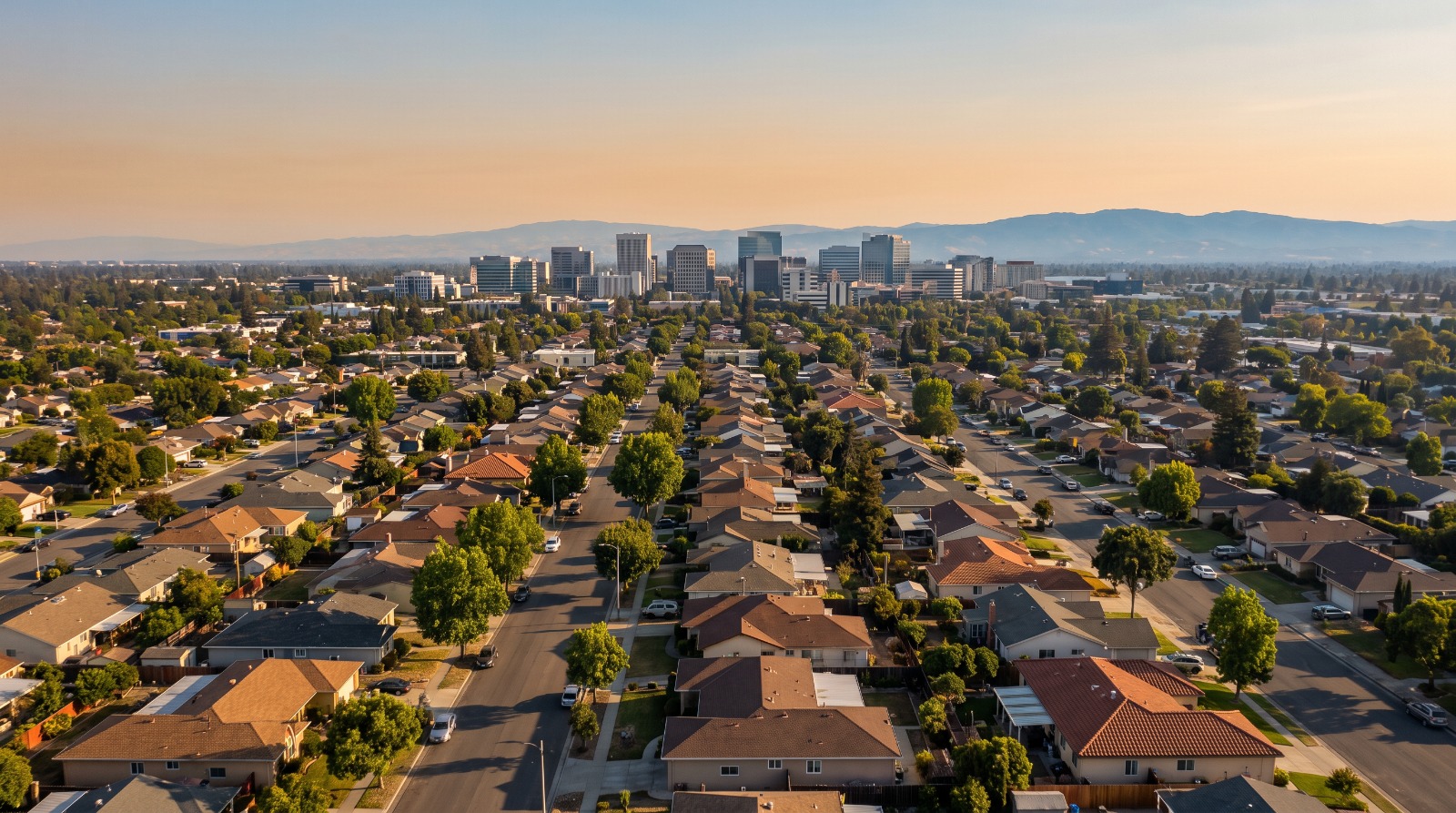
Aerial view of San Jose single-family neighborhoods with the downtown skyline in the distance, the land covered by the new zoning direction Photo: Houseberry
Eight homes per acre. That has been the practical ceiling across most of San Jose’s residential land for decades, and on Tuesday, August 18, the city council voted 8 to 3 to start replacing it, directing staff to draft General Plan changes that allow up to 32 homes per acre in single-family areas citywide, per KQED’s reporting. San Jose single-family zoning covers about 85 percent of the city’s residential land, so this is the biggest rezoning conversation happening anywhere in the Bay Area right now.
Before anyone celebrates or panics, the fine print matters. Here is what the vote did and did not do:
- It set direction, not law. Staff will now draft the actual land-use changes. Nothing about your block’s zoning changed this week.
- The target numbers are real. Up to 32 homes per acre where 8 is the cap today, with bigger jumps on corridors.
- Adoption is a late-2027 story. The drafted changes return to the Planning Commission and council around December 2027, and Mayor Matt Mahan told reporters the process has about a year and a half to run.
What the council actually approved
The vote tells planning staff to write General Plan amendments at the higher densities and study parking requirements along the way. It caps a process that started with ten months of special Planning Commission meetings, and the commission advanced its recommendations on June 24 before sending the package to council.
So the honest description is that San Jose picked a direction, loudly, with a supermajority. The rezoning itself still has to survive an environmental review, more public hearings, and a council that will look different after the 2026 elections. I have watched Bay Area councils walk back bolder votes than this one. The 8 to 3 margin makes a full reversal unlikely, but the details, especially parking, are very much still in play.
The numbers, land use by land use
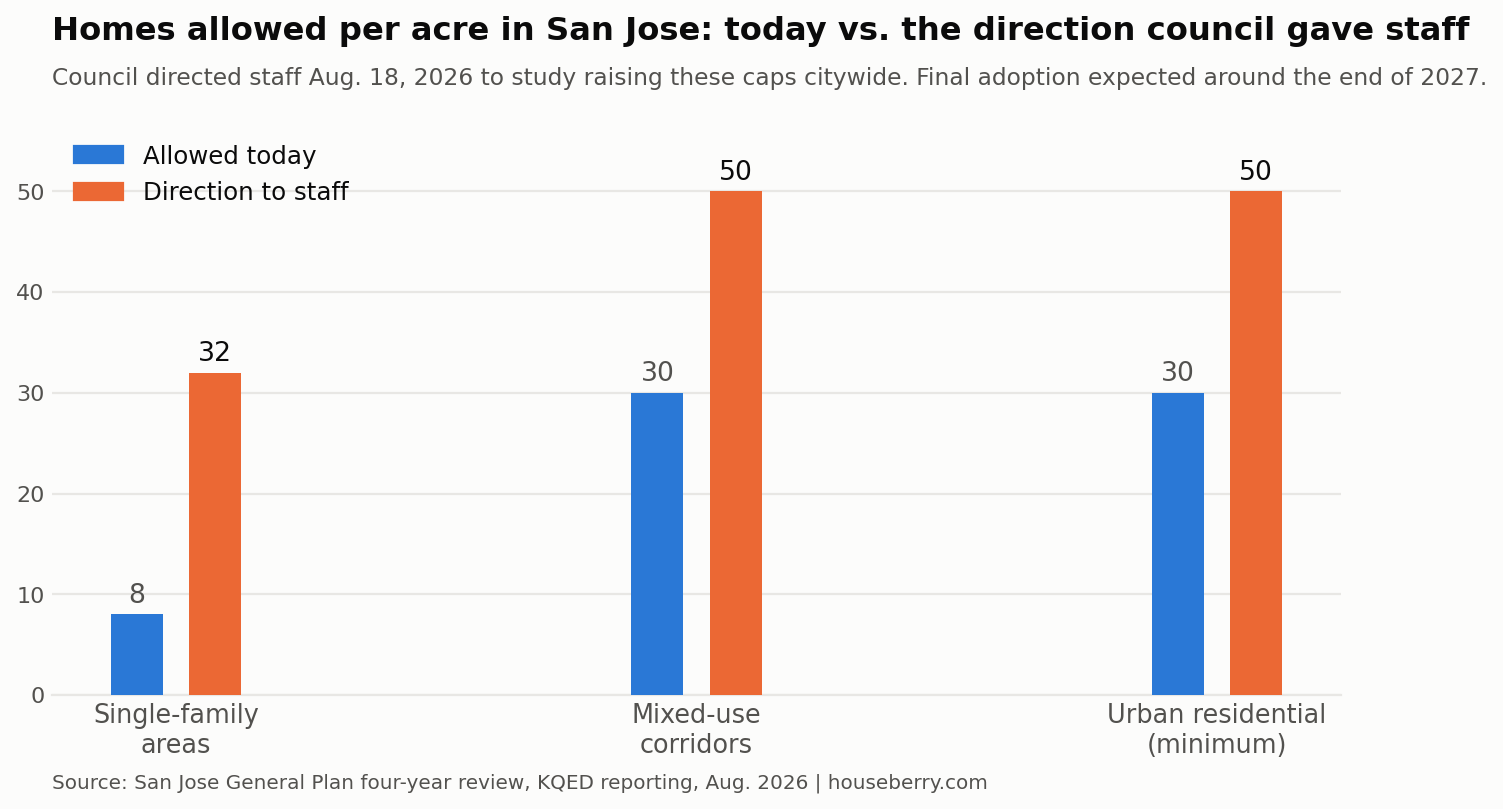
Three changes do almost all of the work in the package KQED detailed. The table below is the whole story in one place.
| Land use type | Allowed today | Council direction |
|---|---|---|
| Single-family areas | 8 homes per acre | Up to 32 homes per acre |
| Mixed-use corridors | Up to 30 homes per acre, 4 stories | 20 to 50 homes per acre, 5 stories |
| Urban residential (downtown) | 30 homes per acre minimum | 50 minimum, 95 maximum unchanged |
Read the first row twice. A four-times jump in allowed density on the land where 85 percent of San Jose’s homes sit is not a tweak. At 32 homes per acre, a typical 6,000-square-foot lot supports a fourplex comfortably, and assembled lots support small apartment buildings and townhome courts, the housing that used to be normal here before it was zoned out.
Why 32 matters when SB 9 already exists
A fair question, since state law already lets most owners split a lot and build up to four units under SB 9, and Mahan himself noted the new plan may not differ much from state allowances on some parcels.
The difference is arithmetic. SB 9 caps the play at four units on one former lot. A 32-homes-per-acre designation lets a builder run a pro forma on eight or ten townhomes across two assembled lots, which is the scale where construction financing starts to work. Missing-middle housing has been legal-ish and unbuildable for years. This is the first San Jose move that actually touches the math.
And the math is the whole reason this passed. The median Santa Clara County home costs about $2 million in mid-2026, which takes roughly $500,000 in household income, per KQED. San Jose’s own citywide median ran about $1.63 million in July 2026, down about 2 percent from a year earlier by our count. Prices this high with a flat market is exactly when a city should be adding legal capacity, because nothing new gets finished during a boom that was not entitled during the lull.
Where the first fourplexes actually show up
Not everywhere, and not evenly. New fourplexes pencil where the land under an aging house is worth a lot relative to the house itself, and where the new corridor densities raise what is buildable nearby. In practice that points at the older ranch tracts ringing downtown and the urban villages, not at the hillside cul-de-sacs.
Worth knowing: the commission already pulled the most contested site-specific idea, a Winchester Boulevard proposal near Santana Row, out of the package before it reached council, per San Jose Spotlight. We wrote about that corridor fight in our July piece on the General Plan reset, and the pattern held: the loudest resistance shows up exactly where the demand is strongest.
For a sense of the spread this lands on, we rank 112 San Jose neighborhoods, and the top of that table is instructive. Graystone leads the city at 4.3 out of 5 as of August 2026, and it is precisely the kind of large-lot, far-from-everything neighborhood where 32 homes per acre will remain a theoretical number for a long time. The change bites first on the flats, near the corridors, where scores are middling and land is cheaper.
The case against, taken seriously
Opponents are not imagining things. Patrick Waite of Citizens for Fiscal Responsibility argues the city is using density as a proxy for affordability, and he has half a point. A brand-new fourplex unit rents at market rate. Nobody should promise cheap apartments on your block by 2028.
Parking and tree canopy came up at every hearing, and former planning commissioner Pierluigi Oliverio called the package radical on both counts. Street parking will genuinely tighten on some blocks. That is a real cost, and pretending otherwise is how pro-housing arguments lose rooms.
But the affordability critique cuts the other way over time. Supply works in years, not per building, and a city where the entry ticket is $2 million has already run the experiment on what restrictive zoning produces. You cannot build what is illegal. Making it legal is step one, and step one took San Jose ten months of meetings.
Between now and December 2027
Three things will tell you whether this vote becomes buildings. First, the parking standard staff writes, since one required stall per unit can quietly kill a fourplex design. Second, whether the council that emerges from the November elections keeps the 8 to 3 shape. Third, how SB 79’s transit-density rules interact with the corridor changes, because state law now sets floors the city cannot duck. The official process lives on the city’s General Plan four-year review page if you want the agendas as they post.
If you are trying to work out which blocks this touches first, start from how a neighborhood prices and scores today. We keep the San Jose city numbers current month by month at Houseberry, and the neighborhoods where a fourplex pencils in 2028 are mostly visible in that data now. The zoning is changing. The geography of where it matters was set a long time ago.
Sources
KQED: San Jose leaders eyeing more multifamily homes in single-family neighborhoods
KION: San Jose leaders updating the General Plan with focus on housing
San Jose Spotlight: Battle lines drawn in San Jose housing plan overhaul
NBC Bay Area: San Jose leaders vote on single-family zoning districts
City of San Jose: General Plan four-year review
Houseberry San Jose city and neighborhood data, July to August 2026
The Houseberry Research Team is Houseberry's reporting team: Bay Area real estate analysts, data specialists and longtime local market watchers. Every day we check the public record: building permits, city council and planning agendas, county recorder filings, state housing bills, police incident data and school results. Then we tie each story to what it means for specific neighborhoods, using Houseberry's own neighborhood data on prices, appreciation, safety, schools and amenities. Questions or corrections: Contact us.
All information provided on this website including but not limited to - school ratings, safety, amenities, user opinions, and property data - is for general informational purposes only. We do not guarantee its reliability, accuracy, or completeness. Users should independently verify information and consult appropriate professionals as needed. By using this website, you agree Houseberry is not responsible for actions, decisions, or consequences arising from reliance on the information provided
houseberry.com - CA DRE# 01847391
 Bay East ©2025. CCAR ©2025. bridgeMLS ©2025. Information Deemed Reliable But Not Guaranteed. This information is being provided by the Bay East MLS, or CCAR MLS, or bridgeMLS. The listings presented here may or may not be listed by the Broker/Agent operating this website. This information is intended for the personal use of consumers and may not be used for any purpose other than to identify prospective properties consumers may be interested in purchasing. Data last updated at October 3, 2026 12:00 AM