San Diego votes to switch off its license plate cameras
The San Diego City Council suspended its license plate readers 7-0 and rejected the Smart Streetlights camera policy. Here is why the council flipped, what police say they lose, and what to watch in neighborhood data.

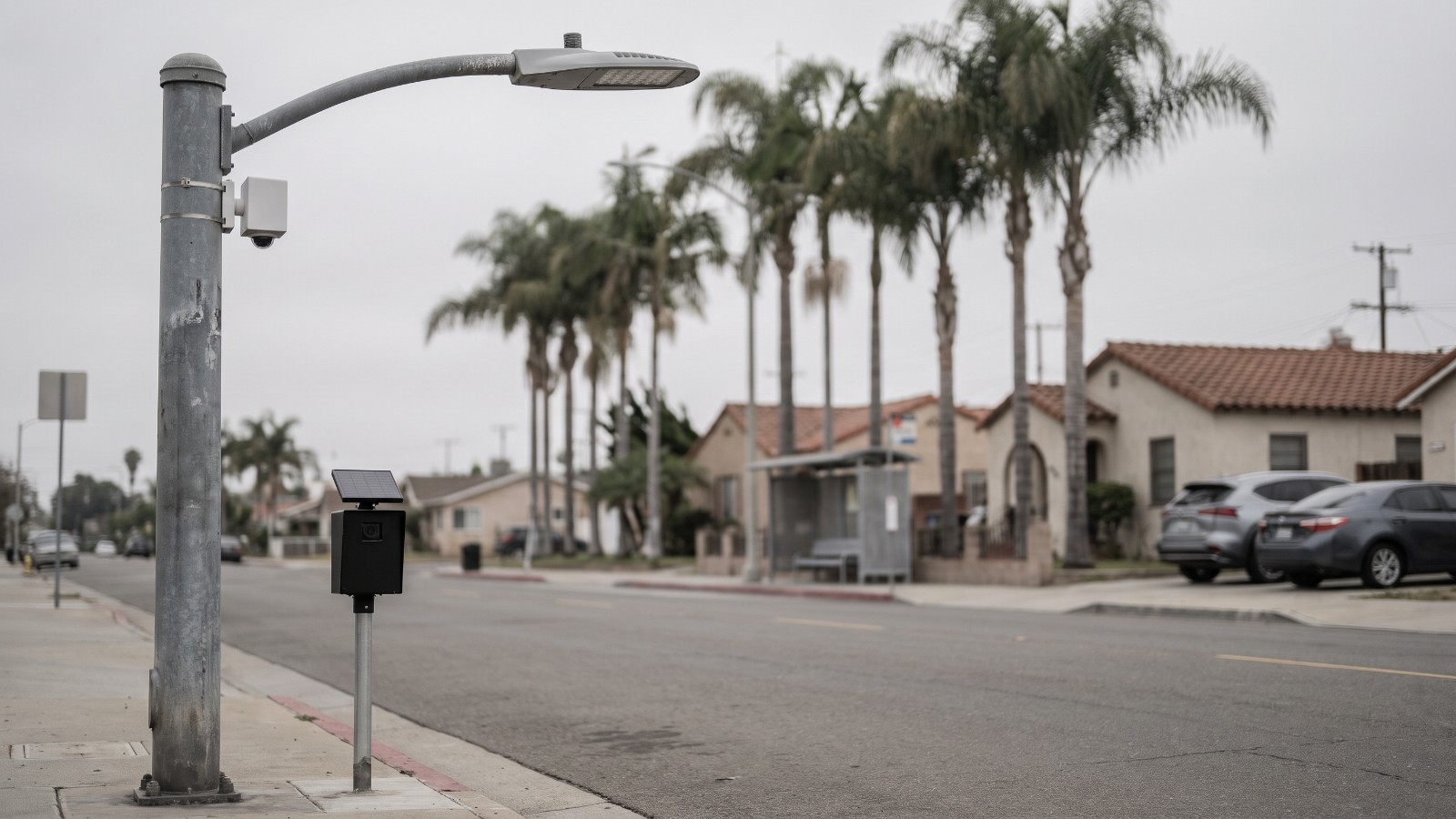
AI-generated view of a San Diego streetlight pole with a camera module and a small license plate reader by the curb Photo: Houseberry
More than 500 small cameras on San Diego streetlight poles are about to go dark. On Monday, Nov. 16, the City Council voted 7-0 to suspend the police department's use of automated license plate readers and rejected the use policy for its Smart Streetlights cameras 5-2, Times of San Diego reported. Councilmembers Vivian Moreno and Raul Campillo voted no on the streetlights. Jen Campbell and Marni von Wilpert were absent.
Mayor Todd Gloria will not veto it. His office said the city will shut the system down on its end and have the police start removing the hardware with the vendors, Flock Safety and Ubicquia.
This is a reversal. The same council approved both technologies in 2023 and renewed them as recently as December 2025. For homeowners, the question is what changes on their block, and the honest answer is that nobody knows yet.
Why the council flipped
Privacy concerns ran through hours of public comment. Speakers described false hits, including a man who spent months in jail and a police shooting of a 19-year-old passenger after a reader flagged a car the owner said was not stolen. They cited a Voice of San Diego report that police used Flock data to track a domestic violence victim during an internal investigation. Many worried that federal immigration agents could reach the data.
Councilmember Stephen Whitburn, who had supported the readers, said his view of their effectiveness had not changed. "What has changed is the context," he said. Campillo, who switched his position the week before, said he was disappointed with the department's stance on using the readers in internal investigations.
San Diego police have credited the system with real arrests. In its first year back, police told NBC 7 the plate readers and streetlight cameras helped recover 210 stolen cars and 10 firearms and make 206 arrests. Chief Scott Wahl has said weekly audits and a 30-day data limit protect privacy, and his office said the contract could be scrapped or renegotiated if both technologies lose approval. The mayor's office has said the readers help solve serious crimes and find missing people.
Both of those things can be true. The cameras helped close cases, and the city could not convince a majority of the council that the data was safe.
San Diego was uneven before the cameras
The cameras were spread across the city, not concentrated in one area. Houseberry's safety scores show how uneven San Diego already is, according to the San Diego safety ranking.
| Houseberry safety score | San Diego neighborhoods |
|---|---|
| 4.5 or higher | 18 |
| 3.0 to 4.4 | 78 |
| Below 3.0 | 14 |
| Median | 3.9 |
The highest scores sit in the northern suburbs, places like Carmel Valley, Scripps Ranch and Torrey Highlands. Coastal neighborhoods split. Pacific Beach scores 3.5 on safety, and the typical home there sold for about $1.4 million in September 2026. La Jolla scores 4.3.
Those scores come from reported crime, not from camera coverage, and they move slowly. A change in policing tools would show up in the data over a year or more, if it shows up at all.
We think the city now owes residents a clean before-and-after. Publish car theft, hit-and-run and arrest numbers for the 12 months before the shutdown and the 12 months after, by police division. If the readers were doing what police say, the numbers will show it. If they were not, that will show too.
Until then, the best guide for a buyer is still neighborhood data, not the hardware on the pole. You can compare any San Diego neighborhood on the San Diego rankings or look up an address on the Houseberry map.
Sources
- San Diego suspends license plate readers, rejects Smart Streetlights policy, Times of San Diego, Nov. 16, 2026
- Council committee votes to end Flock ALPR use, KPBS, Oct. 21, 2026
- San Diego police get more control over streetlight cameras, NBC 7 San Diego
- Chief Wahl defends license plate readers, ABC 10News
The Houseberry Research Team is Houseberry's reporting team: Bay Area real estate analysts, data specialists and longtime local market watchers. Every day we check the public record: building permits, city council and planning agendas, county recorder filings, state housing bills, police incident data and school results. Then we tie each story to what it means for specific neighborhoods, using Houseberry's own neighborhood data on prices, appreciation, safety, schools and amenities. Questions or corrections: Contact us.
Map of San Diego Neighborhoods
Loading map...
View Full Map
Top Neighborhoods in San Diego, CA


All information provided on this website including but not limited to - school ratings, safety, amenities, user opinions, and property data - is for general informational purposes only. We do not guarantee its reliability, accuracy, or completeness. Users should independently verify information and consult appropriate professionals as needed. By using this website, you agree Houseberry is not responsible for actions, decisions, or consequences arising from reliance on the information provided
houseberry.com - CA DRE# 01847391
 Bay East ©2025. CCAR ©2025. bridgeMLS ©2025. Information Deemed Reliable But Not Guaranteed. This information is being provided by the Bay East MLS, or CCAR MLS, or bridgeMLS. The listings presented here may or may not be listed by the Broker/Agent operating this website. This information is intended for the personal use of consumers and may not be used for any purpose other than to identify prospective properties consumers may be interested in purchasing. Data last updated at November 18, 2026 12:00 AM