Richmond CA Park Improvements: The Neighborhoods Getting Them
Wendell Park just reopened after a $2.3 million upgrade, and it is one of several Richmond park projects landing in the same few flatland neighborhoods. Here is which neighborhoods got the money, how they score on public spaces, and what homes there cost now.
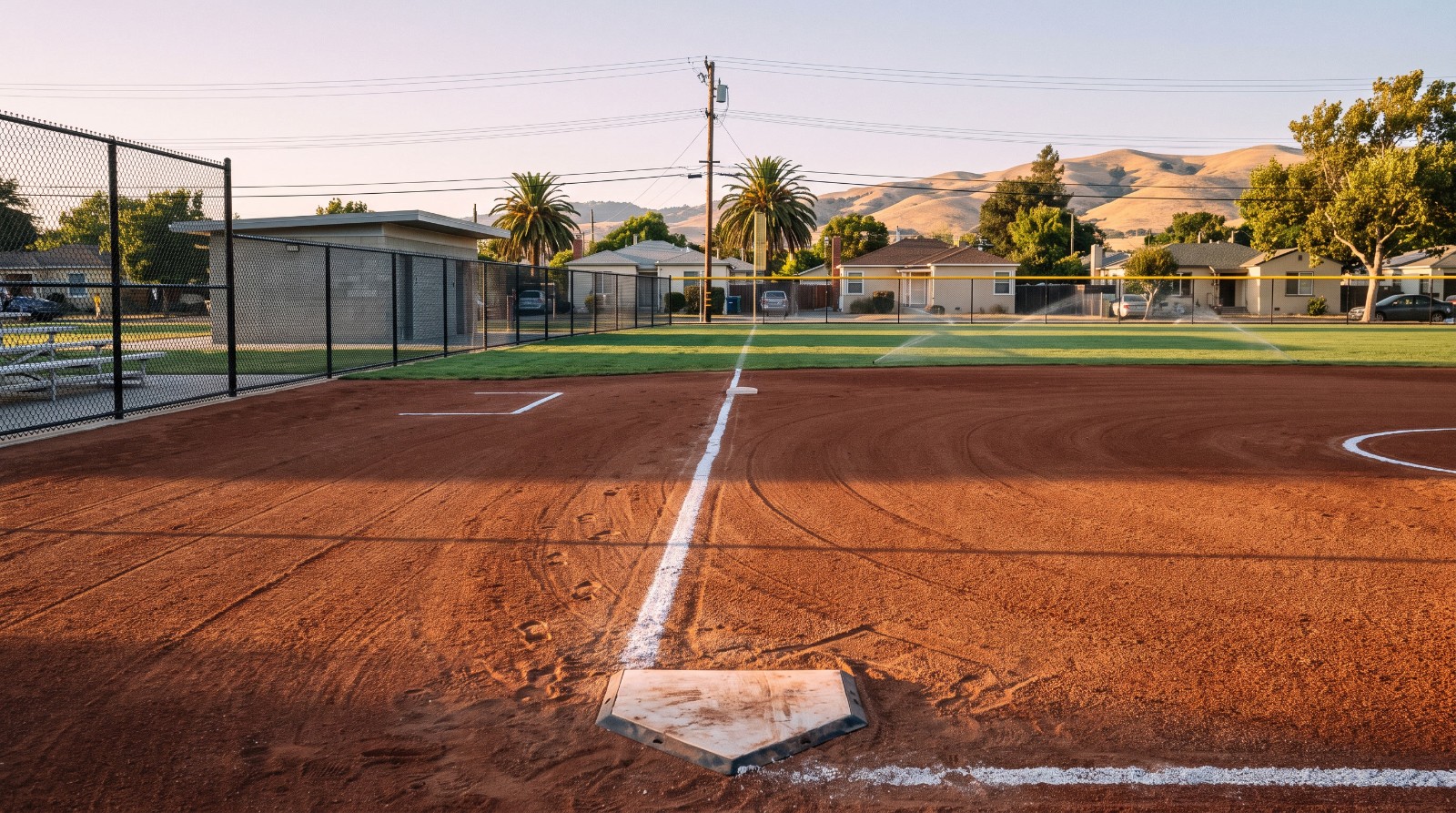
A renovated neighborhood softball field with new fencing and a small restroom building in the Richmond CA flatlands at golden hour. Photo: Houseberry
If you have a kid in Richmond who plays softball, you already know the question. Where is the nearest field with real grass, a working bathroom, and a fence that keeps the ball out of the street?
As of this month, one good answer is Wendell Park. The city finished about $2.3 million in Richmond park improvements there, with a new softball field, a new restroom, a new irrigation system, fencing and playground upgrades, and celebrated the reopening on September 15, 2026. It is the latest of several park projects that have landed in the same handful of central and north Richmond flatland neighborhoods, the ones where Houseberry's public spaces scores run lowest and home prices sit below the city median.
What Wendell Park got for $2.3 million
Wendell Park is a neighborhood park, not a destination one. It sits in North and East, the grid of mostly 1940s cottages and bungalows between 23rd Street and San Pablo Avenue, north of Macdonald Avenue and up to Bush and Moran avenues. People walk there from their front doors.
The work was practical. A restroom that runs on electricity, renovated ballfields including the new softball diamond, an irrigation system so the turf stays green past June, and new fencing. When Richmondside previewed the project in April, it pegged the ARPA grant at about $2 million. Local News Matters put the finished job at about $2.3 million.
That deadline matters, by the way. Cities had to commit their federal rescue money by the end of 2024 and spend it by the end of 2026, as Richmond staff told the council back in 2023. Wendell Park beat the clock by about three months.
Where the rest of Richmond's park money went
The recent spending is concentrated in the flatlands, and it follows a clear logic. Richmond has around 50 city parks, and a 2024 Richmondside review found the city had about 2.4 acres of parkland per 1,000 residents, below California's 3-acre benchmark. The state grants that paid for most of this work were written for exactly that gap.
Here is what we could verify, neighborhood by neighborhood:
- Shields-Reid Park, Shields-Reid. $11.9 million total, including an $8 million Prop 68 state grant. New play area, bike pump track, performance stage, fitness zone, sports fields, lighting and restrooms. It reopened with a festival on July 11, 2026.
- Boorman Park, Iron Triangle edge. $12 million from Prop 68 and a Caltrans Clean California grant, for a trail, skating area, athletic field, basketball court, play areas and restrooms, on a site a 2019 county assessment flagged as a high priority. It broke ground in January 2025 and was still under construction this spring.
- Wendell Park, North and East. About $2.3 million, reopened September 2026.
- Dirt World Bike Park, on the Richmond Greenway. A $1.14 million Prop 68 grant rebuilt the BMX track and its stretch of Greenway trail. The state lists it as complete.
- Nicholl Park, Macdonald Avenue at 33rd Street. The 21-acre park a few blocks east of Wendell is just entering planning, with no budget published yet.
Add up the first four and you get about $27.3 million. We could not find a public breakdown for the other $10 million or so in the $37 million figure, so treat that total as the city's number, not ours.
Now put those locations next to Houseberry's own scores. Our Public Spaces sub-score rates the parks, plazas and open space people can actually use near home. The neighborhoods that got the checks all sit well below the ones that did not need them.
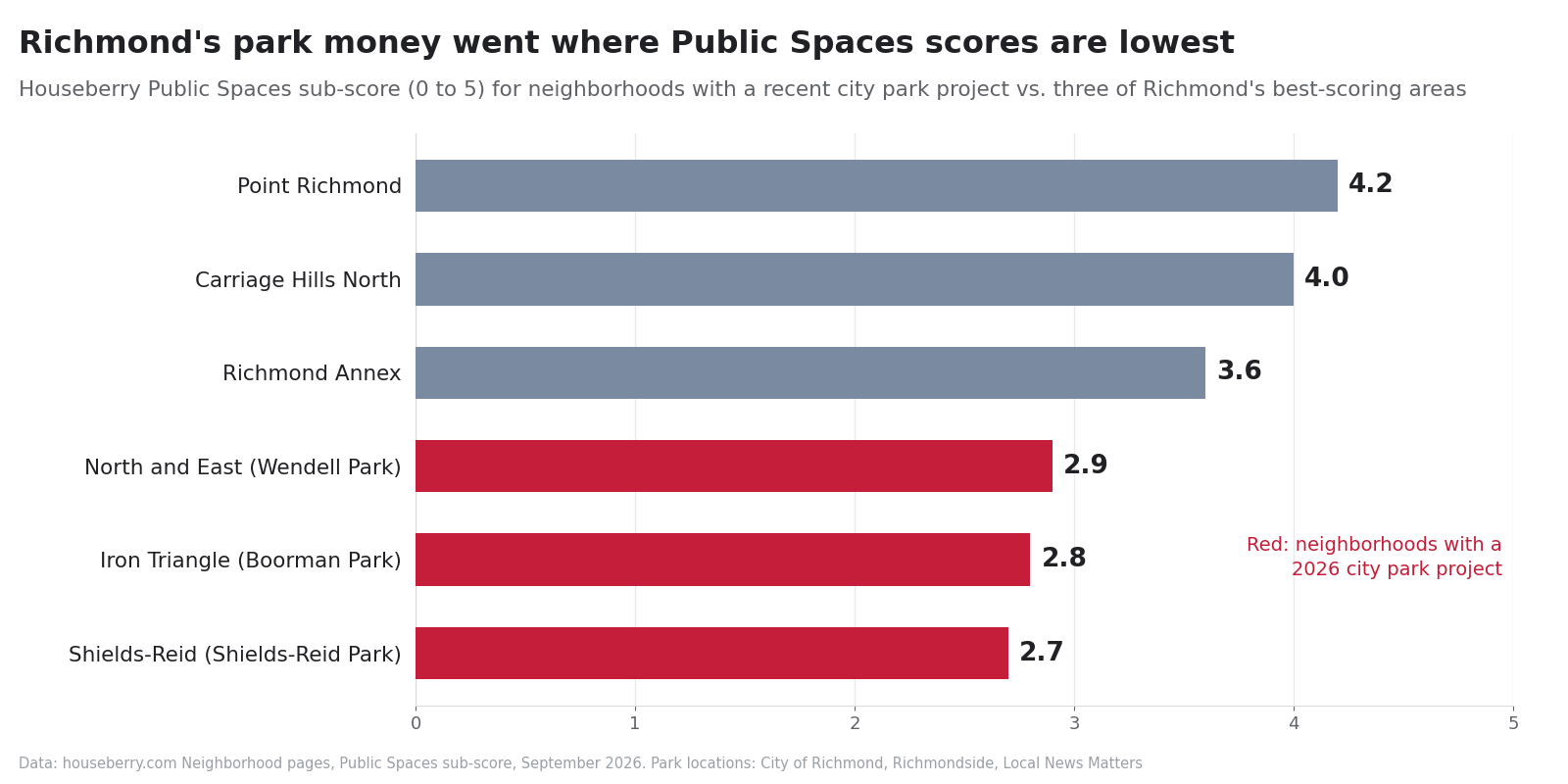
Point Richmond scores 4.2 because it has Miller/Knox Regional Shoreline and Keller Beach minutes away. Carriage Hills North, up by Sobrante Ridge, scores 4.0. North and East comes in at 2.9, the Iron Triangle at 2.8 and Shields-Reid at 2.7. That spread is a real difference in daily life. It is the gap between walking to a shoreline trail after dinner and driving somewhere for a playground with a working bathroom.
What Richmond park improvements mean for home prices here
The honest answer is that a new restroom and a softball field do not move a neighborhood median on their own, and anyone telling you otherwise is selling something. What they change is the daily-life column, which is where these neighborhoods have always been weakest.
Prices tell you who is buying. North and East had a median sale price of about $587,800 in August 2026, on its Houseberry page, and it has bounced between roughly $550,000 and $636,000 over the past year. Shields-Reid was about $576,400 in August, up about 6.6 percent from September 2025. The Iron Triangle was about $397,400, down roughly 19 percent over 12 months, though a neighborhood that small can swing hard on a few sales.
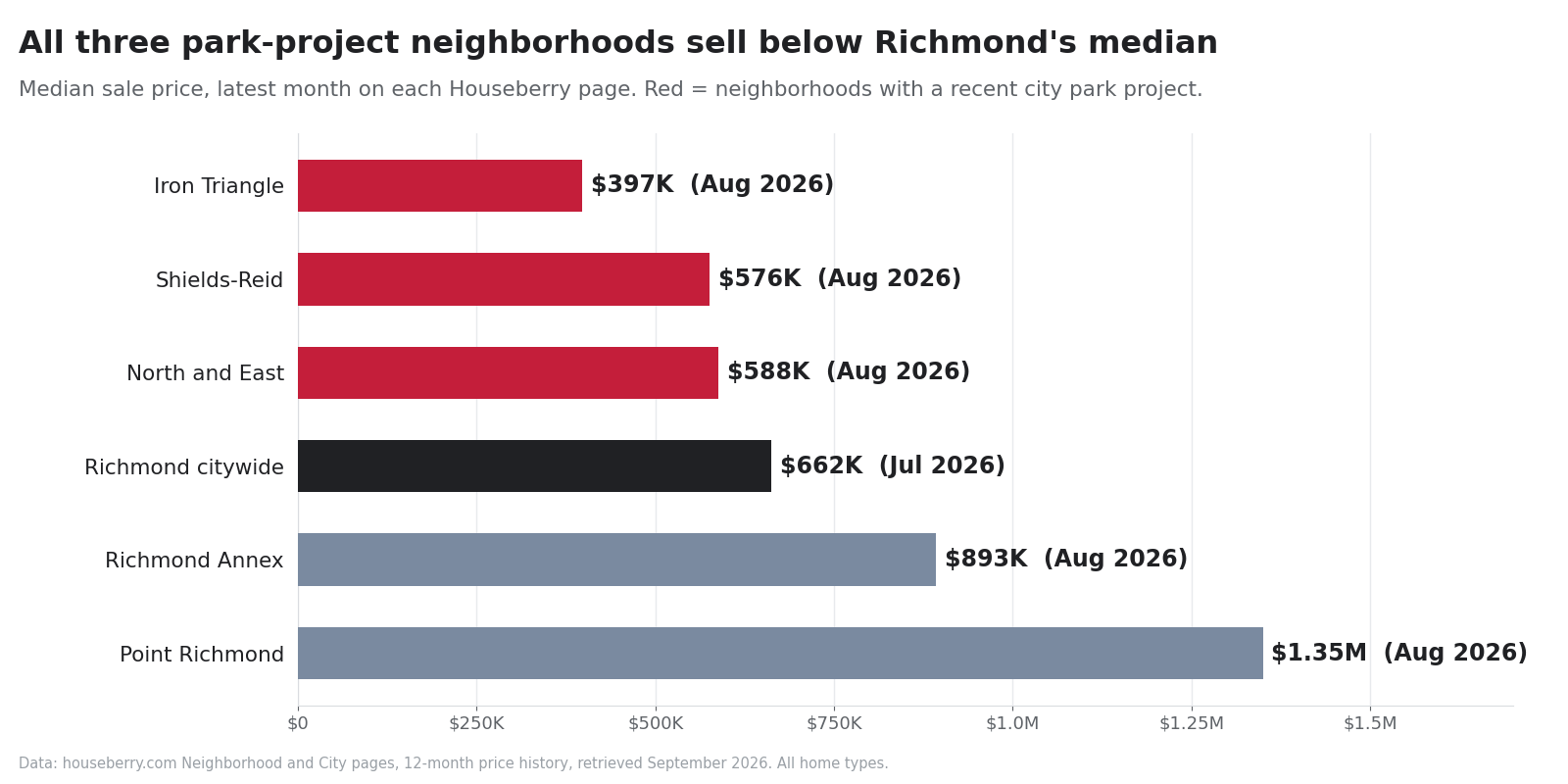
Richmond as a whole sat at about $662,000 in July 2026, per our Richmond city page. Point Richmond was about $1.35 million in August. So the park money is going where a family can still buy a single-family house in the Bay Area for under $600,000. That is the right place for it. And it is a strong argument for letting more homes get built within a few blocks of these parks, so more people get to use them.
Is North and East a better place to live now? It still ranks 27th of 32 overall in our Richmond neighborhood rankings, with a safety score of 1.4. A park does not change that. But it already ranks 9th on amenities, helped by a 4.3 merchants score along San Pablo and Macdonald, and a reliable park is the piece that was missing.
The catch is who mows the grass
Building a park is the easy part in Richmond. Keeping it is the hard part. The 2024 Richmondside review counted about 12 workers maintaining 45 parks on a roughly $2.9 million operations budget, and Council member Doria Robinson put it bluntly at the time: the city has a history of building new things it cannot maintain.
That is the real risk for these projects. New irrigation and new turf are only an asset if someone fixes the broken sprinkler head in year three. If you are buying near Wendell, Shields-Reid or Boorman, walk the park on a weekday afternoon a year from now. That tells you more than the ribbon-cutting did.
The shoreline piece still coming
The next big opening is not a city park at all. The East Bay Regional Park District started building a 2.5-mile Bay Trail segment at Point Molate in October 2025, running from the Richmond-San Rafael Bridge past Point Molate Beach to the old Winehaven district. The district expects it to open in early 2027. Richmondside put the combined budget at about $13 million.
That one mostly helps Point Richmond, which already leads the city on public spaces. It is a good project. It is just not the same kind of project as a bathroom at Wendell Park, and it is worth keeping the two straight when someone tells you Richmond is getting more parks.
How we would use this if we were shopping in Richmond
Start with the park, then look at the block. The same way we would with a school, we would check which park is actually within a 10-minute walk, whether it has a restroom that is open, and how it looks at 5 p.m. on a Tuesday, not on reopening day.
For the flatland neighborhoods, 2026 was the year the park column got better. That does not erase the safety and school scores, and it should not. But if you have been comparing North and East, Shields-Reid or the Iron Triangle on price alone, the parks are now worth a line in the spreadsheet too. Our Richmond pages break every neighborhood down on those scores if you want to do the side-by-side yourself, and if you are weighing the East Bay shoreline more broadly, our piece on the Golden Gate Fields park plan in Albany and Berkeley covers the next big open-space change a few miles south.
Sources
- Local News Matters (Bay City News), Wendell Park reopens with new softball field, restroom, irrigation system, Sept. 22, 2026
- Local News Matters, Richmond to celebrate Shields-Reid Park's $11.9M makeover, July 10, 2026
- Richmondside, Richmond park upgrades include soccer field fixes and modern restrooms, April 7, 2026
- Richmondside, Richmond's Boorman Park is getting $12M renovation, Jan. 27, 2025
- Richmondside, Richmonders want more parks. City struggles to maintain the 50 it has, Sept. 17, 2024
- Parks for California, Shields Reid Park Revitalization (Prop 68 grant)
- Parks for California, Dirt World Bike Park (Prop 68 grant)
- East Bay Regional Park District, San Francisco Bay Trail: Point Molate
- Richmondside, New bike trail to improve access to Richmond's Point Molate beach, Aug. 5, 2025
- Contra Costa Pulse, Richmond continues to consider uses for Rescue Plan funds, May 17, 2023
- Houseberry, Richmond neighborhood rankings, Neighborhood pages and City page, retrieved September 2026
Map of Richmond Neighborhoods
Loading map...
View Full Map
Top Neighborhoods in Richmond, CA



All information provided on this website including but not limited to - school ratings, safety, amenities, user opinions, and property data - is for general informational purposes only. We do not guarantee its reliability, accuracy, or completeness. Users should independently verify information and consult appropriate professionals as needed. By using this website, you agree Houseberry is not responsible for actions, decisions, or consequences arising from reliance on the information provided
houseberry.com - CA DRE# 01847391
 Bay East ©2025. CCAR ©2025. bridgeMLS ©2025. Information Deemed Reliable But Not Guaranteed. This information is being provided by the Bay East MLS, or CCAR MLS, or bridgeMLS. The listings presented here may or may not be listed by the Broker/Agent operating this website. This information is intended for the personal use of consumers and may not be used for any purpose other than to identify prospective properties consumers may be interested in purchasing. Data last updated at September 25, 2026 12:00 AM