Golden Gate Fields Park: What the $125M Vote Buys
California committed up to $125 million toward turning the closed Albany racetrack into a 161-acre bayfront park. Here is when it actually opens, what it costs Albany in the meantime, and which neighborhood it changes most.

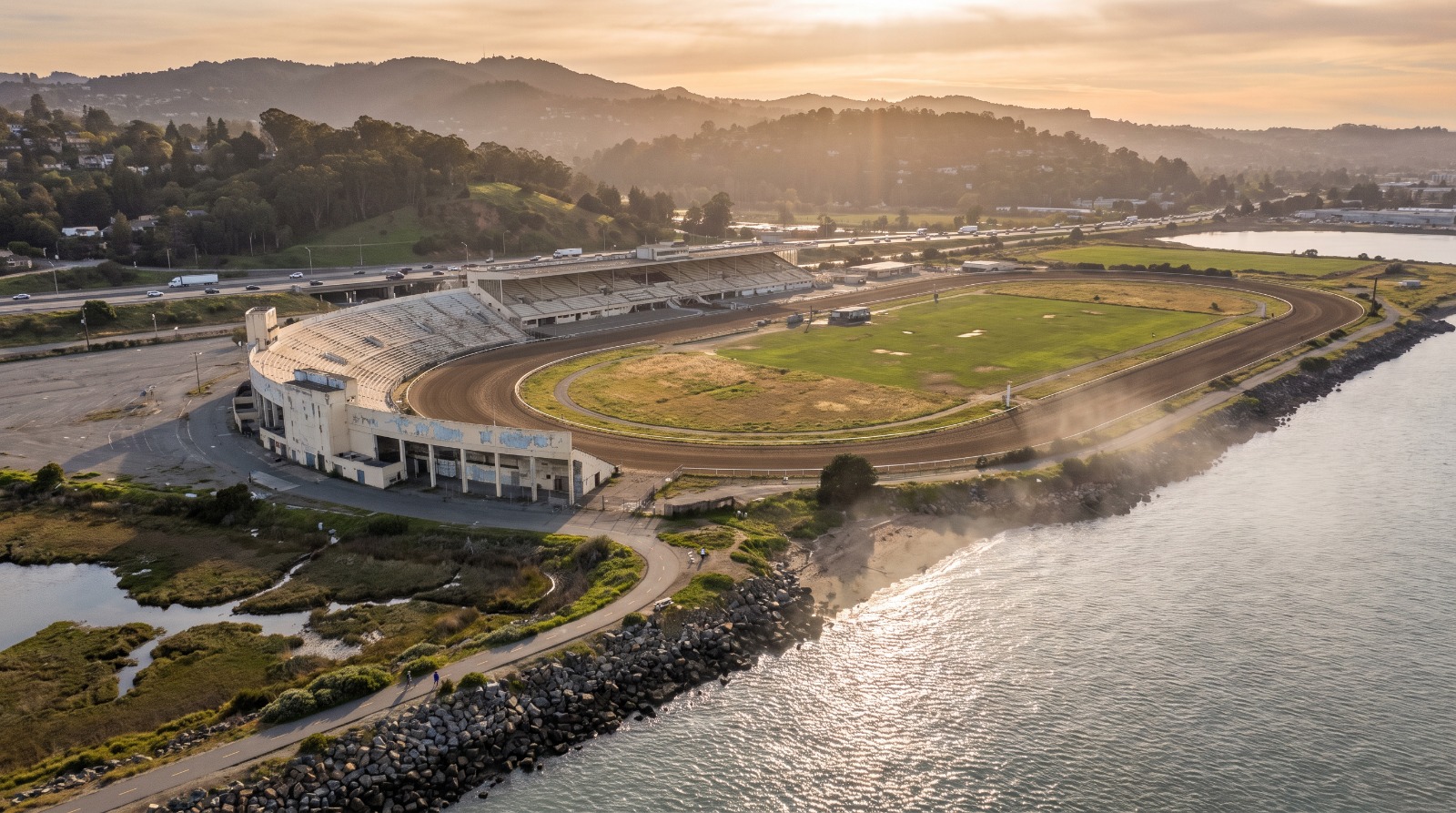
The former Golden Gate Fields racetrack on the Albany and Berkeley bay shoreline, the site of a planned 161-acre public park. Photo: Houseberry
The state has committed up to $125 million to buy the closed Golden Gate Fields racetrack and turn 161 acres of Albany and Berkeley shoreline into a public park. The part that does not fit in a headline: the land does not change hands until spring 2027, the public planning process runs from 2027 through 2029, and construction happens after that, in phases, as money appears. Albany starts absorbing the cost years before anyone walks a new trail.
The money is real. The park is a project measured in decades. If you live in Albany or west Berkeley, the useful question is not whether this is good news. It is what actually changes, and when.
What the Legislature actually approved
SB 113 moves up to $125 million out of Proposition 4, the $10 billion climate bond California voters passed, into the purchase. It rides on the 2026-27 budget and needs Gov. Newsom's signature by the end of September. The bill is carried by Sen. Jesse Arreguin of Berkeley, who called it a major victory for our region.
The full price is $175 million. The Trust for Public Land is assembling it from three sources: the state share, $20 million already committed by the East Bay Regional Park District out of Measure WW, and roughly $30 million the nonprofit is raising itself. If the nonprofit and the district clear $50 million before the end of 2026, the state's contribution drops below $125 million.
Sacramento was not unanimous about it. Budget chair Sen. Eloise Gomez Reyes said plainly that "$125 million out of Prop. 4 is a lot of money," and Annie Burke of TOGETHER Bay Area warned the earmark takes funding away from the competitive grant program that pays for drinking water projects, wildfire prevention, land conservation, and grants to tribes and community organizations.
That objection deserved more airtime than it got. One shoreline park in the East Bay just absorbed 1.25 percent of a statewide climate bond, ahead of every project that has to compete for the rest.
Spring 2027 is a closing date, not a ribbon cutting
The park district's own schedule is public, and it is long. Property transfer is expected in spring 2027. A public engagement process to decide what the park should be runs from 2027 through 2029. Development happens after 2029, in phases, as funding becomes available.
Right after acquisition the site gets secured for safety. The Bay Trail stays open. Everything else waits.
A child starting kindergarten in Albany this fall will be in middle school before the first phase finishes. That is not a knock on the park district, which has been unusually straight about the timeline. It is a caution against reading this vote as something that changes the neighborhood next year.
The site runs 161 acres, 31 of them underwater. Most of it sits in Albany, with roughly 40 acres in Berkeley. It fills the last gap in McLaughlin Eastshore State Park, which means a connected shoreline park chain from Richmond to Oakland.
Albany pays for this twice
Golden Gate Fields ran horses for 83 years and closed in June 2024. The Stronach Group, the Canadian company that had owned it since 1999, has been looking for an exit ever since.
Albany was collecting about $1.1 million a year in special revenues from the track, and the Albany school district roughly $700,000. Inside that $1.1 million, The Berkeley Scanner counted about $400,000 for emergency services under Measure K, $287,000 from the street and storm drain parcel tax, and about $100,000 for the library.
A tax-exempt nonprofit owner erases the property tax line entirely.
Albany has roughly 20,000 residents. Losing north of a million dollars a year in dedicated revenue in a city that size is the kind of gap that ends up on a ballot. If you own in Albany, follow the 2027 and 2028 budget conversations. A replacement revenue measure is a reasonable thing to expect, and it would land on the same parcels that are supposed to benefit from the park.
The Albany neighborhood this changes most already scores worst on amenities
East Shore, the row of bayfront condos and townhouses on the water side of Interstate 80, is where this park lands. We score it 4.5 out of 5 overall, fourth of Albany's 12 neighborhoods, with schools at 4.7 and safety at 4.7. Its amenities score is 3.4, the lowest of the eight Albany neighborhoods that clear 4.0 overall.
That gap is the story in one number. East Shore already has the schools and the quiet. What it does not have is anywhere to walk to. A 161-acre shoreline park is the specific fix for the specific thing holding it back.
The median price in East Shore was about $1.05 million in August 2026, against roughly $1.2 million citywide in Albany the same month. Across the city line, West Berkeley scores 3.1 overall with safety at 2.1 and a median around $1.25 million in July 2026.
Those two neighborhoods sit about a mile apart and score very differently on safety. Both are about to share a park entrance. How that plays out on each side of the line is the thing I would actually watch.
Will it move prices? Here is how I would think about it
Parks do lift nearby home values. The effect shows up reliably enough in the research that you can plan around it, but it shows up when the park exists and is maintained, not when it is announced. An announcement six years ahead of a first phase is the weakest version of that signal.
So the practical answer for anyone shopping Albany or west Berkeley this fall is to avoid paying a 2032 park premium in 2026. Look hard at what is true today: the schools, the safety numbers, an actual insurance quote, the real commute, and whether the Bay Trail segment you can already use is the one you would use. That habit of researching the area before the address is the entire reason Houseberry exists.
The thing that changes sooner than the park is what sits next to you. A fenced, empty 161 acres is a different neighbor than an active restoration and construction site, and that transition starts in 2027.
What to watch between now and spring 2027
Four things. Newsom's signature, due by September 30. The Trust for Public Land's fundraising against its roughly $30 million target by December 31, which can lower the state's share. Albany's budget discussions through 2027, and whether a revenue measure follows. And the park district's first engagement notices, which is the moment residents get to argue about what a park on a former racetrack should contain.
On the housing question, because someone always asks: the site is not zoned for housing in either city, and the park district has said so directly. For 161 acres of bay fill and marsh, that is the right call. It is also worth saying out loud that the East Bay will not park its way out of a housing shortage, and the same energy that moved $125 million through a budget bill would go a long way on the dry, transit-adjacent land a mile inland.
The vote was the easy part. The next three years are hearings.
Sources
- The Berkeley Scanner, Golden Gate Fields park plan nears $125M state vote, August 30, 2026
- CalMatters, California lawmakers tap climate bond for Golden Gate Fields park, September 2026
- East Bay Regional Park District, Future Golden Gate Fields Park
- The Berkeley Scanner, Golden Gate Fields park deal: all the latest details, May 15, 2026
- Houseberry neighborhood scores and price history for Albany and Berkeley, accessed September 2, 2026
The Houseberry Research Team is Houseberry's reporting team: Bay Area real estate analysts, data specialists and longtime local market watchers. Every day we check the public record: building permits, city council and planning agendas, county recorder filings, state housing bills, police incident data and school results. Then we tie each story to what it means for specific neighborhoods, using Houseberry's own neighborhood data on prices, appreciation, safety, schools and amenities. Questions or corrections: Contact us.
All information provided on this website including but not limited to - school ratings, safety, amenities, user opinions, and property data - is for general informational purposes only. We do not guarantee its reliability, accuracy, or completeness. Users should independently verify information and consult appropriate professionals as needed. By using this website, you agree Houseberry is not responsible for actions, decisions, or consequences arising from reliance on the information provided
houseberry.com - CA DRE# 01847391
 Bay East ©2025. CCAR ©2025. bridgeMLS ©2025. Information Deemed Reliable But Not Guaranteed. This information is being provided by the Bay East MLS, or CCAR MLS, or bridgeMLS. The listings presented here may or may not be listed by the Broker/Agent operating this website. This information is intended for the personal use of consumers and may not be used for any purpose other than to identify prospective properties consumers may be interested in purchasing. Data last updated at October 13, 2026 12:00 AM