Prop 40 Billionaire Tax: Where Bay Area Billionaires Live
Prop 40, the one-time 5 percent billionaire tax, goes to voters November 3. Here is where California's billionaires actually live, what those neighborhoods cost, and what past departures did to their home prices.
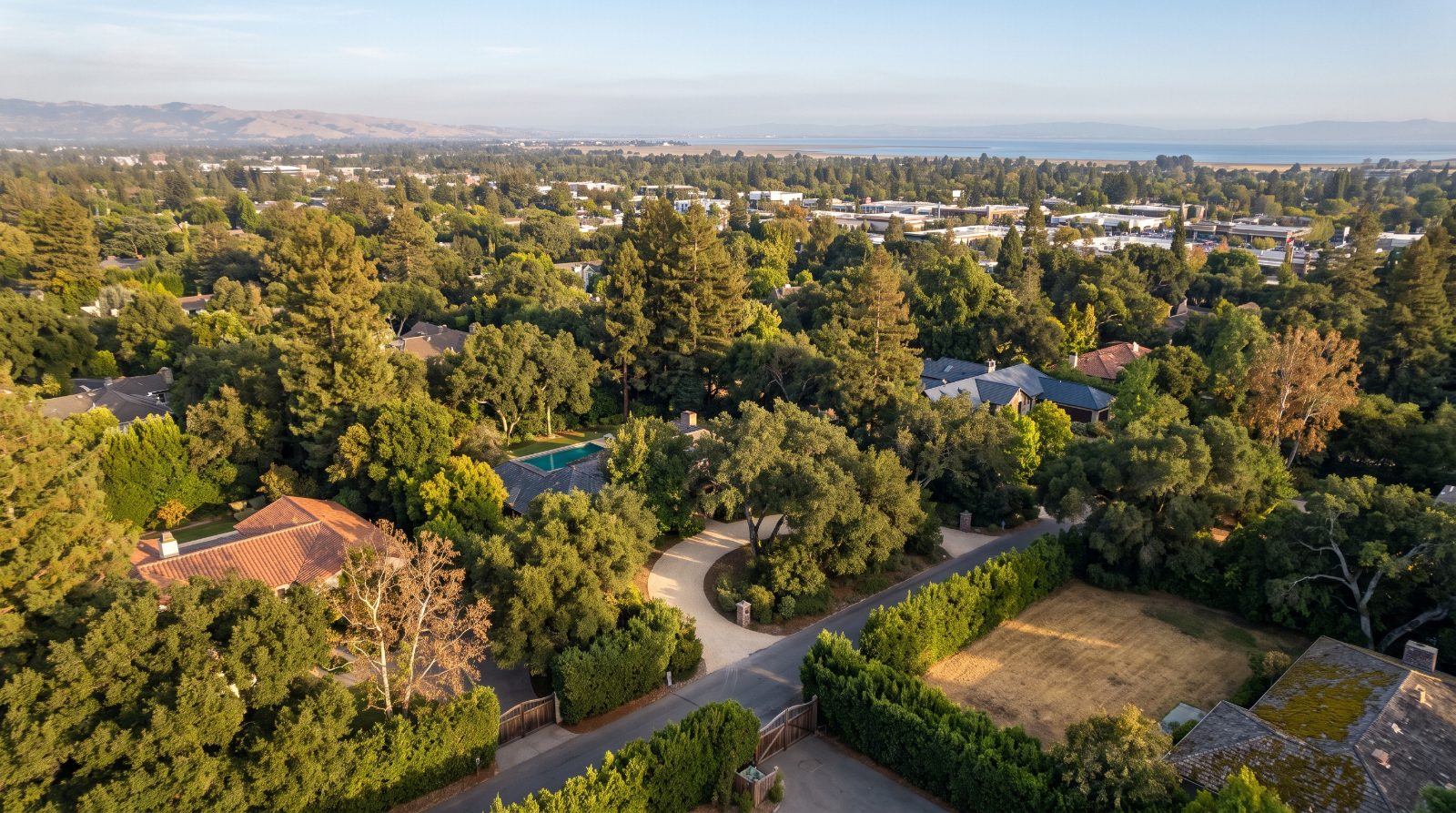
Aerial view of Atherton estates under oak and redwood canopy, a Bay Area town at the center of the Prop 40 billionaire tax debate. Photo: Houseberry
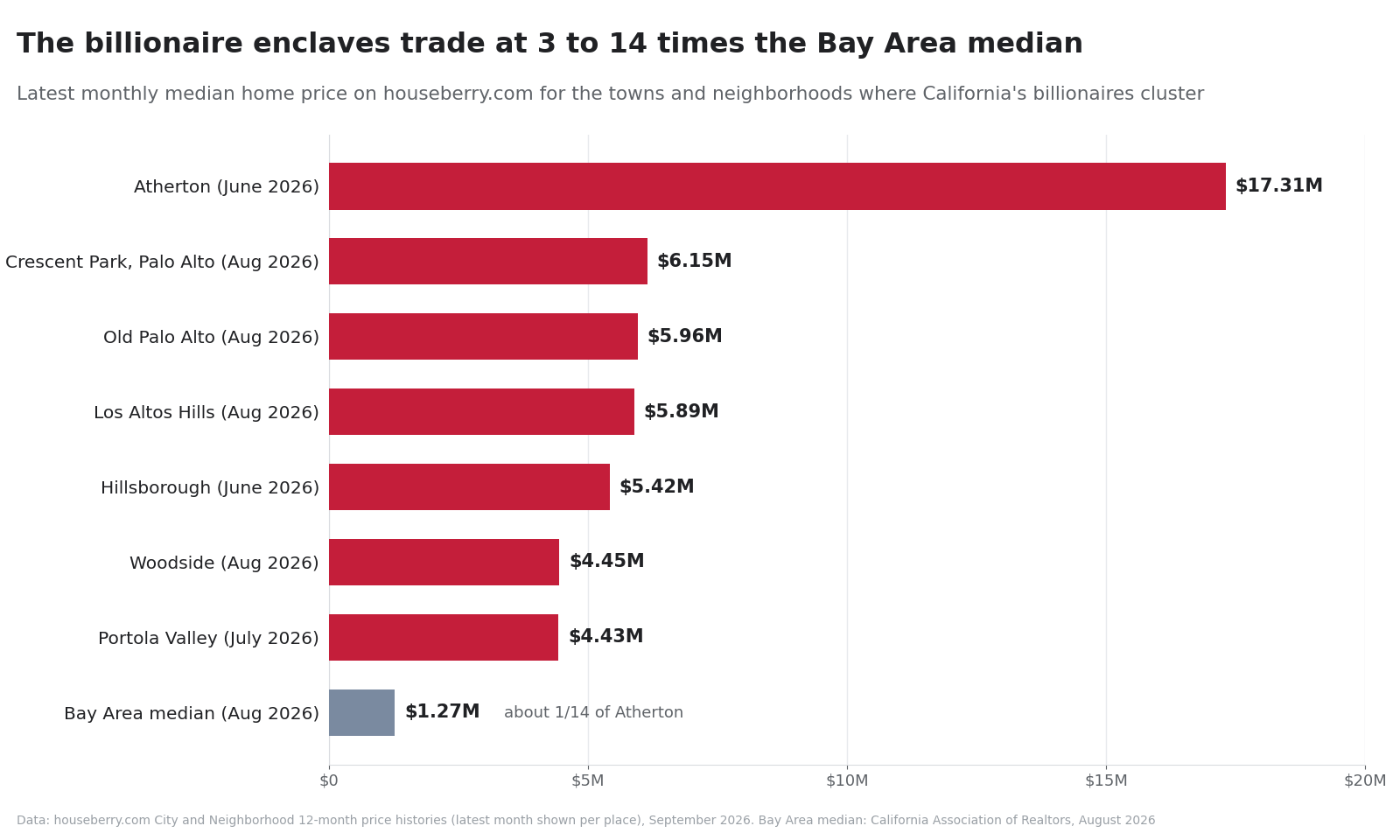
Atherton's median home price was about $17.3 million in June 2026 on our numbers. That is roughly 14 times the $1.27 million Bay Area median the California Association of Realtors reported for August. It is also the town with the most at stake, in housing terms, when Californians vote on Proposition 40, the one-time 5 percent billionaire tax, on November 3, 2026.
The short answer on what the California billionaire tax could do to these neighborhoods: probably less than the campaign rhetoric on either side suggests. The houses themselves are excluded from the tax. The last wave of billionaire departures, in 2020 and 2021, did not dent Atherton prices. And if a trophy estate does sell, Prop 13 means the local property tax take goes up, not down.
What the Prop 40 billionaire tax actually taxes
It taxes stock, business stakes and other financial wealth. It leaves the mansion alone.
Per the Legislative Analyst's Office, billionaires who lived in California on January 1, 2026 would owe 5 percent of their net worth once, with "real estate, pensions, and retirement accounts" generally excluded. The sponsors put the number who would pay at about 200 and the take at roughly $100 billion over five years, with 90 percent going to health care. The LAO's own estimate is "tens of billions."
The mechanics, per Holland & Knight's September 2026 summary: net worth is measured December 31, 2026, the bill is due April 15, 2027, and payers can spread it over five annual installments with a 7.5 percent yearly deferral charge. Moving out later does not help. A person who was a resident on January 1, 2026 stays in scope "even if the person later fully left the state." Two rival measures, Props 41 and 42, would void Prop 40 entirely if either passes with more votes.
So where does housing come in? Through residency. California decides who is a resident by weighing many facts, and where you keep your home is one of the heaviest. When Ellison's San Francisco sale surfaced, tax adviser David Lesperance told the New York Post that Ellison was likely advised that keeping a California residence "was not worth the risk." That is the channel. A tax on stock portfolios can still show up as a for-sale sign.
Where California's billionaires actually live
Mostly in five Peninsula towns and a few blocks of San Francisco.
Forbes residence data, compiled by Stacker and published by KRON4, listed Page, Mark Zuckerberg and Laurene Powell Jobs in Palo Alto, Brin and Nvidia's Jensen Huang in Los Altos, Eric Schmidt, Jan Koum and George Roberts in Atherton, Charles Schwab and John Doerr in Woodside, and Brian Chesky, Dustin Moskovitz and Nathan Blecharczyk in San Francisco. Page and Brin have since cut ties, per Fortune. We keep it to the town level.
On the ground that means Atherton, the flat, oak-shaded town between Menlo Park and Redwood City with one-acre minimum lots. Woodside and Portola Valley, the horse-country foothill towns above Sand Hill Road. Palo Alto's Crescent Park, northeast of downtown along San Francisquito Creek, and Old Palo Alto, south of Embarcadero Road. Los Altos Hills, the no-downtown hill town that wraps around Foothill College. And in the city, the stretch of Broadway through Pacific Heights that locals call Billionaire's Row, plus neighboring Presidio Heights. Our colleague Elena Marsh walked several of these in where the top AI executives live.
Here is how those places score and what they cost right now.
| Place | Latest median price | Overall | Schools | Safety |
|---|---|---|---|---|
| Atherton | $17.31M (June 2026) | 4.0 | 4.3 | 3.8 |
| Pacific Heights, San Francisco | Not reported* | 3.7 | 3.3 | 4.1 |
| Presidio Heights, San Francisco | Not reported* | 4.2 | 4.3 | 4.3 |
| Crescent Park, Palo Alto | $6.15M (Aug 2026) | 4.5 | 4.8 | 4.5 |
| Old Palo Alto | $5.96M (Aug 2026) | 4.6 | 4.8 | 4.7 |
| Los Altos Hills | $5.89M (Aug 2026) | 5.0 | not scored | 5.0 |
| Hillsborough | $5.42M (June 2026) | 4.2 | 4.6 | 4.3 |
| Woodside | $4.45M (Aug 2026) | 3.9 | 3.7 | 4.1 |
| Portola Valley | $4.43M (July 2026) | 4.3 | 4.4 | 4.7 |
| Bay Area median (C.A.R.) | $1.27M (Aug 2026) | n/a | n/a | n/a |
Scores are Houseberry's 0 to 5 ratings. Prices are the latest month on each City or Neighborhood page. *Our Pacific Heights and Presidio Heights pages currently fall back to citywide data for price, so we left those two out rather than guess.
Two things jump out. First, billionaire money does not buy the best scores. Old Palo Alto and Crescent Park beat Atherton on schools and safety, and Pacific Heights scores 3.7 overall, 35th of 92 in San Francisco. People buy these places for land and privacy, not a spreadsheet. Second, even the cheapest enclave on the list, Portola Valley, runs about 3.5 times the regional median.
What happened the last time billionaires left
Atherton prices kept rising. That is the best precedent we have, and it points one way.
In 2020 Palantir moved its headquarters from Palo Alto to Denver, Elon Musk moved to Texas, and in December Oracle moved its headquarters from Redwood City to Austin. Days later Larry Ellison told staff he had moved to Lanai. Musk listed his 47-acre Hillsborough estate at $35 million in May 2020. It sat for about 18 months and closed for about $30 million in December 2021, per SocketSite's read of the recorded sale. One trophy estate took a haircut and a long wait.
The town-level median did not. PropertyShark's annual ranking put Atherton's 94027 ZIP at $7 million in 2020, $7.475 million in 2021 and $7.9 million in 2022. After the 2025 departures it hit $9.93 million in the first half of 2026, up 20 percent in a year and back to No. 1 nationally.
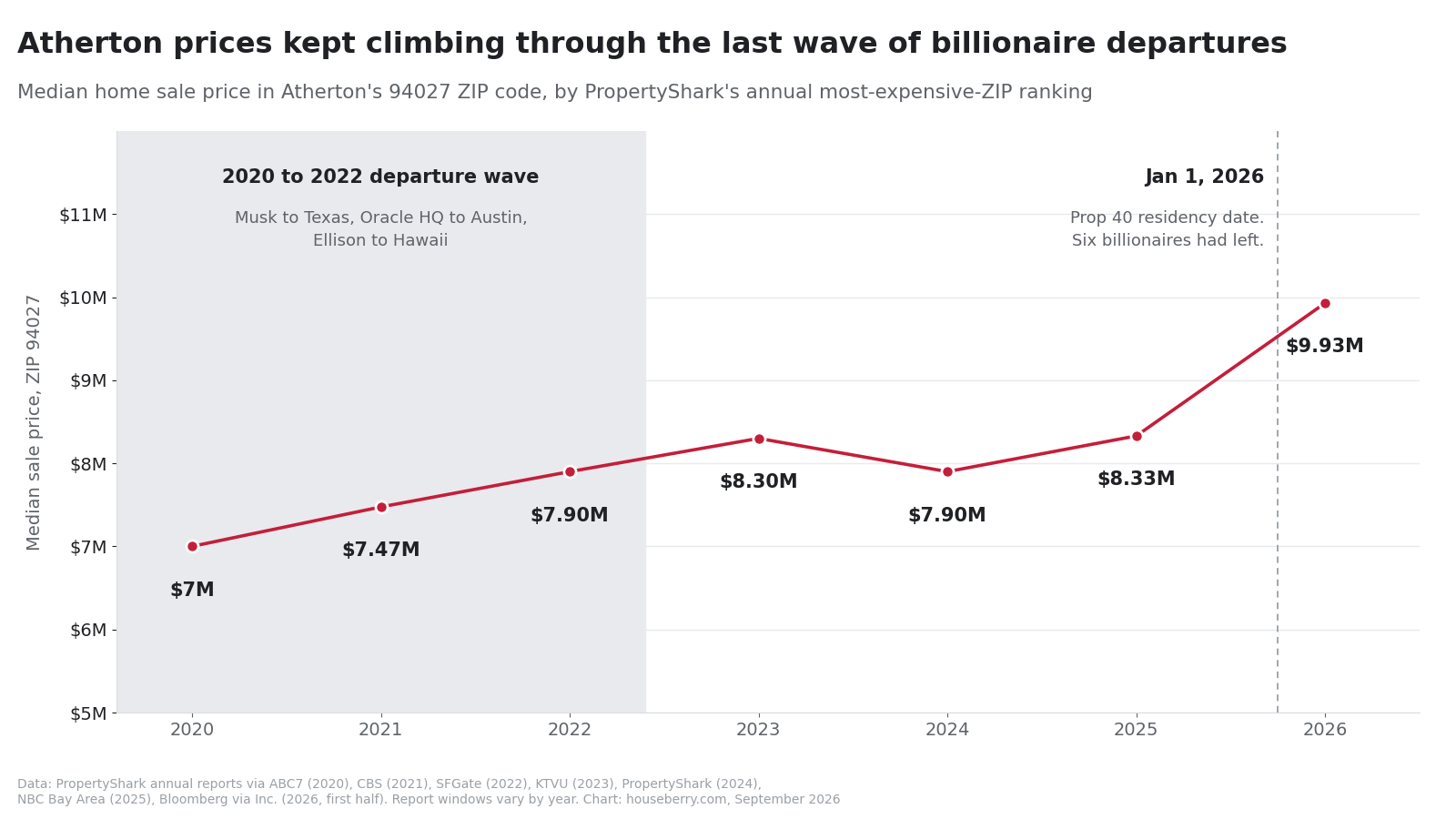
The honest caveat: 2020 and 2021 also brought record-low mortgage rates and a tech stock boom, and 2026 brought AI money. This August, ABC7 reported that an AI-industry buyer paid $70 million for a Hillsborough estate, double the town's old record. Departures were never the only force on these prices.
Why a few listings can swing Atherton's median
Because there are so few sales that each one moves the average.
On our Atherton city page, the monthly median ran from $9.94 million in July 2025 to $18.65 million in January 2026, then $15 million in March. Palo Alto, with far more transactions, stayed between $4.08 million and $4.54 million. PropertyShark's first-half 2026 Atherton median of $9.93 million and our June figure of $17.31 million disagree by more than $7 million, because they cover different windows and a handful of sales. That gap is the point.
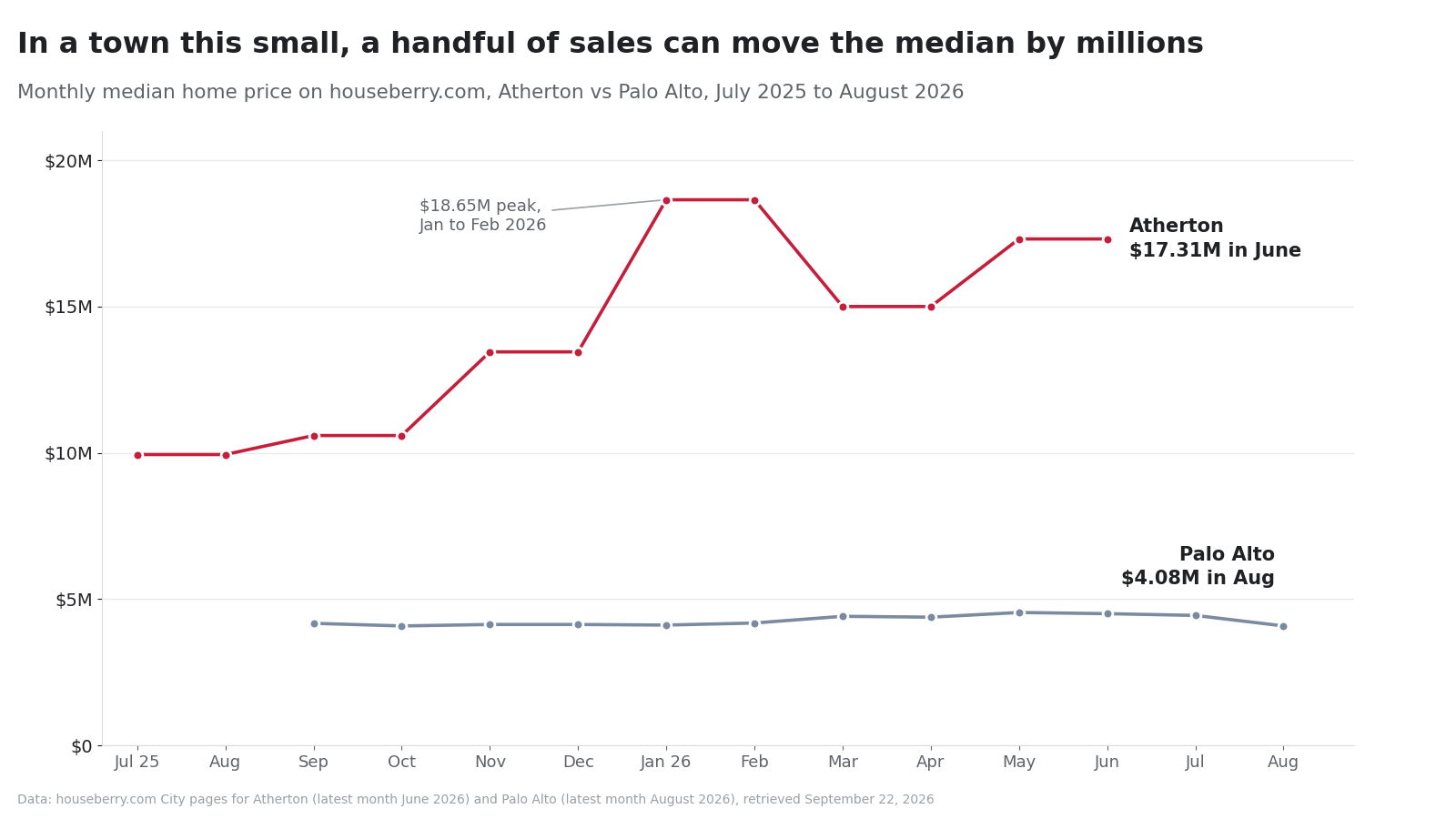
What this does and does not mean. If three or four estate owners listed in the same slow quarter, as opponents warn could happen, Atherton's median could drop sharply on paper. That would not mean the typical Atherton house lost value. For buyers, land is the steadier yardstick. Our look at Peninsula teardown land values found Atherton lots trading around $188 to $258 per square foot.
The Prop 13 twist: a sale raises the tax base
When a long-held trophy home sells, the town's property tax take goes up.
Under Prop 13, a home's assessed value is its purchase price, rising no more than 2 percent a year until it sells, when it resets to the new price. Ellison bought his Pacific Heights home for $3.9 million in 1990 and sold it for $45 million on December 12, 2025. Thirty-five years of 2 percent growth caps a $3.9 million base at about $7.8 million, plus whatever the late-1990s remodel added. The new base is about $45 million. At the 1 percent general levy, that one parcel goes from well under $100,000 a year to roughly $450,000 (our estimate, before local bonds).
That matters most where schools live on local property tax. Palo Alto Unified says it is funded primarily through local property taxes, and its Measure B parcel tax failed in June with 60.8 percent, short of the two-thirds it needed. A reassessed estate helps a district like that. The revenue a departure costs is state income tax, which the LAO pegs at less than $1 billion a year. One more catch: an owner who leaves but keeps the house changes nothing on the property tax side.
What supporters and opponents argue
Both sides make a real case, and we are not taking one.
Supporters, led by sponsor SEIU-United Healthcare Workers West and joined by Sen. Bernie Sanders and the California Democratic Party, say the money would backfill federal health care cuts. Economists Emmanuel Saez and colleagues argue in an expert report on the measure that "the super wealthy do not generally move because of taxes." Nvidia's Huang told Forbes in January he was "perfectly fine" with it.
Opponents include Gov. Gavin Newsom, per CalMatters, the California Business Roundtable, the California Teachers Association, Planned Parenthood, Ron Conway and Chris Larsen. Building a Better California, co-founded by Brin, has put $82 million behind Props 41 and 42, per GV Wire. Their core argument is the one Fortune quantified in March: six departures took about $27 billion of potential revenue with them. San Jose State economist Matthew Holian told San José Spotlight that tax changes "can cause a host of unforeseen reactions."
Prop 40 billionaire tax FAQ
What is the California billionaire tax?
A one-time 5 percent tax on the net worth of Californians worth more than $1 billion who were residents on January 1, 2026, due in 2027 and payable over five years, with 90 percent going to health care.
When do Californians vote on Prop 40?
November 3, 2026. It needs a simple majority, and it is voided if Prop 41 or Prop 42 passes with more votes.
Where do billionaires live in the Bay Area?
Forbes residence data puts most of them in Atherton, Woodside, Palo Alto, Los Altos and Los Altos Hills, plus San Francisco, where Pacific Heights' Broadway corridor is known as Billionaire's Row.
Would home prices in Atherton fall if billionaires leave?
The last test says not by much. Atherton's median rose from $7 million to $7.9 million between 2020 and 2022 while Musk, Ellison and Oracle left. A cluster of estate listings could drag the monthly median down on paper, because so few homes sell there.
Does Prop 40 tax homes?
No. Real estate held directly or through a revocable trust is excluded, according to the LAO and Holland & Knight. Where you keep a home can still count toward whether you are a California resident.
Can a billionaire avoid Prop 40 by moving now?
No. Residency is fixed at January 1, 2026, and leaving after that date does not remove someone from the tax, per Holland & Knight.
Whichever way the vote goes, the housing math starts at the neighborhood, not the headline. If you are watching these towns, our Peninsula neighborhood rankings are the place to compare scores and current prices side by side.
Sources
California Legislative Analyst's Office, Proposition 40 ballot analysis, 2026
Holland & Knight, “California's Proposed Billionaire Tax: What You Need to Know,” September 2026
Galle, Gamage, Saez and Shanske, expert report on the California 2026 Billionaire Tax, December 2025
San José Spotlight via Redwood City Pulse, “Silicon Valley voters to weigh ‘billionaire tax’ ballot measure,” September 22, 2026
Fortune, “Only 6 billionaires left California over its proposed wealth tax,” March 17, 2026
GV Wire, “How to Decode the Minefield of California's Tax Propositions,” July 20, 2026
CalMatters, Newsom and the billionaire tax, July 2026
Forbes, Jensen Huang on the billionaire tax, January 6, 2026
KRON4 and Stacker, Forbes residence list of California's richest billionaires
SF Standard, Larry Ellison San Francisco home sale, January 5, 2026, and New York Post via AOL
SocketSite, Musk Hillsborough estate sale, December 2021, CNBC and Fortune on Oracle and Ellison, December 2020
PropertyShark most expensive ZIP code rankings, 2020 to 2026, via ABC7, CBS, SFGate, KTVU, NBC Bay Area and Inc.
ABC7, Hillsborough $70 million sale, August 2026
California Association of Realtors, August 2026 home sales report, September 16, 2026
LAO, Understanding California's Property Taxes, and Palo Alto Unified School District parcel tax page
Palo Alto Daily Post, Measure B results, June 2, 2026
Houseberry City and Neighborhood pages and Peninsula and San Francisco rankings, retrieved September 22, 2026
Map of Peninsula Neighborhoods
Loading map...
View Full Map
Top Neighborhoods in Peninsula, CA





All information provided on this website including but not limited to - school ratings, safety, amenities, user opinions, and property data - is for general informational purposes only. We do not guarantee its reliability, accuracy, or completeness. Users should independently verify information and consult appropriate professionals as needed. By using this website, you agree Houseberry is not responsible for actions, decisions, or consequences arising from reliance on the information provided
houseberry.com - CA DRE# 01847391
 Bay East ©2025. CCAR ©2025. bridgeMLS ©2025. Information Deemed Reliable But Not Guaranteed. This information is being provided by the Bay East MLS, or CCAR MLS, or bridgeMLS. The listings presented here may or may not be listed by the Broker/Agent operating this website. This information is intended for the personal use of consumers and may not be used for any purpose other than to identify prospective properties consumers may be interested in purchasing. Data last updated at September 22, 2026 12:00 AM