40 Homes, One Ballot: Half Moon Bay Votes on 555 Kelly
Half Moon Bay voters decide Measure Q on November 3, after 1,085 signatures forced a citywide vote on 40 apartments for senior farmworkers. The arithmetic behind the fight, and what it says about Coastside housing supply.

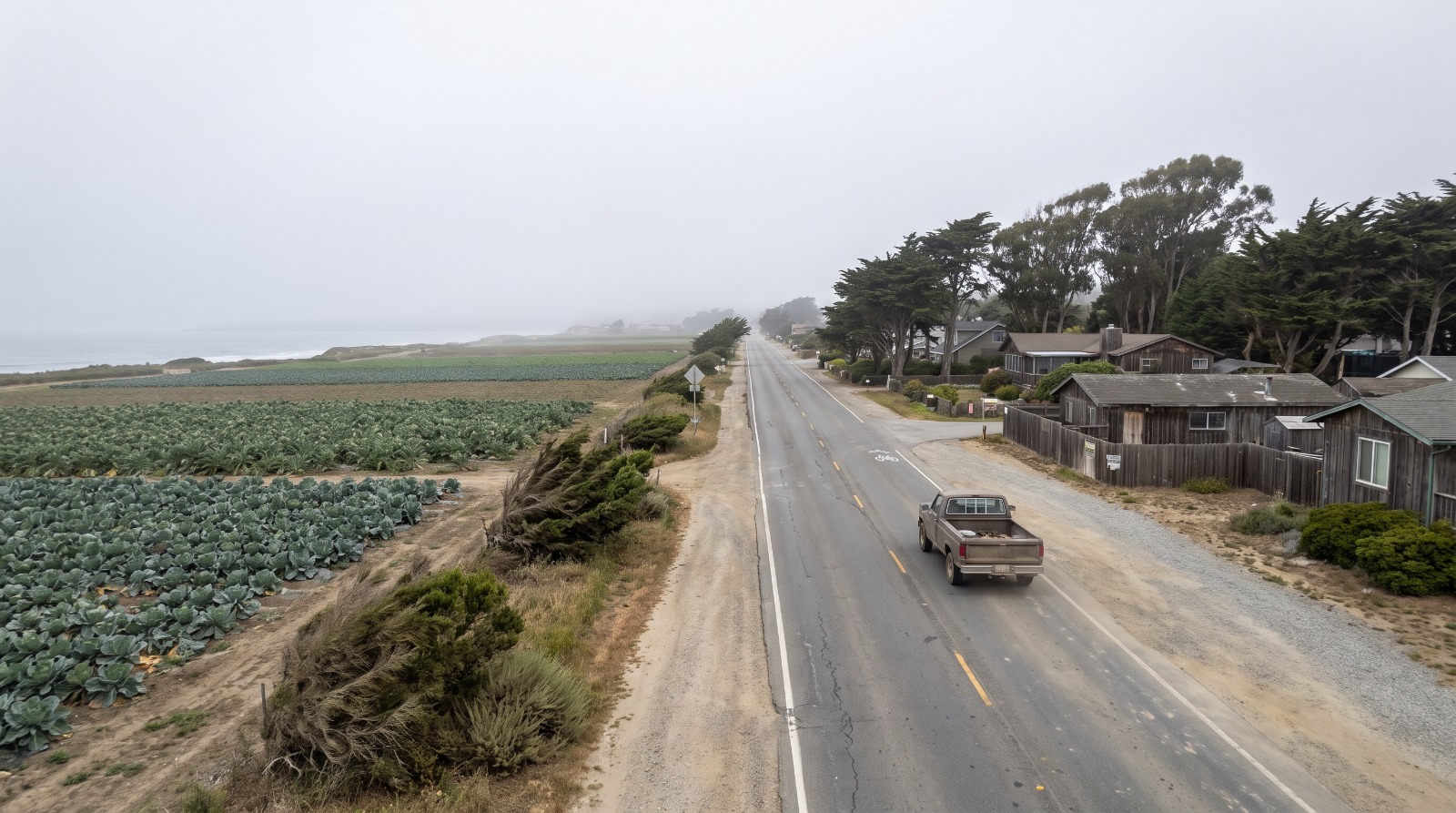
Kelly Avenue in Half Moon Bay looking west toward the Pacific under coastal fog, with farm fields and low coastside buildings. Photo: Houseberry
It took 1,085 signatures to put 40 apartments on a ballot. That is roughly 27 signatures per home, and on November 3, 2026 Half Moon Bay voters will decide Measure Q, which asks whether the city may lease its own land to Mercy Housing California for 40 income-restricted apartments for local farmworkers aged 55 and up at 535 to 555 Kelly Avenue. The project already has its coastal development permit. The council already approved the lease. This vote is about whether that approval stands.
The numbers that matter
| Measure Q by the numbers | Figure |
|---|---|
| Homes proposed | 40 (3 studios, 34 one-bedroom, 3 two-bedroom) |
| Who qualifies | Local farmworkers aged 55 and older |
| Ground lease | 99 years, city keeps ownership of the land |
| Signatures submitted to force the vote | 1,085 on June 16, 2026 |
| Valid signatures required | About 800 |
| Council vote approving the lease | 3 to 2, May 2026 |
| Council vote sending it to voters | 5 to 0, July 21, 2026 |
Two things jump out of that table. The referendum cleared its threshold by a margin of roughly 285 signatures, which is not a landslide in a city this size. And the council that split 3 to 2 on the lease turned around and voted unanimously to let the electorate settle it rather than repeal the ordinance outright, which was the other option on the table that night.
What is actually being built
Forty apartments in a five-story building, with about 2,653 square feet of community space, on city-owned land at the eastern edge of downtown. Mercy Housing California is the developer, working with Ayudando Latinos A Soñar, the Half Moon Bay nonprofit that has spent years on Coastside farmworker services. The Yes campaign says more than $25 million in outside funding is secured, including a $2 million state grant, with no local tax dollars in the deal. That is the campaign's own accounting, and it is the number opponents have not seriously contested.
The entitlement history is longer than the referendum makes it look. The Planning Commission approved the coastal development permit on May 14, 2024. Three appeals landed by May 29. The City Council denied them on June 26, 2024. The council then spent years negotiating lease terms before adopting the ordinance this past May. Roughly four years of process produced 40 homes, and then a petition drive added another six months.
The objection, stated fairly
Opponents say five stories is too tall for downtown Half Moon Bay, and on the built form alone that is not a crazy thing to say. Downtown Half Moon Bay is a two-story town. A five-story building at the edge of it will be the tallest thing for blocks and it will be visible from Highway 1.
The counterweight is that height is what makes 40 income-restricted homes pencil on one parcel. Spread the same unit count over two stories and you need three times the land, in a coastal zone where developable land is the scarcest thing there is. There is no version of this project that is both short and built.
Governor Gavin Newsom and other state officials publicly criticized the length of the city's approval timeline. Whether that helps or hurts at the ballot box in a town that dislikes being told what to do by Sacramento is anyone's guess.
Why the Coastside is expensive, in one comparison
San Mateo County's median sale price was $2,210,000 in July 2026, up 5.2 percent year over year, second-highest in California behind only San Francisco. The nine-county Bay Area median that month was $1,285,000. San Mateo County costs about 72 percent more than the region it sits in.
The coast itself runs cheaper than the county's bayside cities, and that surprises people. We do not score Half Moon Bay yet, so the closest read we have is Pacifica, the other Coastside city on Highway 1. Linda Mar Valley scores 3.9 out of 5 with a median sale price of about $1.24 million in July 2026, and it is the second-highest-scoring of the 11 Pacifica neighborhoods we rank, which average 3.4 out of 5 as a city.
So a strong coastal neighborhood trades at roughly 56 percent of the countywide median. The Coastside discount is real, and it is paid for in commute time over Devil's Slide or Highway 92, fog, and a housing stock that barely grows. The fog we cannot fix. The last part is what Measure Q is about.
What this does and does not mean
It does not mean 40 apartments will change a price anywhere. They will not. Forty income-restricted senior units are invisible to the for-sale market, and no buyer comparing Coastside towns should expect a different number because of this vote.
What it means is a process signal, and process signals are what actually predict supply. The Housing Readiness Report, which tracks jurisdiction compliance, shows Half Moon Bay has permitted about 32 percent of its very-low-income and 21.2 percent of its low-income targets for the 2023-2031 cycle, and lists the city as lacking an HCD-certified housing element for the current period. Thirty-five percent of local households are rent-burdened.
A city in that position holding a referendum on 40 homes is telling you something about how fast the next 400 will move. When we compare places on the Peninsula, that pace is the input people underweight most. Two towns can look identical on schools and safety today and diverge completely over ten years based on nothing but how they handle applications. It is the same pattern we wrote about when Pacifica had to decide what to do with its pier, and it shows up eventually in every score we publish.
Questions people are actually typing
When is the vote? November 3, 2026, the statewide general election. Measure Q needs a simple majority.
Does a yes vote build the project? It ratifies Ordinance 2026-01, the 99-year ground lease with Mercy Housing California. Construction financing and permits still follow.
Does Half Moon Bay pay for it? Not per the funding stack described by the Yes campaign, which puts more than $25 million of outside money against the project and no local tax dollars. The city's contribution is the land, leased rather than sold.
Who can live there? Local farmworkers aged 55 and older, income-qualified. It is a small, specific population, and that specificity is part of why the fight has been unusually pointed.
Sources
- San Mateo Daily Journal, "Half Moon Bay voters to decide fate of 555 Kelly senior farmworker housing," August 19, 2026
- Coastside News, "555 Kelly referendum group submits signatures seeking citywide vote"
- Coastside Buzz, Half Moon Bay City Council votes unanimously to send 555 Kelly to the November 2026 ballot
- NBC Bay Area, "Half Moon Bay voters to decide farmworker housing project"
- City of Half Moon Bay, 555 Kelly Avenue Affordable Housing project page
- Yes on Measure Q campaign, project and funding details (campaign statements)
- California Association of Realtors, July 2026 county sales and price activity
- Housing Readiness Report, Half Moon Bay
The Houseberry Research Team is Houseberry's reporting team: Bay Area real estate analysts, data specialists and longtime local market watchers. Every day we check the public record: building permits, city council and planning agendas, county recorder filings, state housing bills, police incident data and school results. Then we tie each story to what it means for specific neighborhoods, using Houseberry's own neighborhood data on prices, appreciation, safety, schools and amenities. Questions or corrections: Contact us.
All information provided on this website including but not limited to - school ratings, safety, amenities, user opinions, and property data - is for general informational purposes only. We do not guarantee its reliability, accuracy, or completeness. Users should independently verify information and consult appropriate professionals as needed. By using this website, you agree Houseberry is not responsible for actions, decisions, or consequences arising from reliance on the information provided
houseberry.com - CA DRE# 01847391
 Bay East ©2025. CCAR ©2025. bridgeMLS ©2025. Information Deemed Reliable But Not Guaranteed. This information is being provided by the Bay East MLS, or CCAR MLS, or bridgeMLS. The listings presented here may or may not be listed by the Broker/Agent operating this website. This information is intended for the personal use of consumers and may not be used for any purpose other than to identify prospective properties consumers may be interested in purchasing. Data last updated at October 9, 2026 12:00 AM