Walnut Creek Measure U: What a Yes Vote Rezones by BART
Walnut Creek's Measure U asks voters on November 3 to rezone a 2.4-acre office corner across from BART for 200-plus senior homes. Here is what a yes or no vote does, and what our neighborhood data says about the site.
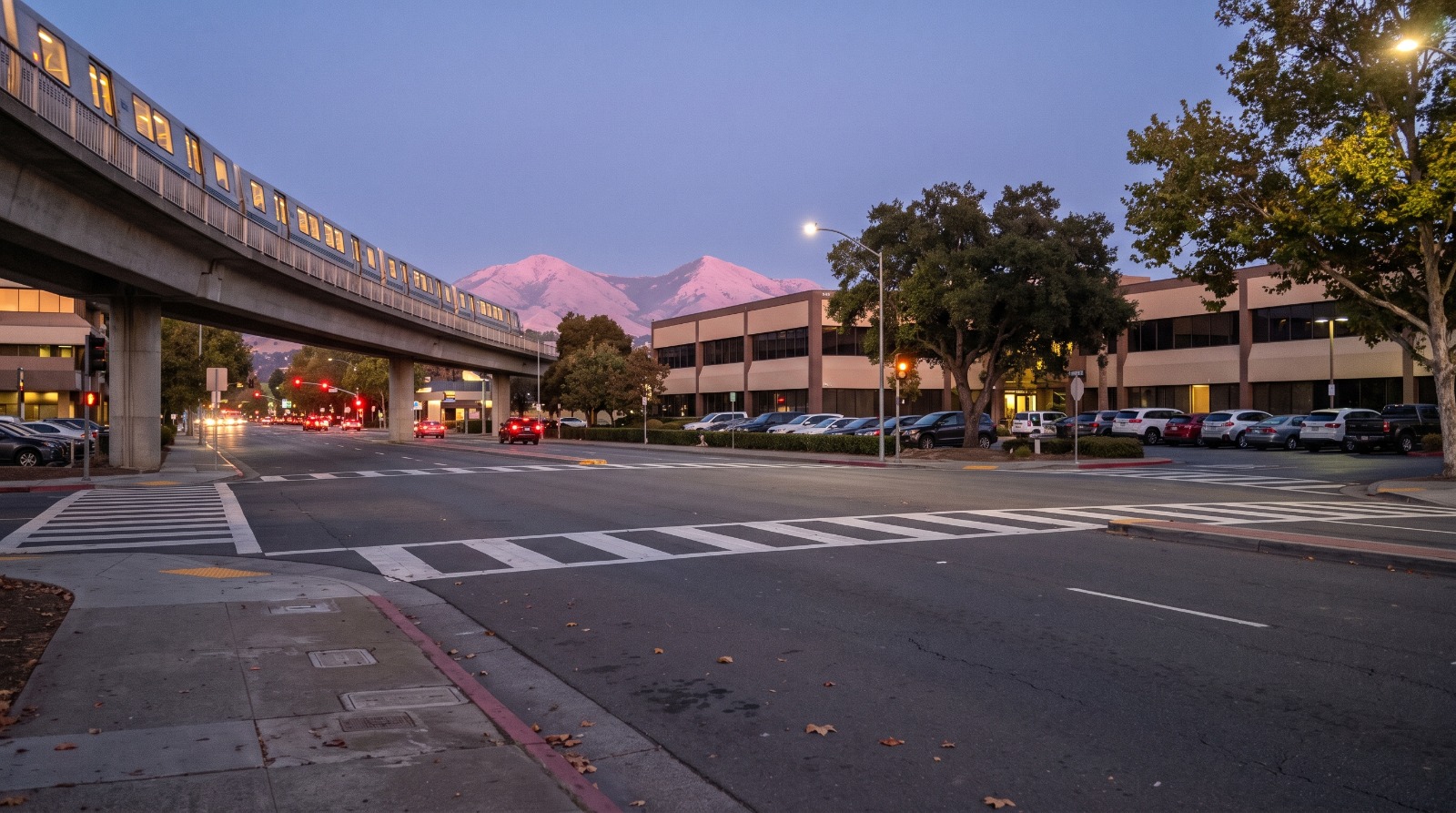
Dusk view along Ygnacio Valley Road by Walnut Creek BART toward the office corner Measure U would rezone for senior housing. Photo: Houseberry
The ballot question for Walnut Creek Measure U is one sentence long, and the key phrase sits in the middle of it: redesignate a 2.4-acre site "from office uses to mixed use residential uses." That is the whole decision. On November 3, Walnut Creek voters choose whether the northeast corner of North California Boulevard and Ygnacio Valley Road, directly across from Walnut Creek BART, stays zoned for offices or opens up for 200-plus homes aimed at residents 55 and older.
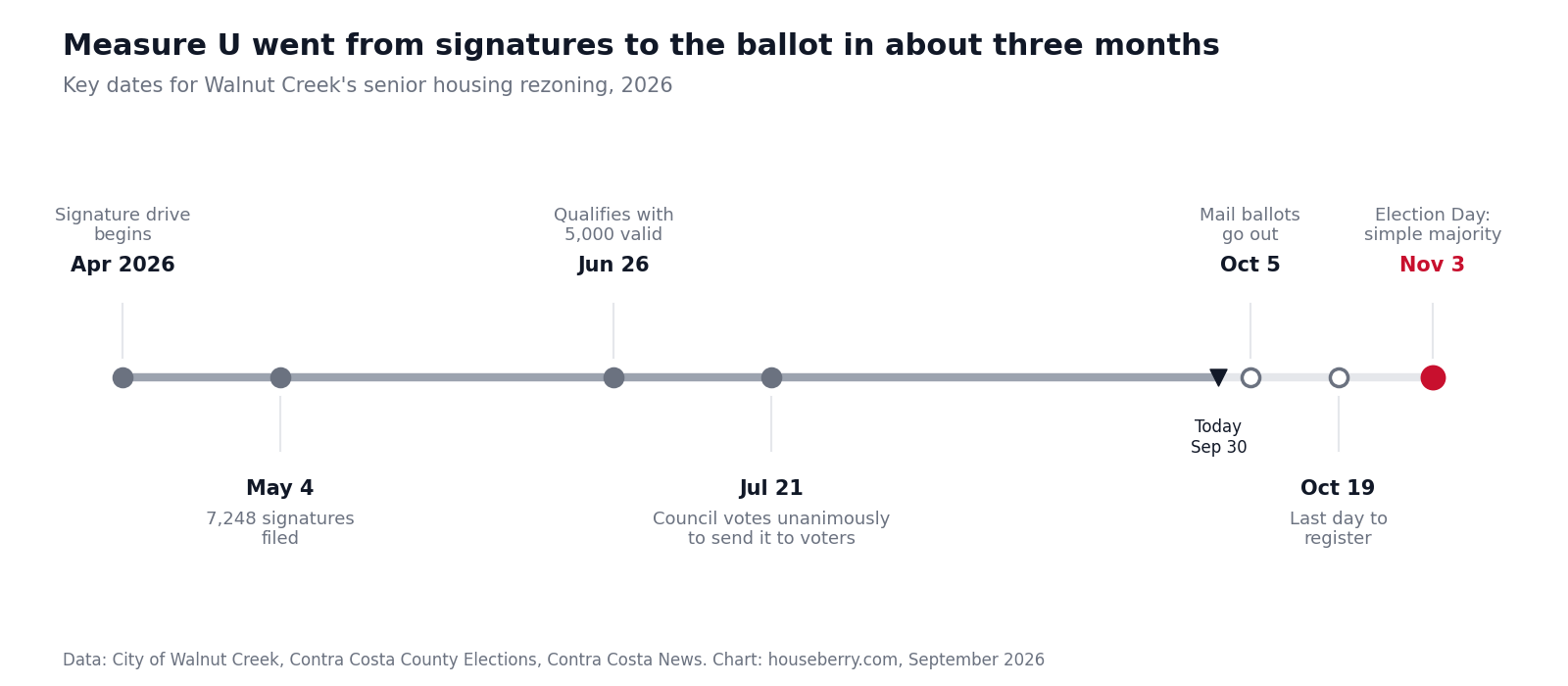
When we wrote about this corner in July, the city council still had a choice to make. It made it. On July 21 the council voted unanimously to send the initiative to voters instead of adopting it outright, and it is now on the ballot as Measure U. This is the next chapter.
What Measure U actually says
Measure U amends three documents at once: the Walnut Creek General Plan, the North Downtown Specific Plan, and the Municipal Code. According to the [county's impartial analysis](https://www.contracostavote.gov/m9013-en/), it creates a new Mixed Use Residential Senior and Commercial district and applies it to one parcel.
The specs, from the ballot materials and the city's July staff analysis:
- Site: 2.4 acres at the northeast corner of North California Boulevard and Ygnacio Valley Road, across from the BART station
- Use: housing "serving primarily persons 55 years or older," plus compatible commercial space
- Base density: one unit per 425 square feet of net lot area
- Height: up to 89 feet, per the [city's §9212 analysis as reported from the July 21 meeting](https://citizenportal.ai/articles/8579254/California/Contra-Costa-County/Walnut-Creek-City/Walnut-Creek-places-Transit-Village-senior-housing-initiative-on-November-ballot-after-receiving-9212-report)
- Residential floor area ratio: 3.5 base, 4.5 maximum
- Proponent: Friends of Walnut Creek Senior Housing, backed by Hall Equities Group and property owner Mark Hall
Run the density math and one unit per 425 square feet works out to roughly 246 homes if the full 2.4 acres counted as net lot area. It will not, quite, once streets and setbacks come out. That is why the city's two scenarios bracket the likely range at 225 to 280.
Why a rezoning ended up on your ballot
Walnut Creek does not require a public vote to rezone a parcel. Measure U is on the ballot because it started as a citizen initiative, and state election law gives a council only two moves once an initiative qualifies: adopt it word for word, or put it before voters.
The signature drive was fast even by Bay Area standards. Proponents turned in 7,248 signatures on May 4 after about 25 days of gathering, [Contra Costa News reported](https://contracosta.news/2026/05/07/walnut-creek-senior-housing-initiative-moves-forward-following-record-signature-effort/). It qualified in June with 5,000 valid signatures against a 4,987 threshold.
The council could have adopted it in July and skipped the campaign. It chose the ballot unanimously and declined to write an argument against it. I read that as a council comfortable with the housing and uncomfortable being the ones who hand a developer a rezoning without a public vote. Fair enough. The opposite critique, which one resident put bluntly back in April as a "backdoor approach," is also on the record.
Downtown's scores explain the site better than the campaign does
The corner sits at the north edge of Downtown Walnut Creek, and our data on that neighborhood makes the case for housing here more plainly than any mailer. Downtown scores 4.6 out of 5 for nearby merchants and 4.8 for public spaces, the kind of numbers you only get where a pharmacy, a grocery store, Broadway Plaza, and a BART platform are all a short walk apart.
It also carries a 2.3 safety score and ranks 24th of 30 Walnut Creek neighborhoods overall at 3.3, according to our [Walnut Creek neighborhood rankings](https://www.houseberry.com/Nhranking/best-overall/Walnut-Creek-CA/). That trade-off is real. Downtowns are busier, and busy places log more incidents.
Here is how the site's surroundings compare with the other places people weigh when they want a walkable downtown and a BART station in central Contra Costa.
| Neighborhood | Overall score | Safety | Amenities | Median price, Aug 2026 |
|---|---|---|---|---|
| Downtown Walnut Creek | 3.3 | 2.3 | 4.2 | $800,360 |
| North Civic (Walnut Creek) | 3.3 | 2.5 | 3.4 | $470,260 |
| Rossmoor (Walnut Creek) | 3.8 | 4.0 | 3.4 | $625,160 |
| Downtown Lafayette | 3.7 | 2.5 | 3.7 | $1,560,000 |
| Downtown Pleasant Hill | 2.8 | 2.4 | 3.7 | $697,440 |
Two rows matter most for Measure U. [Downtown Walnut Creek](https://www.houseberry.com/Neighborhood/Downtown-Walnut-Creek-Walnut-Creek/) leads the group on amenities at 4.2. And Rossmoor, the 1,800-acre gated 55-plus community on the southwest side of town, scores just 0.9 out of 5 for nearby merchants. That gap is the argument for putting age-restricted homes downtown instead of at the edge of town, where most errands start with car keys.
Downtown prices have been softening, not climbing
Downtown Walnut Creek's median home price was about $800,360 in August 2026, down roughly 4 percent from about $832,900 in September 2025, based on the neighborhood's 12-month price history on Houseberry. Over the same stretch, Downtown Lafayette's median rose about 8 percent to roughly $1.56 million.
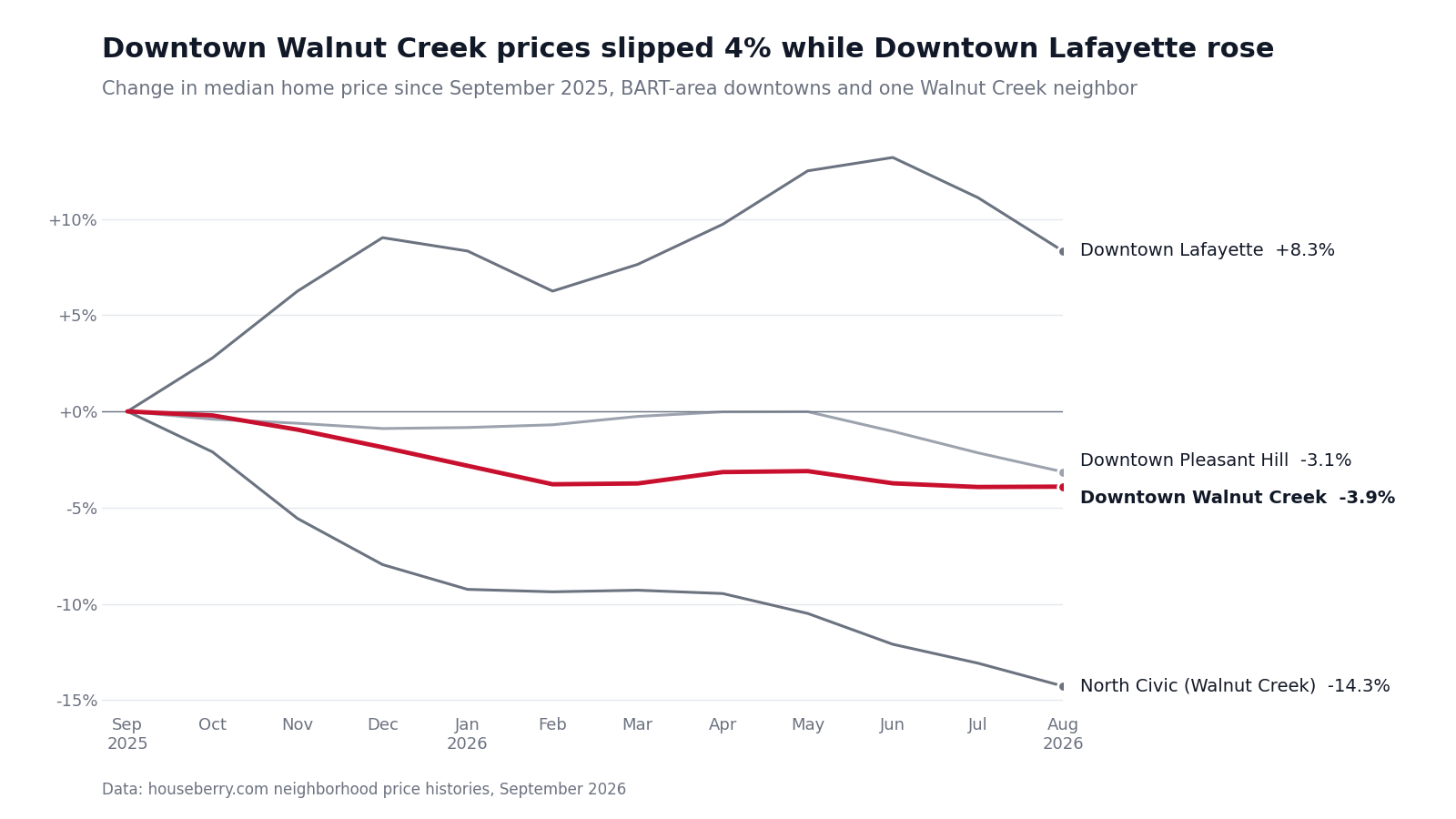
The steepest drop is next door. [North Civic](https://www.houseberry.com/Neighborhood/North-Civic-Walnut-Creek/), the small residential pocket around Civic Park a few blocks north of downtown, slid about 14 percent to roughly $470,300 over those 12 months. It mixes single-family homes and condos, and one small neighborhood's 12-month swing can reflect the mix of what sold, so treat it as a signal rather than a verdict.
So the honest reading is that 200-some senior homes are not arriving into a market that is running hot. If anything, a busier north end of downtown, with ground-floor shops where there is now an office block, is one of the few near-term changes that could give that corner more pull.
Lafayette and Pleasant Hill already ran versions of this experiment
Lafayette broke ground on June 25 on a seven-story, 87-foot, roughly 90-unit building at 1001 Oak Hill Road, steps from its BART station. We covered [Lafayette's seven-story BART project](https://www.houseberry.com/blog/lafayette-bart-seven-story-groundbreaking/) when it happened, in a town that measures its downtown in one- and two-story storefronts. Measure U's 89-foot limit is in the same range.
Pleasant Hill BART is a different model. The station sits in Contra Costa Centre, an unincorporated area run by the county, where apartments were built right up to the platform years ago through county planning, not a city ballot. Downtown Pleasant Hill proper, a couple of miles away, scores 3.7 on amenities and saw its median dip about 3 percent to roughly $697,400 in August 2026.
The lesson from both is plain. The 680 corridor is putting its density next to its BART stations, and the only real question in Walnut Creek is which process gets it there.
What Measure U does not settle
A yes vote rezones land. It does not approve a building. The proponents' own land use counsel told the council in April that any project "needs to be consistent and follow the city's set processes," which means design review and a formal application still come later.
There are real downsides to weigh, too.
- The city estimated $6.4 million to $7.7 million in affordable housing in-lieu fees. That suggests the affordable obligation could be paid as a fee rather than built on the site.
- Zoning passed by voters through an initiative generally cannot be changed by the council alone later, unless the measure itself allows it.
- The office space goes away. In an East Bay office market this soft, I do not lose sleep over that, but it is a trade.
The city's analysis also put ongoing net revenue at $257,000 to $552,000 a year, against $66,000 to $83,000 in added service costs. That is a modest fiscal win, not a windfall.
Measure U, answered quickly
What does a yes vote on Measure U do?
It changes the 2.4-acre corner at North California Boulevard and Ygnacio Valley Road from office zoning to a senior-focused mixed-use district that allows roughly 225 to 280 homes plus shops. A developer still has to bring a project through the city.
What happens if Measure U fails?
The site keeps its office designation. The owner could still apply for housing through the normal planning process, but the initiative route would be closed.
Who can live in the homes?
The district is written for housing serving primarily people 55 and older. Final eligibility rules would come with an actual project.
Who supports it?
[Greenbelt Alliance backs Measure U](https://www.greenbelt.org/blog/vote-yes-measure-walnut-creek/), alongside East Bay YIMBY and the Non-Profit Housing Association of Northern California. No formal ballot argument against it was filed.
Between now and November 3
The [City of Walnut Creek's election page](https://www.walnutcreekca.gov/government/departments/city-clerk/elections-voter-registration/november-3-2026-election-4243) lists October 5 for mail ballots and October 19 as the registration deadline. The same ballot carries the Connect Bay Area transit tax, a half-cent sales tax in Contra Costa that [helps fund BART operations](https://contracosta.news/2026/07/01/connect-bay-area-ballot-measure-to-save-public-transit-officially-qualifies-for-november-2026-election/amp/), which makes it a strange week to be voting on a BART-adjacent building without also voting on the trains.
My view has not moved since July. Two hundred-plus homes on a hard corner across from a BART station is exactly where central Contra Costa should be adding housing, and Measure U gets there with a clear density limit and no surprise height. If you are weighing homes near downtown, the neighborhood around that corner is about to get more interesting either way, and our [earlier piece on the senior housing initiative](https://www.houseberry.com/blog/walnut-creek-senior-housing-transit-village/) has the backstory. We will keep scoring the blocks around it the same way we score everything else, by what is within walking distance of the front door.
Sources
- [Contra Costa County Elections: Measure U ballot question and impartial analysis](https://www.contracostavote.gov/m9013-en/)
- [Mercury News: Walnut Creek voters to consider zoning change for more senior housing](https://www.mercurynews.com/2026/09/30/walnut-creek-voters-to-consider-zoning-change-for-more-senior-housing/)
- [Greenbelt Alliance: Vote yes on Measure U](https://www.greenbelt.org/blog/vote-yes-measure-walnut-creek/)
- [Citizen Portal: Walnut Creek places initiative on November ballot after §9212 report](https://citizenportal.ai/articles/8579254/California/Contra-Costa-County/Walnut-Creek-City/Walnut-Creek-places-Transit-Village-senior-housing-initiative-on-November-ballot-after-receiving-9212-report)
- [Citizen Portal: Walnut Creek council orders report on the initiative, April 21, 2026](https://citizenportal.ai/articles/7856390/california/contra-costa-county/walnut-creek-city/walnut-creek-council-orders-report-on-citizen-led-senior-housing-transit-village-initiative)
- [Contra Costa News: Senior housing initiative moves forward after record signature effort](https://contracosta.news/2026/05/07/walnut-creek-senior-housing-initiative-moves-forward-following-record-signature-effort/)
- [City of Walnut Creek: November 3, 2026 election](https://www.walnutcreekca.gov/government/departments/city-clerk/elections-voter-registration/november-3-2026-election-4243)
- [Contra Costa News: Connect Bay Area measure qualifies for November 2026](https://contracosta.news/2026/07/01/connect-bay-area-ballot-measure-to-save-public-transit-officially-qualifies-for-november-2026-election/amp/)
- [Houseberry: Walnut Creek neighborhood rankings](https://www.houseberry.com/Nhranking/best-overall/Walnut-Creek-CA/)
Map of Walnut Creek Neighborhoods
Loading map...
View Full Map
Top Neighborhoods in Walnut Creek, CA


All information provided on this website including but not limited to - school ratings, safety, amenities, user opinions, and property data - is for general informational purposes only. We do not guarantee its reliability, accuracy, or completeness. Users should independently verify information and consult appropriate professionals as needed. By using this website, you agree Houseberry is not responsible for actions, decisions, or consequences arising from reliance on the information provided
houseberry.com - CA DRE# 01847391
 Bay East ©2025. CCAR ©2025. bridgeMLS ©2025. Information Deemed Reliable But Not Guaranteed. This information is being provided by the Bay East MLS, or CCAR MLS, or bridgeMLS. The listings presented here may or may not be listed by the Broker/Agent operating this website. This information is intended for the personal use of consumers and may not be used for any purpose other than to identify prospective properties consumers may be interested in purchasing. Data last updated at October 1, 2026 12:00 AM