Yolo's Measure X is the lodging tax voters rejected in 2000
Measure X would lift the tax on rural Yolo hotels, farm stays, campsites and short-term rentals to 12 percent. Here is what a night costs and where the money goes.

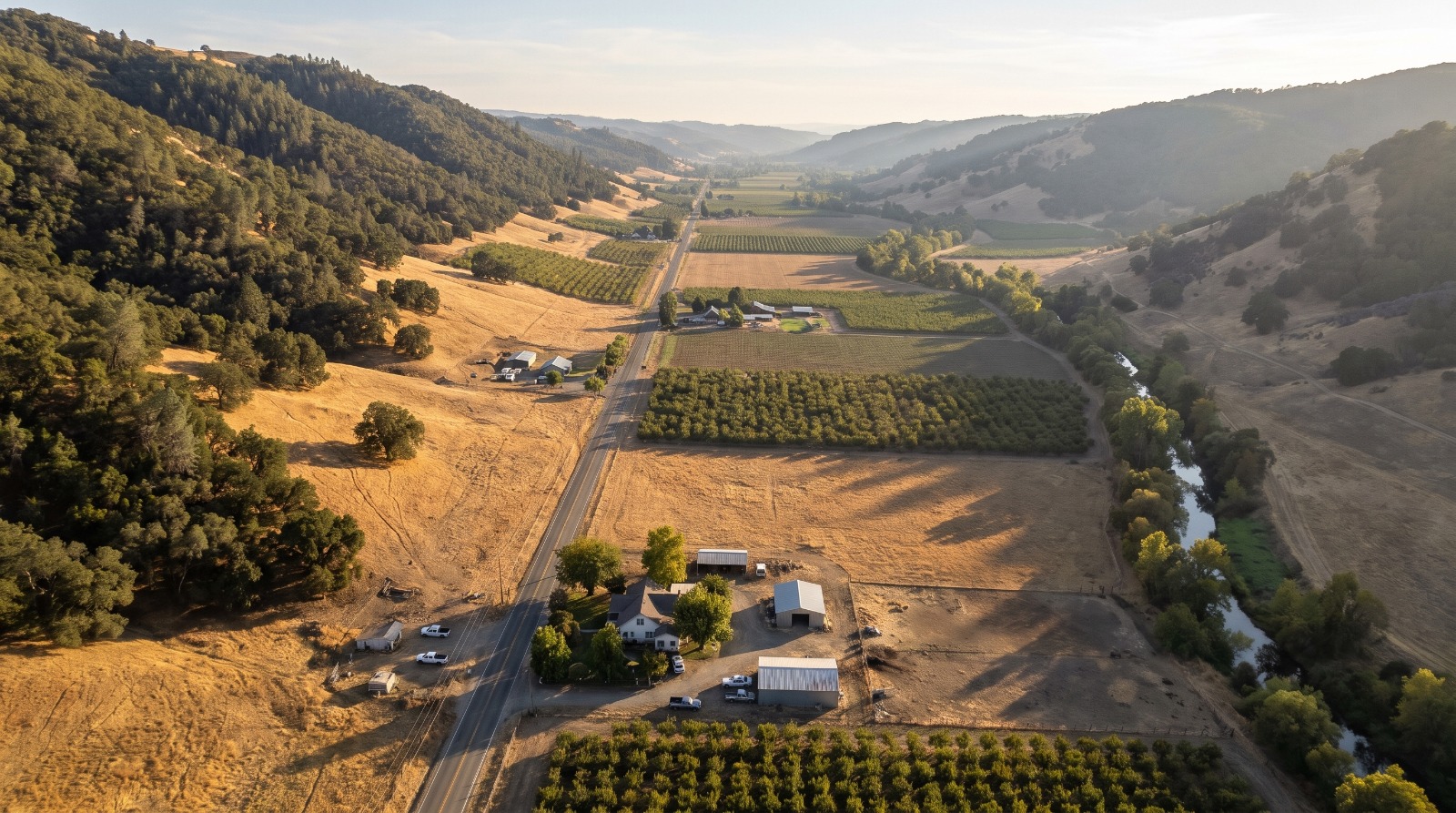
AI-rendered oblique aerial view of the Capay Valley at Guinda in unincorporated Yolo County, with orchards, farmhouses and Cache Creek Photo: Houseberry
In November 2000, Yolo County asked voters to raise the lodging tax outside its four cities from 8 percent to 12 percent. They said no, 4,028 to 2,514, according to the county's election archive. Twenty-six years later the same question is back on the ballot as Measure X, with the same two numbers.
This is a story about who pays a hotel tax in a county with almost no hotels. Measure X covers stays of 30 days or less in unincorporated Yolo County: the farm stays and cabins of the Capay Valley, campsites and RV spaces, rented rooms, and short-term rentals from Clarksburg to Dunnigan. It also covers El Macero, which surprises people. The golf-course enclave has a Davis mailing address, but Houseberry's El Macero page flags it as unincorporated county land, ranked 30th of the 57 neighborhoods we score in Davis. A guest there pays the county rate, not the city's.
If it passes, the rate goes to 12 percent on January 1, 2027. A $100 night that costs $108 today would cost $112.
What a night costs under Measure X
The tax is figured on the whole bill, not just the room rate. The new ordinance spells out what counts as "rent," and the county's Measure X page lists cleaning fees, service fees, booking fees, resort fees and pet fees. So a $250 farm-stay cabin with a $100 cleaning fee is taxed on $350.
Here is the difference on a few typical bills, using our arithmetic.
| Total lodging bill | Tax at 8% today | Tax at 12% | Extra per stay |
|---|---|---|---|
| $150 one night | $12 | $18 | $6 |
| $250 one night | $20 | $30 | $10 |
| $400 one night | $32 | $48 | $16 |
| $1,000 weekend | $80 | $120 | $40 |
On a $250 night, a guest pays $10 more. A host with a single cabin keeps the same $250, since the tax is the guest's. The tax rides on top of the bill. The ordinance also names online booking platforms as collectors, which matters for hosts who list on more than one site.
The line is the city limit. Davis, Woodland, West Sacramento and Winters keep their own rates and are untouched. Lodging on tribal land is exempt too, which leaves out the county's biggest hotel, Cache Creek Casino Resort in Brooks, on Yocha Dehe Wintun Nation land.
What's left is small. Abridged, the PBS KVIE newsroom, counted 10 lodging facilities that would collect the higher rate, plus the short-term rentals scattered through places like Esparto, Guinda, Capay, Madison, Knights Landing and Clarksburg. Campgrounds and RV parks fall under the same rule, since the updated ordinance names campgrounds and recreational vehicle spaces outright.
The vote is countywide. Most of the people deciding live in Davis, Woodland, West Sacramento and Winters, the four cities Houseberry ranks on its Yolo County page, and they will never pay this tax unless they book a night in the countryside.
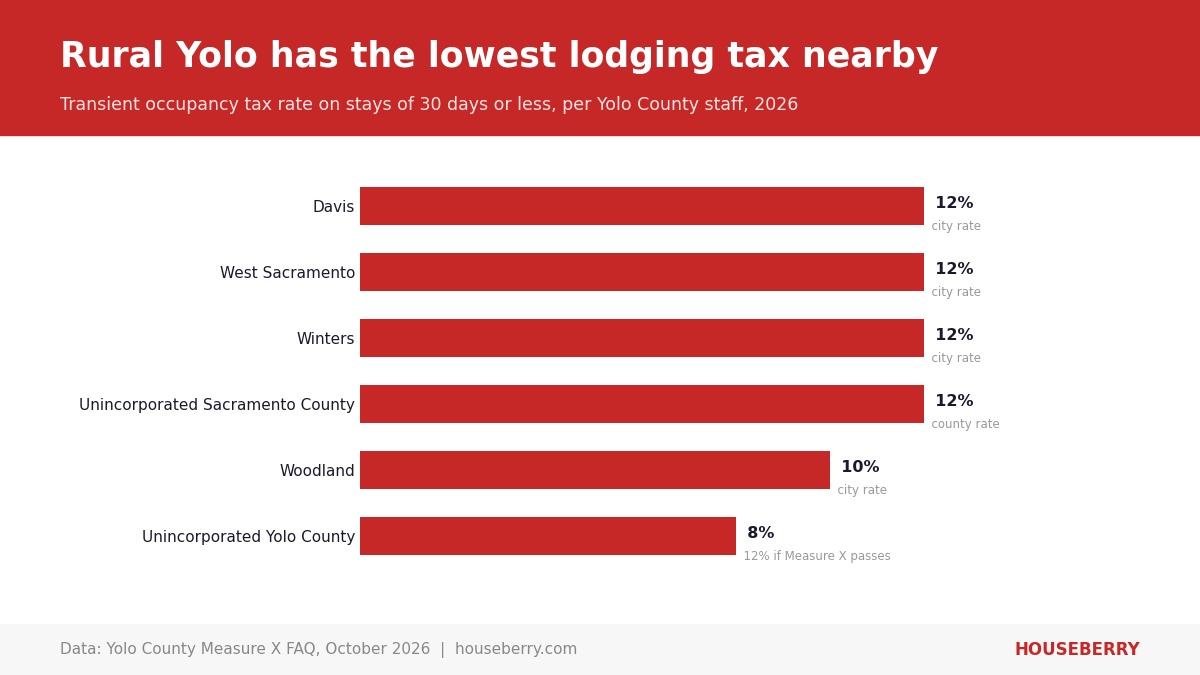
The county's pitch rests on that chart. Every neighbor except Woodland already charges 12 percent, so raising the rural rate would not make a Capay Valley farm stay pricier than a Davis hotel. "We've been a little behind the eight ball when it comes to what other jurisdictions are doing," Supervisor Lucas Frerichs told Abridged.
The county's own numbers don't quite add up
The argument in favor, signed by Supervisors Sheila Allen, Lucas Frerichs, Oscar Villegas and Mary Vixie Sandy, says the tax brought in $250,000 in fiscal 2024-25. It also says the 4-point increase is worth another $250,000 a year.
Those two figures only fit together if the base grows. At 8 percent, $250,000 means about $3.1 million a year in taxable lodging bills across unincorporated Yolo, by our math. Four more points on that same $3.1 million is about $125,000, half the county's estimate. The rest would have to come from the wider definitions in the new ordinance (fees, campsites, RV spaces, platform collection), from more bookings, or from an estimate that runs high. The county materials we read do not show the calculation.
We think that gap matters more than the rate itself. Either number is small. The county started this fiscal year $35 million short, Abridged reported, and closed most of it with reserves and cuts that fell hardest on the Health and Human Services Agency. Even the county's $250,000 is about 0.7 percent of that hole. "It's not a huge amount, but at this point every bit is essential," Frerichs said.
Measure X is a general tax. The money goes into the General Fund, and the ballot question names health and human services, public safety and emergency preparedness as examples. The county's own FAQ says plainly that the revenue is not legally earmarked for any of them. That is why it needs only a majority, not two-thirds.
The bigger fix the county wants is in Sacramento. A state property tax formula, the Educational Revenue Augmentation Fund, has shorted Yolo about $3 million a year for almost 30 years, and the Legislature did not change it this session. Supervisors have also floated a countywide sales tax, with 2028 as the earliest it could pass.
Questions readers ask
Do Davis or Woodland residents pay this? Only when they stay overnight at a lodging business in an unincorporated part of the county. Residents do not pay it at home, and city hotels keep the city rate.
Does it apply to monthly rentals? No. The tax covers stays of 30 days or less.
What happens if it fails? The rate stays at 8 percent and the rest of the ordinance update does not take effect.
Is El Macero in Davis? Not for tax purposes. It is unincorporated, so a short-term rental there would charge the county rate. Houseberry scores both El Macero and neighboring El Macero Estates 4.4 out of 5 on schools.
We covered the rest of the region's local measures, from Davis Measure W to the school bonds, in our Sacramento-area November ballot roundup. In 2000, 61.6 percent of voters turned this exact increase down, and the next count will show whether a county with 10 lodging businesses and a $35 million gap reads it any differently. If you're weighing a home on either side of the Davis city line, compare all 57 neighborhoods on Houseberry's Davis ranking, El Macero included.
Sources
- Yolo County Elections, Measure X ballot question, impartial analysis and argument
- Yolo County, Measure X 2026 frequently asked questions
- Yolo County Board of Supervisors, May 26, 2026 TOT presentation and TOT rate research
- Yolo County election archive, Measure P, November 7, 2000
- Abridged (PBS KVIE), Yolo County seeks revenue bump through new lodging tax, Measure X, October 21, 2026
The Houseberry Research Team is Houseberry's reporting team: Bay Area real estate analysts, data specialists and longtime local market watchers. Every day we check the public record: building permits, city council and planning agendas, county recorder filings, state housing bills, police incident data and school results. Then we tie each story to what it means for specific neighborhoods, using Houseberry's own neighborhood data on prices, appreciation, safety, schools and amenities. Questions or corrections: Contact us.
Map of Davis Neighborhoods
Loading map...
View Full Map
Top Neighborhoods in Davis, CA


All information provided on this website including but not limited to - school ratings, safety, amenities, user opinions, and property data - is for general informational purposes only. We do not guarantee its reliability, accuracy, or completeness. Users should independently verify information and consult appropriate professionals as needed. By using this website, you agree Houseberry is not responsible for actions, decisions, or consequences arising from reliance on the information provided
houseberry.com - CA DRE# 01847391
 Bay East ©2025. CCAR ©2025. bridgeMLS ©2025. Information Deemed Reliable But Not Guaranteed. This information is being provided by the Bay East MLS, or CCAR MLS, or bridgeMLS. The listings presented here may or may not be listed by the Broker/Agent operating this website. This information is intended for the personal use of consumers and may not be used for any purpose other than to identify prospective properties consumers may be interested in purchasing. Data last updated at October 27, 2026 12:00 AM