Affordable Senior Housing in West Oakland Opens on Church Land
Friendship Senior Housing opened 50 rent-restricted apartments for seniors on a West Oakland church parcel. Here is what the nine-year build actually took, who qualifies, and how the four neighborhoods around it score and price.
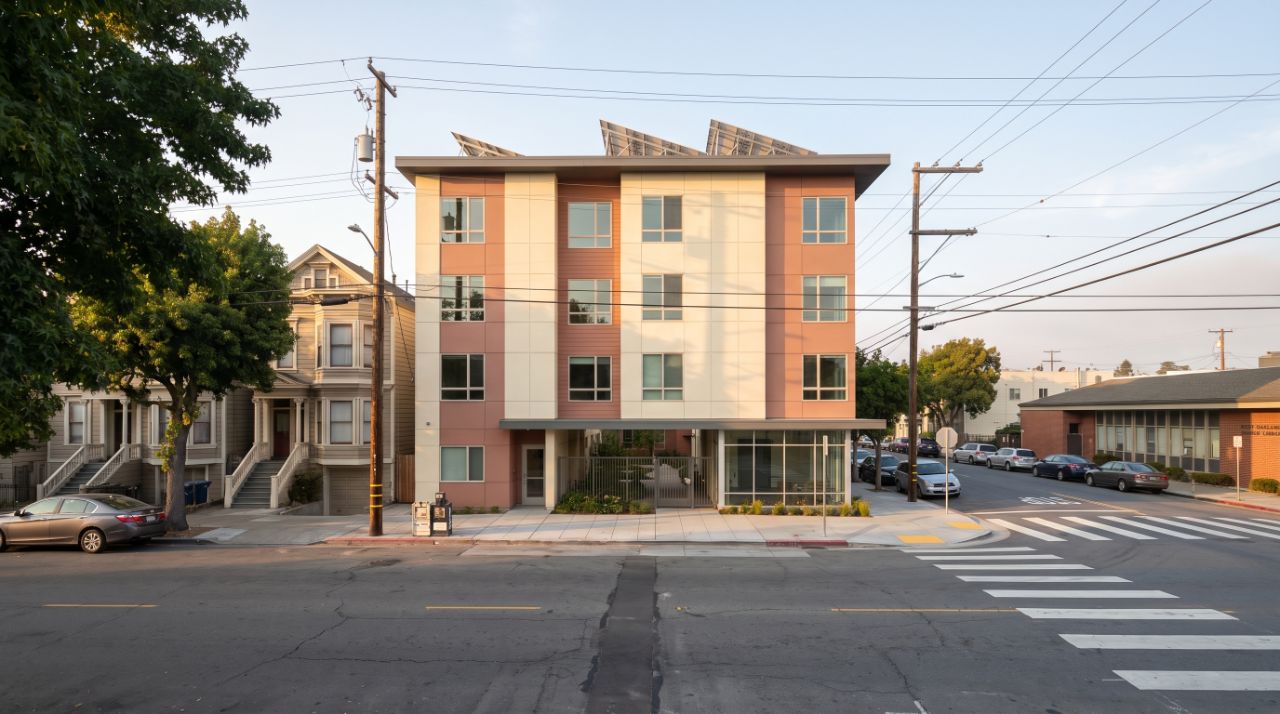
Four-story affordable senior housing building on Adeline Street in West Oakland in late afternoon light Photo: Houseberry
1904 Adeline Street is a half-acre parcel in West Oakland, across from the branch library and two minutes from De Fremery Park. Until 2023 it held the sanctuary of Friendship Christian Center. As of this month it holds 50 apartments, every income-restricted one capped at 40 percent of area median income or below. It is the biggest piece of new affordable senior housing West Oakland has gotten in years, and the congregation still owns the ground under it.
Which is the part worth sitting with. The church did not sell. It leased its own land into a partnership, kept title, and kept the income stream. That arrangement, not any state law, is what built this.
What stood at 1904 Adeline, and who still owns it
The old Friendship Christian Center building came down in late 2023, and the congregation never gave up the parcel. Pastor Gerald Agee started interviewing developers in 2017 and landed on Community Housing Development Corporation, an Oakland nonprofit. The deal they wrote was unusual: CHDC split the developer fee evenly with the church instead of keeping the customary lion's share, and Friendship kept ownership of the land plus the long-term income from the property, according to Partnership for the Bay's Future, which helped fund predevelopment with a $600,000 loan alongside LISC.
That structure matters more than it sounds. Predevelopment money is where most church housing ideas die, because a congregation with land rarely has the millions in at-risk cash a financing close demands. Friendship got it from mission lenders instead of a land sale, and stayed a landowner in a neighborhood that has spent 60 years losing land.
The building is a four-story infill by Kodama Diseno Architects, about 36 feet tall, with a podium garage, a ground-floor community room, a courtyard, solar, and rainwater harvesting. Modest. Which is the point.
Who qualifies for the new affordable senior housing in West Oakland
Residents must be 62 or older, and the rent tiers run deeper than the 60 percent of AMI most Bay Area tax-credit deals stop at. The project's November 2022 tax-credit application (CA-22-617) set 10 units at 20 percent of area median income, 5 at 30 percent and 29 at 40 percent, plus a manager's unit. Thirty-four of the 50 carry federal project-based vouchers, which is what makes a 20 percent AMI rent survivable for an owner.
| Friendship Senior Housing | Detail |
|---|---|
| Address | 1904 Adeline Street, Oakland 94607 |
| Apartments | 50 total: 15 studios, 34 one-bedrooms, 1 manager unit |
| Income targeting | 10 units at 20% AMI, 5 at 30% AMI, 29 at 40% AMI |
| Rental assistance | 34 units with HUD project-based vouchers |
| Age requirement | 62 and older |
| Landowner | Friendship Christian Center, which retains title |
| Timeline | Developer search began 2017, groundbreaking June 2024, opened September 2026 |
For a senior on Supplemental Security Income, about $1,234 a month in California, that 20 percent tier is the difference between an apartment and a shelter bed. We made the same point about The Eliza on Telegraph Avenue, where the cheapest rents still land above what SSI covers. Friendship goes deeper, and the vouchers are why.
SB 4 exists for exactly this. It did not build this.
The YIGBY law arrived too late to matter here, and so far it has not mattered much anywhere else. SB 4, signed October 2023 and effective January 1, 2024, lets religious institutions and nonprofit colleges build 100 percent affordable housing by right on land they already owned, exempt from CEQA, at up to 30 units per acre in urban areas, with parking mandates waived near transit. Friendship had its credits reserved in 2022 and its demolition permits in 2023. None of it applied.
And the record is thin. A February 2025 YIMBY Law assessment found no project had used SB 4, and an industry review in July 2026 reported nothing built under it since. The Terner Center puts the land the law opens at roughly 171,000 acres statewide. Acreage was never the binding constraint. The capital stack was, along with prevailing wage rules and the plain fact that congregations are not developers.
So the YIGBY route works and the YIGBY law is not yet what makes it work. What made Friendship work was a nonprofit developer, a patient lender and about $15 million from the state through the Multifamily Housing Program, No Place Like Home and the Accelerator program, per HCD at the June 2024 groundbreaking.
Where Oakland's new affordable units are actually landing
Oakland is building a higher share of affordable housing than almost any city its size, and a far smaller absolute number than it needs. The city's 2025 Annual Progress Report counted 1,391 homes completed in 2025, 791 of them deed-restricted affordable, and 602 of the 712 homes permitted that year. Market-rate construction has essentially stopped, so the affordable share looks spectacular by default.
The RHNA math is the corrective. Through 2025 Oakland had permitted 1,208 of the 6,511 very-low-income homes it owes for 2023 to 2031, about 19 percent, three years into an eight-year cycle. Fifty apartments is not a dent in that.
It is also landing where the pipeline keeps stalling. A West Oakland site approved for 1,032 homes at 500 Kirkham is now asking to be a parking lot instead. Friendship is 50 units that exist.
What the blocks around Adeline actually score
The four neighborhoods nearest the site sit near the bottom of Oakland's rankings, but unevenly, and the unevenness is the useful part. Ralph Bunche, which holds 1904 Adeline, ranks 122nd of 130 Oakland neighborhoods with a 1.8 overall. Oak Center, the Victorian preservation district just south, scores 2.0. Prescott, the Lower Bottoms, scores 2.1. Acorn scores 1.9.
Average those four and you get 1.95 against Oakland's 2.6 citywide. But the deficit is almost all schools and safety. On amenities they average 2.95 against 3.2, a quarter-point gap, because West Oakland BART, 7th Street, the library and De Fremery are all right there.
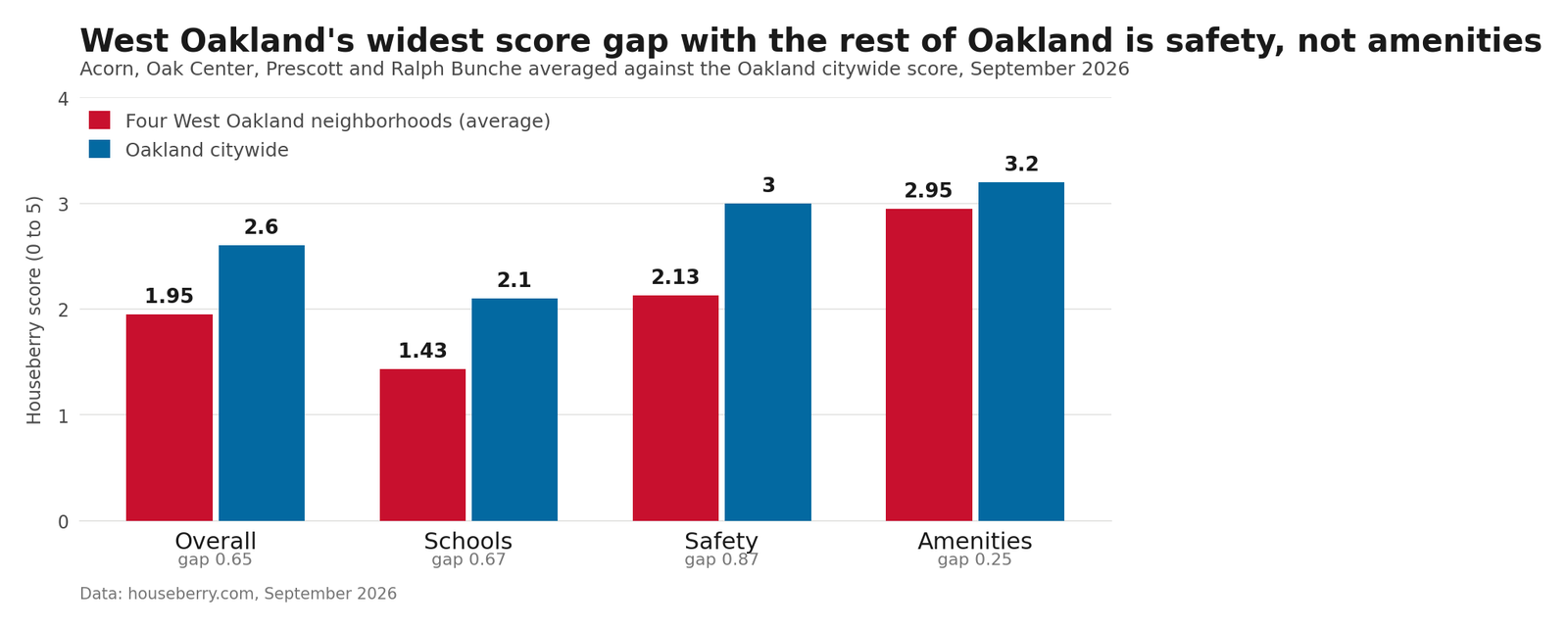
For a senior building that split is close to ideal. School scores mean nothing to a 70-year-old tenant and amenities mean almost everything, and you can reach a BART platform, a library and a park here without a car. The way we look at neighborhoods at Houseberry, the score that should drive a decision is the one tied to how that household actually lives, not the composite.
Prices say the same thing. Ralph Bunche posted a median sale price of about $845,300 in July 2026 against roughly $974,200 citywide in August 2026. West Oakland is not cheap anymore. It is 13 percent under the city median, which is exactly the condition under which subsidized units stop being optional.
Here is what should temper the applause: this model rests on 34 federal vouchers holding and on a congregation willing to tie up its only real asset for 55 years. Neither is guaranteed. The full Oakland neighborhood rankings are where we would start tracing the rest of that pipeline. Watch the 2027 tax-credit round for whether any Bay Area congregation finally uses SB 4 the way it was drawn.
Sources
The Oaklandside, September 11, 2026: Senior housing opens on former church land
CTCAC project CA-22-617, Friendship Senior Housing
California HCD: Senior Affordable Housing Breaks Ground in Oakland (2024)
Post News Group: Faith-Based Group Breaks Ground in West Oakland
San Francisco YIMBY: Permits for Senior Housing at 1904 Adeline Street
Partnership for the Bay's Future: Kinship in Housing
Burke, Williams and Sorensen: SB 4 explained
Map of Oakland Neighborhoods
Loading map...
View Full Map
Top Neighborhoods in Oakland, CA






All information provided on this website including but not limited to - school ratings, safety, amenities, user opinions, and property data - is for general informational purposes only. We do not guarantee its reliability, accuracy, or completeness. Users should independently verify information and consult appropriate professionals as needed. By using this website, you agree Houseberry is not responsible for actions, decisions, or consequences arising from reliance on the information provided
houseberry.com - CA DRE# 01847391
 Bay East ©2025. CCAR ©2025. bridgeMLS ©2025. Information Deemed Reliable But Not Guaranteed. This information is being provided by the Bay East MLS, or CCAR MLS, or bridgeMLS. The listings presented here may or may not be listed by the Broker/Agent operating this website. This information is intended for the personal use of consumers and may not be used for any purpose other than to identify prospective properties consumers may be interested in purchasing. Data last updated at September 13, 2026 12:00 AM