Is Downtown San Francisco Back? The Mall Sale Just Collapsed
The rescue deal for the shuttered San Francisco Centre just fell through, only blocks from a record home-bidding frenzy. We unpack downtown San Francisco's two-speed market and what it means for SoMa, Mid-Market, and Union Square condo values.

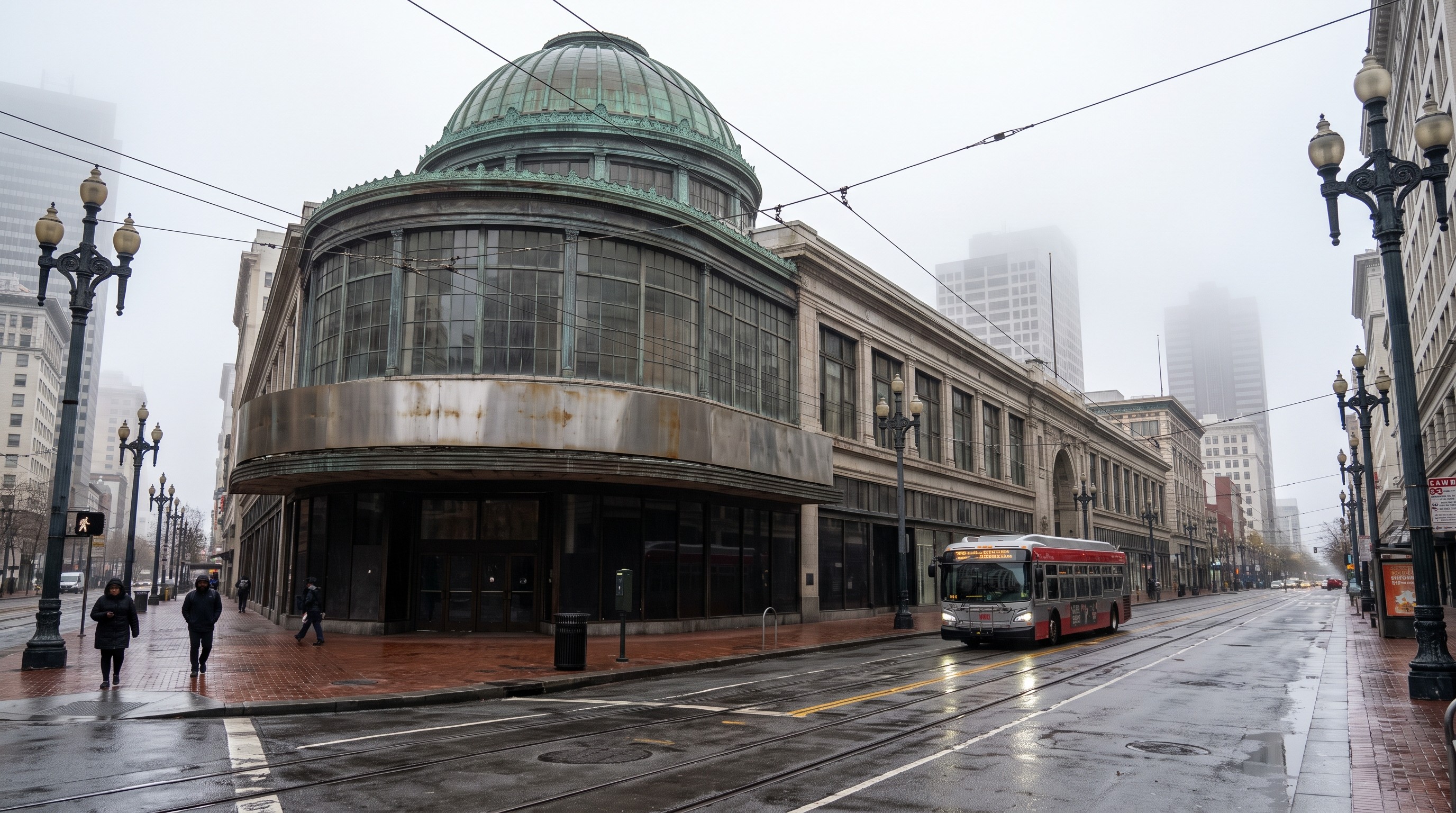
The shuttered San Francisco Centre mall on Market Street in downtown San Francisco, where a rescue sale just collapsed. Photo: Houseberry
Two numbers, three blocks apart, tell you most of what you need to know about downtown San Francisco right now. A 1.2 million square foot mall on Market Street just failed to sell, again. And in the first half of this year, 144 San Francisco homes sold for at least a million dollars over asking. One of those markets is frozen solid. The other is the hottest it has been in eight years. They are close enough to walk between on your lunch break.
On July 8, the deal to rescue the old San Francisco Centre fell apart. Presidio Bay and Prado Group walked away after months of due diligence, and the shuttered mall went back on the market with no buyer and no plan. If you have been Googling some version of "is downtown San Francisco back," this is the kind of headline that makes the question feel unanswerable. So let me answer it the way we answer most things around here, which is by looking at the block instead of the city.
The short version: downtown San Francisco is not one market
Here is the finding, up front. "Downtown San Francisco" is not a single thing that is either back or not back. It is at least four different markets stacked on top of each other, and this summer they are moving in opposite directions at the same time.
| Segment | Where it sits | 2026 signal | Direction |
|---|---|---|---|
| Big-box retail (San Francisco Centre) | Market St / Union Square | Rescue sale collapsed; bondholders paid a $133M credit bid on a mall once valued near $1.2B | Frozen |
| Older offices | Lower SoMa / Mid-Market | Still described as virtually unleasable; citywide office vacancy near 32% | Stuck |
| Prime AI office space | Transbay / Mission Bay | Transbay vacancy near 12%; Mission Bay under 3%; Anthropic and OpenAI expanding | Booming |
| For-sale houses | Citywide, mostly west and north side | Prices up about 22% YoY; homes selling $1M+ over asking up 1,700% | Overheating |
| Condos | Downtown / SoMa | Median condo near $1.33M; the laggard of this cycle | Slowly rising |
Read that top to bottom and the "is it back" question mostly dissolves. The AI money everyone keeps talking about is real, and it is landing in two places: prime office space and trophy houses. It is largely skipping the third place, which is old retail and the tired blocks around it. The dead mall is not a verdict on San Francisco. It is a verdict on one specific corner.
Why nobody will buy a 1.2 million square foot mall
Start with how far this thing has fallen. The San Francisco Centre was valued at roughly $1.2 billion when it was financed back in 2016. Its previous owners, Westfield and Brookfield, defaulted on a $600 million loan in 2023 and handed back the keys. Bondholders seized it in November 2025 with a credit bid of just $133 million. Nordstrom, Bloomingdale’s, and the Cinemark theater are all gone. The mall closed to the public in February.
So when Presidio Bay and Prado Group won the bidding in March, the plan was never to reopen a mall. It was to gut and reimagine the place, turning a vacant department store into offices, the old fifth-floor theater into a concert and events venue, and keeping some retail while preserving the historic dome. Ambitious, and exactly the kind of adaptive reuse downtown needs. It still could not get across the finish line. After months of work the buyers stepped back, and CBRE is now hunting for the next taker.
The reason is not a mystery. Renovating 1.2 million square feet in a spot where the anchor use, big-box retail, is not coming back is a brutal underwriting problem. You are betting hundreds of millions of dollars on foot traffic that does not exist yet, on a corner that empties out after dark.
Three blocks away, buyers are paying a million over asking
Now walk a few blocks in almost any direction and the mood flips completely.
San Francisco home prices jumped 22.2 percent year over year, the biggest gain of any Bay Area county. Those 144 homes that sold for a million or more over asking in the first half of 2026 compare with just eight in the same stretch of 2025. In June alone, 44 homes closed in that hyper-bidding range. Single-family homes went for about 25 percent over asking in May, up from 10 percent a year earlier. Price per square foot pushed toward $1,200 citywide. And there were only about 225 active listings in May, which is almost nothing for a city this size.
What is driving it is not a mystery either. It is the same AI wave. Buyers are racing to lock in homes ahead of expected IPO windfalls from the big AI and space companies, and that money is pooling in a familiar set of neighborhoods. We broke the frenzy down in our look at how far over asking SF homes are going in 2026, and the pattern is clear. The wildest overbids are landing in trophy single-family enclaves like Sea Cliff, Pacific Heights, and Cow Hollow, not on the blocks around a dead mall.
That distinction matters more than any citywide average, and it is the part most "SF is back" takes gloss over.
The office recovery is real. It is also skipping Mid-Market.
The commercial side tells the same split story. San Francisco’s office vacancy rate is still around 32 percent, but it has now ticked down for four straight quarters as AI firms soak up space. Transbay, around Salesforce Park, has fallen to about 12 percent vacancy after Anthropic leased close to a million square feet. Mission Bay has effectively run out of room, with availability under 3 percent, largely thanks to OpenAI.
And then there is the mall’s own neighborhood. Brokers describe Lower SoMa and Mid-Market as still virtually unleasable, full of older buildings that need expensive upgrades nobody wants to fund yet. The recovery is real. It is just concentrated in the newer, amenity-rich pockets and stepping right over the tired middle. The San Francisco Centre sits in the tired middle.
That is the honest read on the "downtown is back" story. Parts of it genuinely are. The parts nearest the mall are the last in line.
What the failed sale means for SoMa and Mid-Market condo values
Here is where it gets practical, because almost nobody reading this is buying a mall. They are wondering what it means for a condo in SoMa, a loft in Mid-Market, or a place near Union Square.
The way we look at it, the collapsed sale is a real signal, but a narrow one. It tells you the ground floor of this district, the retail and the foot traffic, is still years from stabilizing. That matters if you are buying a condo whose whole pitch is "walk to shopping and restaurants downtown," because a lot of that shopping is dark and staying dark for now. Downtown and SoMa condos have been the softest, slowest part of an otherwise scorching San Francisco market, and the mall is a big, visible reason why. The citywide median condo sits around $1.33 million while the median house runs closer to $1.7 million, and the over-asking frenzy has been a house story, not a condo one.
But here is what it does not mean. It does not automatically make SoMa and Mid-Market value traps. It might mean the opposite, if you buy with your eyes open. This is the one part of San Francisco where prices have not run away, where the office recovery is slowly creeping closer block by block, and where projects like the 901 Market office-to-housing conversion across from the mall are trying to drop actual residents onto streets that badly need them. Buy here and you are making a bet on a turnaround, not paying for one that already happened. That can be a smart bet. It is just a different bet than buying a house in a neighborhood the money has already found.
That gap is the whole reason we built Houseberry to look hard at the area before the address. A condo three blocks from the mall and a condo three blocks from Dolores Park are both "San Francisco," and they are on completely different trajectories right now. If you want to see where the value actually sits, our ranking of San Francisco neighborhoods by best value lines them up by price against schools, safety, and amenities, which beats a citywide headline that averages the frozen blocks and the red-hot ones into one number that describes neither.
What to watch next
The near-term signal is what the bondholders do now. They can hold the mall and wait, cut the price until a developer can make the math work, or carve the building into pieces. Whichever they pick tells you how much pain the current owners are willing to eat, and that reads through to every SoMa valuation nearby.
The bigger signal is foot traffic and residents. Watch whether conversions like 901 Market actually get built, whether the AI office boom keeps creeping west from Transbay toward Market Street, and whether Union Square’s tenant mix keeps firming up. Those are the things that decide whether the blocks around the old San Francisco Centre are an early-innings value play or a genuine value trap. For now, treat the mall’s troubles as information about a few specific streets, not a grade for the whole city. And if you are shopping down there, line the neighborhood up against the rest of the city on overall neighborhood score before you decide the discount is worth it.
Questions downtown buyers keep asking
Is downtown San Francisco actually coming back in 2026?
Partly. Office leasing has improved for four straight quarters and AI firms are filling prime space in Transbay and Mission Bay, but older Mid-Market and Lower SoMa buildings, plus big retail like the San Francisco Centre, are still stuck. The recovery is real and very uneven, so "back" depends entirely on which blocks you mean.
Does the San Francisco Centre collapse mean downtown condo prices will fall?
Not on its own. It signals that the retail core around the mall is still weak, which weighs on nearby condo demand, but SoMa and downtown condos have already been the softest part of the market for a while. It is more a reason to research a specific building and block carefully than a citywide price warning.
Are San Francisco home prices really up more than 20 percent?
Yes. Citywide prices rose about 22 percent year over year, the most of any Bay Area county, driven by tech and AI buyers bidding ahead of IPO paydays. But that heat is concentrated in single-family trophy neighborhoods, not in the downtown condo blocks near the mall.
Is a SoMa or Mid-Market condo a good buy right now?
It can be, if you treat it as a turnaround bet rather than a sure thing. Prices here have lagged, which is both the opportunity and the risk. Check how close the office recovery has crept, what is happening with nearby conversions and retail, and how the specific block scores before you commit.
Sources
- The San Francisco Standard, San Francisco Centre mall sale falls apart
- The San Francisco Standard, SF homes selling $1M+ over asking surge 1,700%
- The San Francisco Standard, San Francisco's office market is hot again, but not for everybody
- Redfin, San Francisco Housing Market
- Houseberry, How Far Over Asking Are SF Homes Going in 2026
- Houseberry, SF Office-to-Housing: 901 Market Plans 136 Homes
- Houseberry, San Francisco neighborhoods by best value
- Houseberry, San Francisco neighborhoods by overall score
The Houseberry Research Team is Houseberry's reporting team: Bay Area real estate analysts, data specialists and longtime local market watchers. Every day we check the public record: building permits, city council and planning agendas, county recorder filings, state housing bills, police incident data and school results. Then we tie each story to what it means for specific neighborhoods, using Houseberry's own neighborhood data on prices, appreciation, safety, schools and amenities. Questions or corrections: Contact us.
All information provided on this website including but not limited to - school ratings, safety, amenities, user opinions, and property data - is for general informational purposes only. We do not guarantee its reliability, accuracy, or completeness. Users should independently verify information and consult appropriate professionals as needed. By using this website, you agree Houseberry is not responsible for actions, decisions, or consequences arising from reliance on the information provided
houseberry.com - CA DRE# 01847391
 Bay East ©2025. CCAR ©2025. bridgeMLS ©2025. Information Deemed Reliable But Not Guaranteed. This information is being provided by the Bay East MLS, or CCAR MLS, or bridgeMLS. The listings presented here may or may not be listed by the Broker/Agent operating this website. This information is intended for the personal use of consumers and may not be used for any purpose other than to identify prospective properties consumers may be interested in purchasing. Data last updated at October 7, 2026 12:00 AM