California's First ADU Condo Just Sold in San Jose
A 749-square-foot backyard unit in San Jose just sold on its own for $530,000, California's first ADU condo sale. Here is what it means for a lower-cost path to ownership, and which South Bay cities could follow.
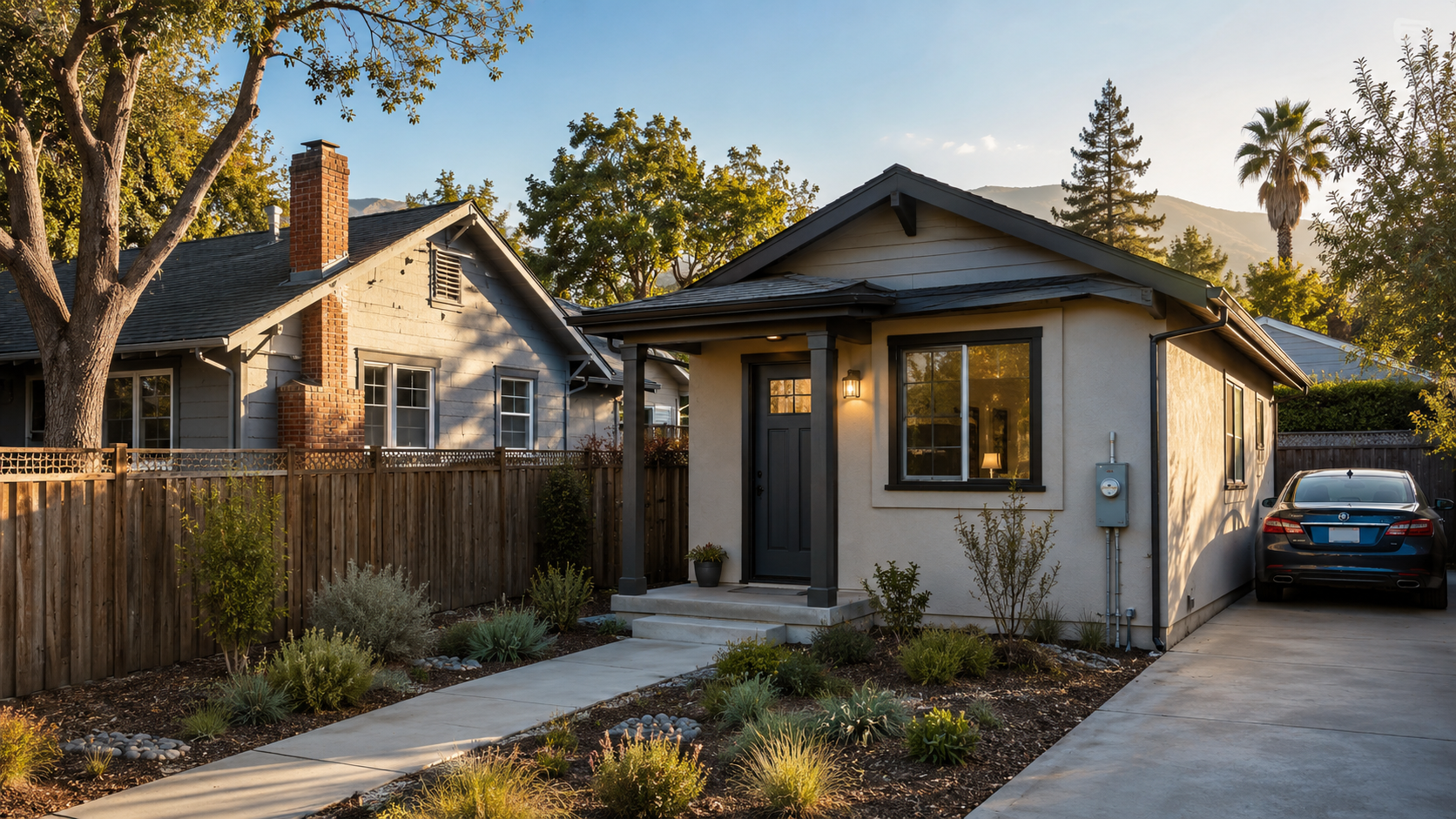
A small newly built detached backyard cottage with its own private entrance and driveway in San Jose, illustrating California's first ADU condo sale. Photo: Houseberry
A 749-square-foot house on Josefina Street, a few blocks from downtown San Jose, just did something no home in California had done before. It sold by itself. Not the lot, not the main house in front of it. Just the little one in back. This is the state's first San Jose ADU condo sale, and it closed this month for $530,000 as its own condominium, according to the City of San Jose. If you have watched the backyard-cottage boom and wondered when one of these would finally become a home someone could buy outright, this is the moment.
What actually closed on Josefina Street
The unit is a two-bedroom, one-bath detached ADU, newly built, and it lives more like a small single-family home than a condo. It has its own parking, its own exterior entry door, separately metered utilities, and no HOA. That last part matters more than it sounds. A lot of “affordable” ownership in the Bay Area comes wrapped in monthly HOA dues that quietly eat the savings. This one does not.
The developer, Bay Area firm AlphaX RE Capital, ran the conversion as a proof of concept, and the city's streamlined process moved the parcel map in about 60 days, as KQED reported. Here is the short version of what changed hands:
- A detached 749 sq ft ADU, 2 bed / 1 bath, newly constructed
- Sold for $530,000, closed in June 2026
- Private parking, private entrance, separately metered utilities
- No HOA and no shared building, unlike a typical condo or townhouse
“We're unlocking homeownership opportunities at lower price points, one ADU at a time,” Mayor Matt Mahan said in announcing the sale. The developer's own framing was blunter: proof that there is a real market for small, ground-up, for-sale starter homes aimed at working families who are priced out of the usual San Jose listings.
How a backyard unit becomes a condo you can sell
None of this was legal a couple of years ago. The mechanism is AB 1033, a 2024 state law authored by then-Assemblymember Phil Ting that lets cities opt in to allow ADUs to be sold separately from the main house, by treating them as condominiums on the same lot. San Jose was the first city in California to adopt the local ordinance, and this sale is the first time the full path has run all the way to a closing.
I am firmly in the camp that thinks this is good news. The region has spent years permitting ADUs as rentals, which added supply but did nothing for ownership. Letting a homeowner build a unit and sell it turns one lot into two deeds. It is infill on land the city already zoned for housing, close to jobs and transit, without knocking anything down. When a policy quietly creates a new for-sale home inside an existing neighborhood, that is roughly what the housing math has been asking for.
The number that makes this interesting
Now the part worth slowing down on. A $530,000 sale price in San Jose is not a typo. The median single-family home here runs around $1.5 million, and even a typical condo sits near $717,000, per Redfin. At 749 square feet, this ADU penciled out to about $708 a foot, which is actually below the city's roughly $876 median price per square foot. So this is not a gimmick price. It is a genuinely smaller, genuinely cheaper way onto the ownership ladder.
The honest caveats belong right next to that number. It is small. It shares a lot with another household, which means fences, driveways, and neighborly logistics you would not have on a standalone parcel. And lending on a brand-new ADU condo is still thin, because there are almost no comparable sales yet, so financing and future resale are the real open questions, not the build quality. This is where the neighborhood-first habit earns its keep. A $530,000 entry point only works if the block around it works, which is exactly the kind of thing worth checking against San Jose's best-value neighborhoods before falling for the price tag alone.
Which South Bay cities could be next
This is the question every homeowner with a deep backyard is now asking. For the moment, the map is short and still being drawn. Only a handful of California jurisdictions have opted into AB 1033 so far. San Jose is out front, with a scattering of others like San Francisco, San Diego, Santa Monica, and Santa Cruz having adopted or launched programs. The catch for the South Bay is that San Jose's immediate neighbors, places like Santa Clara, Sunnyvale, and Mountain View, mostly have not adopted an ordinance yet. So whether you can sell an ADU separately still depends entirely on which city you are standing in, and that list keeps changing month to month.
If you are a homeowner weighing this, the practical move is to confirm your city's current status with its planning department before you count on a separate sale, because a permit to build an ADU is not the same as permission to sell it. And if you are a buyer, treat one of these units the way you would any home in a fast-moving corner of the San Jose market: look hard at the block, the schools, the commute, and the resale story, not just the headline price. The neighborhood is the part that decides whether a clever new deed becomes a good place to live. Researching the area before the address is the whole reason we built Houseberry.
San Jose says it wants to repeat the process and drive costs down as it learns from this first one. Whether that becomes a real pipeline of sub-$600,000 starter homes, or stays a one-off proof of concept, depends on lenders getting comfortable and more cities following San Jose's lead. It is the same slow, unglamorous supply story we tracked in our look at the 2026 California housing bond. The policy clears the path, and then the market has to actually walk it. This week, for one small house on Josefina Street, it finally did.
Sources
Map of San Jose Neighborhoods
Loading map...
View Full Map
Top Neighborhoods in San Jose, CA


All information provided on this website including but not limited to - school ratings, safety, amenities, user opinions, and property data - is for general informational purposes only. We do not guarantee its reliability, accuracy, or completeness. Users should independently verify information and consult appropriate professionals as needed. By using this website, you agree Houseberry is not responsible for actions, decisions, or consequences arising from reliance on the information provided
houseberry.com - CA DRE# 01847391
 Bay East ©2025. CCAR ©2025. bridgeMLS ©2025. Information Deemed Reliable But Not Guaranteed. This information is being provided by the Bay East MLS, or CCAR MLS, or bridgeMLS. The listings presented here may or may not be listed by the Broker/Agent operating this website. This information is intended for the personal use of consumers and may not be used for any purpose other than to identify prospective properties consumers may be interested in purchasing. Data last updated at September 30, 2026 12:00 AM