El Camino Real Is Becoming Palo Alto's Apartment Corridor
A builder has filed plans to replace the Coronet Motel with 76 homes, the third big housing project on the same stretch of El Camino Real. Here is what the corridor's turn toward apartments means for Ventura and Evergreen Park.

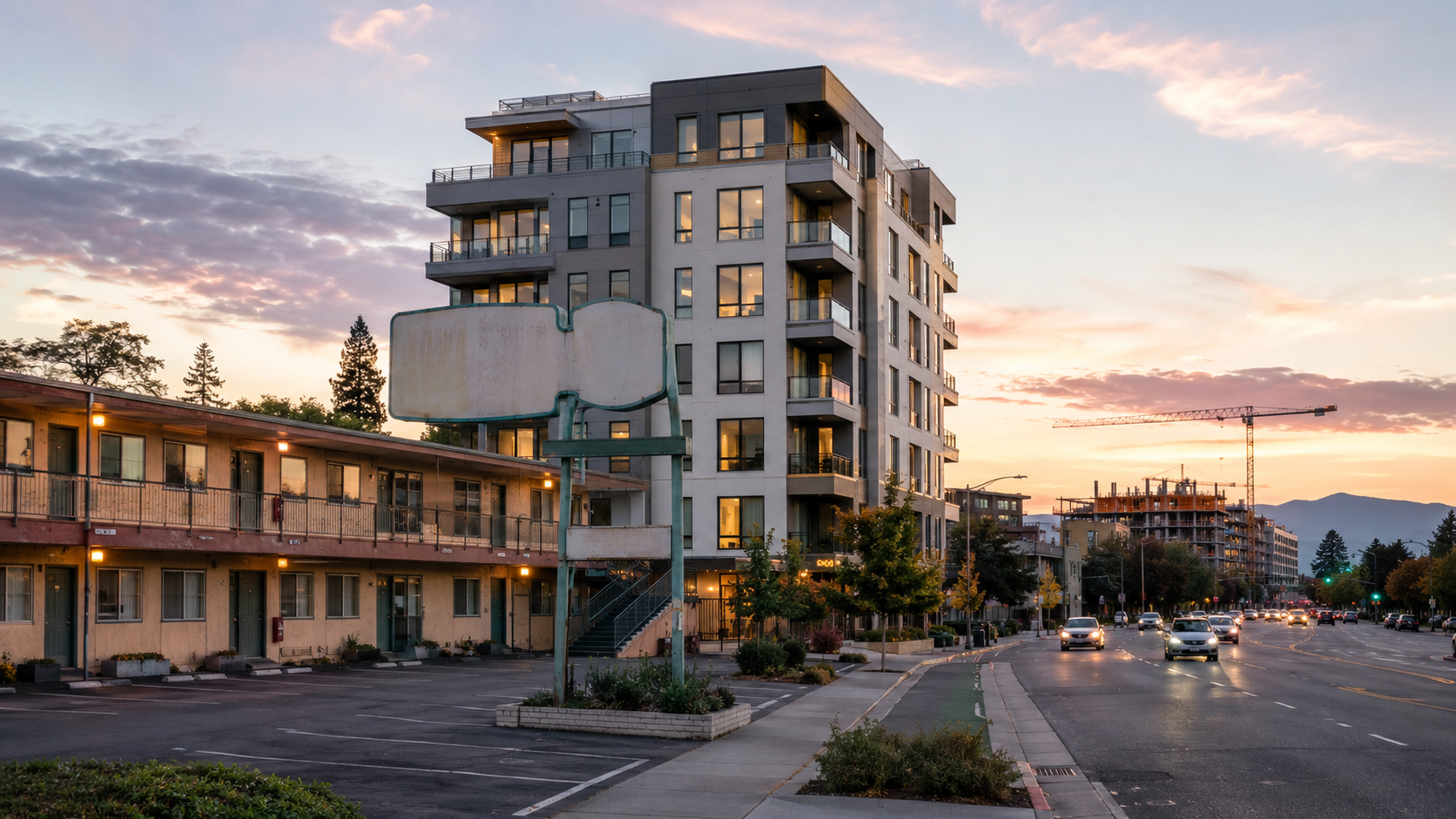
An aging motel on El Camino Real in Palo Alto with a new six-story apartment building rising behind it. Photo: Houseberry
The Coronet Motel is nobody's idea of a landmark. It is a two-story, 22-room motor lodge at 2455 El Camino Real in Palo Alto, wrapped around a small parking lot, a short walk from the California Avenue Caltrain station. For decades that location was mostly a convenient place to put visiting Stanford parents. Under California's new transit-density law, it is a development site, and a San Francisco builder just moved on it.
Bayhill Ventures has filed plans to demolish the motel and replace it with a six-story, 76-unit residential building, Palo Alto Online reported today. It is the third major housing project proposed or approved on this stretch of El Camino, and the clearest sign yet that the corridor is turning into the city's apartment district, one tired commercial parcel at a time.
A 0.38-acre motel lot, 76 homes
The filing is blunt about the swap. The 0.38-acre site currently holds the 22-room motel and 15 surface parking spots. Bayhill wants a 65-foot building in their place: parking in a basement and at ground level, five stories of homes above, 76 units in all, 12 of them designated below market rate, per the application.
And this is the kind of parcel where the density argument is easiest to make. Nobody loses a home. Nobody loses a historic building or a beloved business. A budget motel becomes 76 households within walking distance of a Caltrain platform, a grocery store, and the California Avenue restaurant strip. If that trade is controversial, every trade is.
Palo Alto's first SB 79 filing
The legal path is the interesting part. Bayhill is the first developer to file in Palo Alto under SB 79, the state transit-density law that took effect July 1. Within half a mile of a busy rail stop like California Avenue, the law overrides local zoning to allow residential buildings of 65 feet and up, with the exact ceiling depending on distance to the station, as Holland & Knight's analysis lays out.
Palo Alto's council had a chance on June 15 to adopt an urgency ordinance that could have slowed this down, and it declined. Bayhill's application leans on that decision directly, noting the law is now fully effective in the city outside of designated local historic resources. The Coronet, whatever its mid-century charm, is not one.
We wrote last week about how unevenly Bay Area cities are handling SB 79. Palo Alto just became the live Peninsula test case. If this project moves through review cleanly, every aging commercial parcel within half a mile of the city's two Caltrain stations gets more interesting to builders. That is not a loophole. It is the entire design of the law.
Three projects, one short stretch of El Camino
Zoom out and the Coronet is not an outlier. It is the third domino on the same corridor:
| Site | There now | What's coming | Status |
|---|---|---|---|
| 2455 El Camino Real | Coronet Motel, 22 rooms | 76 apartments, 12 below market | Application filed July 2026 |
| 3001 El Camino Real | Former Mike's Bikes | 129 all-affordable apartments (Charities Housing) | Demolition permits filed 2025 |
| 3150 El Camino Real | Former Fish Market restaurant | 368 apartments, 74 below market | Approved July 2025 |
Add it up: one motel, one bike shop, and one seafood restaurant become 573 homes, roughly 215 of them deed-restricted affordable. The Fish Market project at 3150 El Camino won approval last July with 74 below-market apartments. At 3001 El Camino, the nonprofit Charities Housing pulled demolition permits for a fully affordable 129-unit building on the old Mike's Bikes site.
None of this is accidental. When Palo Alto had to find sites for its state housing targets, the city pointed the pipeline at El Camino rather than at its single-family neighborhoods. The corridor was the path of least resistance: commercial parcels, no displaced homeowners, a state highway nobody romanticizes. The predictable result is now arriving on schedule, and the city is already debating how to keep ground-floor retail alive as the apartments land.
Next door: Ventura and Evergreen Park
The neighborhoods that will actually live with this sit right off the corridor. The Coronet block runs along the western edge of Evergreen Park, the compact grid of 1920s cottages between El Camino and the Caltrain tracks. The other two projects flank Ventura and Barron Park, where California Avenue's low-key business district gives way to auto shops and aging strip retail.
Here is the part we find most interesting. In our 2026 Palo Alto neighborhood rankings, Ventura sits 22nd of 27 with a 3.9 overall score, dragged down mostly by a 3.1 amenities score, one of the lowest in the city. Evergreen Park sits 25th at 3.6. Both post school scores of 4.6 or better. What they lack, in plain terms, is stuff: places to walk to, services, the daily-life texture the top of the rankings has in abundance.
That is exactly what 573 new households can change. Apartment residents are foot traffic, and foot traffic is what keeps a bakery or a hardware store alive on a corridor that has mostly sustained muffler shops. If this pipeline delivers, the amenities math in both neighborhoods starts moving, and the rankings will eventually say so.
The question owners in those neighborhoods will ask: do six-story buildings next door hurt house values? Nobody can promise anything, and we will not pretend otherwise. But the pattern along comparable Peninsula corridors has not been scary. The houses sit on quiet interior streets, the apartments front a six-lane state highway, and buyers have always priced those as different worlds. The likelier effect runs the other way: more neighbors, better retail, fewer reasons to drive across town.
For buyers comparing this part of Palo Alto, the pipeline now belongs in the research alongside schools and commute. A few loud construction years near El Camino are real. So is the more complete neighborhood on the other side of them. Weighing that trade, area first and address second, is the habit we built Houseberry around.
Watch the demolition permits
An application is not a building. Bayhill's proposal now heads into review, and SB 79 sharply limits how much of it Palo Alto can negotiate away. Three dates worth watching: whether this filing reaches a hearing by fall, whether Charities Housing starts vertical construction at 3001, and whether the Fish Market site breaks ground on its 368 units.
El Camino has spent seventy years as the road Palo Alto drives down without really looking at it. Within a few years it will be the street a few thousand more people call home. From where we sit, trading an empty motel bed for a household with a Caltrain pass is the easiest yes in Bay Area housing.
Sources
California HCD: SB 79 Transit-Oriented Development
Holland & Knight: California Gov. Gavin Newsom Signs SB 79
Palo Alto Online: Palo Alto approves 368-apartment complex in Barron Park (July 2025)
SF YIMBY: Demolition permits for affordable housing at 3001 El Camino Real (February 2025)
Palo Alto Online: Hungry for new housing sites, Palo Alto shifts focus to El Camino (October 2023)
San Jose Spotlight: Palo Alto hopes to protect El Camino retail amid housing boom
The Houseberry Research Team is Houseberry's reporting team: Bay Area real estate analysts, data specialists and longtime local market watchers. Every day we check the public record: building permits, city council and planning agendas, county recorder filings, state housing bills, police incident data and school results. Then we tie each story to what it means for specific neighborhoods, using Houseberry's own neighborhood data on prices, appreciation, safety, schools and amenities. Questions or corrections: Contact us.
All information provided on this website including but not limited to - school ratings, safety, amenities, user opinions, and property data - is for general informational purposes only. We do not guarantee its reliability, accuracy, or completeness. Users should independently verify information and consult appropriate professionals as needed. By using this website, you agree Houseberry is not responsible for actions, decisions, or consequences arising from reliance on the information provided
houseberry.com - CA DRE# 01847391
 Bay East ©2025. CCAR ©2025. bridgeMLS ©2025. Information Deemed Reliable But Not Guaranteed. This information is being provided by the Bay East MLS, or CCAR MLS, or bridgeMLS. The listings presented here may or may not be listed by the Broker/Agent operating this website. This information is intended for the personal use of consumers and may not be used for any purpose other than to identify prospective properties consumers may be interested in purchasing. Data last updated at October 6, 2026 12:00 AM