Hayes Valley Adds 64 Affordable Homes at 78 Haight
A 64-unit affordable building just opened at 78 Haight Street in Hayes Valley, one of San Francisco's most searched and least affordable neighborhoods. What it adds, who it houses, and what our data says about the area behind the boutiques.

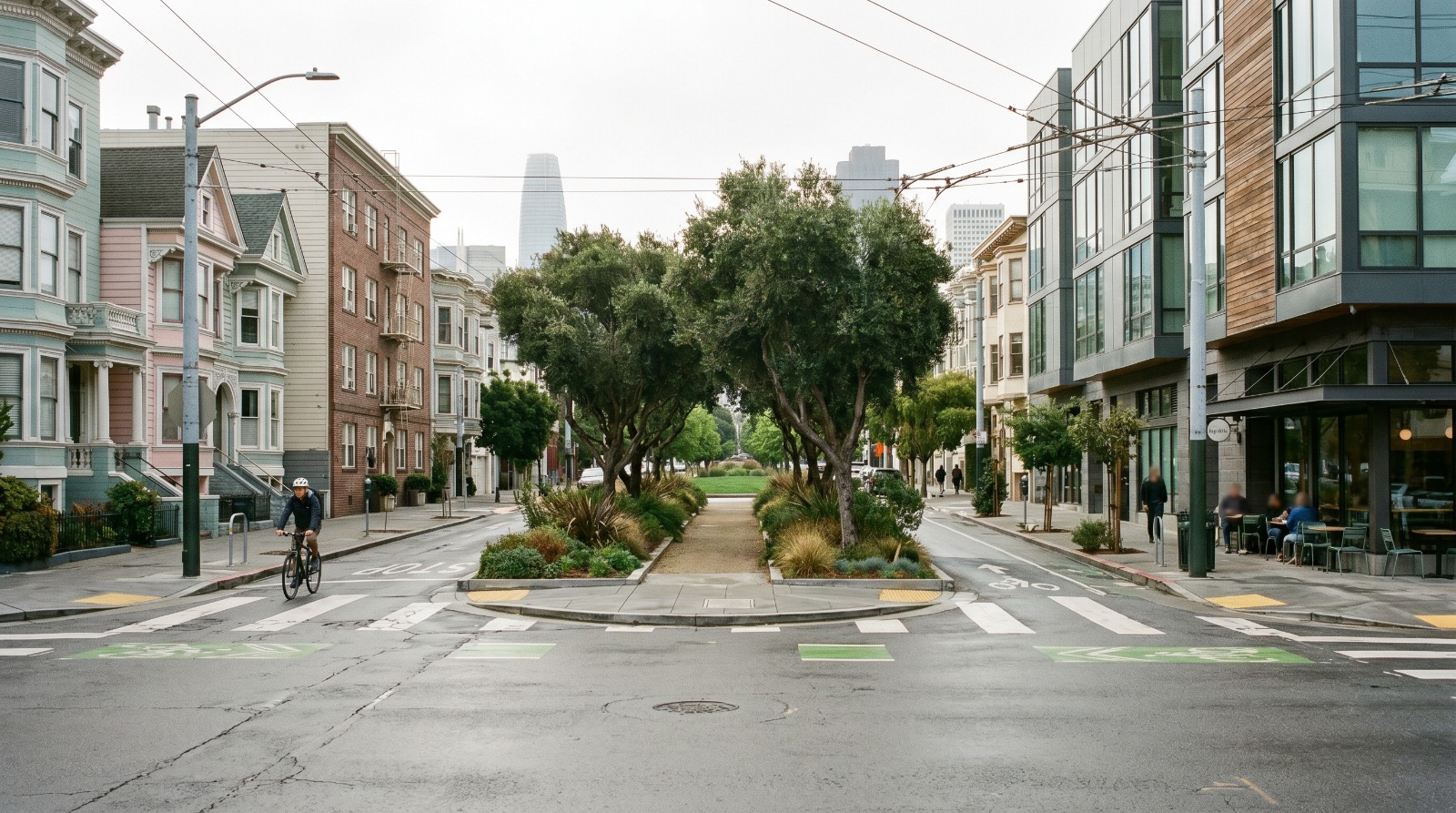
The tree-lined Octavia Boulevard in Hayes Valley, San Francisco, near the new 78 Haight affordable housing building. Photo: Houseberry
The Central Freeway ramps that once ran past the corner of Haight and Octavia came down in the years after the 1989 Loma Prieta earthquake, and the skinny parcel they left behind sat mostly empty ever since. That is the kind of awkward, leftover lot that stays vacant for a generation while everyone argues about what to do with it. This month it finally became housing. City officials and the project team celebrated the grand opening of a seven-story, 64-unit affordable building at 78 Haight Street. For a neighborhood as expensive as Hayes Valley, that is worth paying attention to.
New Hayes Valley affordable housing does not come along often, which is exactly why this one is a useful window into the neighborhood itself.
Who actually gets to live here
The 64 homes are split down the middle by design. Half are set aside for transitional-age youth, people roughly 18 to 27 who have aged out of foster care or come through homelessness, with 32 units carrying onsite support from Larkin Street Youth Services. The other half serve low-income adults and families, with 27 homes for households at or below 65 percent of area median income and four for those at or below 50 percent. There is even a three-bedroom unit on the ground floor set up as a family daycare.
The developer is the Tenderloin Neighborhood Development Corporation, which does not build luxury anything. The project ran about $54 million, with $21 million from the Mayor's Office of Housing and Community Development, $4 million through California's No Place Like Home program, and the rest from a mix of bank and community-capital financing.
This is what deeply affordable housing looks like when it actually gets built in a rich neighborhood. It is slow, it is heavily subsidized, and it is small next to the need. Sixty-four units will not move Hayes Valley's rents. But the location is the point. TNDC's CEO called Hayes Valley one of the city's most resource-rich neighborhoods, and putting formerly homeless young people a block from Market Street and four blocks from Patricia's Green, rather than on the far edge of the city, is the whole idea.
What the boutiques hide
Here is where our own data pushes back on the neighborhood's reputation a little.
Hayes Valley reads, from the outside, as one of San Francisco's most desirable addresses. Hayes Street is a genuine destination, all high-end boutiques and acclaimed restaurants, within walking distance of the Symphony, the Opera, and the Ballet. On the Hayes Valley neighborhood page, that shows up right where you would expect. The neighborhood scores a perfect 5.0 for being near good merchants. Nobody who has strolled Hayes Street on a Saturday would argue.
But the overall picture is more mixed than the vibe suggests. Hayes Valley carries a 3.0 out of 5 overall on our scores, which lands it 68th out of 92 San Francisco neighborhoods. Its amenities score is 3.4, held down by middling marks for public space and curb appeal despite the shopping. Schools come in at 2.8 and safety at 3.1, both a notch below the citywide averages of 3.3 and 3.8 on the San Francisco city page. This is the gap a listing photo never shows you. A place can be a wonderful spot to spend an afternoon and still be an average place to raise a kid or bank on the local middle school.
None of that is a knock on 78 Haight. If anything it makes the project more sensible. The people moving into those 64 units get the thing Hayes Valley genuinely does best, walkable access to jobs, transit, and services, without having to clear the roughly $3 million median sale price the neighborhood posted in June 2026.
The affordability gap in one number
Sit with that median for a second. The typical home that changes hands in Hayes Valley now runs around $2.98 million. A household earning 50 percent of area median income, one of the tiers 78 Haight is built for, is looking at somewhere near $60,000 a year for a small family. There is no version of the private market that connects those two numbers. The only way a barista, a preschool teacher, or a 22-year-old aging out of foster care lives on these blocks is a building like this one, put up on land the city had been sitting on since the first Bush administration.
That is not a knock on Hayes Valley either. It is the math of a neighborhood that got very popular very fast. And it is why the fights over these leftover freeway parcels get so heated. There are still several of them scattered around Octavia Boulevard, and what goes on them, housing, park, or parking, will shape the neighborhood more than any single boutique opening.
What this means if you are looking here
If you are comparing San Francisco neighborhoods, Hayes Valley is a useful test case for a habit we think matters. The reputation and the data do not always line up. The shopping is elite, the schools and safety are average, and the price of entry is brutal. All three are true at once, and only one of them shows up in the marketing.
A new affordable building does not change those scores. What it does is add a small amount of the one thing this neighborhood has almost none of, a home someone of ordinary means can actually get. Whether that matters to you depends on who you are in this story. But it is exactly the kind of on-the-ground detail, weighed alongside schools, safety, parks, and value, that is worth checking before you fall for a block on looks alone. That is the whole reason we build neighborhood profiles the way we do.
For the wider picture of what is and is not getting built across the region right now, our rundown of the new federal housing law and where it lands in the Bay Area is a good companion read.
Sources
The Houseberry Research Team is Houseberry's reporting team: Bay Area real estate analysts, data specialists and longtime local market watchers. Every day we check the public record: building permits, city council and planning agendas, county recorder filings, state housing bills, police incident data and school results. Then we tie each story to what it means for specific neighborhoods, using Houseberry's own neighborhood data on prices, appreciation, safety, schools and amenities. Questions or corrections: Contact us.
All information provided on this website including but not limited to - school ratings, safety, amenities, user opinions, and property data - is for general informational purposes only. We do not guarantee its reliability, accuracy, or completeness. Users should independently verify information and consult appropriate professionals as needed. By using this website, you agree Houseberry is not responsible for actions, decisions, or consequences arising from reliance on the information provided
houseberry.com - CA DRE# 01847391
 Bay East ©2025. CCAR ©2025. bridgeMLS ©2025. Information Deemed Reliable But Not Guaranteed. This information is being provided by the Bay East MLS, or CCAR MLS, or bridgeMLS. The listings presented here may or may not be listed by the Broker/Agent operating this website. This information is intended for the personal use of consumers and may not be used for any purpose other than to identify prospective properties consumers may be interested in purchasing. Data last updated at October 11, 2026 12:00 AM