The New Housing Bill Is Law. What Changes in the Bay Area
The 21st Century ROAD to Housing Act became law without a presidential signature. Here is what its 56 provisions actually do, and which ones reach Bay Area neighborhoods.

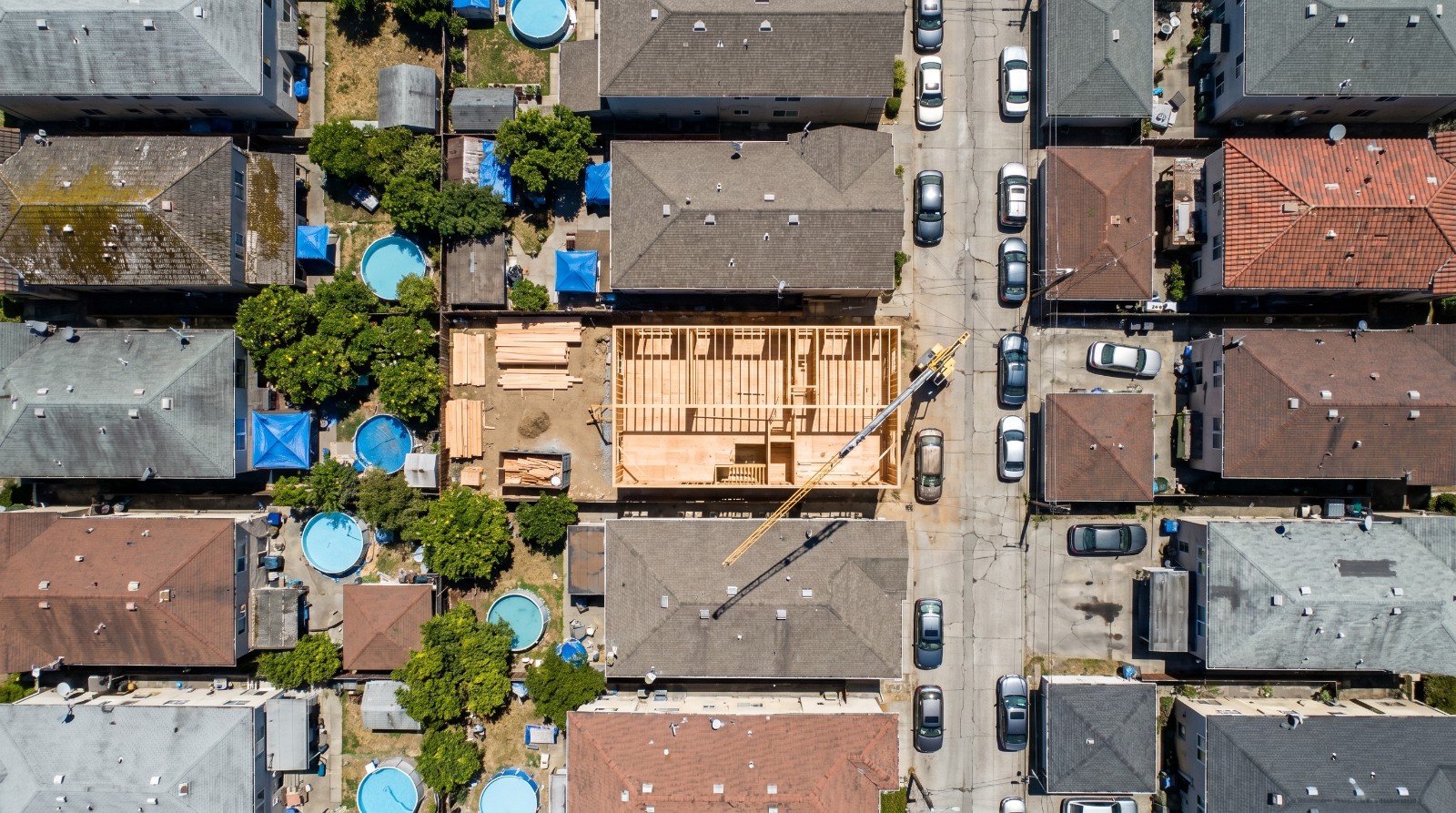
Overhead aerial view of an Oakland block where a new multifamily building is being framed on an infill lot, the kind of Bay Area housing the new housing bill is designed to make easier to build. Photo: Houseberry
Nobody signed it.
At one minute past midnight on Saturday, the biggest piece of federal housing legislation in a generation became law anyway, because the Constitution says a bill the president neither signs nor vetoes inside ten days becomes law on its own. So the new housing bill everyone spent the week arguing about, formally the 21st Century ROAD to Housing Act, is now on the books with a blank space where a signature usually goes.
That is the part getting the headlines. It is also the least interesting thing about it.
The interesting part is the 56 provisions underneath. Most of them are small. None of them are glamorous. Several of them are aimed straight at bottlenecks that have been strangling housing production in this region for years, and one of them is aimed at San Francisco specifically. Here is what is actually in the law, and where it lands here.
How a housing bill becomes law with nobody's signature on it
House Speaker Mike Johnson delivered the bill to the White House on June 29. Article I, Section 7 gives the president ten days, Sundays excepted, to sign it or veto it. President Trump did neither. He said he would withhold his signature until Congress passed a national voter ID bill, the SAVE America Act, which stalled in the Senate, and he dismissed the housing package as being of minor importance. The clock ran out Friday night. The law took effect at 12:01 a.m. Saturday.
The politics were loud. The vote counts were not. The Senate passed it 85 to 5 and the House passed it 358 to 32. It began life as a joint proposal from Senator Tim Scott, a South Carolina Republican, and Senator Elizabeth Warren, a Massachusetts Democrat. When those two write the same housing bill and it clears both chambers by those margins, the fight over the signature is theater. The bill is law either way, and the last time Congress passed housing legislation on this scale was 1990.
What is actually in the 21st Century ROAD to Housing Act
The bill does not do one big thing. It does a lot of little things, pulled from more than 60 separate pieces of legislation. The section-by-section breakdown runs long, but the provisions that matter for supply come down to these:
- Single-stair buildings. HUD must write federal guidelines for point-access block buildings, meaning residential buildings with one internal stairway up to six stories, plus competitive grants for pilot projects.
- Federal grant money can build housing now. Community Development Block Grant funds, which cities have mostly spent on repairs and services, become eligible for new affordable housing construction.
- A production scoreboard. High-cost cities that keep under-building lose a slice of their CDBG money. Cities that build faster get a bonus.
- Environmental review gets shorter. NEPA compliance is streamlined for federally supported housing, with new categorical exclusions and exemptions for small infill projects.
- A $200 million Innovation Fund, awarded to local governments that show measurable increases in housing supply through permitting reform, density bonuses, or rezoning.
- Pattern book homes. Grants for cities to adopt pre-reviewed designs for ADUs, duplexes, and townhouses so a builder is not paying for a bespoke plan check on a standard product.
- A conversion pilot. The RESIDE Act creates roughly $100 million a year in grants to turn vacant commercial and industrial buildings into housing.
- The chassis rule dies. Manufactured homes no longer have to be built on a permanent steel frame.
- The RAD cap rises by 100,000 units, clearing a backlog of public housing rehab that had run into the old ceiling.
- Institutional investors get capped. Anyone controlling 350 or more single-family homes cannot buy more.
- Banks can invest more. The public welfare investment cap goes from 15 percent to 20 percent, which frees up private capital for affordable housing.
One line at the very bottom of the bill deserves its own paragraph. Section 1202 is titled "No Additional Funds Authorized." Every program above is competing for money Congress has already appropriated, or waiting for money Congress has not appropriated yet. This law changes the rules. It does not, on its own, write a check.
The five provisions that actually reach the Bay Area
Most of the 56 are aimed at places that do not look like this one. These are the ones with a plausible path to a Bay Area block.
| Provision | What it does | What it means here | When |
|---|---|---|---|
| Point-access block guidelines (Sec. 102) | HUD writes a federal template for single-stair buildings up to six stories | Narrow-lot corridors in San Francisco, Oakland, and Berkeley become buildable at five and six stories instead of unbuildable | HUD guidance first, then a state code fight |
| Build Now (Sec. 213) | Cuts CDBG funds for high-cost cities that under-build, redirects them to cities that build | Aimed squarely at San Francisco and Los Angeles | Once HUD writes the formula |
| RESIDE conversions (Sec. 210) | Grants to convert vacant commercial buildings into housing | Stacks on top of San Francisco's existing downtown conversion incentives | Pilot, roughly 12 to 24 months out |
| Chassis rule repeal (Sec. 301) | Manufactured homes no longer need a permanent steel frame | Factory-built housing gets cheaper and stackable, right as the region's modular factory fights for its life | Rulemaking, then production |
| Institutional investor cap (Sec. 1001) | Blocks investors holding 350-plus houses from buying more | Real headline, muted local effect | Prospective only |
Single-stair is the sleeper, and San Francisco's lots were built for it
If you only track one provision, track Section 102.
American building codes generally demand two separate stairways in an apartment building. Most of the rest of the world does not. That second stair eats floor area, forces long double-loaded corridors, and on a narrow urban lot it is often the difference between a project that pencils and a project that never gets drawn. Section 102 directs HUD to publish guidelines helping states and cities permit single-stair residential buildings up to six stories, and it backs that with competitive grants for pilot projects.
San Francisco is a city of 25-foot lots. So is a good stretch of the older Oakland and Berkeley grid. Those parcels are exactly where a five-story, single-stair building works and a conventional double-loaded slab does not. The corridors that keep showing up in every housing conversation here, Geary, San Pablo, International, El Camino, are lined with them.
Be clear-eyed about the ceiling on this, though. Washington cannot override the California Building Standards Code. The State Fire Marshal, asked by AB 835 to study the question, came back skeptical, leaning on the value of redundant exits. Culver City became the first California city to legalize six-story single-stair apartments, and San Francisco and San Jose are studying it. A federal template does not settle that argument. It does hand the pro-single-stair side a credible national standard to point at, which is a real change from where the debate sat a year ago.
Washington fixed the factory rules. The Bay Area's factory may not be here to use them.
Section 301 kills a rule that has quietly been taxing affordable housing since the 1980s.
Manufactured homes have to be built on a permanent chassis, a steel frame with axle mounts, because the federal code still treats them as things that roll. In practice fewer than one in ten ever move again. The chassis just sits there, a 10 to 12 inch floor beneath the floor, adding thousands of dollars per unit and making it hard to stack units into two-story or multifamily buildings. Manufacturers have been asking for this fix since the mid-1980s. It finally happened at 12:01 on a Saturday morning with nobody's signature on it.
Now the hard part. The Bay Area's flagship modular housing factory sits in the old naval machine shop on Mare Island in Vallejo. You may know it as Factory_OS, the company Google's parent bought 300 apartments from before anyone else did. It is called Harbinger Production now, and in February it sent a notice to city, county, and state officials saying it might lay off all 280 of its employees, citing a gap in its pipeline and lost capital funding. Layoffs were slated to begin in April. The company said publicly it was chasing contracts to keep the doors open. Its future has not been settled since.
That factory built roughly 4,000 homes since 2017, about 90 percent of them affordable. It built The Union, 110 units by the West Oakland BART station. It built the Mayfair, 156 units next to El Cerrito Del Norte BART. Those buildings exist because a crane stacked boxes trucked over from Vallejo.
The lesson is not comfortable for anyone who thinks deregulation alone fixes housing. The chassis rule was a real, dumb, expensive barrier and Congress was right to kill it. But Harbinger is not dying of federal regulation. It is dying of an empty order book, out-of-state competition from Idaho, and modules shipped in from overseas. Rules were never the only problem. Demand for the product was.
And it is worth noticing where that factory sits. Vallejo scores 2.2 out of 5 overall on our city page, with a median home price of about $539,000 as of May 2026, which makes it one of the last big Bay Area cities where an ordinary income and a home purchase are in the same conversation. The place that builds the region's cheap housing is also one of the few places that still has any.
The CDBG penalty is pointed at San Francisco
Section 213, the Build Now Act, is the provision that would have been unthinkable in any previous Congress.
Expensive cities with a track record of under-building that keep building below average will lose about 10 percent of their Community Development Block Grant funds, and that money gets handed to the cities building faster. San Francisco's last CDBG award was $18.9 million. Los Angeles got $48.4 million. Ten percent of San Francisco's slice is under $2 million, which is a rounding error in a city budget north of $15 billion.
So the money is not the story. The precedent is. David Garcia of UC Berkeley's Terner Center told CalMatters this has "real implications for cities like Los Angeles and San Francisco that have traditionally lagged behind." Laura Foote of YIMBY Action called it "a small nudge," and added the honest version: little nudges add up.
Here is the part worth arguing about. California already punishes cities for failing to plan for housing, through the Housing Element and the builder's remedy. Nobody has ever punished a city for failing to actually grow. That is a different thing, and it is not entirely within a city council's control. San Francisco has approved a mountain of housing that no one has financed. Getting docked for a developer's interest-rate math is a strange kind of accountability.
Then again, a city that has spent forty years making projects expensive, slow, and legally risky does not get to act shocked when the pipeline stops converting. On balance we think this one is fair.
Empty offices finally get a federal partner
Section 210, the RESIDE Act, funds a pilot to convert vacant commercial and industrial buildings into housing, with priority for economically distressed areas and Opportunity Zones.
San Francisco has already built the local half of this. In February the city signed a $610.5 million financing district that returns a share of new property tax to conversion developers for up to 30 years, layered on a 2025 program waiving inclusionary requirements and impact fees on adaptive reuse. That is why Hudson Pacific filed to turn 901 Market Street into 136 homes, and why roughly 50 downtown buildings now look like plausible candidates.
Federal grant money on top of that stack is genuinely useful, especially for the buildings that are close to penciling and not quite there. It is also a $100 million pilot for the entire country. Downtown Oakland, which has the same empty floors and none of San Francisco's local incentives, is the place to watch. If RESIDE money shows up anywhere in this region outside of San Francisco, it will show up there.
The Wall Street ban that mostly misses California
If you have heard one thing about the new housing bill, it is that it bans big investors from buying single-family homes. Section 1001 does that, sort of.
The threshold is 350 homes. It is not retroactive, so an investor sitting on 40,000 houses keeps all of them. There are exemptions for new construction, build-to-rent, renovations, and senior housing. And in California, institutional investors were never a major force in the market to begin with.
Which means the honest answer for Bay Area buyers is deflating. If you lost a house last spring, you almost certainly did not lose it to a private equity fund. You lost it to a family with a bigger down payment and fewer contingencies. State Senator Aisha Wahab of Fremont tried to go further with SB 880, which would have banned bundled sales of single-family homes. It died in Assembly Judiciary in late June.
What this law does not do
Being clear about the ceiling matters as much as the win.
- It does not touch your zoning. By design. Section 107 has HUD publish best-practice zoning frameworks, with an explicit guardrail barring HUD from taking adverse action against any city that ignores them. That is the opposite of the state approach, where SB 79 overrides local zoning near transit whether a city likes it or not. Sacramento preempts. Washington asks nicely and offers grant money.
- It does not lower your mortgage rate. Nothing in the bill touches rates.
- It does not arrive this month. Agencies have 12 to 24 months to write rules, run comment periods, and stand programs up.
- The small-dollar mortgage pilot is not for us. Section 105 backs FHA mortgages under $100,000. That is a lifeline in Cleveland. In a region where the median clears seven figures, it is a rounding error.
Where a federal housing law shows up in an actual neighborhood
Not everywhere. That is the whole point, and it is the part that gets lost when a bill this size lands.
A law like this does not lift a region evenly. It raises the ceiling on specific parcels: the narrow commercial lot that suddenly pencils at five stories without a second stair, the half-empty office floor that finally clears the conversion math, the surplus city-owned lot that shows up on the public land database every CDBG city now has to publish under Section 104. That last one is quietly the most useful thing in the bill for a curious resident, because for the first time you will be able to look up which vacant parcels your own city is sitting on.
So the practical move for anyone comparing places to live has not changed. Read what exists today, not what is now legal. An approved project is not a built one, and a federal grant program that has not written its rules yet is not a neighborhood. That gap between allowed and delivered is exactly why we built Houseberry around looking hard at the area before the address, weighing schools, safety, amenities, and value on the ground rather than betting on a permit. If you are watching the East Bay corridors most likely to see this first, start with how Oakland's neighborhoods rank overall and where the value actually sits today, then treat the new law as a reason to check back in two years.
Because that is the real timeline. Somebody will get their permit faster in 2028 and never know a Saturday-morning law nobody signed is the reason. That is generally how good housing policy works. It is boring, it is slow, and you only notice it in the buildings that quietly got built.
Questions people are asking about the new housing bill
Did Trump sign the housing bill?
No. He declined to sign it and declined to veto it, in protest over a stalled voter ID bill. Under Article I, Section 7 of the Constitution, a bill the president neither signs nor returns within ten days, Sundays excepted, becomes law without a signature. That happened at 12:01 a.m. on Saturday, July 11, 2026.
When does the ROAD to Housing Act take effect?
The law itself is in effect now. Most of what it does is not. Federal agencies have 12 to 24 months to write rules, run public comment, and stand up the new grant and pilot programs, so the first real-world effects land in 2027 and 2028.
Will the new housing bill lower home prices in the Bay Area?
Not soon, and not on its own. Every serious analyst quoted on this bill has said the same thing: individually the provisions are small, and the hope is that collectively they add up. Nothing in it puts downward pressure on Bay Area prices this year.
Does the housing bill stop investors from buying single-family homes?
Partly. It blocks investors controlling 350 or more single-family homes from buying more, but it is not retroactive and it carves out new construction, build-to-rent, renovations, and senior housing. In California, where institutional investors hold a small share of the market, the practical effect is limited.
Does the new federal housing law override local zoning?
No. It deliberately avoids preemption. HUD will publish model zoning frameworks and is explicitly barred from penalizing cities that ignore them. The only real stick is a small CDBG funding cut for high-cost cities that keep under-building.
What should a Bay Area homebuyer actually do about it?
Nothing this month. The provisions worth tracking are single-stair reform, which could reshape narrow-lot corridors, and the conversion pilot, which matters most in downtown San Francisco and downtown Oakland. Both are years from changing a block you might buy on.
Sources
- Congress.gov, H.R. 6644, 21st Century ROAD to Housing Act
- Bipartisan Policy Center, Inside the Deal: What's in the Final 21st Century ROAD to Housing Act
- CalMatters, What the 'once-in-a-lifetime' federal housing bill means for California
- National League of Cities, 10 Things for Local Leaders to Know About the 21st Century ROAD to Housing Act
- NPR, Largest housing affordability bill in decades becomes law without Trump's signature
- PBS NewsHour, Trump will let bipartisan housing bill become law without signing
- Vallejo Sun, Vallejo modular home manufacturer tells officials it may close
- CalMatters, California's fire safety regulators are finally out with a 'single stair' report
- Morgan Lewis, Congress Limits Institutional Acquisition of Single-Family Homes
- SF.gov, Mayor Lurie Signs Legislation to Boost Conversion of Empty Office Buildings Into New Homes Downtown
The Houseberry Research Team is Houseberry's reporting team: Bay Area real estate analysts, data specialists and longtime local market watchers. Every day we check the public record: building permits, city council and planning agendas, county recorder filings, state housing bills, police incident data and school results. Then we tie each story to what it means for specific neighborhoods, using Houseberry's own neighborhood data on prices, appreciation, safety, schools and amenities. Questions or corrections: Contact us.
All information provided on this website including but not limited to - school ratings, safety, amenities, user opinions, and property data - is for general informational purposes only. We do not guarantee its reliability, accuracy, or completeness. Users should independently verify information and consult appropriate professionals as needed. By using this website, you agree Houseberry is not responsible for actions, decisions, or consequences arising from reliance on the information provided
houseberry.com - CA DRE# 01847391
 Bay East ©2025. CCAR ©2025. bridgeMLS ©2025. Information Deemed Reliable But Not Guaranteed. This information is being provided by the Bay East MLS, or CCAR MLS, or bridgeMLS. The listings presented here may or may not be listed by the Broker/Agent operating this website. This information is intended for the personal use of consumers and may not be used for any purpose other than to identify prospective properties consumers may be interested in purchasing. Data last updated at October 11, 2026 12:00 AM