400 Homes, Two Cities: Inside the Island Parkway Plan
A 400-home proposal straddles the Belmont and Redwood City line, and roughly half of it is ownership housing, which is rare on the Peninsula right now. Here is the parcel-by-parcel breakdown and how the two cities actually compare for buyers.

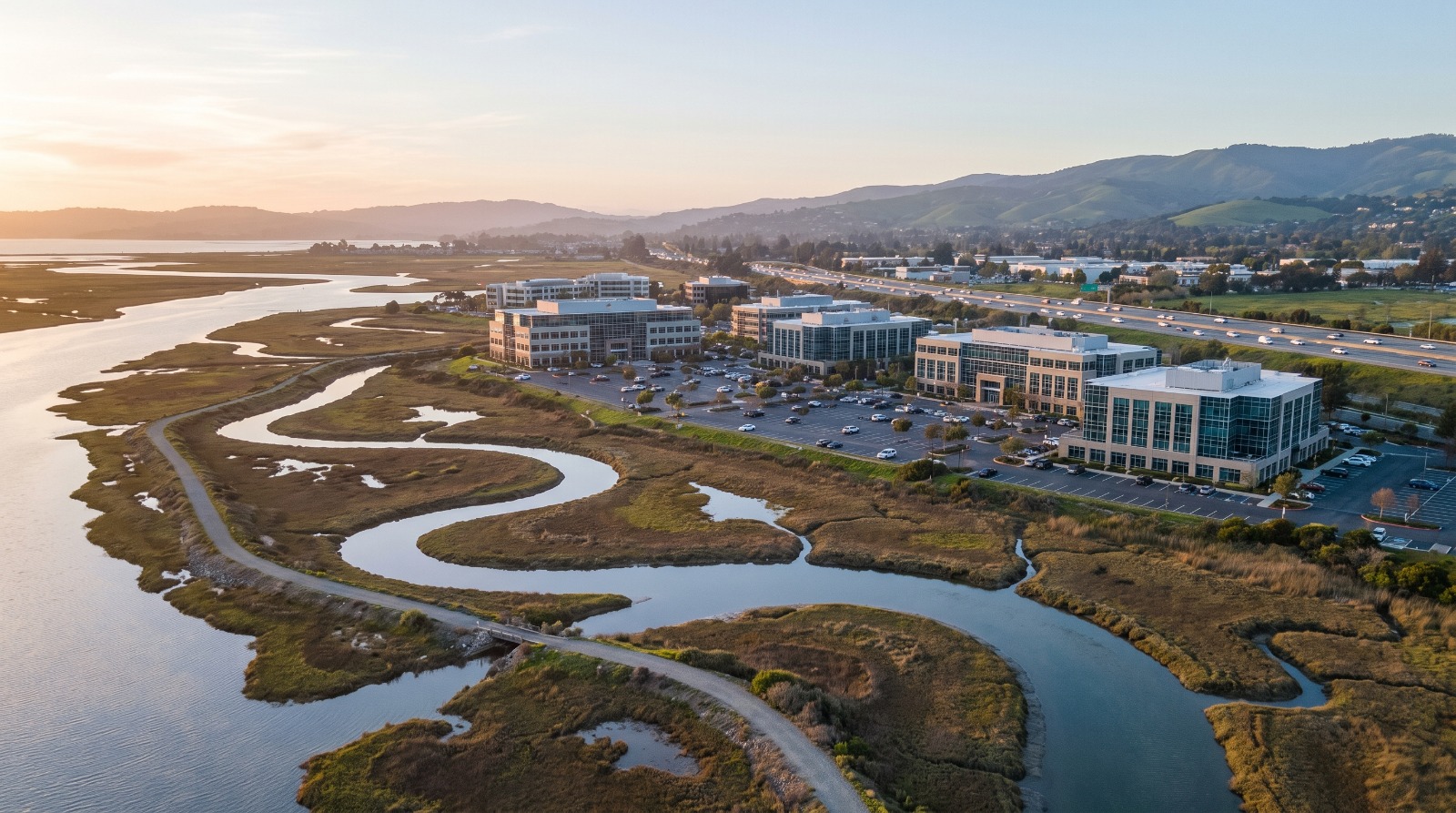
Aerial view of the Belmont Slough and the bayside office campus on the Belmont and Redwood City line where the Island Parkway housing project is proposed. Photo: Houseberry
Roughly 197 of the 400 homes proposed at Island Parkway are townhomes and detached houses. On the Peninsula in 2026, that is the unusual part. Almost everything filed on this side of the bay lately has been apartments, and apartments are rentals. Baywest Development's plan for five parcels straddling the Belmont and Redwood City line is close to half ownership product, which makes it a different kind of project than the unit count alone suggests.
The numbers that matter: 400 homes total. 336 in Belmont, 64 in Redwood City. 11 acres of existing office buildings and a parking garage. And nothing is approved. What has been filed is a preliminary application under SB 330, which reserves the rules in place today and gives the applicant 180 days to come back with a full application.
Add the townhomes and the detached houses and you get 197 units in shapes that almost always sell rather than rent. That is the number I would keep an eye on. Peninsula buyers looking for anything new to purchase under a detached-house price have had close to nothing to choose from on this stretch for years.
The applicant intends to use SB 6, AB 130 and State Density Bonus Law, according to Redwood City Pulse, and Redwood City is still deciding what level of environmental review its parcel needs.
Belmont and Redwood City cost about the same. They are not the same buy.
This is the comparison the project coverage skips, and it is the one a buyer actually needs. The two cities were within about $40,000 of each other on median sale price in July 2026, and they look nothing alike underneath.
| Belmont | Redwood City | |
|---|---|---|
| Median sale price, July 2026 | $2.34M | $2.30M |
| 12-month range | $2.20M to $2.49M | $2.13M to $2.35M |
| Overall score | 4.1 / 5 | 3.5 / 5 |
| School score | 5.0 / 5 | 3.5 / 5 |
| Safety score | 3.6 / 5 | 3.5 / 5 |
| Ranked neighborhoods | 9 | 15 |
| Homes in this project | 336 | 64 |
Same money, different product. Belmont's citywide school score of 5.0 out of 5 is as high as our scale goes, and it is remarkably even across the city. Every one of the nine ranked Belmont neighborhoods scores 4.9 or 5.0 on schools, from Belmont Heights at the top down to Homeview at the bottom. Redwood City is the opposite shape. Its citywide 3.5 is an average of a very wide spread, from Redwood Shores at 5.0 to several neighborhoods below 3.0.
The practical version: in Belmont the school question is close to settled wherever you land. In Redwood City it is the single biggest variable between one address and another, which is why the Redwood City neighborhood rankings spread so far apart on price and score.
Check the school district line, not the city line
The site sits next to Redwood Shores, which is technically Redwood City and carries a 4.5 overall score, a 5.0 school score and a $2.51M median as of May 2026. It is also served by the Belmont-Redwood Shores Elementary School District, not by Redwood City's district.
So on this particular stretch of shoreline, the city on your mailing address and the district your kid attends do not have to match. If any of these 400 homes get built and you are shopping them, confirm the attendance zone parcel by parcel with both districts rather than assuming the city boundary decides it. On most of the Peninsula that assumption is safe. Here it is not.
It is the same habit we build everything at Houseberry around. Research the area first at the level the data actually varies, then pick the address.
Four hundred homes will not move a $2.3M median
I want to be straight about this, because project coverage tends to imply otherwise. Four hundred homes delivered over several years into two cities whose combined housing stock runs to tens of thousands of units is not a price event. Anyone waiting for this to make Belmont affordable will be waiting a long time.
What it can move is choice. Redwood City's median has sat in a tight band all year, between $2.13M in November 2025 and $2.35M in March 2026, and Belmont's has drifted down from $2.49M in May to $2.34M in July. Flat markets with almost no new ownership inventory are markets where buyers have no leverage and no options. Adding 197 new for-sale homes into that is a real change in the choice set even when it is invisible in the median.
The honest counterweight: this is a preliminary filing on an office campus, in a region where large Peninsula projects routinely take the better part of a decade or die quietly. Treat the 400 as a ceiling, not a forecast.
Questions buyers are already asking
Is the Island Parkway project approved?
No. Baywest filed a preliminary application under SB 330 in May 2026, which locks in current standards and starts a 180-day window to submit a full application. Nothing has been entitled, and Redwood City has not finished determining its environmental review path.
How many homes would be in each city?
About 336 in Belmont, split across 203 multifamily units, 76 townhomes and 57 single-family homes, plus 64 townhomes on the Redwood City parcel at 501 Island Parkway.
Will any of it be affordable?
One multifamily building in Belmont is described as the affordable component. No unit count or income mix has been published yet, which is normal at the preliminary stage and worth asking about at the first public hearing.
When could anyone actually move in?
No timeline has been published. A full application, environmental review, entitlements and construction on 11 acres realistically puts first move-ins toward the end of this decade at the earliest.
The bottom line for buyers
If you are comparing Belmont against Redwood City today, the price tag is not the deciding factor, because it is close to identical. The deciding factor is how much variance you are willing to manage. Belmont hands you a consistent, expensive, school-strong city with nine neighborhoods that barely differ. Redwood City hands you a much wider menu, where the best neighborhoods pull far ahead of the citywide average and the gap between a good address and an average one is worth hundreds of thousands of dollars.
Island Parkway is worth following because it would drop new ownership housing into both answers at once, on one piece of ground. That is rare enough on this side of the bay to be worth a calendar reminder for whenever the full application lands.
Sources
- City of Belmont: Island Parkway Housing Project
- Redwood City Pulse: Preliminary plans filed for 400-home project in Redwood City, Belmont
- San Francisco YIMBY: Preliminary Plans Filed For Island Parkway Development
- The Registry: Baywest Development files plans for 400-unit, 11-acre residential project
- Houseberry: Belmont neighborhood rankings
The Houseberry Research Team is Houseberry's reporting team: Bay Area real estate analysts, data specialists and longtime local market watchers. Every day we check the public record: building permits, city council and planning agendas, county recorder filings, state housing bills, police incident data and school results. Then we tie each story to what it means for specific neighborhoods, using Houseberry's own neighborhood data on prices, appreciation, safety, schools and amenities. Questions or corrections: Contact us.
All information provided on this website including but not limited to - school ratings, safety, amenities, user opinions, and property data - is for general informational purposes only. We do not guarantee its reliability, accuracy, or completeness. Users should independently verify information and consult appropriate professionals as needed. By using this website, you agree Houseberry is not responsible for actions, decisions, or consequences arising from reliance on the information provided
houseberry.com - CA DRE# 01847391
 Bay East ©2025. CCAR ©2025. bridgeMLS ©2025. Information Deemed Reliable But Not Guaranteed. This information is being provided by the Bay East MLS, or CCAR MLS, or bridgeMLS. The listings presented here may or may not be listed by the Broker/Agent operating this website. This information is intended for the personal use of consumers and may not be used for any purpose other than to identify prospective properties consumers may be interested in purchasing. Data last updated at October 3, 2026 12:00 AM