Newsom Signed 82 Bills, Vetoed 24. Four Touch Bay Area Homes
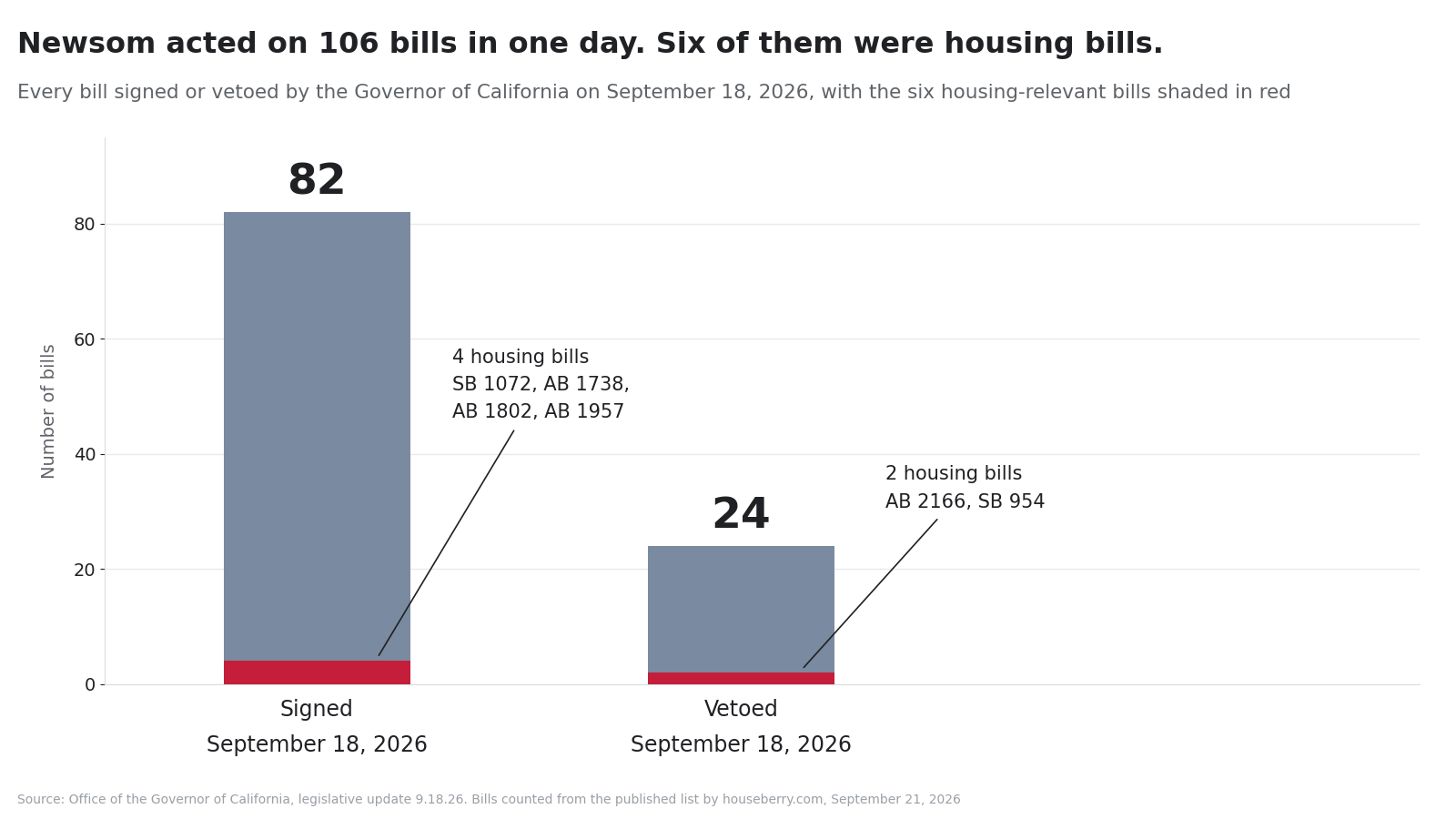
The Governor cleared 106 bills off his desk on September 18. Four of the signings change how Bay Area homes get inspected, financed and foreclosed on, and two of the vetoes tell modular builders where the state stops.

The west face and dome of the California State Capitol in Sacramento, where Newsom signed 82 bills on September 18, 2026. Photo: Houseberry
Eighty-two bills signed. Twenty-four vetoed. One hundred and six pieces of California law settled on a single Thursday, September 18, and nobody we can find has pulled the housing out of that list. So we counted it ourselves, off the Governor's own published update. Four of the 82 signings change how a Bay Area home gets inspected, financed or foreclosed on. Two of the 24 vetoes tell builders where the state's help stops.
Earlier this month we listed the eleven housing bills sitting on Newsom's desk until September 30. Here is the first thing worth knowing about Thursday: none of those eleven moved. What went through instead was a quieter set that never got a press release, and one of them matters to anyone who has taken a Tuesday off to wait for an inspector.
AB 1738 is the bill you will actually feel, and not until 2028
AB 1738 requires almost every California city to let a homeowner or a contractor ask for a remote inspection instead of waiting for a van. It is now Chapter 271 of the Statutes of 2026. It does not bind your city until January 1, 2028.
The covered work is small and common: heat pump water heaters, heat pump HVAC, reroofs, rooftop solar at 15 kilowatts or less with battery storage, and smoke and carbon monoxide detectors. A department can work by videoconference or from photos the homeowner sends, and the inspector picks which. The remote option has to come at no greater cost and with no greater delay than the in-person one, the clause that stops a city from complying on paper and burying it in practice.
The inspection itself takes five to fifteen minutes. The wait around it takes hours. SPUR, which backed the bill, put contractor standby cost at $600 to $1,000 per inspection in February 2026, and found that only 19 of California's roughly 540 permitting jurisdictions offer remote video inspections today. Four are here: Berkeley, San Mateo, San Ramon and Santa Rosa.
Santa Rosa already offers it, and with a citywide median sale price of about $742,200 in June 2026, a thousand dollars of standby time is not a rounding error. In Bennett Valley, the Sonoma County neighborhood southeast of downtown that we score 3.7 out of 5 overall and 5.0 on safety, the August 2026 median was about $775,000.
The deadlines are tiered. Cities over 50,000 people comply by January 1, 2028, smaller ones by July 1, 2028. Cities under 5,000 and counties under 150,000 are exempt, so no Bay Area county escapes and only the smallest towns do.
The honest objection came from the building officials. CALBO opposed AB 1738 on the ground that a camera cannot find a gas leak or a bad splice the way a person standing in the room can. Not a frivolous complaint. It is why the method stays at the inspector's discretion.
The six bills, side by side
The whole housing slice of Thursday, in one place.
| Bill | What it does | Outcome | When it bites |
|---|---|---|---|
| AB 1738 (Carrillo) | Cities must offer remote inspections on water heaters, heat pumps, reroofs, small solar and detectors | Signed | Law January 2027. Cities comply by January 1, 2028, or July 1, 2028 if under 50,000 |
| SB 1072 (Committee on Housing) | Housing omnibus. Adds a 12-month notice before an owner ends a subsidy contract or lets rent limits lapse | Signed | January 1, 2027 |
| AB 1957 (Pacheco) | Rewrites who may bid after a foreclosure and extends the window before a trustee's sale is final | Signed | January 1, 2027 |
| AB 1802 (Stefani) | Deletes the sunset on agencies and nonprofits holding mitigation land endowments | Signed | January 1, 2027, the day the old repeal would have hit |
| AB 2166 (Carrillo) | Would have had the state credit-backstop surety bonds for offsite housing factories | Vetoed | Not law |
| SB 954 (Blakespear) | Would have exempted certified advanced manufacturing plants on industrial land from CEQA | Vetoed | Not law |
Everything signed Thursday is January 2027 law at the earliest, and the one people will notice is 2028.
SB 1072 and AB 1957 are the quiet ones with teeth
Two of the other three do more than housekeeping.
SB 1072 is the Housing Committee's annual cleanup bill, and most of it reads like one. Buried in it is a real requirement. An owner of subsidized housing must now notify affected public entities at least twelve months before ending a subsidy contract or letting rent restrictions expire. Twelve months is enough time to assemble a preservation deal. Ninety days is not.
AB 1957 reopens the post-foreclosure bidding rules California wrote in 2020 to keep investors off the courthouse steps. It narrows the preference to tenant bidders and community buyers, drops prospective owner-occupants, extends the window before a trustee's sale is final, and adds civil penalties. Foreclosures cluster when they happen, and this rule decides who ends up owning the block.
AB 1802, by San Francisco's Catherine Stefani, is plumbing. It deletes a January 1, 2027 repeal date so agencies and nonprofits can keep holding endowments for mitigation land, which any project buying habitat offsets needs somebody to do.
The vetoes tell modular builders to find their own backstop
AB 2166 would have put the state's credit behind surety bonds for offsite housing factories, and Newsom said no.
Factory-built housing keeps stalling in California for one unglamorous reason. A factory needs payment and performance bonds to win multifamily contracts, sureties will not write them for a young manufacturer with no completed projects, so the track record never starts. AB 2166 would have had the California Infrastructure and Economic Development Bank stand behind those bonds, subject to appropriation. Newsom also vetoed AB 2012 the same day, which would have eased hauling manufactured homes on state highways.
We would like to give you his reasoning. The veto messages for AB 2166 and SB 954 are posted as scanned images with no readable text, so we cannot quote either and will not guess.
Nine days, eleven bills, one desk
The deadline is September 30, and everything we flagged on September 2 is still sitting there.
AB 956 on two detached ADUs. SB 1117 on impact fees. SB 1116 on starter home subdivisions. AB 2074 on transit hub districts. The two insurance bills and the three HOA bills. Eleven in all, none touched. A bill the Governor neither signs nor vetoes by the deadline becomes law anyway, so silence is not rejection, but it is a strange way to find out.
For anyone weighing a project before January, the read is short. Nothing signed Thursday speeds up a permit this year, and the remote inspection you want is fifteen months out unless you live in one of those four cities. Permitting friction is the layer people skip when they compare places at Houseberry, because it stays invisible until you are the one living in it. The Santa Rosa neighborhood rankings are one place that comparison starts.
Check back in ten days. The bigger list resolves itself either way.
Sources
Office of the Governor of California, “Governor Newsom issues legislative update 9.18.26,” September 18, 2026. Signed and vetoed bills counted directly from the published list.
CalMatters Digital Democracy, bill records for AB 1738 (Chapter 271), SB 1072 (Chapter 322), AB 1802 (Chapter 274) and AB 1957 (Chapter 279), Statutes of 2026.
California State Assembly, Committee on Local Government analysis of AB 1738, April 15, 2026.
California Building Officials (CALBO), position statement on AB 1738 (Carrillo).
SPUR, Colleen Corrigan, “How Virtual Construction Inspections Can Address California’s Housing Crisis and Meet Clean Energy Goals,” February 18, 2026.
LegiScan, text of AB 1738 as amended July 2, 2026, Health and Safety Code section 17970.9.
CalMatters Digital Democracy, bill record for AB 2166 (vetoed) and SB 954 (vetoed), September 18, 2026.
Houseberry, Santa Rosa city guide, Bennett Valley neighborhood page and Santa Rosa neighborhood rankings, retrieved September 21, 2026.
Houseberry, “Eleven Housing Bills Now Sit With Newsom Until September 30,” September 2, 2026.
All information provided on this website including but not limited to - school ratings, safety, amenities, user opinions, and property data - is for general informational purposes only. We do not guarantee its reliability, accuracy, or completeness. Users should independently verify information and consult appropriate professionals as needed. By using this website, you agree Houseberry is not responsible for actions, decisions, or consequences arising from reliance on the information provided
houseberry.com - CA DRE# 01847391
 Bay East ©2025. CCAR ©2025. bridgeMLS ©2025. Information Deemed Reliable But Not Guaranteed. This information is being provided by the Bay East MLS, or CCAR MLS, or bridgeMLS. The listings presented here may or may not be listed by the Broker/Agent operating this website. This information is intended for the personal use of consumers and may not be used for any purpose other than to identify prospective properties consumers may be interested in purchasing. Data last updated at September 21, 2026 12:00 AM