Palo Alto SB 79 Rush: 7 Transit Projects Filed
Seven projects and about 253 apartments were filed under SB 79 before Palo Alto's limiting ordinance took effect July 16. Here is where they landed and what it means for buyers comparing neighborhoods.

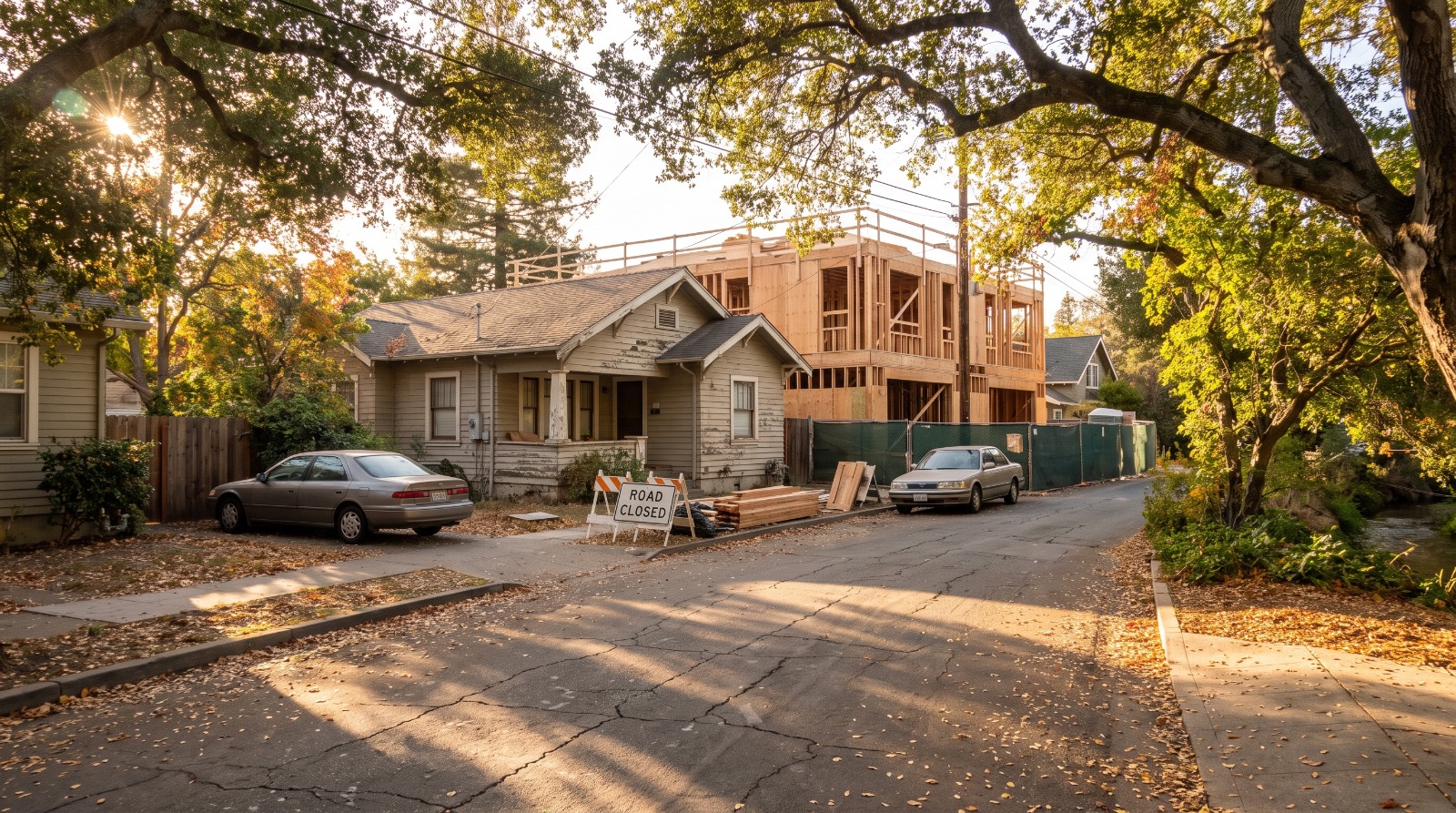
A tree-shaded Downtown North street in Palo Alto near the Caltrain corridor, where Palo Alto SB 79 projects are bringing new transit-oriented housing. Photo: Houseberry
Seven applications. About 253 apartments. Sixteen days. That is what the Palo Alto SB 79 window produced before the city's own limiting ordinance took effect on July 16, and the last proposal in the door was a plan to knock down a single-family house on a shaded creekside street and put up six condominiums. This was not the slow trickle the City Council predicted. It was a rush, and it landed in the part of town that has spent years watching everyone else absorb the growth.
The short version: a new state law briefly overrode Palo Alto's zoning near its Caltrain stations, the city left a two-week gap before its own rules kicked in, and developers ran through it. What they filed tells you where Palo Alto is about to change, and it is not where the city planned.
What SB 79 changed on July 1
SB 79, the transit-density law from state Senator Scott Wiener, was signed by Governor Newsom in October 2025 and took effect July 1, 2026. It applies to what the state calls urban transit counties, meaning counties with 15 or more passenger rail stations, and Santa Clara County qualifies. Near a busy rail stop, cities can no longer cap height and density below the state's floors. That is the whole mechanism, and it is deliberately blunt.
In Palo Alto, the law reaches the half-mile rings around the city's three Caltrain stations. Within those rings it allows buildings of roughly five to six stories, rising toward nine stories on parcels right next to a platform, according to Palo Alto Online. Downtown, the standards applicants cited were 65 feet of height and 100 homes per acre. Those numbers are ordinary in most cities. In a place where the default has long been one house per lot, they are a jolt.
Palo Alto had a chance in June to blunt the impact with an urgency ordinance and the council declined, betting few developers would move fast. The city's permanent limiting rules instead took effect July 16, exempting historic properties and cutting SB 79's height and density allowances roughly in half through 2032. That decision created a clean two-week window when the full state standards applied with no local restrictions. Builders noticed.
The seven projects, and where they landed
Here is the detail that matters. For two years, Palo Alto steered its apartment growth south, onto El Camino Real and away from its single-family neighborhoods. The SB 79 filings did the opposite. Almost all of them cluster in the northern half of the city, in and around downtown and California Avenue, reaching into historic residential pockets like Downtown North, Old Palo Alto, and College Terrace. A quick tour of the concrete ones:
- 525 Hamilton Avenue: a six-story building with 21 apartments and ground-floor parking, replacing an existing six-unit building, two units set aside for very-low-income tenants. The applicant, Mindframe, is led by a member of the city's own Architectural Review Board.
- 555 College Avenue, in College Terrace: a six-story, 64-foot project with 70 residential units and ground-floor commercial space, eight of the units designated very-low-income, proposed by the nonprofit Minority Television Project.
- 127-129 Lytton Avenue, downtown: a 75-foot building with 24 units and ground-floor commercial, two very-low-income units, using the state density bonus to skip parking requirements entirely.
- 2455 El Camino Real: the Coronet Motel, slated to become a 76-unit building, the first filing of the batch and the one we covered on its own.
- 340 Palo Alto Avenue, in Downtown North: the last in the door, a four-story building of six for-sale condominiums replacing a single-family home along San Francisquito Creek, about 1,500 square feet each, with nine parking spaces.
Add the two remaining downtown proposals and the tally reaches seven filings and roughly 253 apartments, per Palo Alto Online and San Jose Spotlight. Most of the applicants are represented by the same law firm, Holland & Knight, which has also threatened litigation over the city's handling of a separate apartment proposal at the Mollie Stone's site on California Avenue. This is a coordinated push, not a coincidence.
Why the filings clustered downtown, not on El Camino
For the last two years, when Palo Alto needed to find room for state-mandated housing, it pointed the pipeline at El Camino Real, the six-lane commercial strip nobody romanticizes. That is the corridor we wrote about in our earlier look at El Camino becoming Palo Alto's apartment district, where a motel, a bike shop, and a fish restaurant are turning into hundreds of homes. Those were easy calls. Commercial parcels, no displaced homeowners, a state highway.
SB 79 does not care about that political geography. Its half-mile rings around the downtown and California Avenue stations reach straight into leafy, historic single-family blocks that the city has always protected. That is why the 340 Palo Alto Avenue condo plan drew the sharpest reaction. Turning one house on a quiet creekside street into six units is a real change to that block, and it is fair for neighbors to feel it. But it is worth being honest about the other half of the argument. When Downtown North calls itself irreplaceable neighborhood character, part of what it is protecting is its long exemption from the growth the rest of the city absorbed. Three hundred homes near a Caltrain platform is roughly what a functioning region looks like, even when the parking debate runs long.
What it means if you are comparing Palo Alto neighborhoods
The practical caution first: these are preliminary applications. Filing one starts a clock, giving applicants 180 days to submit formal plans, and plenty of preliminary proposals never become buildings. Nobody should price a home today on the assumption that all 253 units rise on schedule.
What has actually changed is the map. For years the mental model was simple, that Palo Alto grows along El Camino and leaves the interior alone. SB 79 quietly redrew that to anything within a half-mile of the University Avenue and California Avenue Caltrain stations. That reshuffles which blocks stay low-rise and which ones start getting neighbors, and the way we look at it when we compare neighborhoods, that belongs in your research next to schools and commute. If you are weighing addresses here, how Palo Alto neighborhoods actually rank is a better starting point than a single project rendering.
It also does not stop at the city line. The same Caltrain corridor runs through Menlo Park and Mountain View, which sit under the same law with the same half-mile rings around their stations. Buyers weighing transit-adjacent value on the Peninsula should expect the pattern to repeat, and how Mountain View neighborhoods rank is a useful comparison point as the spillover plays out.
Three dates worth watching
This story is only getting started. Watch whether these preliminary filings convert into formal applications inside the 180-day window, since a project that stalls there quietly disappears. Watch how the July 16 ordinance handles anything filed after the window closed, because that is where the city will try to reassert control. And watch the Mollie Stone's dispute on California Avenue, where the litigation threat could set the tone for how hard Palo Alto fights the projects it does not want. The window is shut. The pipeline it filled is not going anywhere.
Sources
San Jose Spotlight: Palo Alto condo proposal is 7th to use new state housing law
Palo Alto Online: Palo Alto sees wave of housing projects as state law kicks in
California YIMBY: SB 79 (Wiener) transit-oriented development
The Houseberry Research Team is Houseberry's reporting team: Bay Area real estate analysts, data specialists and longtime local market watchers. Every day we check the public record: building permits, city council and planning agendas, county recorder filings, state housing bills, police incident data and school results. Then we tie each story to what it means for specific neighborhoods, using Houseberry's own neighborhood data on prices, appreciation, safety, schools and amenities. Questions or corrections: Contact us.
All information provided on this website including but not limited to - school ratings, safety, amenities, user opinions, and property data - is for general informational purposes only. We do not guarantee its reliability, accuracy, or completeness. Users should independently verify information and consult appropriate professionals as needed. By using this website, you agree Houseberry is not responsible for actions, decisions, or consequences arising from reliance on the information provided
houseberry.com - CA DRE# 01847391
 Bay East ©2025. CCAR ©2025. bridgeMLS ©2025. Information Deemed Reliable But Not Guaranteed. This information is being provided by the Bay East MLS, or CCAR MLS, or bridgeMLS. The listings presented here may or may not be listed by the Broker/Agent operating this website. This information is intended for the personal use of consumers and may not be used for any purpose other than to identify prospective properties consumers may be interested in purchasing. Data last updated at October 13, 2026 12:00 AM