Can You Grill on a Condo Balcony in California?
The Foster City condo fire started with a propane barbecue on a first-floor deck. What California's fire code actually says about grills at multi-unit buildings, and where Bay Area cities differ.
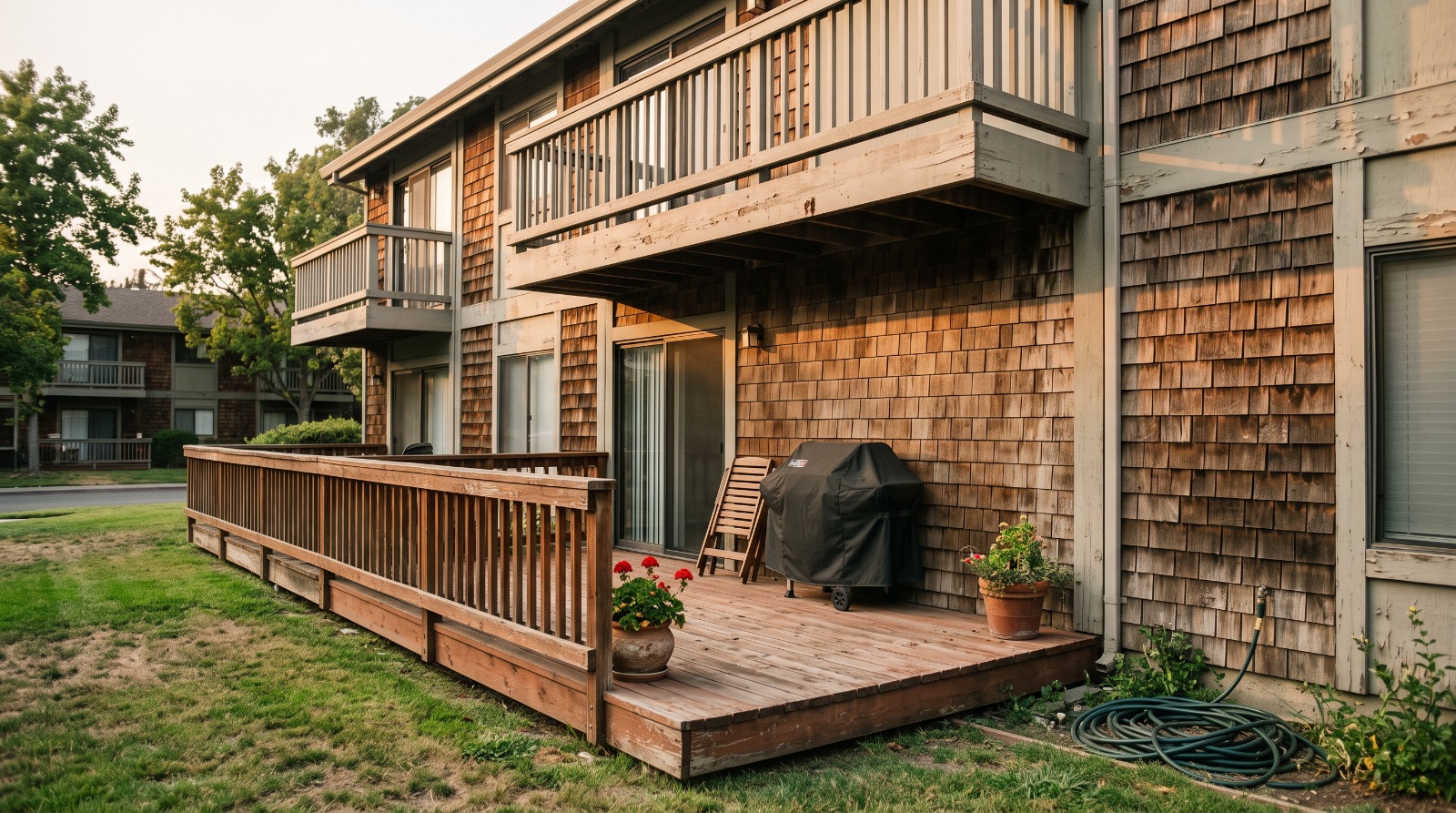
A covered propane barbecue on a ground-floor wooden deck against the siding of a 1980s California condominium building. Photo: Houseberry
Mostly no, and the reason surprises people. Under California Fire Code section 308.1.4, open-flame cooking devices cannot be operated on combustible balconies or within 10 feet of combustible construction at any residential building with more than two dwelling units. There are three exceptions, and the propane one is small enough to disqualify almost every grill people actually own.
This is not an abstract question this week. San Mateo Consolidated Fire determined the cause of Sunday's six-alarm fire at 815 Sea Spray Lane in Foster City, and we wrote about that fire three days ago. The cause was a propane barbecue.
It was a ground-floor deck, not a balcony
The fire department's own wording is precise: the origin and cause was a propane barbecue on the exterior deck of a first-floor unit. Some coverage rendered that as a balcony. It was not, and the correction matters, because the version of this rule most people carry around in their heads is "no grills on balconies," which would have told a first-floor resident nothing.
The federal data says the same thing. In the U.S. Fire Administration's study of residential grill fires, the single most common area of origin was a courtyard, patio, terrace or screened porch at 32 percent, ahead of exterior balconies and unenclosed porches at 23.7 percent. Ground level is where more of these start, not less. More recent NFPA figures, published in May 2026 from 2020 to 2024 averages, put U.S. home grill fires at 12,141 a year causing 15 deaths, 171 injuries and $241 million in property damage, with gas grills involved in 76 percent of them and July the peak month. The Foster City fire was August 2.
The building was 51 units, built in 1981, and had no fire sprinklers. More than 150 people were displaced, four firefighters had minor injuries, and no residents were hurt. The structure is red-tagged and fenced with a real risk of collapse. Foster City police arrested a resident on Thursday morning on suspicion of unlawfully causing a fire resulting in injury and of obstructing the investigations. That person has not been publicly named and nothing has been proven, and they are not the subject of this piece. The rules are.
The rule is ten feet and a one-pound tank
Here is 308.1.4 in plain terms, with the three exceptions that decide every real case.
- One- and two-family dwellings are exempt. If you own a house, none of this applies to you. The rule exists for shared walls.
- Sprinklered buildings are exempt. If the building, balcony or deck is protected by an automatic sprinkler system, you can grill. This is why a 2015 building and a 1981 building follow different rules on the same street.
- Propane is allowed only in a container of 2.5 pounds water capacity or less, which is a nominal one-pound camping canister. A standard backyard tank is 20 pounds. It gets no exception at all.
So the practical answer at an older, unsprinklered condo building is that the little green canister is fine, the tank under your barbecue is not, and charcoal may be stored on a balcony but not lit there. Electric grills sit outside the rule entirely and are the workaround every fire department in the region points to. Several also add that propane cylinders over a pound may not be carried through elevators or enclosed hallways, which is the part almost nobody knows.
Two things I want to be careful about. Nobody has published the tank size or the distance from the wall at Sea Spray Lane, so whether that grill met the code has not been established. And this is a floor, not a ceiling. An HOA can ban barbecues outright through its governing documents, and insurance carriers are usually the ones pushing for it, particularly in wood-frame complexes. If you want the insurance side of this, it is in Monday's post rather than here.
Foster City's own code book reads differently
This is the part I did not expect to find.
Foster City adopted the 2025 California Fire Code under Ordinance 697, and its codified chapter amends 308.1.4. Where the state lists Exception 1 as "one- and two-family dwellings," the city's chapter lists it as "Group R-2, R-3, and R-3.1 occupancies." R-2 is the occupancy class for apartment and condominium buildings with three or more units. Read literally, that language would exempt exactly the buildings the state rule was written to protect.
San Mateo Consolidated Fire's own model ordinance, adopted November 19, 2025 and effective January 1, 2026, contains no amendment to 308.1.4 at all. The two documents do not reconcile, and I cannot tell from the public record whether Foster City deliberately widened the exception or whether this is a codification error. It is a fair question for the city, and it is the sort of thing that only surfaces after something burns.
| Jurisdiction | Amends section 308.1.4? | Effect on a propane grill at a condo |
|---|---|---|
| Foster City | Yes. Codified exception 1 reads Group R-2, R-3 and R-3.1 occupancies | Read literally, would exempt apartment and condo buildings. Unreconciled with the county model ordinance |
| San Mateo Consolidated Fire model ordinance | No | State default: banned unless sprinklered or a one-pound canister |
| Palo Alto | No | State default |
| San Francisco | No, but adds an LP-gas permit layer | State default plus a permit regime for cylinders |
| Santa Clara County cities | No, all follow one countywide standard | State default. Electric grills expressly unrestricted |
| Sunnyvale | No, but publishes stricter guidance | Applies the 10-foot rule at ground level and restricts cylinders in elevators |
The takeaway is not that one city is lax. It is that a rule most people assume is statewide and uniform turns on which code book your fire marshal opens, and the answer can change when you move six miles up the Peninsula.
Whatever replaces it will have sprinklers the old building never had
Foster City's fire code carries a retrofit trigger at section 903.6: any combination of additions, alterations and fire repairs touching more than 50 percent of a building's existing gross area requires the entire building to be sprinklered.
A red-tagged structure with collapse risk is not going to come in under 50 percent. So whatever gets rebuilt at 815 Sea Spray Lane will have the sprinkler system the 1981 building lacked, and under exception 2, grills would then be legal there. That is a grim way to reach a safety standard, and it is worth saying because it points at the real exposure across this part of the Peninsula. Roughly 64.5 percent of Foster City's 13,174 housing units are attached or multifamily, and about 8,910 of them, 68 percent of the city's stock, were built between 1960 and 1979. Older than the building that burned.
That is also where the affordable end of the market lives. Metro Center, the condo and apartment core where Sea Spray Lane sits, had a median sale price around $1.27 million in June 2026 against a Foster City median of about $2.05 million the same month. The attached stock is the reason a family can get into this city at all, and the region needs more of it, not less. None of that is an argument for being casual about a twenty-pound tank against a wood wall.
So the useful thing to do this weekend is boring. Find out whether your building has sprinklers, which your HOA or manager can answer in a sentence. Read the grill clause in your CC&Rs. Check what your own city's fire code chapter actually says rather than assuming the state rule travels. A neighborhood score will tell you about schools, amenities and reported crime, and we have never pretended it measures fire. That answer sits one level down, inside the building, and you have to go ask for it.
The Foster City Chamber of Commerce is coordinating relief for displaced households.
Sources
San Mateo Consolidated Fire Department, incident updates
KTVU, Cause of massive Foster City condo complex fire revealed (Aug 2026)
CBS News Bay Area, Foster City condo complex fire caused by propane barbecue
SFist, Propane grill blamed for Foster City condo fire (Aug 6, 2026)
Foster City Municipal Code chapter 15.24, fire code adoption and amendments
San Mateo Consolidated Fire, Ordinance 2025-003 adopting the 2025 fire code
Unidocs UN-090, standards for open flame cooking devices on balconies, patios and decks
San Francisco Fire Department, outdoor grill and gas grill safety
City of Sunnyvale, barbecue safety for patios and balconies (May 28, 2024)
NFPA, Home Grill Fires (May 2026)
U.S. Fire Administration, Grill Fires on Residential Properties
All information provided on this website including but not limited to - school ratings, safety, amenities, user opinions, and property data - is for general informational purposes only. We do not guarantee its reliability, accuracy, or completeness. Users should independently verify information and consult appropriate professionals as needed. By using this website, you agree Houseberry is not responsible for actions, decisions, or consequences arising from reliance on the information provided
houseberry.com - CA DRE# 01847391
 Bay East ©2025. CCAR ©2025. bridgeMLS ©2025. Information Deemed Reliable But Not Guaranteed. This information is being provided by the Bay East MLS, or CCAR MLS, or bridgeMLS. The listings presented here may or may not be listed by the Broker/Agent operating this website. This information is intended for the personal use of consumers and may not be used for any purpose other than to identify prospective properties consumers may be interested in purchasing. Data last updated at September 18, 2026 12:00 AM