Sacramento may buy the Maven on Broadway. Most rents barely move
A new city-created nonprofit wants to buy the 408-apartment Maven on Broadway for $106.5 million. We break down who pays less, by how much, and what the city gives up.

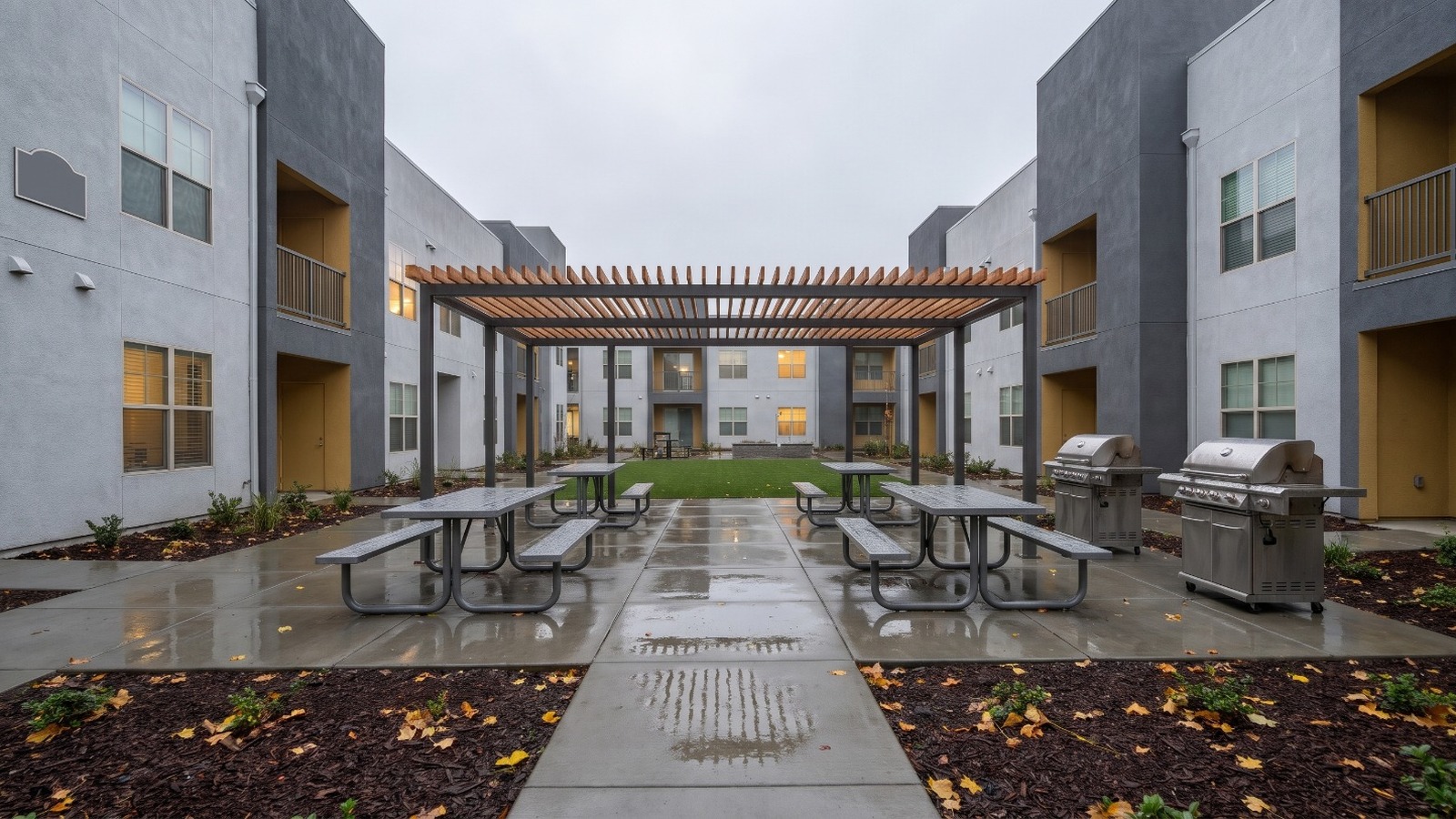
AI-rendered view of the courtyard at The Maven on Broadway apartments in Sacramento after rain, with a wood pergola, picnic tables and three-story buildings Photo: Houseberry
Twelve three-story buildings, a pool, a co-working room and 408 apartments on 8.73 acres at 230 Broadway, about a mile south of the Capitol. The Maven on Broadway opened in 2023. On Tuesday, Nov. 10, the Sacramento City Council will hold a hearing on letting the city's housing authority borrow up to $135 million in tax-exempt bonds so a new nonprofit it created can buy the place for $106.5 million.
That works out to $261,029 an apartment, less than half the price of a typical house in the surrounding Upper Land Park neighborhood, which Houseberry data puts at about $551,000 this month. The question for anyone who rents in Sacramento, or pays property taxes here, is what the public gets for lending its name to the deal. Our read of the 27-page staff report: a real discount on 82 apartments, a thin one on 224, and none on the other 100.
Who is buying, and why now
The Maven was built with Opportunity Zone money, the federal program that lets investors defer capital gains taxes if they put the money into designated neighborhoods. The catch, according to the staff report, is that the property must be sold within five years. 29th Street Capital opened the complex in June 2023 on the old Seltzer Forest Products mill site, so the clock is running.
Ethos Real Estate, a California firm that buys newer apartment complexes and converts them to income-restricted housing with public agencies, brought the deal to the Sacramento Housing and Redevelopment Agency earlier this year. On Oct. 13 the city's housing authority formed Canopy Housing, Inc., a nonprofit that would own the Maven. Ethos would administer it. AMC Management would run the property, and LifeSTEPS would provide 20 hours a week of resident services. Ethos says it has done ten of these deals statewide, covering more than 3,300 units. This would be its first in Sacramento.
The city does not lend money. The bonds are repaid from the building's rent, and the Nov. 10 resolution says plainly that they are not a debt of the city or the county. What Sacramento gives up is property tax.
What a renter would actually pay
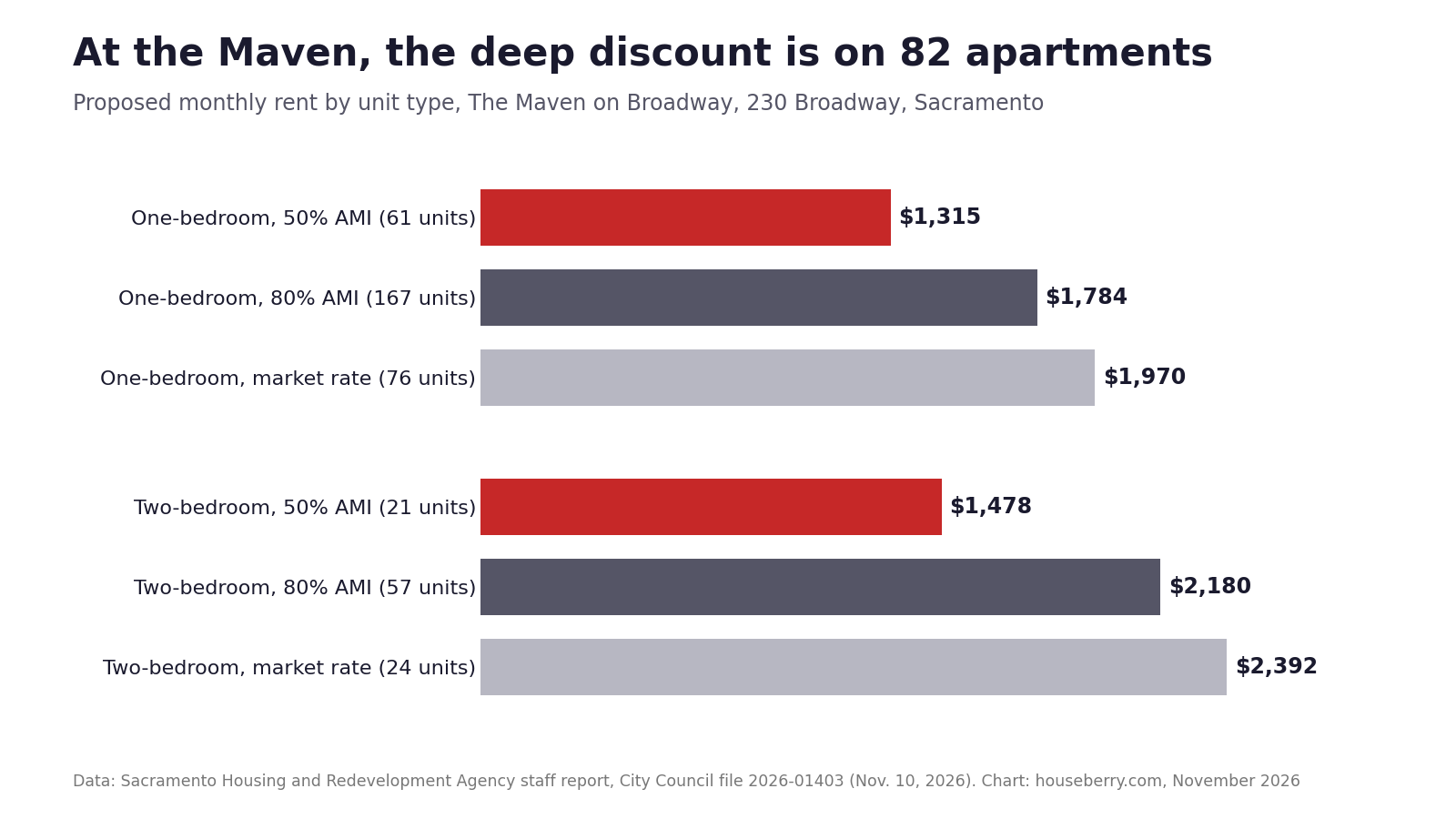
The 50 percent tier is the part of this deal that changes lives. A one-bedroom at $1,315 is $655 a month under the Maven's market rent, a third off. A two-bedroom at $1,478 is $914 under. A single person qualifies at up to $46,000 a year, a family of four at up to $65,700, and the report says water, sewer and garbage will not be billed on top for these units.
The 80 percent tier is a different product. The staff report sets income limits for those 224 apartments ($73,600 for one person, $105,100 for four) and then says there will be no rent restrictions on them. The $1,784 one-bedroom and $2,180 two-bedroom are proposed rents, not caps. Tenants in that tier would also pay electricity, water, sewer and garbage separately, on month-to-month leases, with parking fees and pet rent allowed. All four items require waivers of the agency's own lending policies, and the report lists them.
For comparison, a 2022 study by SPUR and UC Berkeley's Terner Center of this kind of public-agency purchase found 80 percent tier rents running 13 percent below market at Creekwood in Hayward and a projected 17 percent below at the Clover Apartments in Sacramento. The Maven's proposal is about 9 percent.
Nobody gets evicted. Current residents stay at their current terms, and the income limits apply as apartments turn over. That is the humane way to do it. It also means the 82 deeply discounted homes at 230 Broadway arrive one vacancy at a time.
The property tax trade
The staff report says the Maven will claim a property tax exemption under a state law for housing authority property. A complex that sold for $106.5 million would owe about $1.07 million a year at California's 1 percent base rate alone, before local bonds and assessments, if the full value comes off the rolls. Schools, the county and the city share that money.
Against it, the rent discount on the restricted units adds up to about $102,000 a month, or $1.23 million a year, once every unit has turned over. Our analysis, using the report's own rent table, puts 58 percent of that discount in the 82 apartments at 50 percent of median income.
So the trade roughly washes on paper. About $1.07 million a year in property tax goes away, about $1.23 million a year in lower rent goes to Maven tenants, and most of it lands on the lowest-income households. That is a better ratio than some of the earlier deals the Terner study looked at, where the 120 percent tier rented at market.
The risk in year 10
The financing is interest-only. The pro forma shows $5.38 million a year in debt service at 4.43 percent, with the full $121.5 million principal due in year 10. The deal assumes the building is refinanced or sold around 2036, under the 30-year regulatory agreement that would still bind it. If rates are higher then, the pressure lands on rents, and the 80 percent tier has no cap to protect it.
The margin is not large, either. Year one net operating income of $6.35 million covers debt service 1.17 times. After a $219,865 asset management fee to Ethos, the projected cash flow is about $685,000.
Then there is what the deal does not do. It adds no homes. The Maven exists, its tenants are housed, and the $106.5 million buys a price ceiling on existing apartments, not new ones. New construction, more than any purchase, is what keeps a city's rents in check.
We would approve it, with one condition. The 82 apartments at half of median income are a real public good, bought at no cost to the general fund. The council should ask that the proposed 80 percent tier rents be written into the regulatory agreement as caps, so that "workforce housing" means a number a tenant can count on for 30 years, not a promise that lasts until the first refinance.
The blocks around 230 Broadway
Upper Land Park scores 2.5 out of 5 overall on Houseberry, 119th of 185 Sacramento neighborhoods. Schools are its strength at 3.2 out of 5, 45th in the city, with Crocker/Riverside and Phoebe Hearst elementary schools each scoring 5 out of 5. Public spaces score 4.3. Miller Park and the Sacramento River sit a short walk west of the Maven. Safety is its low score at 1.4. The typical home, about $551,000, runs roughly 10 percent above the citywide typical price of $499,000 in Houseberry's Sacramento data.
Next door, Land Park scores 3.1 overall and Southside Park scores 2.8. The Maven sits on the seam between the riverfront industrial land and the older blocks around William Land Park, which is why a nonprofit owner here matters for more than one complex.
Questions renters are asking
Will current Maven tenants see their rent change? Not because of the sale, according to the Oct. 27 staff report. Restrictions apply when units turn over, and current residents are not displaced.
How does someone get one of the 50 percent units? None are open yet. Watch the Maven's leasing office and SHRA's affordable housing listings after the bonds close, since units open only as current tenants leave.
Does the city owe anything if the deal fails? No. The bonds are paid from the building's revenue, and the Nov. 10 resolution says they are not a debt of the city, the county or the state.
The council hears it Tuesday at 5 p.m. If it passes, Sacramento will own, through Canopy, one of the newest apartment complexes on Broadway for 30 years, and the rent caps it writes now are the ones renters will live with. To see how the blocks around 230 Broadway compare with the rest of the city, start with Houseberry's ranking of all 185 Sacramento neighborhoods.
Sources
- City of Sacramento staff report, file 2026-01403, The Maven on Broadway Apartments TEFRA hearing, published Oct. 27, 2026, for the Nov. 10, 2026 council meeting. Includes the project summary, pro forma and income limits.
- Carmichael Times, "29th Street Capital holds grand opening event at Maven on Broadway", June 13, 2023.
- SPUR and Terner Center for Housing Innovation, "The ABCs of JPAs", June 2022.
- Houseberry neighborhood scores and typical home prices for Sacramento, November 2026.
The Houseberry Research Team is Houseberry's reporting team: Bay Area real estate analysts, data specialists and longtime local market watchers. Every day we check the public record: building permits, city council and planning agendas, county recorder filings, state housing bills, police incident data and school results. Then we tie each story to what it means for specific neighborhoods, using Houseberry's own neighborhood data on prices, appreciation, safety, schools and amenities. Questions or corrections: Contact us.
Map of Sacramento Neighborhoods
Loading map...
View Full Map
Top Neighborhoods in Sacramento, CA




All information provided on this website including but not limited to - school ratings, safety, amenities, user opinions, and property data - is for general informational purposes only. We do not guarantee its reliability, accuracy, or completeness. Users should independently verify information and consult appropriate professionals as needed. By using this website, you agree Houseberry is not responsible for actions, decisions, or consequences arising from reliance on the information provided
houseberry.com - CA DRE# 01847391
 Bay East ©2025. CCAR ©2025. bridgeMLS ©2025. Information Deemed Reliable But Not Guaranteed. This information is being provided by the Bay East MLS, or CCAR MLS, or bridgeMLS. The listings presented here may or may not be listed by the Broker/Agent operating this website. This information is intended for the personal use of consumers and may not be used for any purpose other than to identify prospective properties consumers may be interested in purchasing. Data last updated at November 9, 2026 12:00 AM