Santa Clara's $15M Levi's Stadium vote is the cheap part
Santa Clara is signing three design firms to a 10-year Levi's Stadium repair pool. The staff report's own math shows a bigger bill coming for the city that owns it.

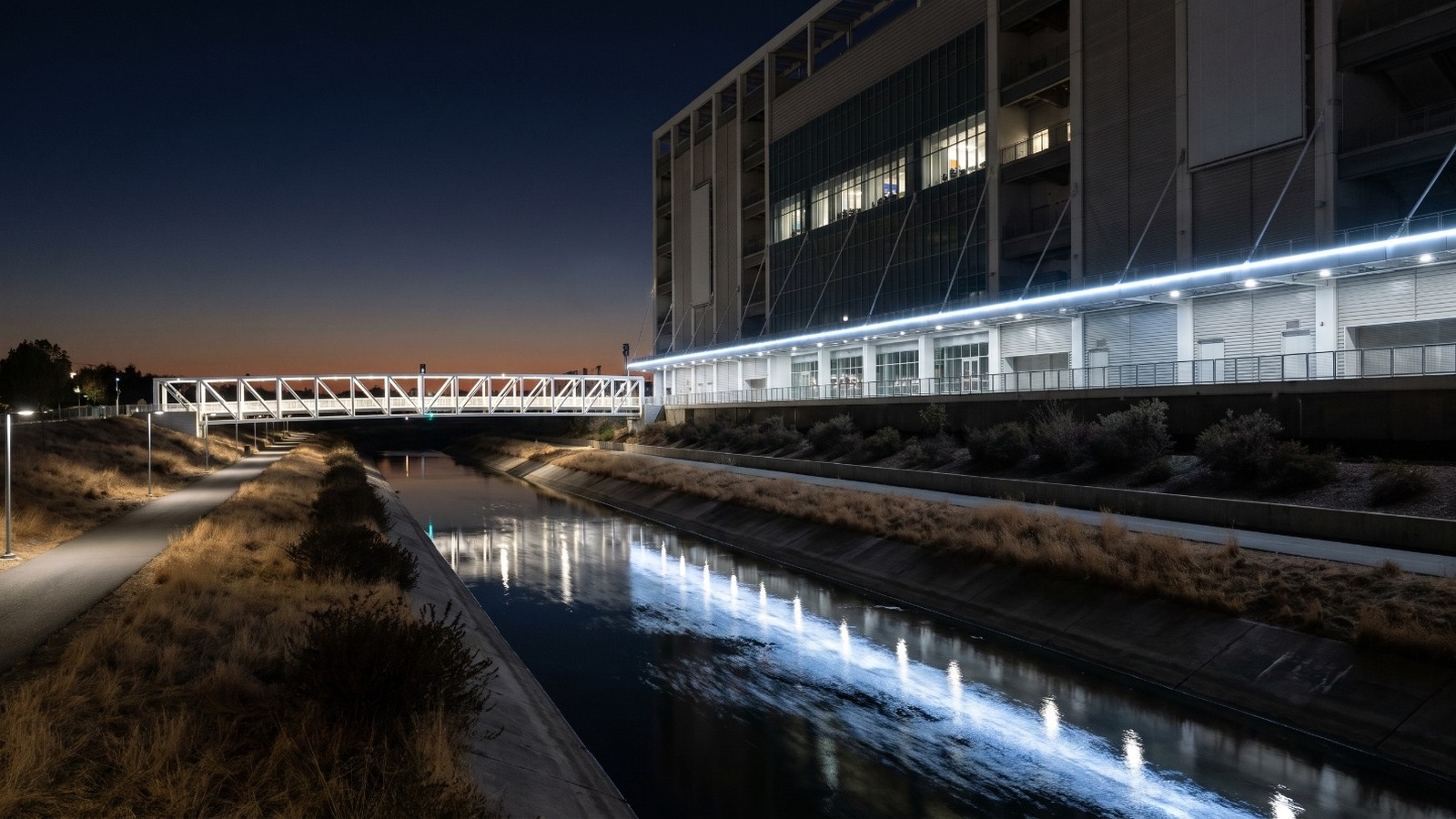
AI-rendered night view of Levi's Stadium in Santa Clara from the San Tomas Aquino Creek trail, with the pedestrian bridge lit Photo: Houseberry
Levi's Stadium turned 12 in July, and Tuesday night Santa Clara starts paying architects to fix it. On the City Council's November 10 consent calendar, with no debate scheduled, the board that owns the stadium is asked to sign three design firms, HKS, HOK and Populous, to a pool worth up to $15 million over 10 years.
That sounds like a sports story. It is a city budget story. The stadium belongs to the Santa Clara Stadium Authority, a public agency run by the same seven people who run the city, and the 49ers only manage it. The building sits in North 101, the neighborhood north of the freeway where Houseberry data puts the typical home at about $1.43 million in October 2026, roughly 16 percent below the citywide figure. Whatever the stadium costs to keep up comes out of a public ledger, and that ledger has a line that pays into Santa Clara's general fund.
What the city is actually buying
Nothing physical yet. The staff report is a menu of what wears out in a 68,500-seat building: structural repairs, building systems, life safety and disability access upgrades. The firms get paid only when the stadium manager hands them a task order for a project the board has already budgeted. No firm is promised any work at all.
The three are the big names in the business. HKS designed SoFi Stadium. Populous has drawn dozens of NFL and Major League Baseball parks. HOK did Atlanta's Mercedes-Benz Stadium. A fourth bidder, Gordon Prill, was passed over. HKS bid the lowest labor rates, and Populous asked for no markup on subcontractors. Rates stay flat for two years and then rise about 3 percent a year.
The current on-call contracts expire November 14. If the council pulls the item off consent, the stadium goes without a design team on the day after its old one runs out.
The math in the staff report
Here is the number to read twice. The stadium manager set the yearly cap by assuming design costs about 15 percent of construction, then assumed $10 million a year of projects to design. That gives $1.5 million.
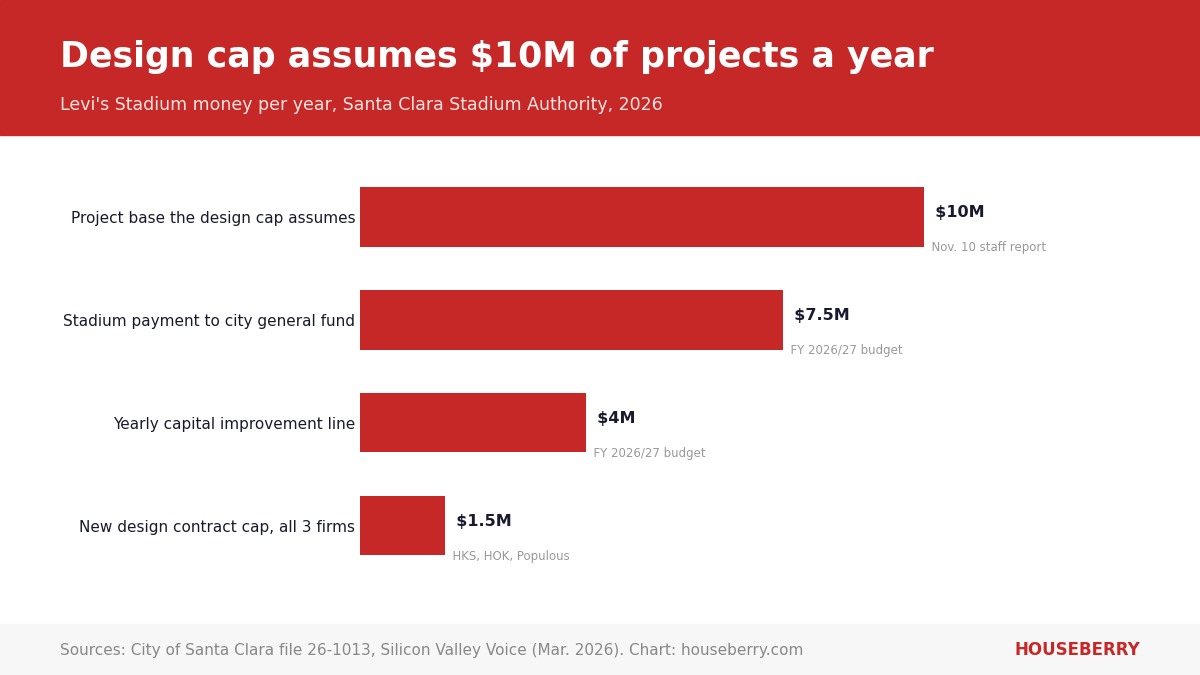
The report calls $10 million "conservative."
In March, when the council passed the stadium's 2026/27 budget on a 5 to 2 vote, Treasurer Kenn Lee said the $4 million a year set aside for capital improvements was not enough for the building's needs, according to Silicon Valley Voice. The same report noted $58.4 million sitting in the stadium's demolition fund, which the city may have to borrow from for repairs. Mayor Lisa Gillmor called the situation "dire." Councilmember Kelly Cox said the deal had "privatized profit and socialized risk."
Read together, the two documents say the same thing in different tones. The staff report says the stadium will need about $10 million of work a year for the next decade. The budget sets aside $4 million. A stadium condition assessment in the budget is supposed to say what the real number is.
Why a homeowner in Santa Clara should care
The 2026/27 stadium budget sends about $7.5 million to Santa Clara's general fund, the same fund that pays for libraries and police. Every dollar of stadium repair the authority cannot cover from events and rent competes with that payment. A 12-year-old building with a $1.3 billion price tag does not get cheaper to run.
For the blocks closest to the stadium, the trade has always been event traffic in exchange for the Great America light rail stop and the stores at Rivermark Plaza. Houseberry's scores show what that mix looks like on paper. North 101 scores 4.0 out of 5 on public spaces, its best mark, and 2.8 on safety, second lowest in the city on Houseberry's Santa Clara safety ranking. Its typical price held flat over the last 12 months, $1.44 million in November 2025 and $1.43 million in October 2026.
| Santa Clara neighborhood | Overall score | Safety | Typical home, Oct. 2026 | 12-month change |
|---|---|---|---|---|
| Santa Clara Southwest | 4.1 | 4.1 | $2.39M | down 2.4% |
| Santa Clara North Central | 3.6 | 4.2 | $1.82M | up 4.0% |
| Santa Clara Southeast | 3.8 | 3.8 | $1.79M | up 3.5% |
| Santa Clara East Central | 3.6 | 3.6 | $1.67M | up 3.1% |
| North 101 (stadium) | 3.3 | 2.8 | $1.43M | down 0.7% |
| Santa Clara West Central | 3.4 | 2.9 | $1.43M | down 6.5% |
| South 101 | 2.9 | 2.5 | $1.37M | down 4.9% |
North Central, Southeast and East Central, the only Santa Clara neighborhoods that gained value over the year (3 to 4 percent each), all sit south of US 101, away from the stadium. That is a Houseberry analysis of our own price history, and it says nothing about cause by itself. It does say the stadium has not been lifting the homes around it.
The area north of 101 is also where Santa Clara has planned the most new housing. We covered the 6,000-home Tasman East plan and the 8,300-home station area plan. A stadium that is well kept and paying its way helps every one of those projects. One that drains the city's budget does the opposite.
Our view
Approve it. The three contracts beat a fourth bidder on qualifications, carry a hard cap of $1.5 million a year, and a city that owns a 68,500-seat stadium has to keep architects on call. Fighting over $1.5 million a year would be fighting over the wrong number.
The right number is the one in the staff report's own assumption. If Levi's needs $10 million a year of work and the budget holds $4 million, the gap is $6 million a year, most of the general fund payment. The council should ask for the condition assessment in public before next spring's budget, with a dollar figure on it. North 101 homeowners will live next to whatever that study finds, and you can see how their neighborhood stacks up against the rest of the city on Houseberry's Santa Clara ranking.
Sources
- City of Santa Clara, file 26-1013, Stadium Manager's recommendation memo, Stadium Authority Board, November 10, 2026.
- Silicon Valley Voice, stadium budget coverage, March 11, 2026.
- Levi's Stadium, opening date, cost and capacity.
- Houseberry, Santa Clara city page and neighborhood price histories, October 2026.
The Houseberry Research Team is Houseberry's reporting team: Bay Area real estate analysts, data specialists and longtime local market watchers. Every day we check the public record: building permits, city council and planning agendas, county recorder filings, state housing bills, police incident data and school results. Then we tie each story to what it means for specific neighborhoods, using Houseberry's own neighborhood data on prices, appreciation, safety, schools and amenities. Questions or corrections: Contact us.
Map of Santa Clara Neighborhoods
Loading map...
View Full Map
Top Neighborhoods in Santa Clara, CA



All information provided on this website including but not limited to - school ratings, safety, amenities, user opinions, and property data - is for general informational purposes only. We do not guarantee its reliability, accuracy, or completeness. Users should independently verify information and consult appropriate professionals as needed. By using this website, you agree Houseberry is not responsible for actions, decisions, or consequences arising from reliance on the information provided
houseberry.com - CA DRE# 01847391
 Bay East ©2025. CCAR ©2025. bridgeMLS ©2025. Information Deemed Reliable But Not Guaranteed. This information is being provided by the Bay East MLS, or CCAR MLS, or bridgeMLS. The listings presented here may or may not be listed by the Broker/Agent operating this website. This information is intended for the personal use of consumers and may not be used for any purpose other than to identify prospective properties consumers may be interested in purchasing. Data last updated at November 9, 2026 12:00 AM