Santa Clara Moves to Put 6,000 Homes on 45 Acres
Santa Clara filed to add 1,500 homes to the Tasman East plan without adding any land. What that does to the neighborhood absorbing all of it, and how to comment before October 13.

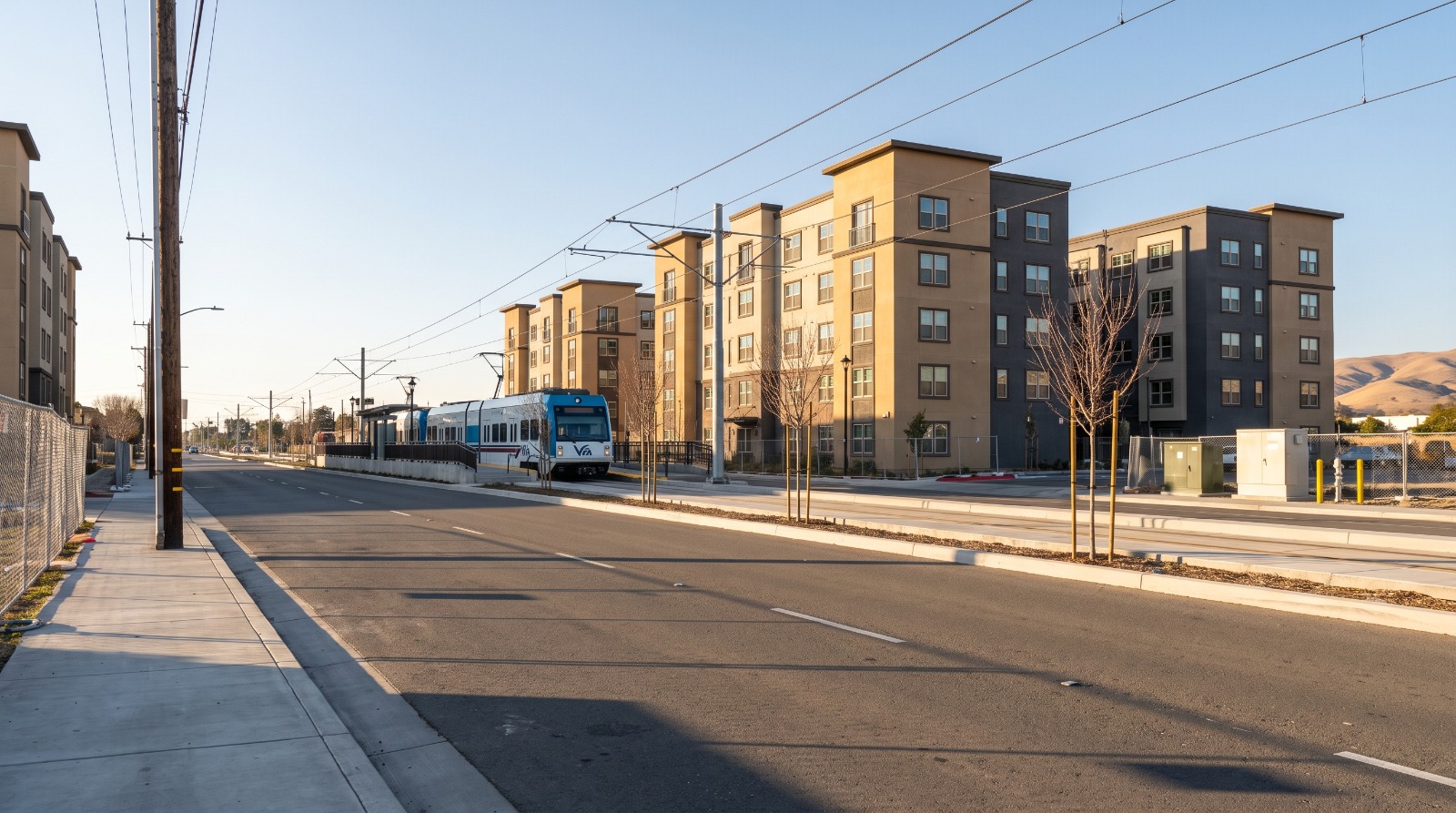
New mid-rise apartment buildings beside a VTA light rail platform on Tasman Drive in Santa Clara, where the Tasman East plan would grow to 6,000 homes. Photo: Houseberry
On August 28 Santa Clara filed a supplemental environmental impact report to raise the Tasman East Specific Plan from 4,500 homes to 6,000. The extra 1,500 do not get new land. They go on the same roughly 45 acres between Tasman Drive and the Guadalupe River that the council rezoned in 2018, which takes the plan area from about 98 homes per gross acre to about 130. Public and state review closes October 13, 2026.
That is more housing on one industrial pocket of north Santa Clara than most Bay Area cities approve in a decade, and as of this week no news outlet has reported the filing.
The specifics, from the filing itself:
- 1,500 additional homes on top of the adopted 4,500, for a plan total of 6,000
- 20,000 square feet of retail, 20,000 square feet of co-working space, and a 10,000 square foot day care
- Minimum densities unchanged at 60 homes per acre on sites under an acre and 100 per acre above that
- Maximum height unchanged at 220 feet
- Review window August 28 to October 13, 2026
What the amendment actually changes, and what it leaves alone
Most of the plan does not move. The amendment adds units and a small amount of non-residential space, and explicitly leaves the density floors and the height cap where they were.
| Adopted 2018 plan | Proposed amendment | |
|---|---|---|
| Homes | 4,500 | 6,000 |
| Retail | Up to 106,000 sq ft | Plus 20,000 sq ft |
| Co-working | None specified | 20,000 sq ft |
| Day care | None specified | 10,000 sq ft |
| Minimum density | 60 per acre under 1 acre, 100 per acre above | Unchanged |
| Maximum height | 220 feet | Unchanged |
| Plan area | About 45 acres | Unchanged |
One housekeeping note on that last row. The state filing lists the site as 46 acres while the city and SV at Home have both described the plan area as 45. It is the same ground either way, and the point stands: nothing is being annexed. The density is going up inside a boundary that already exists.
One hundred homes per acre is the floor, not the ceiling
This is the detail that gets reported backwards, so read it carefully. The plan does not permit up to 100 homes per acre. It requires at least 100 homes per acre on any site larger than an acre, and at least 60 on the smaller ones. There is no maximum density in the plan at all. Height and the building code do the limiting.
Density minimums are one of the few land use tools that reliably work, because they stop a developer from putting 40 townhomes on a parcel the region needs 300 apartments on. Santa Clara wrote them into this plan in 2018 and has not touched them since, which is why the plan area filled in with towers rather than the usual three-story compromise.
More than 2,200 of the first 4,500 are already up
The 6,000 number is not a fantasy pipeline. As of July 2026 more than 2,200 homes had already been built inside the plan area, across roughly eleven approved projects on streets that did not exist ten years ago, Calle Del Mundo and Calle De Luna and Calle Del Sol. The Clara opened with 509 apartments. Ellore added 176 senior homes. Mainline North opened in January 2026 with 151 affordable units. Parkside, 301 more, is under construction and due in 2028.
So the honest way to read the amendment is not as a new project. It is a city that watched its own plan work and decided to run it harder.
North 101 is the neighborhood absorbing all of it
Every one of those 6,000 homes lands in one place, and it is the second cheapest and second lowest scoring of the seven Santa Clara neighborhoods we score. North 101, anchored by Levi Stadium and bounded by the freeways it is named for, carries a 3.3 out of 5 overall, sixth of seven, with a 2.8 on safety and a 3.5 on schools.
Its weakest number is the one the amendment is aimed at. North 101 scores 2.4 out of 5 for nearby merchants, the lowest of any Santa Clara neighborhood we cover. The city is proposing to drop 20,000 square feet of retail and 20,000 square feet of co-working into precisely the neighborhood our own data says has the least to walk to. Whether 40,000 square feet moves a 2.4 is a fair question, and the answer depends entirely on whether it is ground-floor space on a street people actually use or a lobby-facing cafe nobody outside the building finds.
| Santa Clara neighborhood | Overall score | Median home price | Month |
|---|---|---|---|
| Santa Clara Southwest | 4.1 | About $2.13M | August 2026 |
| Santa Clara Southeast | 3.8 | About $2.40M | August 2026 |
| Santa Clara East Central | 3.6 | About $1.81M | August 2026 |
| Santa Clara North Central | 3.6 | About $2.03M | June 2026 |
| Santa Clara West Central | 3.4 | About $1.95M | August 2026 |
| North 101 (Tasman East) | 3.3 | About $1.62M | August 2026 |
| South 101 | 2.9 | About $1.65M | August 2026 |
Read that table as a spread, not a ranking of where to live. North 101 sits about $350,000 below the citywide median of roughly $1.97 million in July 2026 and about $500,000 below Santa Clara Southwest. It is also one of the few Santa Clara neighborhoods that appreciated over the past year, up about 7 percent. That combination, cheapest ground plus the only real construction, is what a plan area looks like while it is still becoming something.
The three schools named on the filing
The state filing lists Kathryn Hughes Elementary, Dolores Huerta Middle and Kathleen MacDonald High, all Santa Clara Unified. Hughes enrolled 281 students in 2025-26, with 37 percent of students meeting or exceeding state standards in math and 42 percent in English on the most recent published results. Huerta enrolled 571. MacDonald, which opened in 2022, enrolled 683 for 2026-27.
A wrinkle worth knowing before you tour anything: two of those three campuses have San Jose mailing addresses on Zanker Road even though they are Santa Clara Unified schools. That confuses buyers constantly, and it is why we tie school scores to the neighborhood boundary rather than the city line on an envelope. These are small schools serving a neighborhood that is about to add several thousand households, and enrollment is the number to watch as the plan fills in.
Six thousand homes will not move the Santa Clara median
Someone will tell you this much construction drags prices down. It does not work that way at this scale. Santa Clara owes 11,632 homes under its current state allocation running to 2031, so the 1,500 additional units are about 13 percent of an eight-year obligation. And what is being built here is towers, which competes with apartments and condos, not with the 1950s ranch on a 6,000 foot lot in Santa Clara Southwest that most buyers in this city are actually bidding on.
The comparison that does matter is between cities. Santa Clara was at about $1.97 million in July 2026, against San Jose at about $1.63 million in August and Sunnyvale at about $2.48 million in July. Santa Clara sits in the middle, and North 101 is the only part of it priced like San Jose.
The trade-off nobody in favor of this plan should skip: a 220-foot tower district next to a stadium and two freeways is a specific kind of place to live, and it is not for everyone. It is loud on game days. It has almost no retail yet. The Guadalupe River Trail on its eastern edge is genuinely good and it is currently the main thing to walk to. Buyers who need a yard should look south and pay for it.
How to comment before October 13
The review window runs August 28 to October 13, 2026, and the draft supplemental EIR plus its traffic, air quality, transportation and water supply appendices are all posted on the state clearinghouse listing. The city contact on the filing is John Davidson, principal planner, at jdavidson@santaclaraca.gov. The city own CEQA archive has not caught up yet and still shows the 2022 notice of preparation as its most recent Tasman East entry, so go to the state listing rather than hunting the city site.
One last thing about the calendar. The notice of preparation for this amendment went out in July 2022 and the environmental document landed four years later. That gap is the whole Bay Area housing story in one filing, and it is the reason state streamlining laws keep arriving, including the transit rules cities are still sorting out this year. Six thousand homes in one plan area is what happens when a city commits. Four years between a notice and a document is what happens the rest of the time.
Sources
- CEQAnet, Tasman East Specific Plan Amendment supplemental EIR, SCH 2016122027, received August 28, 2026
- City of Santa Clara, Tasman East Specific Plan
- San Jose Spotlight, Santa Clara celebrates more housing in former industrial park, July 16, 2026
- City of Santa Clara 6th Cycle Housing Element and RHNA allocation
- Kathryn Hughes Elementary School profile
- Houseberry Santa Clara neighborhood rankings
- Houseberry Santa Clara city data
The Houseberry Research Team is Houseberry's reporting team: Bay Area real estate analysts, data specialists and longtime local market watchers. Every day we check the public record: building permits, city council and planning agendas, county recorder filings, state housing bills, police incident data and school results. Then we tie each story to what it means for specific neighborhoods, using Houseberry's own neighborhood data on prices, appreciation, safety, schools and amenities. Questions or corrections: Contact us.
All information provided on this website including but not limited to - school ratings, safety, amenities, user opinions, and property data - is for general informational purposes only. We do not guarantee its reliability, accuracy, or completeness. Users should independently verify information and consult appropriate professionals as needed. By using this website, you agree Houseberry is not responsible for actions, decisions, or consequences arising from reliance on the information provided
houseberry.com - CA DRE# 01847391
 Bay East ©2025. CCAR ©2025. bridgeMLS ©2025. Information Deemed Reliable But Not Guaranteed. This information is being provided by the Bay East MLS, or CCAR MLS, or bridgeMLS. The listings presented here may or may not be listed by the Broker/Agent operating this website. This information is intended for the personal use of consumers and may not be used for any purpose other than to identify prospective properties consumers may be interested in purchasing. Data last updated at October 13, 2026 12:00 AM