Fewer Than 700 Homes Are for Sale in All of SF
San Francisco has fewer than 700 homes on the market, and single-family houses are selling in 12 days. Here is where the supply actually is.

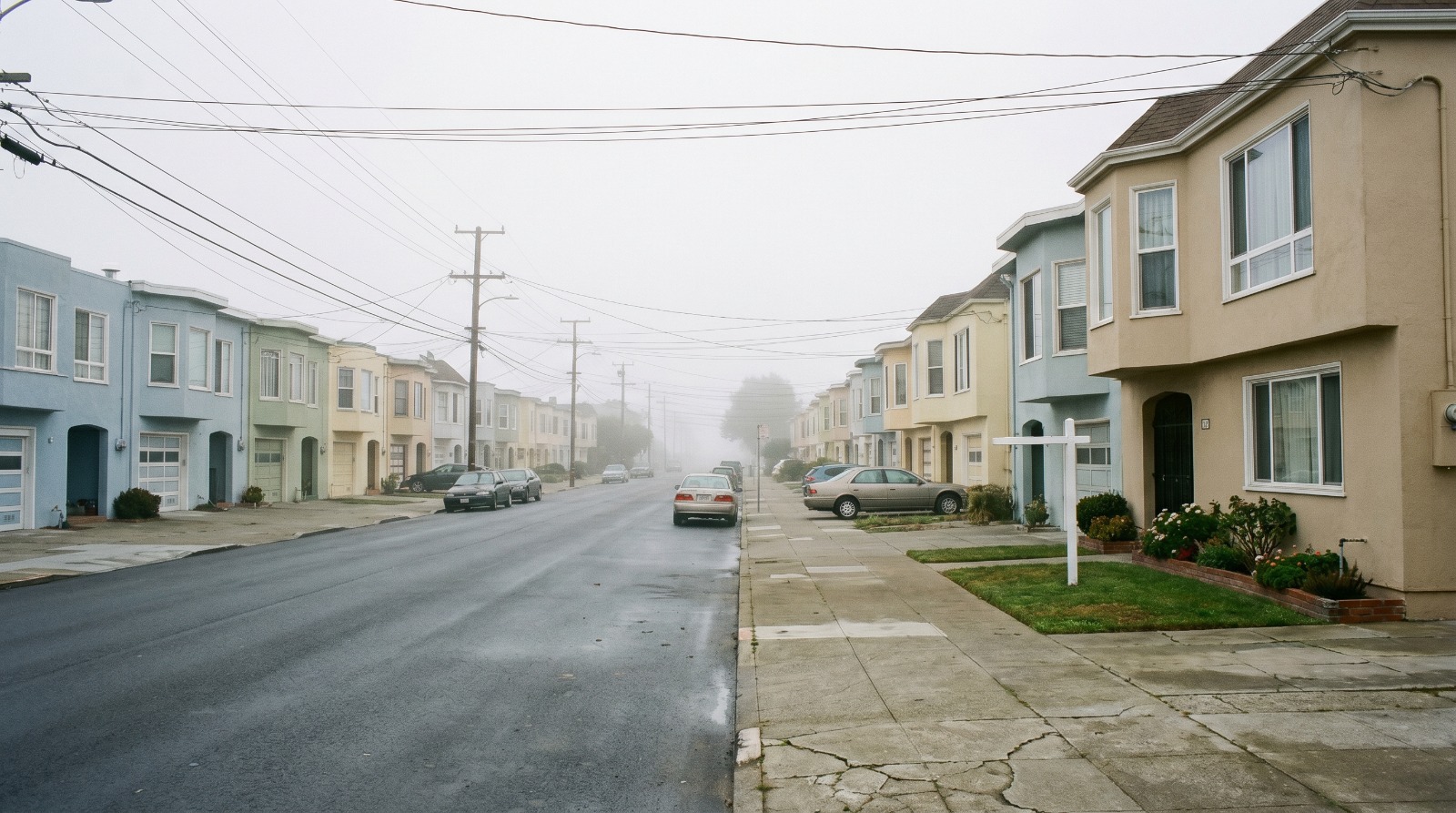
A foggy block of single-family homes in San Francisco's Outer Sunset, where much of the city's under-700 homes-for-sale supply sits. Photo: Houseberry
Every home for sale in San Francisco right now would fit inside a single mid-size apartment building. That is not a figure of speech. As of the July 2026 market update, the entire city had about 216 single-family homes and 469 condos listed, fewer than 700 properties across all seven-by-seven miles of it.
If you are hunting for San Francisco homes for sale this summer, that number is the market. Everything else, the prices, the pace, the bidding, follows from it.
The single-family side is nearly sold out
Break the count apart and the house market is the tighter half. Those 216 single-family homes are down more than 44 percent from a year ago, and they are moving in about 12 days on average. That works out to roughly 1.1 months of supply. A balanced market runs closer to three months. San Francisco's house market is sitting at about a third of balanced.
Condos give buyers a little more room, but not much. The 469 condos on the market represent about 2.3 months of supply and are selling in around 16 days, down from 26 a year ago. The condo market that was tilting toward buyers last spring has flipped hard the other way.
Prices went where you would expect when that little is for sale. The median single-family home crossed $2.2 million for the first time, up almost 23 percent year over year, with houses selling for nearly 25 percent over their original asking price on average.
Where there is actually anything to buy
A citywide count hides the real search problem, which is that supply is not spread evenly. The houses that do exist cluster on the west and south sides, in the Sunset and Richmond districts and out toward the Excelsior and Ingleside, where San Francisco still has real single-family blocks. The eastern and central neighborhoods everyone wants, the ones with the restaurants and the flat walkable streets, have the least to offer and the fastest clocks.
That is where neighborhood-level data earns its keep. Take Noe Valley, one of the most-searched family house markets in the city. Houseberry scores it 3.4 out of 5 overall, with a strong 4.0 for safety, and its median sat around $2.53 million in June. A few miles north, Pacific Heights scores 4.0 overall with a perfect amenities mark and a June median near $4.53 million. Same city, very different budgets, and in a 12-day market you do not have time to sort that out after you have already found a listing you like.
The playbook when the whole city inventory fits in one building
A market this thin rewards preparation and punishes browsing. A few things actually help.
- Get fully underwritten, not just pre-approved, before you tour anything. In a 12-day market, the buyer who can close cleanly often beats the buyer who simply bids highest.
- Pick your neighborhoods before you pick your listings. When only a couple hundred houses exist citywide, you cannot afford to fall for a block you have not researched. Know the schools, safety, and price history of your target areas cold.
- Widen the map west. The Sunset, Richmond, and southern neighborhoods carry more of the actual single-family supply and a little less of the frenzy. If your budget keeps losing in the eastern core, the same money often buys more house a few Muni stops west.
- Keep condos on the table. With 2.3 months of supply versus 1.1 for houses, the condo market gives you marginally more room to breathe, and the over-asking premium is far smaller.
None of this makes San Francisco cheap. It makes it navigable. The reason we built Houseberry was exactly this problem, doing the neighborhood homework before the address, because in a market where you get 12 days and one shot, the research has to happen before the listing shows up, not after. Our San Francisco neighborhood scores are a decent place to start narrowing before you ever open a listing app.
Will it loosen? Not soon. Nothing in the current data points to a wave of new inventory this year, and the fall could bring fresh tech demand rather than fresh supply. For now, fewer than 700 homes is the whole ballgame, and the buyers who treat neighborhood research as step one instead of step three are the ones who will actually close.
Sources
Helm Real Estate: San Francisco Real Estate Market Update, July 2026
Houseberry: Noe Valley neighborhood guide
Houseberry: Pacific Heights neighborhood guide
Houseberry: San Francisco city guide and neighborhood scores
The Houseberry Research Team is Houseberry's reporting team: Bay Area real estate analysts, data specialists and longtime local market watchers. Every day we check the public record: building permits, city council and planning agendas, county recorder filings, state housing bills, police incident data and school results. Then we tie each story to what it means for specific neighborhoods, using Houseberry's own neighborhood data on prices, appreciation, safety, schools and amenities. Questions or corrections: Contact us.
All information provided on this website including but not limited to - school ratings, safety, amenities, user opinions, and property data - is for general informational purposes only. We do not guarantee its reliability, accuracy, or completeness. Users should independently verify information and consult appropriate professionals as needed. By using this website, you agree Houseberry is not responsible for actions, decisions, or consequences arising from reliance on the information provided
houseberry.com - CA DRE# 01847391
 Bay East ©2025. CCAR ©2025. bridgeMLS ©2025. Information Deemed Reliable But Not Guaranteed. This information is being provided by the Bay East MLS, or CCAR MLS, or bridgeMLS. The listings presented here may or may not be listed by the Broker/Agent operating this website. This information is intended for the personal use of consumers and may not be used for any purpose other than to identify prospective properties consumers may be interested in purchasing. Data last updated at October 11, 2026 12:00 AM