AB 179 Cuts Impact Fees. What It Means for the Bay Area
Newsom signed AB 179 in Oakland, cutting the cost of an affordable unit by $60,000 to $70,000, largely by reducing local impact fees. Here is where that actually moves the needle in the Bay Area, and where land, not fees, is still the wall.
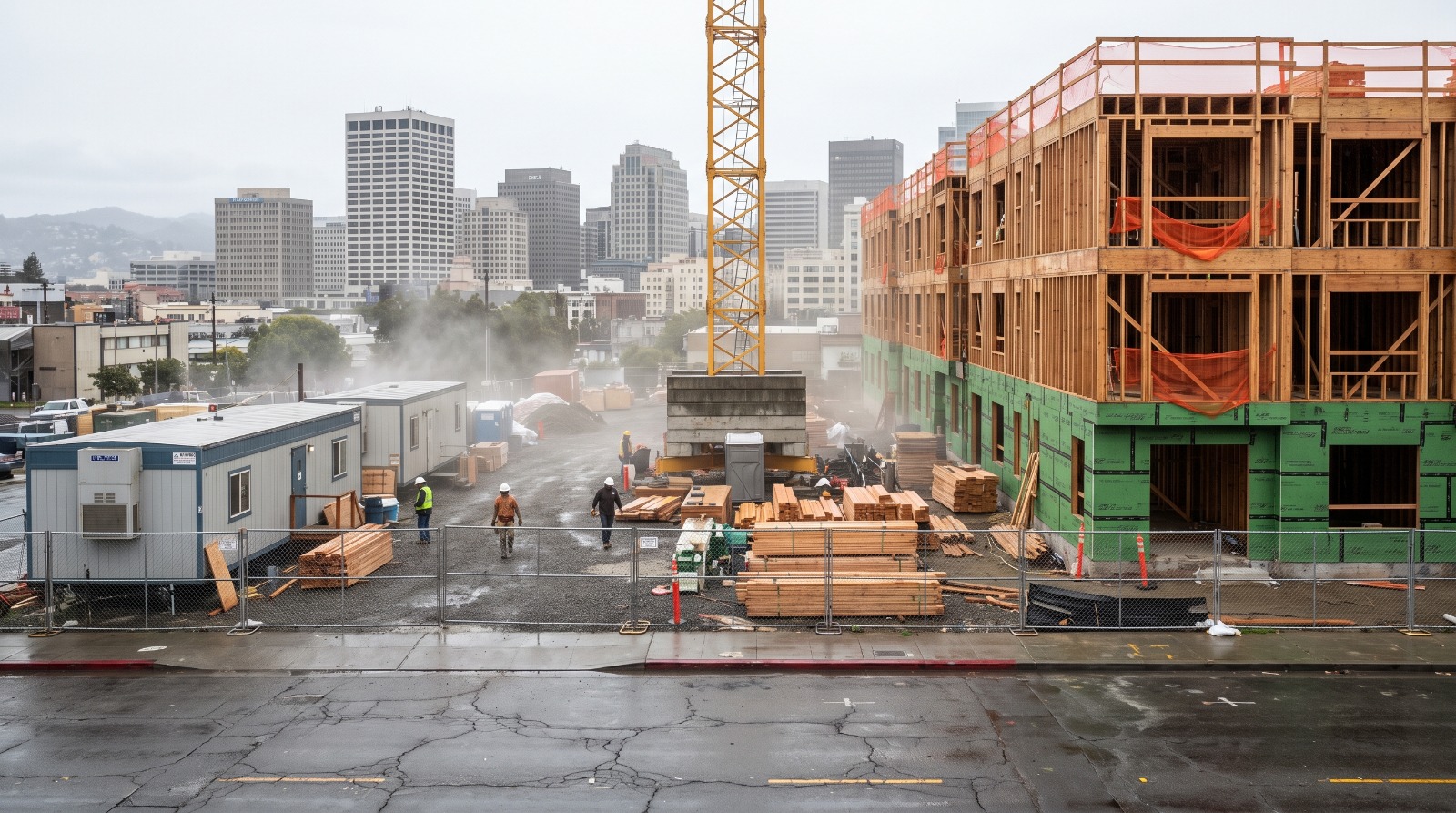
An affordable-housing apartment building under construction in downtown Oakland, where Newsom signed AB 179 to cut impact fees. Photo: Houseberry
Gov. Gavin Newsom signed AB 179 on a construction lot in Oakland's Chinatown this week, in front of a site where a 97-unit affordable building is set to break ground this fall. The pitch was a single number. The new law is expected to shave $60,000 to $70,000 off the cost of building each affordable unit, mostly by going after the impact fees cities pile onto new housing. For a state that keeps setting money on fire trying to hit its affordable-housing targets, that is a real number. The question worth asking is where it actually changes the math, and where it does not.
The part that matters for neighborhoods is the fee piece. Impact fees are the one-time charges a city levies on a new project to pay for the schools, parks, and sewer capacity those new residents will use. KQED reported that Newsom called them "comical" and "outrageous," which is strong language for a sewer connection charge, but the frustration is earned. A Terner Center analysis found affordable developments across California paid roughly $300 million a year in these fees, adding almost $20,000 per unit on average.
Where a $60,000 fee cut actually moves the needle
Here is the thing the press release will not tell you. Fees are not the binding constraint everywhere. They bite hardest in the cities that charge the most, and in the Bay Area that means the outer East Bay and the Tri-Valley, not San Francisco.
Fremont is the clearest example. Terner Center researchers have flagged Fremont for some of the highest development fees in the state, north of $50,000 on a modest one-bedroom apartment, close to a fifth of the city's median home price. In a place like that, knocking $60,000 to $70,000 off the cost of a subsidized unit is not a rounding error. It can be the difference between a project that pencils and one that dies in a spreadsheet.
| Area | What drives the cost | Does the fee cut help? |
|---|---|---|
| Fremont, Tri-Valley (East Bay) | Very high impact fees (Fremont near $50K+ per unit, roughly a fifth of median price) | Yes. Fees are a large, cuttable share. |
| Oakland, Antioch, San Jose | Mid-range fees, more available infill sites | Yes. It stretches subsidy dollars further. |
| San Francisco, inner Peninsula | Land and construction costs dominate | Limited. Fees are a small slice. |
If you are looking at where this law has teeth, it is the fee-heavy suburbs. The neighborhoods worth watching are the ones near transit and job centers in cities like Fremont and Pleasanton, where high fees have quietly throttled the pipeline for years. You can see how those areas stack up on Houseberry's Fremont neighborhood rankings and the same breakdown for Pleasanton.
Where land, not fees, is still the wall
San Francisco is the counterexample. The city's fees are real, but they are a smaller share of a project's cost because the land underneath is so expensive. Cut every impact fee to zero in Pacific Heights and you still cannot build affordable housing there, because the dirt costs more than the building. The same holds across much of the inner Peninsula.
So AB 179 is better understood as a supply tool for the middle of the map than a fix for the most expensive zip codes. It stretches state subsidy dollars further, so the fixed pot of tax-credit money finances more units, and those units are far more likely to land in Oakland, Fremont, Antioch, or San Jose than in the places where a single lot costs seven figures. When we compare neighborhoods, this is the pattern that keeps showing up. The policies that unlock the most homes rarely unlock them in the areas people fantasize about, and that is fine, because the East Bay and South Bay are where the demand actually is. Oakland's neighborhood rankings are a decent map of where new affordable supply is most likely to show up first.
What this law does not do
A few honest caveats, because the framing around this bill got rosy fast.
It is aimed at affordable, subsidized housing, not your average market-rate condo. The marquee $60,000-to-$70,000 figure is an affordable-unit number tied to state financing programs. If you are a private buyer hoping this drops the price of a new townhouse, that is not what this is.
It also does not force a single city to build anything. It lowers a cost and reshuffles financing. Cities still control zoning, entitlements, and the pace of approvals, and the ones that want to slow-walk housing have plenty of other levers. This lands the same week the federal 21st Century ROAD to Housing Act became law, and the two together are less a revolution than another couple turns of the same ratchet the state has been cranking since 2019.
A few quick questions
Does AB 179 lower the price of market-rate homes?
Not directly. Its cost savings are targeted at affordable, income-restricted housing built with state financing. Market-rate buyers may benefit indirectly if more overall supply eases pressure, but that is slow and diffuse, not a price cut you will see on a listing.
Which Bay Area cities benefit most?
The ones with the highest impact fees, which skews toward the East Bay and Tri-Valley. Fremont, with fees running near a fifth of its median home price, has the most to gain. Land-constrained cities like San Francisco benefit less, because fees are a smaller slice of their costs.
When does it take effect?
AB 179 was signed as part of the 2026-27 state budget, so its provisions phase in over the current fiscal year. The financing and fee changes apply to projects moving through the pipeline now, though how fast each city implements the fee limits will vary.
The real test comes this fall
The signing ceremony is not the test. The test is whether a project in Fremont or East Oakland that was stuck at 90 percent of the way to feasible suddenly closes its financing this year. Watch the fall groundbreakings, starting with that 97-unit building in Chinatown that Newsom used as a backdrop. If the pipeline in the fee-heavy cities starts moving while the expensive land markets stay frozen, that tells you exactly what this law was, and was not, built to do.
Sources
- KQED: Newsom Signs Law to Reduce Costs of Building Affordable Housing
- Governor of California: Newsom signs historic housing affordability reforms
- Terner Center: Assessing the Cost of Impact Fees on Affordable Housing
- Terner Center: Residential Impact Fees in California
- ABC7 News: Newsom signs affordable housing bill in Oakland
All information provided on this website including but not limited to - school ratings, safety, amenities, user opinions, and property data - is for general informational purposes only. We do not guarantee its reliability, accuracy, or completeness. Users should independently verify information and consult appropriate professionals as needed. By using this website, you agree Houseberry is not responsible for actions, decisions, or consequences arising from reliance on the information provided
houseberry.com - CA DRE# 01847391
 Bay East ©2025. CCAR ©2025. bridgeMLS ©2025. Information Deemed Reliable But Not Guaranteed. This information is being provided by the Bay East MLS, or CCAR MLS, or bridgeMLS. The listings presented here may or may not be listed by the Broker/Agent operating this website. This information is intended for the personal use of consumers and may not be used for any purpose other than to identify prospective properties consumers may be interested in purchasing. Data last updated at September 14, 2026 12:00 AM