Bay Area Rents Keep Rising. The Landlord's Books Agree.
Essex Property Trust's second quarter shows San Francisco same-property revenue up 7 percent and Northern California outrunning every other region it owns. Here is what that means if you rent here.
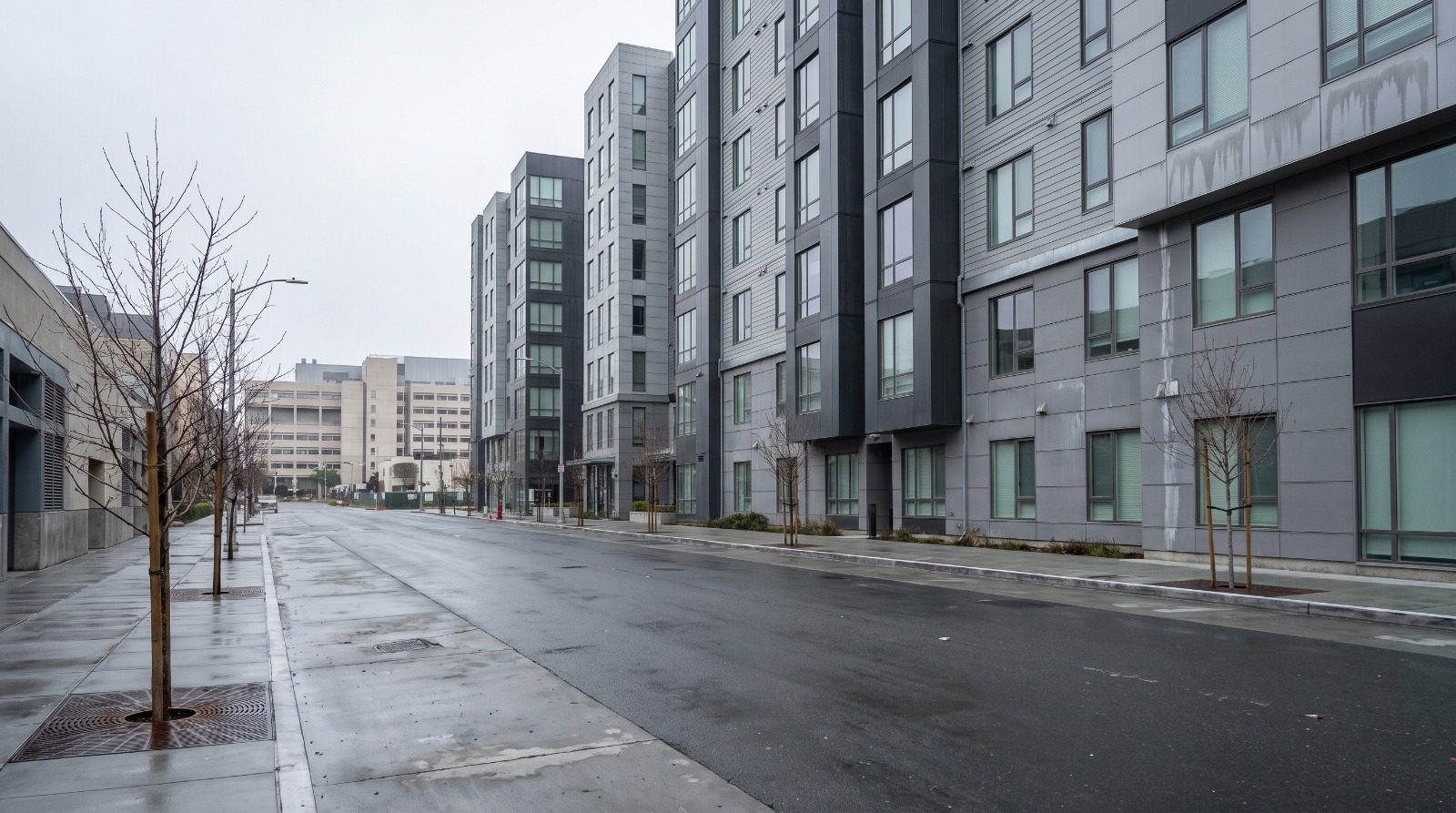
Mission Bay apartment mid-rises in San Francisco, the dense rental district behind rising Bay Area rents in 2026. Photo: Houseberry
Essex Property Trust owns apartments up and down the West Coast, and in the second quarter of 2026 the best-performing corner of that entire portfolio was San Francisco. Same-property revenue there rose 7.0 percent year over year. Not asking rents on empty units. Revenue, across occupied buildings, renewals included.
Bay Area rents have been a story told mostly through listing sites for two years. This is the same story told through a public company's audited quarterly numbers, which is a meaningfully different kind of evidence.
What the region's biggest landlord actually reported
In its second quarter results, Essex posted 4.4 percent same-property revenue growth in Northern California against 1.5 percent in Southern California and 1.7 percent in Seattle. Northern California was not slightly ahead. It nearly tripled the other two.
Inside that number, the county split is the interesting part. San Francisco led at 7.0 percent, San Mateo County came in at 5.4 percent, and Santa Clara County at 4.5 percent. Portfolio occupancy sat at 96.3 percent as of June 30, and Northern California was the tightest region at 96.8 percent. Core funds from operations came in at $4.08 per share, ten cents above the guidance midpoint.
Then Essex raised full-year Core FFO guidance by twenty cents to a $16.03 to $16.25 range and lifted same-property net operating income guidance to 2.3 to 3.3 percent. A public company does not raise guidance on a feeling. It raises guidance after the leases are already signed.
Why a revenue line beats an asking-rent headline
You have probably seen the scarier version of this. Zumper's July report put San Francisco's median one-bedroom at $4,180, up 22.9 percent year over year, and the two-bedroom at $6,020, up 25.9 percent and over $6,000 for the first time. CoStar's metro-level read, quoted in the San Francisco Standard, is closer to 11 percent. Essex says 7.0 percent.
Those three numbers disagree, and the disagreement is the most useful thing in this article. Zumper measures newly listed units, which skew toward the buildings and neighborhoods actually turning over. CoStar measures the broader metro stock. Essex measures its own occupied portfolio, where most residents renewed at an increase far smaller than what a stranger would pay to move in tomorrow.
So the honest read is layered. A brand-new San Francisco lease costs dramatically more than it did last summer. What the average sitting tenant pays went up considerably less. All three measures point the same direction, and only the magnitude is in dispute. If you are renewing, you are in the 7 percent world. If you are moving, you are in the 22 percent one.
Fewer than a thousand starts explains most of it
Grant Montgomery, CoStar's national director of multifamily analytics, told the Standard that "San Francisco's development pipeline remains relatively thin by historical standards," with fewer than 1,000 market-rate units breaking ground over twelve months, held back by construction costs, financing, and entitlement hurdles. Crystal Chen of Zumper told NBC Bay Area that AI hiring is pulling high earners back into the city while active listings are down about 30 percent year over year.
Under a thousand market-rate starts in a year, in a city of 800,000 people, during a hiring boom. That is not a mystery. That is arithmetic. Every conversion filing downtown and every mid-rise fight in a transit corridor is, in the end, about this line item, and the rent numbers are what losing that argument looks like on a lease.
The neighborhood detail tracks it. One-bedrooms run about $5,500 in Mission Bay and $5,100 in SoMa, the two districts closest to the AI offices. Two-bedrooms in the Marina are near $7,660. The premium is concentrated exactly where the jobs are and where almost nothing new opened.
What this does and does not change if you are thinking about buying
Run the comparison straight. A two-bedroom in San Francisco asks about $6,020 a month. Buying at our current San Francisco median of $1.33 million as of June 2026, with 20 percent down at 6.58 percent, is roughly $6,781 in principal and interest, plus about $1,308 in property tax and $388 in insurance. Call it $8,477 a month before a single repair.
That is still a gap of about $2,450. But a year ago, with the two-bedroom median near $4,780, the same gap was closer to $3,700. The rent side moved more than $1,200 a month in twelve months while the ownership side barely moved at all. When we wrote about San Francisco rent nearing $4,100 and bending the buy math in June, that was the trend in its early innings. Essex's quarter is the same trend with an auditor attached.
What it does not mean is that the gap has closed, or that it closes everywhere. San Mateo's median is $2.21 million as of June 2026, which carries near $14,031 a month all in. San Mateo rents rose 5.4 percent on Essex's books. Nothing about a 5 percent rent increase closes a gap that size. Peninsula renters watching this story should not read San Francisco's math onto their own county.
Three questions renters keep asking us
Does a 7 percent revenue increase mean my rent goes up 7 percent?
No. Same-property revenue blends new leases, renewals, occupancy, and fees across a whole portfolio. Renewal increases are typically much smaller than what a newly listed unit asks. In San Francisco, rent-controlled units are capped separately by the city's annual allowable increase, which is unrelated to what a landlord reports to shareholders.
Are Bay Area rent increases hitting every city equally?
Not close. Essex reported 7.0 percent in San Francisco, 5.4 percent in San Mateo County, and 4.5 percent in Santa Clara County, and San Jose's median one-bedroom sits near $2,770 against San Francisco's $4,180. The further you get from the AI hiring cluster, the flatter the curve gets.
If San Francisco has priced me out, where should I actually look?
Start with the trade you are willing to make rather than a city name. If you want to stay in the city, how San Francisco neighborhoods rank overall is a better first screen than a listings feed, since Outer Sunset and Inner Richmond score well on the things people actually miss after they move. If you are open to crossing the bay, the East Bay neighborhoods ranked by value sort by quality relative to price rather than by price alone.
The next read is October
Essex reports again in late October, and the number to watch is whether Northern California holds above 4 percent while Southern California and Seattle stay near 1.5. If that spread persists through a third quarter, the regional imbalance stops being a post-pandemic bounce and starts being the new shape of the West Coast rental market.
Either way, the practical move for a renter here has not changed. Know what a specific neighborhood costs, what it scores, and what it would cost to own rather than rent, before the renewal letter arrives and the clock starts. That is the comparison we built Houseberry to make easy, and it is a lot cheaper to run in July than in the week your lease ends.
Sources
All information provided on this website including but not limited to - school ratings, safety, amenities, user opinions, and property data - is for general informational purposes only. We do not guarantee its reliability, accuracy, or completeness. Users should independently verify information and consult appropriate professionals as needed. By using this website, you agree Houseberry is not responsible for actions, decisions, or consequences arising from reliance on the information provided
houseberry.com - CA DRE# 01847391
 Bay East ©2025. CCAR ©2025. bridgeMLS ©2025. Information Deemed Reliable But Not Guaranteed. This information is being provided by the Bay East MLS, or CCAR MLS, or bridgeMLS. The listings presented here may or may not be listed by the Broker/Agent operating this website. This information is intended for the personal use of consumers and may not be used for any purpose other than to identify prospective properties consumers may be interested in purchasing. Data last updated at September 13, 2026 12:00 AM