California's New Housing Agency and the Bay Area
California's Housing and Homelessness Agency launched July 1 to move affordable housing funding through one door instead of many. Here is what that changes for Bay Area projects, and the catch.

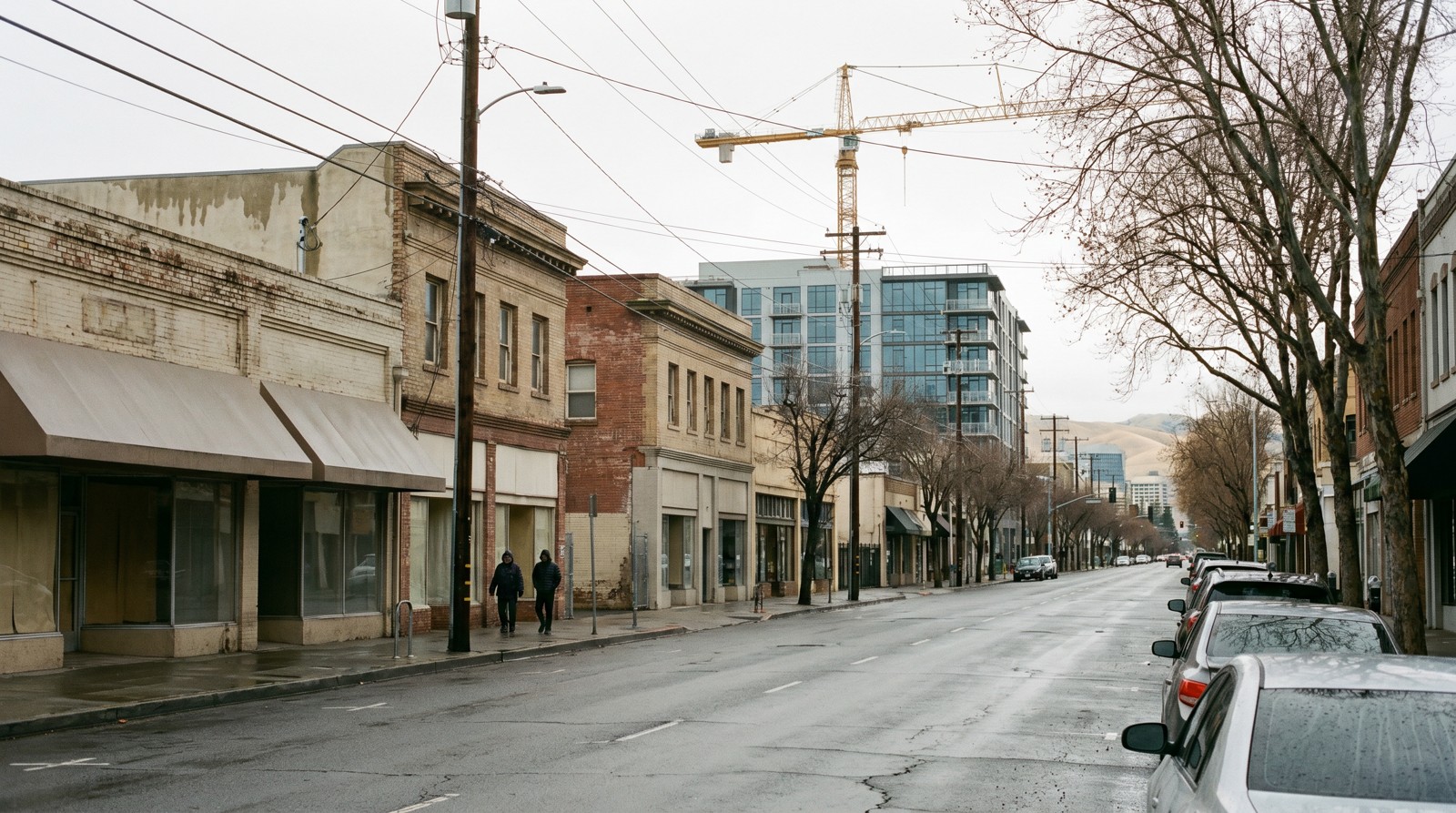
A downtown San Jose street in the SoFA district where new mid-rise housing is going up, illustrating how California's new Housing and Homelessness Agency could speed affordable housing funding. Photo: Houseberry
California just built a new front door for affordable housing. On July 1 the state stood up the California Housing and Homelessness Agency, a cabinet-level shop that folds the Department of Housing and Community Development, the California Housing Finance Agency, the state's homelessness council, and the Civil Rights Department under one roof. Governor Newsom swore in Tomiquia Moss as its first secretary the day before it opened.
The pitch is simple, and if it holds up it is a real deal for the Bay Area: make it faster and cheaper to finance the affordable homes that already have approvals and just cannot get funded. The catch is just as simple. The new agency arrived with no new money.
That gap between a better process and an empty account is the whole story, and it is worth understanding before you decide what it means for the block you are watching.
What the new housing agency actually launched on July 1
For years, financing an affordable project in California has meant applying to several separate state programs and stacking tax credits, bonds, grants, and subsidies until a deal finally pencils out. Different applications, different agencies, different timelines. It can take years to gather enough to break ground.
The headline fix is a single point of contact. A new Housing Development and Finance Committee, chaired by Secretary Moss alongside HCD's Gustavo Velasquez and CalHFA's Tony Sertich, is meant to be the one desk developers go to for state funding on affordable multifamily deals.
“I think a key component of this is the potential for a one stop shop for affordable housing finance,” Christi Economy of UC Berkeley's Terner Center told San José Spotlight. “This is ideally a place where developers can apply and receive funding through a single application process.”
If you have ever watched a good project sit on a corner for years, you know why that matters. The reorganization does not add a single dollar. It tries to make the dollars that already exist move faster.
The math the one-stop shop is trying to fix
Here is where it gets concrete, because the cost of the old fragmented system has actually been measured. The Terner Center found that each additional funding source a project has to chase delays construction by about four months and adds roughly $20,406 per home. Stack four or five sources, which is normal, and the delay and the cost compound fast.
You can see the stakes in one developer's own numbers. MidPen Housing, based in San Mateo County, says it has taken an average of 2.6 years just to assemble financing to start construction over the last five years. Its policy vice president, Nevada Merriman, estimates the reorganization could cut that timeline by up to half.
| Today's stacked system | The one-stop-shop goal | |
|---|---|---|
| Applications | Several, across separate state programs | One, through the new Housing Development and Finance Committee |
| Time to assemble financing (MidPen's recent average) | About 2.6 years | Potentially about half that |
| Cost of each added funding layer | Roughly four more months and about $20,406 per home | Fewer layers, less stacking delay |
| New money attached | None in the current proposed budget | None yet |
Shave a year off the front of a Bay Area project and you save more than time. In a region where affordable construction runs two to four times what it costs in Texas or Colorado, months are money, and public dollars stretch further. That is the pro-housing case for the reorg, and it is a good one.
The catch: a faster pipe with no water in it
Now the part the press release skips. A streamlined process does not help if there is nothing to hand out. The governor's proposed budget does not put new money behind the agency, and developers say some projects will stall as a result.
“So we're creating a framework that is going to be able to administer the money more effectively, but it doesn't come with the money itself,” Alison Cingolani of the nonprofit SV@Home told San José Spotlight. “So this agency is still going to need to be adequately resourced.”
There are sharper worries too, and they deserve a fair hearing. Tia Boatman Patterson, who used to run CalHFA, argues the reorganization is happening without anyone first evaluating the programs being moved, and that how a program is designed matters more than which agency houses it. Two well-run programs are getting rolled into the new finance committee: the Mixed-Income Program, which helped fund downtown San Jose's 15-story, all-affordable Gateway Tower, and the Affordable Housing and Sustainable Communities program, which put a $38 million grant toward a 195-apartment building next to the Berryessa transit center. If the reorg slows those down, the Bay Area feels it directly.
Eden Housing CEO Linda Mandolini flagged another wrinkle. One proposal would automatically set aside tax credits for projects that win an award through the new agency, which could crowd out solid projects that do not need a state subsidy at all. The honest read is that the framework is promising and the execution is unproven. Both are true at once.
What it changes block by block
This is where a neighborhood-first habit earns its keep. A faster funding pipe does not change a neighborhood's score. What it changes is the pace at which approved-but-stalled projects turn into real buildings, and that pace is what quietly reshapes a block over a few years, from rents to foot traffic to which corners finally feel finished.
The practical takeaway is narrow and useful. When you see an affordable project announced near a place you are considering, the new agency slightly raises the odds it actually gets built on a human timeline instead of sitting entitled for half a decade. That is worth tracking. It is not a reason to expect prices to drop, and not soon. This is affordable and below-market housing, and its effect on overall prices is indirect and gradual, working through supply rather than a price cut.
So treat it the way we treat any single signal when we compare neighborhoods at Houseberry: as one input, not a verdict. If you are weighing the top-ranked neighborhoods in San Jose or where San Jose value holds up best, a nearby affordable project moving faster belongs in the research pile next to schools, safety, commute, and price, not ahead of them.
The thing to watch next is money, not org charts. The reorganization is real as of July 1, but whether it delivers depends on the budget fight and on whether that single application actually shows up for the next funding round. For the bigger pool of dollars that could flow through this new front door, our look at what the 2026 state housing bond would fund is a good companion, as is our read on how SB 79 is reshaping transit-adjacent blocks. The agency decides how fast the money moves. Those decide how much money there is.
Sources
Office of Governor Gavin Newsom, swearing-in of Secretary Tomiquia Moss
San José Spotlight, “California streamlines affordable housing funding” (Joyce Chu)
UC Berkeley Terner Center, a one-stop shop for affordable housing finance
California Business, Consumer Services and Housing Agency, CHHA overview
The Houseberry Research Team is Houseberry's reporting team: Bay Area real estate analysts, data specialists and longtime local market watchers. Every day we check the public record: building permits, city council and planning agendas, county recorder filings, state housing bills, police incident data and school results. Then we tie each story to what it means for specific neighborhoods, using Houseberry's own neighborhood data on prices, appreciation, safety, schools and amenities. Questions or corrections: Contact us.
All information provided on this website including but not limited to - school ratings, safety, amenities, user opinions, and property data - is for general informational purposes only. We do not guarantee its reliability, accuracy, or completeness. Users should independently verify information and consult appropriate professionals as needed. By using this website, you agree Houseberry is not responsible for actions, decisions, or consequences arising from reliance on the information provided
houseberry.com - CA DRE# 01847391
 Bay East ©2025. CCAR ©2025. bridgeMLS ©2025. Information Deemed Reliable But Not Guaranteed. This information is being provided by the Bay East MLS, or CCAR MLS, or bridgeMLS. The listings presented here may or may not be listed by the Broker/Agent operating this website. This information is intended for the personal use of consumers and may not be used for any purpose other than to identify prospective properties consumers may be interested in purchasing. Data last updated at October 6, 2026 12:00 AM