Cloverdale may give up apartment land for a new car wash
A LUV Car Wash at 680 South Cloverdale Boulevard needs the city to rezone 1.52 acres of apartment land. Here is what the swap costs, what state law asks, and when to comment.

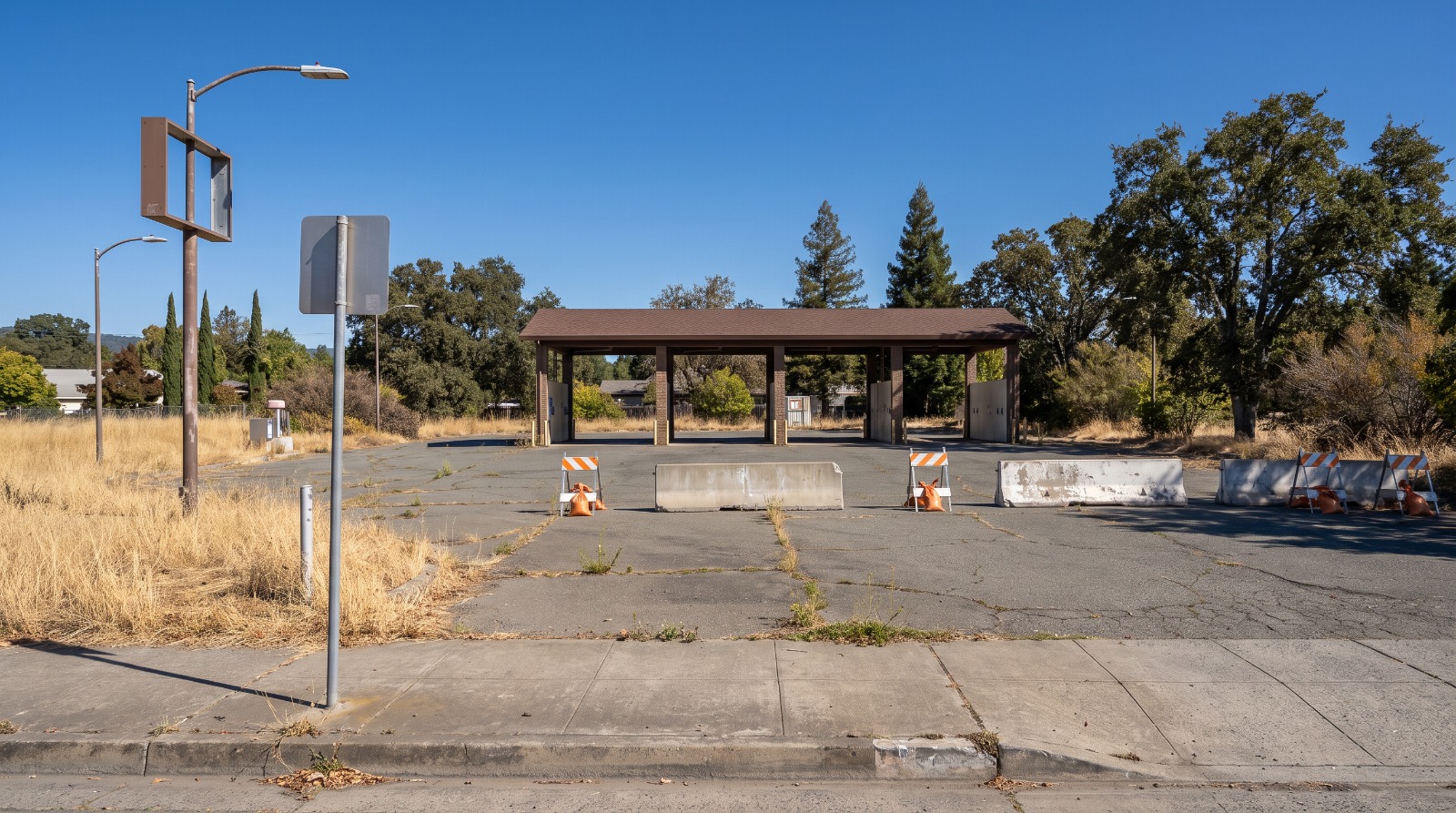
AI-rendered view of the vacant former car wash lot at 680 South Cloverdale Boulevard in Cloverdale, California, as it looks today Photo: Houseberry
The old Cort's Car Wash at 680 South Cloverdale Boulevard has been closed long enough that Yelp files it under "closed." Now a Santa Rosa developer wants to put a new car wash on the same lot: a 3,900-square-foot LUV Car Wash with a 110-foot tunnel and 16 vacuum stalls.
To do it, Cloverdale has to take the land out of its housing supply. The lot and a 0.28-acre sliver next door at 690 South Cloverdale Boulevard are planned for high density residential use and zoned for apartments. The application asks the city to move all 1.52 acres to general commercial. In a town of 8,701 people that has shrunk since 2020, that is a housing decision dressed up as a car wash permit, and the public comment window closes November 14.
What's there now, and what LUV wants to build
The filing on the state's CEQAnet database lists the applicant as Amaturo Commercial Real Estate of Santa Rosa, the same developer behind the LUV site on Healdsburg Avenue that the Healdsburg Planning Commission approved in September 2024, according to the Healdsburg Tribune. In that deal Amaturo owns the land and LUV is the tenant.
LUV is an Arizona chain founded in 2021. It had more than 81 locations nationally by September 2025, when the International Carwash Association reported its American Canyon purchase and named Cloverdale as a planned Northern California site. It already runs washes in Rohnert Park and Santa Rosa.
The Cloverdale plan is a single tunnel building, a new driveway off the boulevard, landscaping, signs and parking. The lots sit at the south end of town, between Cherry Creek Road and Hillview Drive, a short drive from the Highway 101 interchange.
The city's Mitigated Negative Declaration, prepared by LACO Associates of Eureka, found nothing it could not fix with conditions. Those include nesting bird surveys, a tribal monitor whenever crews dig, and a noise test at the north, east and west property lines before the wash opens. If you live behind the lot, the noise test is the condition to read.
The zoning swap is the real decision
Cloverdale is ahead on its state housing target, which takes some heat out of this. The city's 2023 to 2031 housing element draft set a target of 278 homes, raised to 335 after the county shifted 57 to the city. Cloverdale said projects already approved or pending covered 179 percent of the higher number.
State law still asks a direct question when a city rezones housing land. Under California's no net loss law, if a lot is on the housing element's list of sites, the city has to show in writing that the sites left over still cover its target at every income level. If they don't, it has 180 days to find replacements. Separately, the Housing Crisis Act generally bars a covered city from rezoning land to a less intensive use than was allowed in 2018 unless it adds the same capacity somewhere else at the same time.
The filing doesn't say whether 680 or 690 South Cloverdale Boulevard is on the sites list. The staff report should.
There is also a wrinkle. The online copy of Cloverdale's zoning code we read allows apartments in the general commercial zone at up to 20 homes per acre. On paper, then, the rezone may not shrink capacity at all. In practice a tunnel wash is a building that stays put for a generation, and no one builds apartments around one.
Here is what the two lots allow today next to what the application would build.
| Today's rules | Proposed | |
|---|---|---|
| General plan | High density residential | General commercial |
| Zoning | Apartments, up to 16 homes per acre | General commercial |
| Homes the land could hold | About 24 | 0 planned |
| Building | Vacant former car wash | 3,900 sq ft tunnel wash |
| Jobs | 0 | 4 |
The table makes the trade look one-sided, and it isn't quite. The lot has sat empty under apartment zoning for years, and Cloverdale's market explains why. Redfin counted 24 home sales in town in September 2026 at a median of $589,219. A builder putting two dozen apartments on boulevard frontage at that price point is a hard pitch.
Our view
We'd approve the car wash only if the same resolution rezones a matching acre and a half for housing somewhere else in town.
That is a cheap ask. Cloverdale is debating Esmeralda, a plan for 600 or more homes on 266 acres off Asti Road, which the City Council took up on October 7 and October 14, according to the Bay Area Brief. A town planning hundreds of homes at its edge can spare the paperwork to keep its in-town apartment land whole. Giving it away one lot at a time is how small cities end up with a housing plan that only works on greenfields.
The other honest point: a dead car wash is not housing either. If the choice is an empty lot on South Cloverdale Boulevard for another decade or a working business, the business wins. The replacement site is how Cloverdale gets both.
Comments go to the Associate Planner, City of Cloverdale Planning and Community Development, 124 North Cloverdale Boulevard, by November 14, and the hearing will be at 6 p.m. at the Cloverdale Performing Arts Center or on Zoom, on a date the city hasn't announced.
Houseberry doesn't score Cloverdale's neighborhoods yet. The closest city we rank is Santa Rosa, about 30 miles south on 101, where you can see how Santa Rosa's 31 scored neighborhoods compare on schools, safety and price. In Cloverdale, the answer to whether this lot stays housing land is due in writing by mid-November, and once the tunnel goes in, it won't come up again for a long time.
Sources
- CEQAnet: LUV Car Wash General Plan Amendment, Rezone, Conditional Use Permit, and Design Review Project, SCH 2026100392
- City of Cloverdale, 6th cycle housing element draft, December 2022
- HCD memo on SB 166, the no net loss law
- Government Code 66300, the Housing Crisis Act
- U.S. Census QuickFacts, Cloverdale
- Redfin, Cloverdale housing market, September 2026
The Houseberry Research Team is Houseberry's reporting team: Bay Area real estate analysts, data specialists and longtime local market watchers. Every day we check the public record: building permits, city council and planning agendas, county recorder filings, state housing bills, police incident data and school results. Then we tie each story to what it means for specific neighborhoods, using Houseberry's own neighborhood data on prices, appreciation, safety, schools and amenities. Questions or corrections: Contact us.
All information provided on this website including but not limited to - school ratings, safety, amenities, user opinions, and property data - is for general informational purposes only. We do not guarantee its reliability, accuracy, or completeness. Users should independently verify information and consult appropriate professionals as needed. By using this website, you agree Houseberry is not responsible for actions, decisions, or consequences arising from reliance on the information provided
houseberry.com - CA DRE# 01847391
 Bay East ©2025. CCAR ©2025. bridgeMLS ©2025. Information Deemed Reliable But Not Guaranteed. This information is being provided by the Bay East MLS, or CCAR MLS, or bridgeMLS. The listings presented here may or may not be listed by the Broker/Agent operating this website. This information is intended for the personal use of consumers and may not be used for any purpose other than to identify prospective properties consumers may be interested in purchasing. Data last updated at October 18, 2026 12:00 AM