SB 79 won't touch these 24 Mountain View buildings, for now
Mountain View has taken 24 historic properties, including six Castro Street buildings from 1874 to 1926, out of SB 79 until about 2032. Here is the list, and what the pause leaves open downtown.

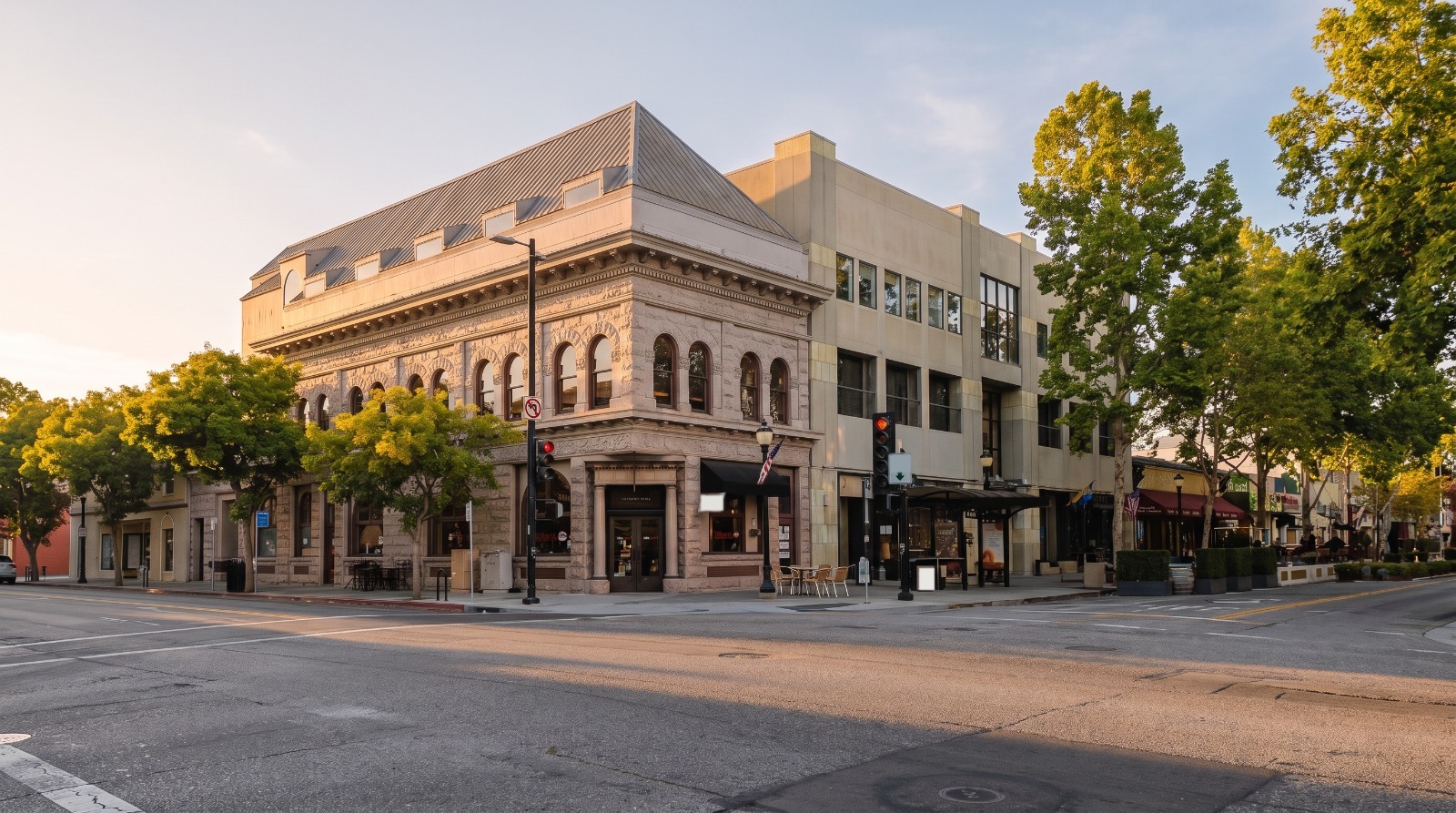
AI-rendered view of the 1905 Farmers and Merchants Bank building at Castro and Villa streets in downtown Mountain View at golden hour Photo: Houseberry
The Farmers and Merchants Bank building has stood at Castro and Villa since 1905, rough-cut stone under a gray mansard roof. It sits about a block from the downtown Mountain View station. That is close enough for SB 79, the state's transit housing law, to allow a 75-foot building on the lot. Starting November 12, it doesn't, at least until around 2032.
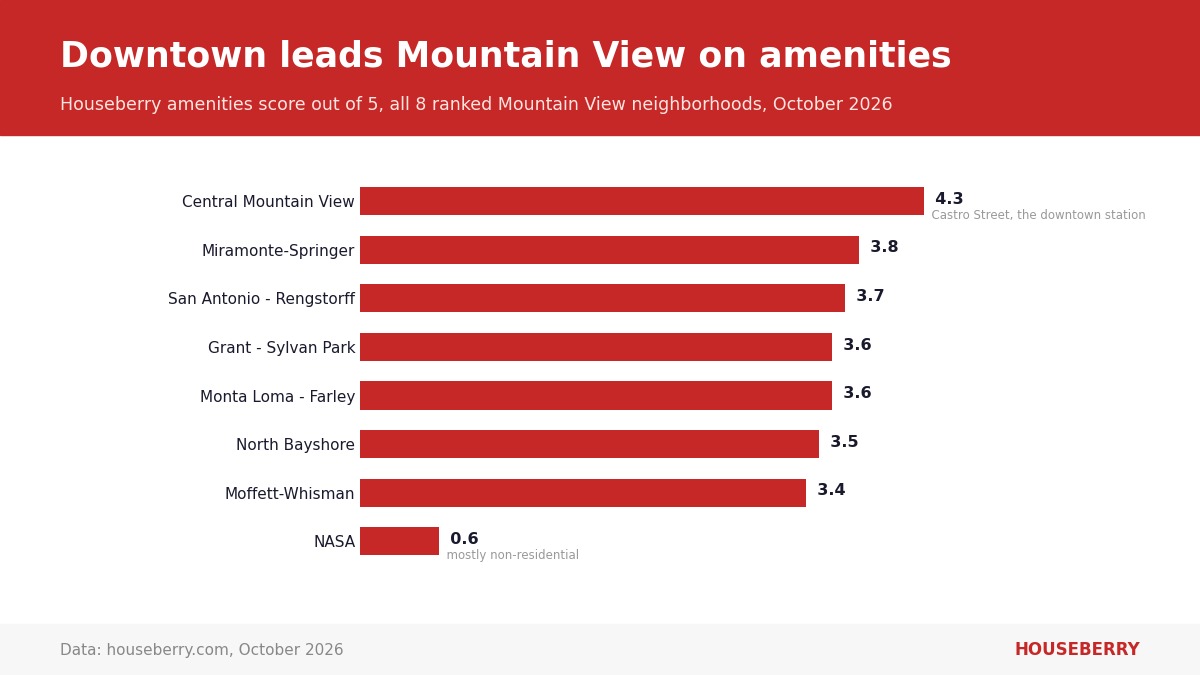
Mountain View has pulled 24 properties on its historic register out of SB 79. Six are Castro Street commercial buildings from 1874 to 1926, in the neighborhood Houseberry calls Central Mountain View, which scores 4.3 out of 5 for amenities on Houseberry's Mountain View rankings, the best of the city's eight ranked neighborhoods. The council introduced the ordinance 7-0 on September 22 and brought it back for final adoption on the October 13 consent calendar. The city filed its notice of exemption with Santa Clara County two days later.
This is a small carve-out, and it was built to be one. State law only lets a city pause SB 79 for buildings that were on a local register before January 1, 2025, and only until a year after its next housing element. The 24 parcels add up to about 5 acres. Every other qualifying lot within half a mile of Mountain View's stations still falls under the state rules. The bigger question, a downtown historic district, is still open.
Six Castro Street buildings, and 18 quieter ones
The center of the list is the 100 and 200 blocks of Castro, where the city's oldest commercial buildings sit a short walk from the Caltrain and light rail platforms. The zoning map ordinance names each lot, and the city's register supplies the history.
| Address | Building | Built |
|---|---|---|
| 124-126 Castro St | Weilheimer Store | 1874 |
| 142-156 Castro St | Rogers Building (Mountain View Hotel) | 1906 |
| 169-175 Castro St | Ames Building | 1903 |
| 201 Castro St | Farmers and Merchants Bank | 1905 |
| 228 Castro St | Mountain View Theater | 1926 |
| 298 Castro St | Scarpa's Meat Market | 1908 |
The other 18 get less attention. One is the Adobe Building at 157 Moffett Boulevard, a city-owned 1934 building that is already on the National Register. The remaining 17 are houses, built between 1875 and 1930, on Bush, Calderon, Franklin, Hope, Loreto, Oak, View, Villa and Wright, plus single addresses on Mountain View Avenue, Palo Alto Avenue and South Shoreline Boulevard. Twelve of those houses already have Mills Act contracts, which cut property taxes in exchange for keeping the building intact.
Across all 24, the median year built is 1906, by the register's estimates. Sixteen were standing before 1911.
What SB 79 would have allowed on these lots
SB 79 took effect July 1. Within a quarter mile of the downtown station, a qualifying project can rise to 75 feet at 120 homes an acre, and to 65 feet at 100 homes an acre out to half a mile, with another 20 feet for lots right next to the station, according to ABAG's summary of the law. City staff told the council in January that the law reaches about 21 percent of Mountain View's land, the Mountain View Voice reported.
Run the paper math and 5 acres at 100 to 120 homes an acre is roughly 500 to 600 homes. That is a ceiling, and a high one. No one was going to knock down a city-owned adobe, and a 1910 house on View Street does not turn into a seven-story building because the zoning says it could. The housing really at stake sits on the six Castro lots, in the commercial core a block or two from the platforms.
Who the pause helps, and who pays
The owners helped most are the ones who already chose preservation. The 12 houses under Mills Act contracts were unlikely SB 79 sites to begin with, since those contracts already commit their owners to keeping them.
The cost lands on the blocks people actually use. Central Mountain View scores 4.5 for nearby merchants and 4.3 for amenities overall on its Houseberry neighborhood page. The city as a whole scores 3.3 for amenities on Houseberry's Mountain View city page, and no other ranked neighborhood clears 4.0.
Homes near that station are not getting cheaper on their own. Houseberry's price history puts the typical Central Mountain View home at about $2.07 million in January 2026 and about $2.21 million in September, a gain of about 7 percent in eight months.
Homeowners face an odd twist. The SB 79 exception is frozen at January 1, 2025, while the register keeps growing. A city survey found 99 eligible properties, 58 of them not yet listed, though the council has since dropped several. A house added at the December 8 hearing would take on the register's review rules and get none of the SB 79 shelter.
Our view: the 24 are fine. A district is a bigger ask
We think this pause is a fair use of the law as written. It covers about 5 acres, most of the houses are already under preservation contracts, and the Legislature wrote the exception in on purpose. Palo Alto exempted its historic properties in June as part of broader rules that also cut SB 79's allowances about in half, according to the city, though seven projects landed there in the two weeks before those rules took effect. Other Bay Area cities met the law's start very differently, as our SB 79 rollout piece found.
The district is the part that could go too far.
Mountain View's new preservation ordinance lets historic districts form only inside the blocks bounded by California, Hope, Evelyn and Bryant, and the council asked staff to explore one there. In the September 22 staff report, staff wrote that a district could justify a permanent SB 79 exemption if it comes with a local alternative plan. That plan has to fit the same number of homes somewhere else near transit, and state law caps historic carve-outs at 10 percent of the eligible area around any one station.
Preservationists see real risk. Robert Cox of Livable Mountain View warned the council last December that SB 79 could wipe out the historic downtown, while Christian Murdock, the city's community development director, called that fear overstated. We would judge any district by one test. Do the homes it takes off the table land within a walk of the same station, or somewhere a car is required?
Three questions about the pause
Does this stop SB 79 projects downtown? No. It covers 24 properties. Every other qualifying site within half a mile of the downtown station keeps SB 79's heights and densities, including newer commercial buildings and parking lots on the same blocks if they qualify.
My house is on the draft register. Is it covered? Only if it was listed before January 1, 2025. Additions approved at the December 8 hearing can't be paused without an alternative plan.
When does it end? One year after the city adopts its seventh-cycle housing element, which staff expect in 2031. The zoning language is written to repeal itself then.
The council is scheduled to adopt the new register on December 8. If your house is on the draft list, that night decides whether you take on the rules without the shelter. Before then, see where Central Mountain View lands against the rest of the city on Houseberry's amenities ranking for Mountain View.
Sources
- City of Mountain View, Notice of Exemption, "Temporary exclusion of historic resources from SB 79," SCH 2026100570, filed October 15, 2026 (CEQAnet)
- City of Mountain View, Council report, "Historic Preservation Ordinance and Zoning Map Update," September 22, 2026 (PDF)
- City of Mountain View, Zoning Map Amendment Ordinance, October 13, 2026 (PDF)
- City of Mountain View, Council report, "Historic Preservation Ordinance and Zoning Map Amendment (Second Reading)," October 13, 2026 (PDF)
- City of Mountain View, Register of Historic Resources, August 2026 (PDF)
- ABAG, SB 79 summary, April 2026 (PDF)
- Mountain View Voice, January 28, 2026 and December 11, 2025
- City of Palo Alto, status of temporary SB 79 regulations
- Houseberry neighborhood scores and price history for Mountain View, October 2026
The Houseberry Research Team is Houseberry's reporting team: Bay Area real estate analysts, data specialists and longtime local market watchers. Every day we check the public record: building permits, city council and planning agendas, county recorder filings, state housing bills, police incident data and school results. Then we tie each story to what it means for specific neighborhoods, using Houseberry's own neighborhood data on prices, appreciation, safety, schools and amenities. Questions or corrections: Contact us.
Map of Mountain View Neighborhoods
Loading map...
View Full Map
Top Neighborhoods in Mountain View, CA






All information provided on this website including but not limited to - school ratings, safety, amenities, user opinions, and property data - is for general informational purposes only. We do not guarantee its reliability, accuracy, or completeness. Users should independently verify information and consult appropriate professionals as needed. By using this website, you agree Houseberry is not responsible for actions, decisions, or consequences arising from reliance on the information provided
houseberry.com - CA DRE# 01847391
 Bay East ©2025. CCAR ©2025. bridgeMLS ©2025. Information Deemed Reliable But Not Guaranteed. This information is being provided by the Bay East MLS, or CCAR MLS, or bridgeMLS. The listings presented here may or may not be listed by the Broker/Agent operating this website. This information is intended for the personal use of consumers and may not be used for any purpose other than to identify prospective properties consumers may be interested in purchasing. Data last updated at October 18, 2026 12:00 AM