278 Homes at San Mateo's Hillsdale Inn, 13 Years Later
SummerHill filed formal plans for 278 homes at the shuttered Hillsdale Inn. It is the fourth proposal for the site since 2013, and the Peninsula's dying motels are quietly becoming its largest land bank.

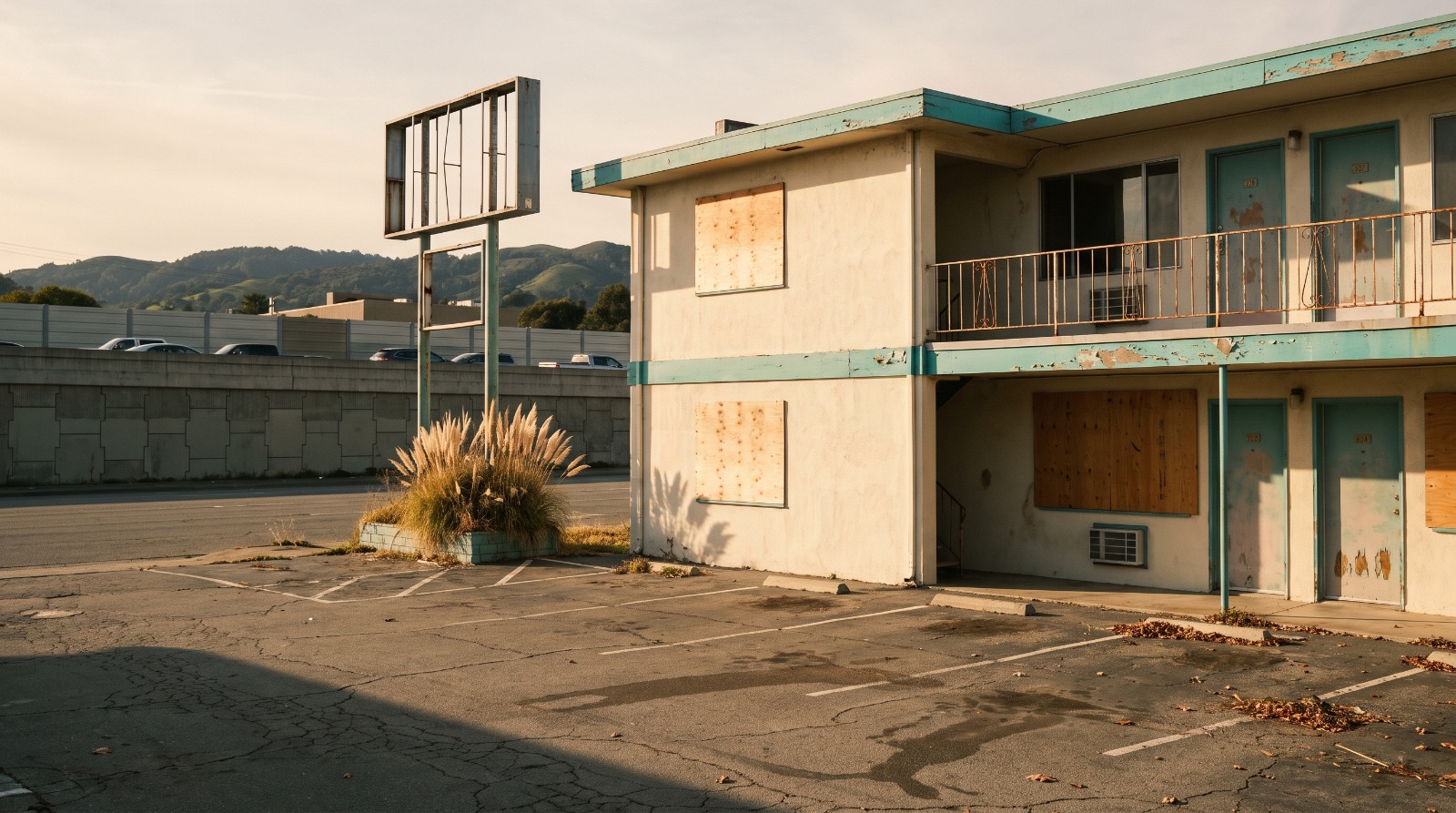
A shuttered mid-century roadside motel beside a freeway in San Mateo, the kind of site now being redeveloped into housing like the 278 homes proposed at the Hillsdale Inn. Photo: Houseberry
SummerHill has filed formal plans for 278 apartments and townhomes at 477 East Hillsdale Boulevard in San Mateo, on the roughly three-acre site of the shuttered Hillsdale Inn. It is the fourth housing proposal for this parcel since 2013 and by a wide margin the largest. The first one was 180 condominiums on four low buildings. The jump to 278 homes and seven stories is not really a market story. It is a ballot measure.
The Hillsdale Inn opened in the 1950s as a Highway 101 motel with a tower modeled on an air traffic control tower, which served as the honeymoon suite. The tower came down in 2001. The motel, a self-service car wash and a car rental service center are what get demolished now.
Four proposals, thirteen years, nothing built
The useful way to read this filing is as the latest entry in a long losing streak for one piece of ground.
| Filed | What was proposed | Homes | Stories |
|---|---|---|---|
| About 2013 | Condominiums, Barry Swenson Builder | 180 | 3 to 4 |
| 2022 | Apartments, 23 below market rate | 230 | 4 |
| February 2026 | SB 330 preliminary application, SummerHill | 276 | 7 |
| August 2026 | Formal application, apartments and townhomes | 278 | 7 |
Barry Swenson Builder had already owned the site about a decade when the 180-condo plan surfaced, and had cycled through ideas for senior housing and a new hotel before that. So this parcel has resisted development for well over twenty years, which is roughly as long as the tower has been gone. Each new plan has been bigger than the last, and none of them has produced a single home.
The current filing carries 41 deed-restricted homes, 37 of them at very low income and four at moderate, against 23 in the 2022 version. The February preliminary application described a mix running from 25 studios up through 20 four-bedroom apartments, which is an unusual amount of family-sized rental for the Peninsula. Total built area comes to about 462,750 square feet, with 350 car spaces and 314 bicycle spaces.
Measure T is the reason 180 became 278
San Mateo voters passed Measure T in November 2024 with about 59 percent of the vote, and it repealed Measure Y, a 1991 initiative that had capped development in the city at five stories and 50 units per acre for a generation.
That single change is why a seven-story building is now drawable on this lot at all. By April 2025, roughly 3,000 apartment units had been proposed in San Mateo since the measure passed. We have covered two of them already, 847 homes at 690 Concar Drive and 94 homes at Nazareth Vista downtown. This is the same wave arriving at the freeway edge.
The application itself uses SB 330 and State Density Bonus Law, the streamlining combination that locks in the rules in force on the filing date and limits how many hearings a city can hold. It is not a Builder's Remedy filing. San Mateo has a certified housing element and does not need to be forced.
This is a freeway site, not a transit site
Worth being blunt about, because the label gets used loosely and it changes what you are buying. 477 East Hillsdale Boulevard sits east of Highway 101. Hillsdale Caltrain station sits west of El Camino Real, on the far side of the freeway and most of the city. You are not walking there.
The filing knows this. It did not invoke SB 79 or any other transit-proximity law, the way the Coronet Motel project in Palo Alto did in July when it claimed a quarter-mile Caltrain radius. This is infill on a freeway gateway, and the honest pitch for it is that a shuttered motel and a car wash are a poor use of three acres in one of the most expensive counties in America. That pitch is strong enough on its own without borrowing a transit story.
Which is not to say the trains are irrelevant. The new Hillsdale station opened in April 2021 as part of the $205.9 million 25th Avenue grade separation, and Caltrain has been running full electrified service since September 2024, with about 20 percent more trains and average weekday ridership back above 40,000. If you drive to the station, that station is much better than it was five years ago. The walk is the part that does not work.
The Peninsula's quietest land bank is its dying motels
Step back from this one site and a pattern shows up that nobody has assembled in one place. San Mateo County is running two separate motel-to-housing machines at the same time, and they barely acknowledge each other.
One is public. Starting in December 2020, the county used the state's Homekey program to buy aging motels outright and keep the buildings, converting rooms into supportive and interim housing. A civil grand jury reviewing the effort in June 2024 found the county had converted five hotels into 315 housing units at a cost about 43 percent below new construction.
The other is private, and it does the opposite. Developers buy the motel and knock it down. Here is the roster, public and private together.
| Former motel or hotel | City | What is replacing it | Homes |
|---|---|---|---|
| Stone Villa Inn | San Mateo | El Camino House, county supportive housing | 44 |
| Comfort Inn | Redwood City | Casa Esperanza, permanent supportive housing | 51 |
| TownePlace Suites | Redwood City | Shores Landing, county housing | 95 |
| La Quinta Inn and Suites | Millbrae | County supportive housing | About 75 |
| Best Western El Rancho Inn | Millbrae | Market-rate apartments plus a replacement hotel | 384 |
| Coronet Motel | Palo Alto | Apartments filed under SB 79 | 76 |
| Hillsdale Inn | San Mateo | SummerHill apartments and townhomes | 278 |
Add the Ramada Limited near the South San Francisco airport, another 45 county units, and the pattern is unmistakable. The roadside motel built for a driving America that stopped at Highway 101 has become the most available large parcel on the Peninsula, because it is already zoned commercial, already paved, already served by utilities, and already worth less as a motel than as land.
There is real loss in that column. The El Rancho Inn in Millbrae opened in 1948 and its bar had an underwater window into the swimming pool, which turned up in The Right Stuff. Nobody is going to build that again. Trading it for 384 homes and a replacement hotel is still the right trade, and pretending otherwise is how a region ends up with a lot of preserved parking lots.
Hillsdale is absorbing three things at once
The 278 homes are the smallest of the changes coming to this part of San Mateo, which is the context missing from every story about them.
A quarter mile of freeway away, Hillsdale Shopping Center, open since December 1954, has a redevelopment application on file that would demolish roughly three quarters of the mall and add housing. The unit count has moved across filings, from 1,392 in the February 2025 preliminary plan to about 1,403 in the formal application and 1,670 in a later amendment, on 44.7 acres with heights up to 160 feet. Buildout is expected to take more than a decade. On the other side, Bay Meadows has been filling in the old racetrack since 2008 and had built roughly 808 homes across eleven of eighteen blocks as of 2019.
Hillsdale is not one of the 23 San Mateo neighborhoods we score, and that absence is telling. It has been a shopping center, a train station and a set of edges rather than a residential district with a center. Over the next fifteen years it becomes one. Citywide, San Mateo carries a 3.7 out of 5 on amenities against a 3.5 overall, and the neighborhoods topping the city on amenities are downtown and Hayward Park, both at 4.3. If the mall plan happens, Hillsdale ends up competing in that tier for the first time.
The pipeline number is doing a lot of work
San Mateo has been quoted at more than 6,200 housing units in its pipeline against a 2023 to 2031 state target of 7,015, which reads like a city about to finish early. It is not what the number means. Those are units proposed and seeking entitlement, not approved and nowhere near permitted.
Permitting tells a harder story. The Housing Readiness Report has San Mateo at about 4.8 percent of its very-low-income allocation and 7.8 percent of its low-income allocation actually permitted. A pipeline is a hope. A permit is a building. The gap between the two is where most California housing plans go to die, and it is the reason 41 deed-restricted homes in a 278-home project is worth more attention than the headline total.
The objection worth taking seriously
Not everything raised about this corner of San Mateo is about parking. The strongest argument against the pace here is cumulative, and it has been made publicly by the Beresford Hillsdale Neighborhood Association: 278 homes plus 1,400 to 1,700 at the mall, arriving in the same square mile, means thousands of additional daily car trips onto El Camino Real, Highway 92 and the residential streets between them, plus real questions about school capacity, water, sewer and emergency response.
At the 2022 neighborhood meeting for the earlier version of this project, residents raised traffic at the Saratoga Drive and East Hillsdale Boulevard intersection and the loss of street parking during construction. Those are the specific, checkable versions of the concern, and they deserve specific, checkable answers rather than a paragraph about regional housing need.
Where we come down: the region needs the homes, this site has produced nothing for two decades, and the freeway edge is exactly where density belongs. The cumulative traffic question is still real and the city should answer it with a study rather than a slogan.
The dates that matter next
SummerHill's own recent precedent in San Mateo sets a benchmark. The company filed preliminary permits for 220 West 20th Avenue in June 2025 and had approval by June 18, 2026, about twelve months, for 232 apartments at seven stories. Apply that pace here and an approval lands sometime in late 2027, with demolition after it and construction after that. Neither cost nor construction timeline has been disclosed.
The thing to watch in the meantime is whether the mall application and this one get reviewed against each other or one at a time. If you are shopping in this part of San Mateo, that procedural question decides more about the next ten years of your street than the unit count does. The way we look at it when we compare neighborhoods, an area with three simultaneous megaprojects is not automatically better or worse. It is an area whose defining facts have not settled yet, and that belongs in the decision rather than in a surprise three years after closing.
Sources
- The Registry, SummerHill advances formal plans for 278-unit redevelopment of San Mateo's shuttered Hillsdale Inn, August 2026
- SF YIMBY, Preliminary plans for housing at 477 East Hillsdale Boulevard, San Mateo, February 2026
- City of San Mateo, 477 E. Hillsdale Boulevard multi-family development project page
- San Mateo Daily Journal, New plan for Hillsdale Inn
- San Mateo Daily Journal, Hillsdale Inn redevelopment neighborhood meeting, 2022
- Greenbelt Alliance on Measure T, San Mateo
- Redwood City Pulse, Grand jury investigates San Mateo County's hotel conversions using Homekey funds, June 2024
- San Mateo County, County to purchase two hotels to convert to supportive housing, September 2023
- San Mateo Daily Journal, Millbrae prepares for demolition of Best Western El Rancho Inn
- Palo Alto Daily Post, El Camino motel may be turned into housing thanks to new state law, July 2026
- SF YIMBY, Preliminary plans surface to redevelop the Hillsdale mall, San Mateo, February 2025
- City of San Mateo, 25th Avenue Grade Separation Project
- Housing Readiness Report, San Mateo
- SF YIMBY, Housing approved for 220 West 20th Avenue, San Mateo, June 2026
- Houseberry city price history and neighborhood scores for San Mateo, read August 27, 2026
The Houseberry Research Team is Houseberry's reporting team: Bay Area real estate analysts, data specialists and longtime local market watchers. Every day we check the public record: building permits, city council and planning agendas, county recorder filings, state housing bills, police incident data and school results. Then we tie each story to what it means for specific neighborhoods, using Houseberry's own neighborhood data on prices, appreciation, safety, schools and amenities. Questions or corrections: Contact us.
Map of San Mateo Neighborhoods
Loading map...
View Full Map
Top Neighborhoods in San Mateo, CA



All information provided on this website including but not limited to - school ratings, safety, amenities, user opinions, and property data - is for general informational purposes only. We do not guarantee its reliability, accuracy, or completeness. Users should independently verify information and consult appropriate professionals as needed. By using this website, you agree Houseberry is not responsible for actions, decisions, or consequences arising from reliance on the information provided
houseberry.com - CA DRE# 01847391
 Bay East ©2025. CCAR ©2025. bridgeMLS ©2025. Information Deemed Reliable But Not Guaranteed. This information is being provided by the Bay East MLS, or CCAR MLS, or bridgeMLS. The listings presented here may or may not be listed by the Broker/Agent operating this website. This information is intended for the personal use of consumers and may not be used for any purpose other than to identify prospective properties consumers may be interested in purchasing. Data last updated at October 11, 2026 12:00 AM