The Marina Safeway Project Is Now a Test of AB 2011
Align's revised Marina Safeway project asks for 848 apartments at 15 Marina Boulevard. The real fight is over whether AB 2011 applies to a site that faces parkland, and the decision window closes this fall.
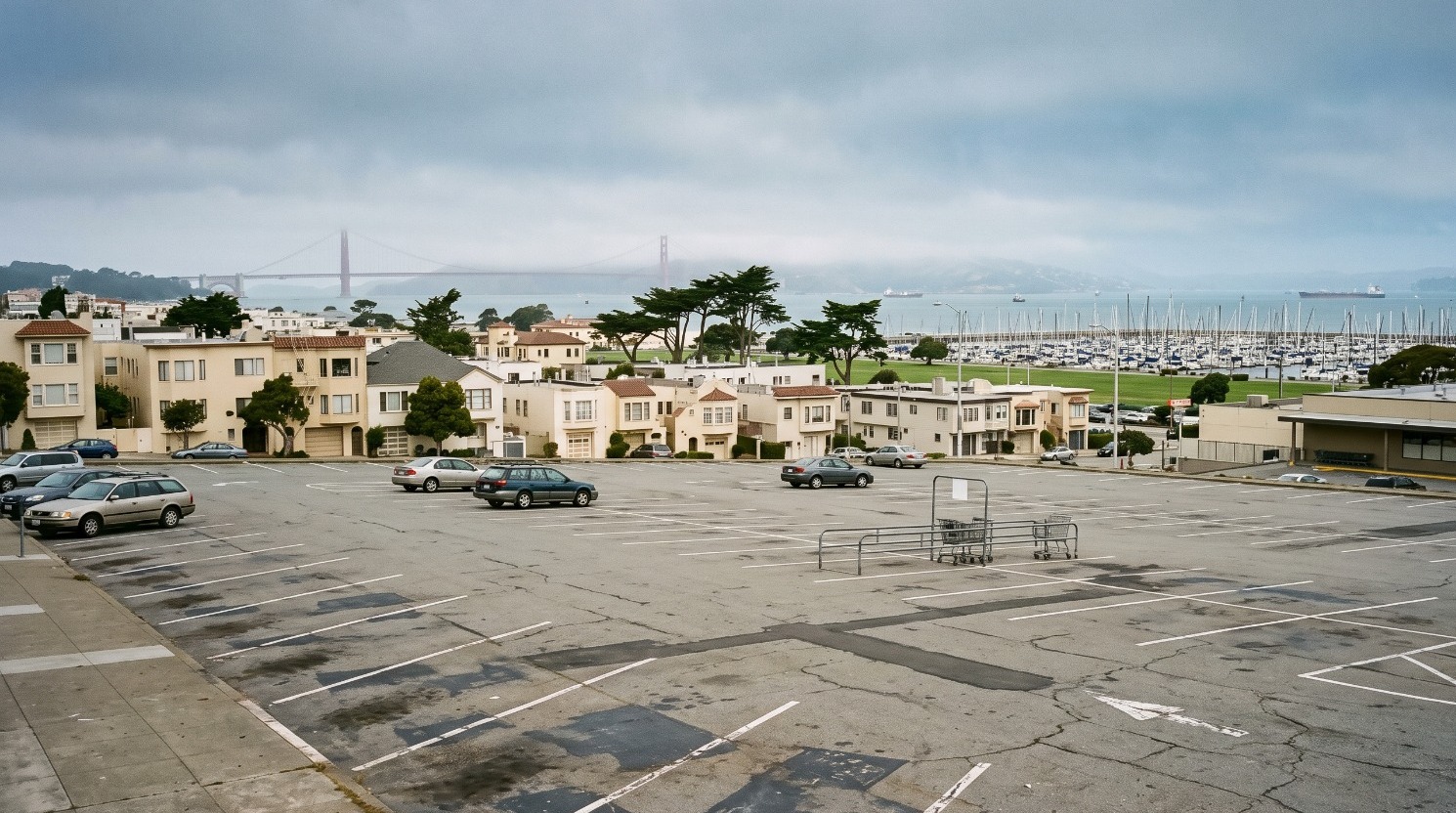
The Safeway parking lot at 15 Marina Boulevard in San Francisco, the site of the Marina Safeway project's proposed 848 apartments, with Marina Green and the bay beyond. Photo: Houseberry
Align Real Estate revised its plans for 15 Marina Boulevard in mid-July, and the revision did something people usually assume is impossible. The buildings got shorter and the project got bigger. The Marina Safeway project now asks for 848 apartments instead of 790, and the taller of its two towers drops from 25 floors to 22, from 297 feet to roughly 258.
That combination is not a peace offering. It is a signal about which rules everyone thinks apply here. Because the fight over this site was never really about height. It is about one clause in a 2022 state law, and about whether a grocery store parking lot across the street from a national park site counts as the kind of place California has decided must accept housing.
If you have ever shopped that Safeway you know the parcel without needing a map. It is the enormous surface lot people cut across on the way to Marina Green, one of the largest single-owner pieces of ground in a neighborhood that otherwise runs two and three stories with a garage on the bottom.
Shorter towers, more homes, and why that is not a contradiction
The unit mix did the work. Studios nearly tripled to 254, which lets the same envelope hold more households. At the same time Align added family-sized units, and that pushed its density bonus request from 39 percent up to 49 percent. Co-founder Dave Balducci told The Real Deal the changes respond to Planning Department feedback, with tighter floor plans and less amenity space.
Trading about 39 feet of tower for 58 more homes is a good trade. It is also the state density bonus doing exactly the thing it was written to do, which is worth noticing in a debate where the density bonus is usually described as a loophole.
The whole fight is one clause in AB 2011
AB 2011 lets qualifying housing on commercially zoned land go through ministerial approval. No discretionary hearing, no environmental impact report, no opportunity for the Board of Supervisors to shrink a compliant project, provided the developer meets objective standards and pays prevailing wage. San Francisco's Planning Department deemed the Marina site eligible for that track in March.
The contested piece is a perimeter test. An AB 2011 site is supposed to be surrounded by urban uses along a defined share of its edge. Supervisor Stephen Sherrill and Mayor Daniel Lurie argue the Marina Safeway fails that test, because Fort Mason and Marina Green sit across the street and open parkland is not an urban use. Align's attorneys have warned that reversing the eligibility finding would expose the city to real liability under the Housing Accountability Act, as SF Public Press reported. State Senator Scott Wiener and Supervisor Bilal Mahmood back the project. Lurie's office says it is still not prepared to support the revised version.
The legal question is a real one and nobody should pretend otherwise. But look at what the argument means in practice. It says that the blocks with the best views and the most open space next door should be the hardest blocks in the city to add homes to. Whatever anyone thinks of a 22-story building on Marina Boulevard, that is the principle being defended, and it deserves to be said out loud.
August 13, then roughly October 12
Here is the calendar that actually governs this. The Planning Department has until August 13 to certify the application complete. A 90-day clock then runs to a decision, which lands somewhere around October 12. Under AB 2011 that decision is ministerial, which is a bureaucratic way of saying that if the project meets the objective standards, the answer is yes.
A few hundred people packed a town hall at Fort Mason in mid-July to argue about it, as KQED reported. The meeting was genuine, well attended, and legally beside the point. That gap between how a neighborhood expects to be consulted and how the process now works is most of the anger in this story.
The objections themselves are a mix. Some are worth answering: the site's industrial history, its position in a flood zone, the absence of an environmental review. AB 2011 does not exempt anyone from the building code, and soils and flood engineering will get scrutinized. Then there is the population argument. The Marina Community Association calculates that roughly 850 units means about 1,600 more people, which it describes as a 12 percent addition to the neighborhood. "People come here because it's beautiful and it's open and has a feeling of expansiveness," the group's Erin Roach told KQED. "Having a giant building is going to take that feeling away."
That is an honest thing to say, and it is also a description of what adding housing looks like. Twelve percent more neighbors, on a lot currently used to store cars, in one of the most desirable places in the country to live.
What 848 apartments would do to a neighborhood that scores 3.4
Here is where our own data gets interesting, and where the conversation usually skips. The Marina scores 3.4 out of 5 overall on Houseberry, which puts it 54th of 92 San Francisco neighborhoods, behind Cow Hollow at 3.6 and well behind Pacific Heights at 4.0. Its median was about $3.18 million in June 2026. Break the score apart and the picture sharpens:
| Score | Marina | Cow Hollow | Pacific Heights |
|---|---|---|---|
| Overall | 3.4 | 3.6 | 4.0 |
| Amenities | 4.2 | 3.6 | 5.0 |
| Schools | 3.6 | 3.6 | 3.6 |
| Safety | 2.8 | 3.7 | 4.0 |
The Marina's problem is not amenities. Amenities are its best number. Its softest number by a wide margin is safety at 2.8, lower than its immediate neighbors and lower than its price would lead anyone to guess. Part of what drives that is a commercial neighborhood that empties out. Chestnut Street is busy at 7pm and thin at 10pm, and North Point after dark is mostly parked cars and closed roll-up doors.
Eight hundred and forty-eight households living on that block, most of them in studios and one-bedrooms, means people walking home at hours when nobody currently walks there. That is not a guarantee of anything. It is a direction, and it is the opposite of the direction the opposition assumes.
On schools, the honest read is that this changes very little. Studios and one-bedrooms do not generate much school demand, and 114 three-bedrooms spread across a neighborhood does not move an attendance zone. Anyone weighing how San Francisco neighborhoods actually rank should not expect the Marina's neighborhood scores to jump because of one building. What could move is the safety number, and slowly.
The Safeway parking lot is the region's next housing frontier
This is not a one-off. Align is working through a portfolio of Albertsons-owned sites across the Bay Area: more than 1,800 units proposed at the Fillmore Safeway, 415 senior units at a Rockridge site in Oakland, and 379 homes at the Bernal Heights Safeway on Mission Street, which we covered when the permits landed in June.
Grocery-anchored surface parking is one of the last large soft sites left in built-out Bay Area neighborhoods. It is flat, it is single-owner, it is already commercially zoned, and it sits in the middle of places people already want to live. Which is to say: if you live near a Safeway with a lot that size, the Marina outcome is your preview. Worth knowing what your own neighborhood scores and what is entitled around it before the story sign goes up, rather than after. That habit of looking hard at the area before zeroing in on an address is the whole reason we built Houseberry.
What people get wrong about this project
Does AB 2011 mean San Francisco has no say at all?
No. The city still enforces objective standards, the building code, and the affordability requirement, and it still decides whether the site qualifies in the first place. What it loses is discretionary review, meaning the hearing where a compliant project can be shrunk or delayed for reasons that are not written down anywhere.
Is the Safeway going away?
Not permanently. The plans include a replacement store of roughly 67,180 square feet, and the developer has described keeping a grocery operating at the site through construction. Construction on a project this size still means years of disruption.
Are 86 affordable units a lot?
They are about 10 percent of the building, at roughly 50 percent of area median income, which is deeper affordability than most market-rate projects deliver. They are also what earns the 49 percent density bonus. Both of those things are true at once, and the trade is the whole design of the law.
Should Marina buyers wait to see how this lands?
Timing a purchase around a single entitlement is usually a bad trade. The decision window closes around October, and if it is approved, the building takes years after that. The more useful move is knowing what the site is, what the timeline looks like, and what the block scores today.
Sources
- KQED: Can wealthy San Francisco residents stop a massive housing redevelopment project?
- SF Public Press: Controversial housing project gets denser as it nears approval
- The Real Deal: Align ups unit count, lowers height for Marina Safeway project
- San Francisco YIMBY: Reduced floor count, more units for Safeway Marina redevelopment
- San Francisco YIMBY: City deems Safeway Marina tower eligible for AB 2011 approval
- Houseberry: Marina neighborhood scores and median price
All information provided on this website including but not limited to - school ratings, safety, amenities, user opinions, and property data - is for general informational purposes only. We do not guarantee its reliability, accuracy, or completeness. Users should independently verify information and consult appropriate professionals as needed. By using this website, you agree Houseberry is not responsible for actions, decisions, or consequences arising from reliance on the information provided
houseberry.com - CA DRE# 01847391
 Bay East ©2025. CCAR ©2025. bridgeMLS ©2025. Information Deemed Reliable But Not Guaranteed. This information is being provided by the Bay East MLS, or CCAR MLS, or bridgeMLS. The listings presented here may or may not be listed by the Broker/Agent operating this website. This information is intended for the personal use of consumers and may not be used for any purpose other than to identify prospective properties consumers may be interested in purchasing. Data last updated at September 14, 2026 12:00 AM